Access & aggregation
Count endpoint interfaces, required speeds, fiber routes and the aggregated busy-hour load. Reserve uplinks for services and recovery paths.

H3C optical switching · model selection
Select H3C optical Ethernet switches by interfaces, uplinks, PoE budget, matched optics and licenses. Build a configuration you can purchase and maintain.
H3C equipment · NexPro-Link design, selection & project supply

Specify the complete switching system
A switch model is one line in the purchasing scope. Optics, power, software and downstream limits determine whether it fits the project.
Count endpoint interfaces, required speeds, fiber routes and the aggregated busy-hour load. Reserve uplinks for services and recovery paths.
Match both active ends, connectors, wavelengths and loss budgets. Separate optical data from PoE or hybrid electrical supply.
Confirm the full suffix/PID, release, port upgrade and management licenses. Include compatible PSUs, fans and support terms.
FS5500V2-24UXS6Y-EI has 24 base 2.5GE access ports; only 12 supported ports can be licensed to 10GE. EGT910-H-PD offers up to 30W per PoE port but only 120W total. Neither a family name nor a count of sockets establishes the usable capacity.
Official model sources · checked 11 October 2026
Compare verified candidate models. Product images and hardware drawings come from H3C. Availability, regional variants and a final matching configuration are confirmed in the quotation.
14 models shown. Architecture tags describe possible roles; they do not guarantee any-to-any compatibility.
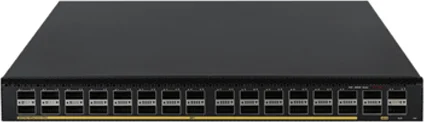
Core / optical aggregation
Dedicated Ethernet channels for campus aggregation.
official product photograph. Specifications checked 2026-10-11.
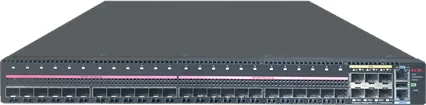
H3C official specifications ↗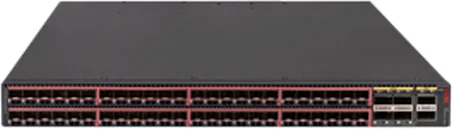
High density optical access / power sourcing
Many optical access points with a designed hybrid cable power system.
official product photograph. Specifications checked 2026-10-11.
H3C official specifications ↗Floor / building optical aggregation
A 24-link fiber distribution point with optional hybrid powering.
official product photograph. Specifications checked 2026-10-11.
H3C official specifications ↗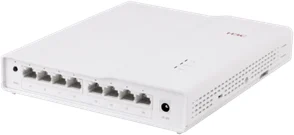
Room / zone access switch
Fiber to a work area, with eight copper endpoint ports.
official product photograph. Specifications checked 2026-10-11.
H3C official specifications ↗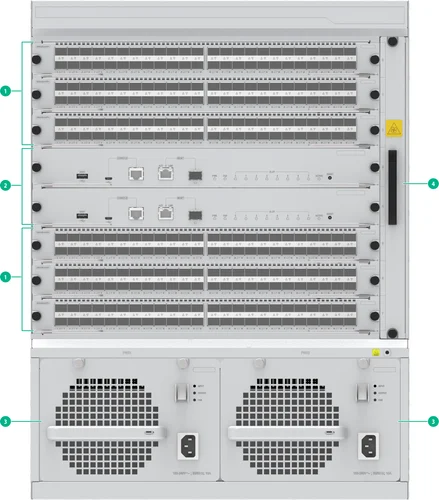
Modular campus core / OLT platform
Larger converged campuses needing modular Ethernet and PON service boards.
official hardware drawing. Specifications checked 2026-10-11.
H3C official specifications ↗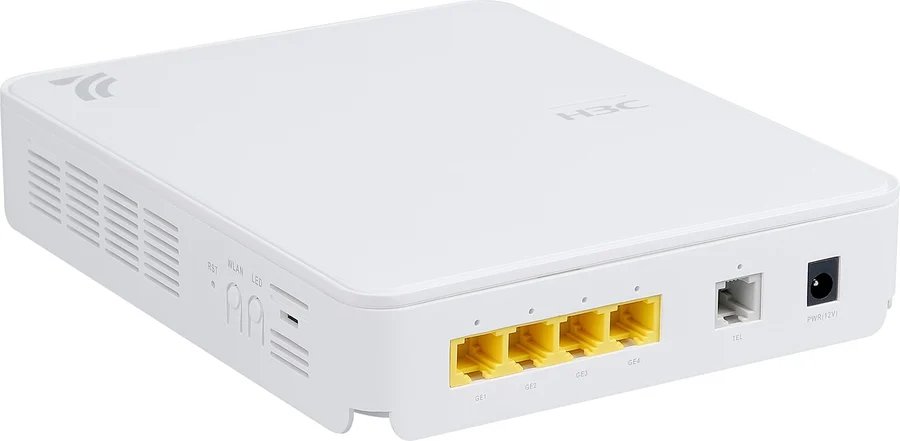
Room ONU with WLAN
Hotel rooms or residential areas with local DC power.
official product photograph. Specifications checked 2026-10-11.
H3C official specifications ↗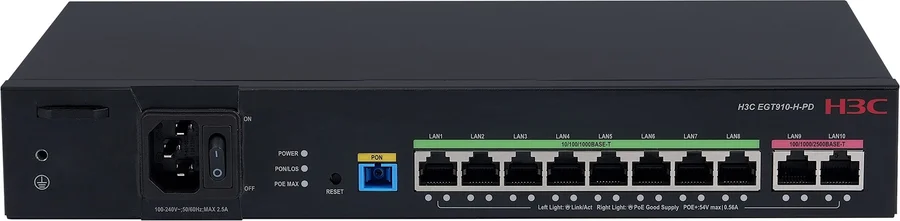
Zone ONU with PoE+
Several APs, cameras or phones near a local power point.
official product photograph. Specifications checked 2026-10-11.
H3C official specifications ↗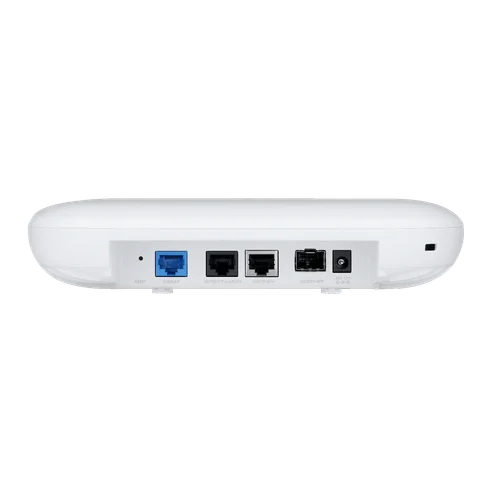
Indoor Wi-Fi 7 AP
High demand indoor WLAN where RF design and upstream capacity justify it.
official product photograph. Specifications checked 2026-10-11.
H3C official specifications ↗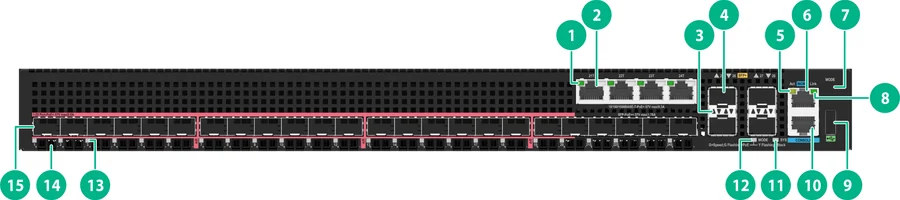
Industrial optical aggregation
Industrial distribution using the documented environmental limits.
official hardware drawing. Specifications checked 2026-10-11.
H3C official specifications ↗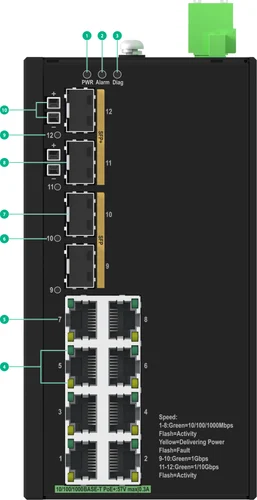
Industrial zone access
DIN-rail access for separated telemetry, surveillance or local industrial services.
official hardware drawing. Specifications checked 2026-10-11.
H3C official specifications ↗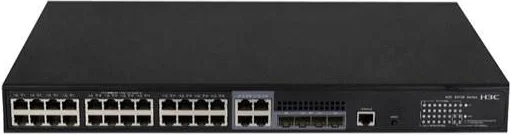
Copper PoE access
Small or medium local PoE access with GE fiber uplinks.
official product photograph. Specifications checked 2026-10-11.
H3C official specifications ↗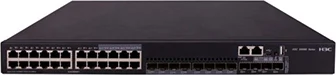
Compact campus core / aggregation
Modest routed networks with a checked uplink and service port plan.
official product photograph. Specifications checked 2026-10-11.
H3C official specifications ↗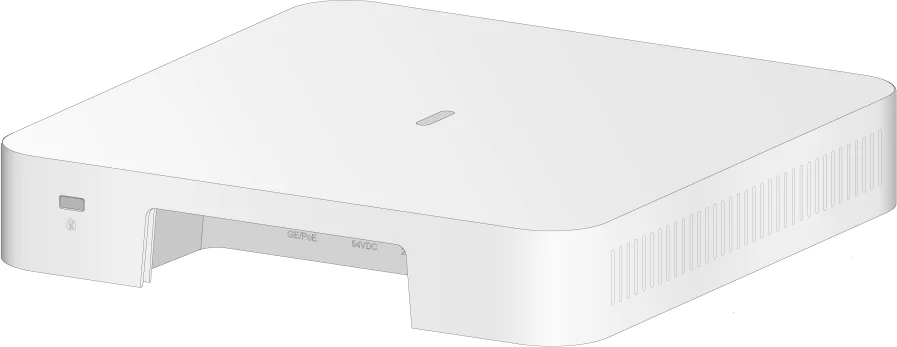
Indoor Wi-Fi 6 AP
Indoor access with a GE wired connection and low power demand.
official hardware drawing. Specifications checked 2026-10-11.
H3C official specifications ↗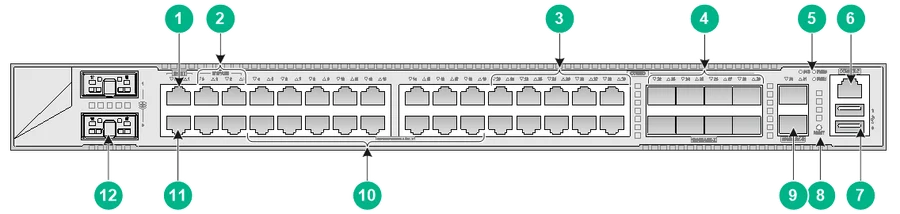
Enterprise security gateway
A candidate WAN / policy boundary, sized after enabled-service throughput review.
official hardware drawing. Specifications checked 2026-10-11.
H3C official specifications ↗Select up to four cards. Compare role, speed, power and the components required to make the quoted model usable.
| Selection point | FS6300V2-48UX2Q4C-EI | FS5500V2-24UXS6Y-EI | ES4200-8P2RX-B |
|---|---|---|---|
| Role | High density optical access / power sourcing | Floor / building optical aggregation | Room / zone access switch |
| Access ports | 48 × 1/2.5/10GE SFP+ optical/electrical ports. | 24 × 2.5GE ports; 12 ports can be upgraded to 10GE with license. | 8 × 10/100/1000BASE-T PoE+ ports. |
| Uplinks | 2 × 40GE QSFP+ and 4 × 40/100GE QSFP28. | 6 × 10/25GE SFP28. | 2 × 1/2.5/10GE SFP+ with compatible powered input. |
| Power input | 100–240V AC through modular supplies. | 100–240V AC through modular supplies. | Local adapter or compatible PoE IN optical/electrical interface. |
| PoE output | 802.3af/at/bt; published maximum 100W per supported port. | 802.3af/at/bt; maximum 100W per supported port with matched components. | 802.3at; maximum 30W per copper port. |
| Total budget | Published maximum configurations: 1,400W single AC / 2,800W dual AC PoE. Actual budget depends on PSU configuration and redundancy. | Published maximum configuration: 1,450W single AC / 2,400W dual AC PoE; quote the actual PSU configuration. | 115W with local adapter; 40W with single or dual PoE IN. Do not add the two input budgets together. |
| Optics / components | Matched -F optical modules, optical/electrical pigtails and hybrid cable; verify receiving device. | Matched optical modules; -F modules and matching pigtails for hybrid power. | Select standard, multichannel or hybrid receiving optics to match the upstream system. |
| Supplies / fans | 2 PSU slots; size selected supplies for endpoint load and failure mode. | 2 modular PSU slots; supplies specified in BOM. | Optional LSAM1POE135W local adapter; otherwise a designed compatible remote supply. |
| Licenses | Confirm release and management licenses; no assumed bundle. | 10GE upgrade license required for the supported 12 access ports. | Confirm management mode and software; no feature bundle assumed. |
| Limits / open items | Published maximum power is not available with every PSU. Copper gauge, length and receiver voltage determine remote power feasibility. | Base access speed is 2.5GE, not 24 ports of 10GE. Confirm exact upgraded ports and software. | Eight 30W ports do not mean 240W available. Dual PoE IN still has the published 40W output limit. |
Six industry reference designs
Each example includes assumptions, a physical topology, logical/power notes, exact H3C candidates, calculations and a downloadable BOM. These are reference designs, not completed installation claims.

A room-based network with locally powered ONUs, a separate common-area PoE branch and an explicit bandwidth plan for guest, TV and operational services.
View topology, equipment & BOM →
A six-floor office reference with 24 point-to-point fiber links, local access power and a measurable upgrade path from 2.5GE access to selected 10GE ports.
View topology, equipment & BOM →
Separate office access, warehouse mobility and production telemetry around four industrial network zones, with explicit PoE and environmental limits.
View topology, equipment & BOM →
An illustrative public-service network and restricted office network with independent switches, uplinks, fiber cables and management paths.
View topology, equipment & BOM →
Four building groups with passive intermediate distribution and 16 dedicated 10G terminal channels, plus an explicit plan for local terminal power.
View topology, equipment & BOM →
Sixteen retail/common-area zones fed by point-to-point optical Ethernet and a separately engineered hybrid cable DC path, with a 40W output limit at each terminal.
View topology, equipment & BOM →Use the property size to open a planning conversation. Room count alone does not determine AP, camera, switch or optical port quantity.
Read the hotel sizing guideEngineering inputs that change selection
Calculations use project assumptions and current manufacturer documentation. Final designs need measured routes, actual endpoint loads and agreed acceptance criteria.
| Decision | What must be checked | What it changes |
|---|---|---|
| Ports & capacity | Endpoint quantity/speed; active vs spare ports; combo exclusivity; uplink ratio; video/client bursts. | Access/core model, quantity, uplink rate and expansion. |
| Optical path | Tx/Rx wavelengths, SMF/MMF, connector/polish; fiber + connector + splice + passive loss + maintenance margin. | Matched module pair/set, ODF and achievable path—not distance alone. |
| PON service | OLT board/protocol, ONU model/release, split ratio, class, branch loading, multicast and registration. | Shared capacity, optics and provisioning; an OLT chassis alone is insufficient. |
| Electrical power | PoE class per endpoint; total output; device input; cable/conversion losses; PSU failure mode; UPS runtime. | PSU, adapters, hybrid conductor gauge, number of powered endpoints and backup scope. |
| WLAN | Wall materials, channels, country code, concurrent clients, roaming, interference and Ethernet bottlenecks. | AP type/locations, controller/cloud and AP capacity licenses. |
| Resilience & operations | Single failure domains, diverse routes, recovery protocol, port use, management access, spares and support. | Backup devices/links, software and tested recovery procedure. |
Optical budget method: route attenuation + connector losses + splice losses + splitter/passive insertion loss + agreed margin ≤ usable optical budget of the matched transmitting/receiving class. Verify receive overload at short distances too.
Partner equipment · coordinated supply
NexPro-Link works with H3C, IP-COM, Fanvil, TP-Link and Huawei as technology and equipment supply partners, with wholesale and project quotations.





H3C is the manufacturer of the H3C equipment shown. NexPro-Link provides selection, project supply and agreed design support. Cross-brand protocol, software, optical and power compatibility must be confirmed for the exact models. CCTV manufacturing and OEM/ODM remain a separate NexPro-Link offering.
Project resources
Compare dedicated and shared access, management, power, optical budgets and complete project cost.
Read the guide →Prepare drawings, device counts, routes, test results and service boundaries without completing a long first inquiry.
Read the guide →Separate glass-fiber data paths, hybrid cable conductors, local adapters and PoE power budgets.
Read the guide →Use 20, 50, 100, 200 and 500-room starting points without inferring device quantities from room count.
Read the guide →Selection & procurement questions
We start with device roles and exact interfaces, then check capacity, environmental conditions, power input/output and required software. The full model suffix matters: FS5500V2-24UXS6Y-EI has base 2.5GE access and licensed upgrades on selected ports, while ES4200-8P2RX-B has different PoE budgets under local and remote power. The proposed model, accessories and unresolved configuration items are listed together.
They are included only when expressly listed. Ask for quantity and exact SKU of both optical ends, fiber/connector type, wavelengths, rated loss/distance, PSU/fan sets and feature/AP/security licenses. Multichannel optics must be a matched generation/set; PON needs the correct OLT board, optic class and ONU interoperability. A chassis price alone is not a complete network BOM.
Use a compatible PoE copper port, local AC/DC adapter, or an approved hybrid fiber/copper power system. Glass fiber carries data only. Hybrid cables use electrical conductors alongside fiber and need voltage-drop, gauge, length and receiver checks. Calculate each PSE port limit and total switch/ONU budget, including startup, losses, reserve and the required single-supply failure condition.
Yes, when interfaces and service requirements are compatible. CCTV adds sustained recording traffic and storage/retention demand; IPTV may require multicast with an IGMP querier and controlled replication; phones need the supported SIP/PBX platform, power and QoS. Define VLANs, routing/ACLs, DHCP/DNS, time synchronization, peak demand and backup power, then test the actual endpoint/software combination.
Standards-based Ethernet and selected optical links can interoperate when speed, wavelength, connector, fiber and configuration match. That does not guarantee proprietary management, stacking, PON ONU registration or hybrid power compatibility. Give us the exact other-brand model and firmware so the common protocol path, unsupported functions and required bench tests can be identified.
NexPro-Link supplies H3C and partner-brand equipment with wholesale and project quotations. Send models and quantities if you have a BOQ, or drawings if selection is still open. The offer confirms exact configuration, regional availability, accessories, licenses, warranty/support scope, payment and delivery terms. No fixed discount, stock position or lead time is implied by these reference pages.
Start with the country, building use, new-build/upgrade stage, drawings or current device list, and the services to connect. Useful follow-up inputs are port/client counts, distances, fiber/copper tests, power and UPS needs, security boundaries, availability targets and preferred brands. Use the downloadable checklist and leave unknown fields blank; uncertain quantities are identified before quotation.
These six projects are reference designs prepared to explain architecture, model selection and BOM structure. They are not claims of completed customer installations. Each states its assumed scale, port/power calculations and outstanding site inputs. Official H3C product photographs or hardware drawings are identified separately from application imagery, and model sources are linked beside the specifications.
Your next step
Send a short requirement, drawings, an existing BOQ or the exact H3C models you need. We will identify the selection and supply scope.
The page, architecture and reference equipment are included automatically. Your selected quote-list quantities can be edited before sending.
One attachment up to 3 MB, or a shared-file link. Unknown engineering fields can be confirmed later.