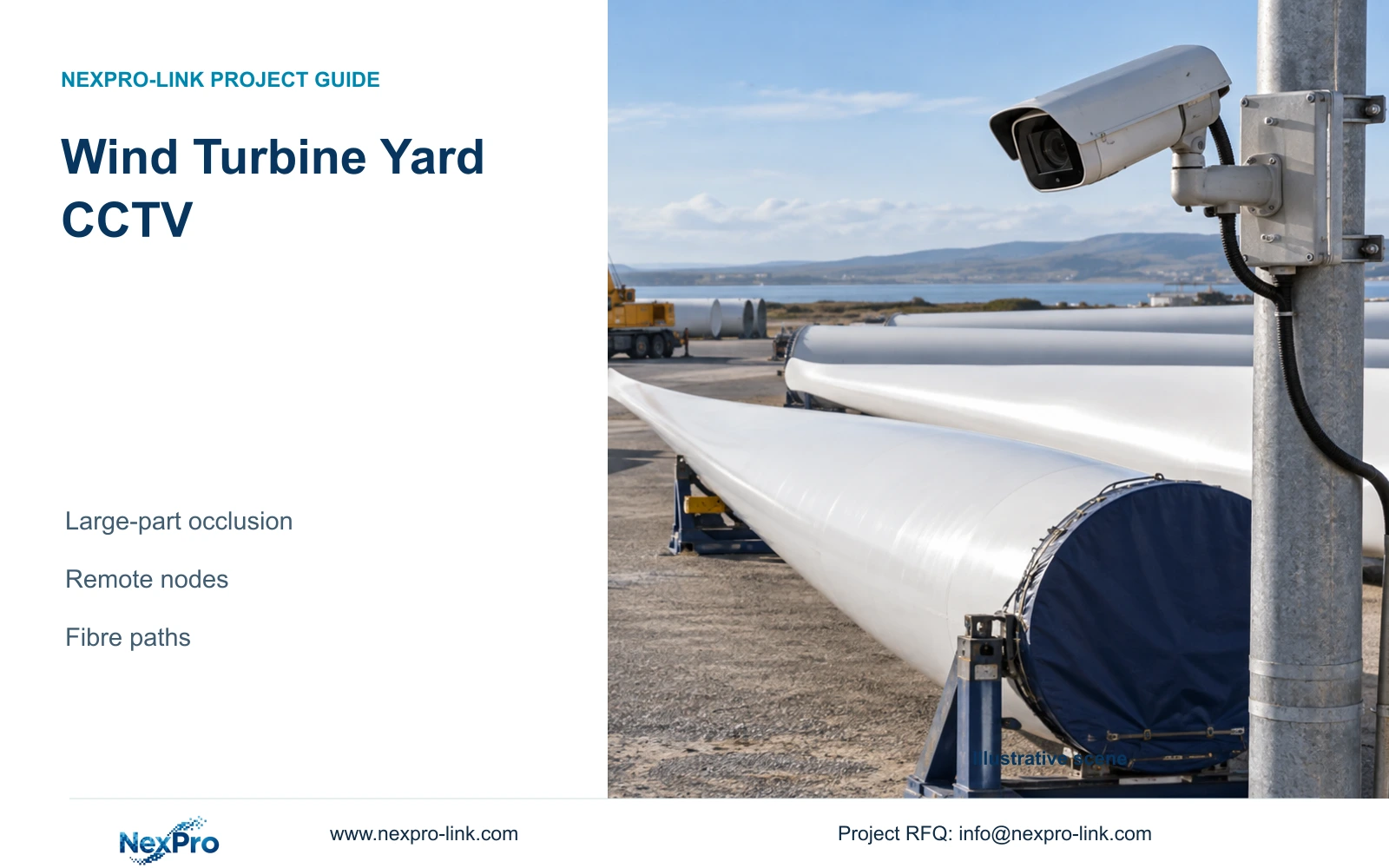
Wind-turbine component yards need stable loading and entry views despite changing blade and tower layouts. Distributed recording and deliberate fibre routes separate custody evidence from remote overview traffic.
Section 01
Protect stable observation points from changing storage geometry
Wind turbine component yard CCTV should prioritise stable entry and loading tasks, then add overview views that remain useful as stored parts move. Blade profiles and tower sections can physically block sightlines. Camera zoom cannot recover an event hidden behind them. The quantity surveyor should base quantities on accepted custody tasks and infrastructure locations rather than an assumption that one long-range camera covers the yard.
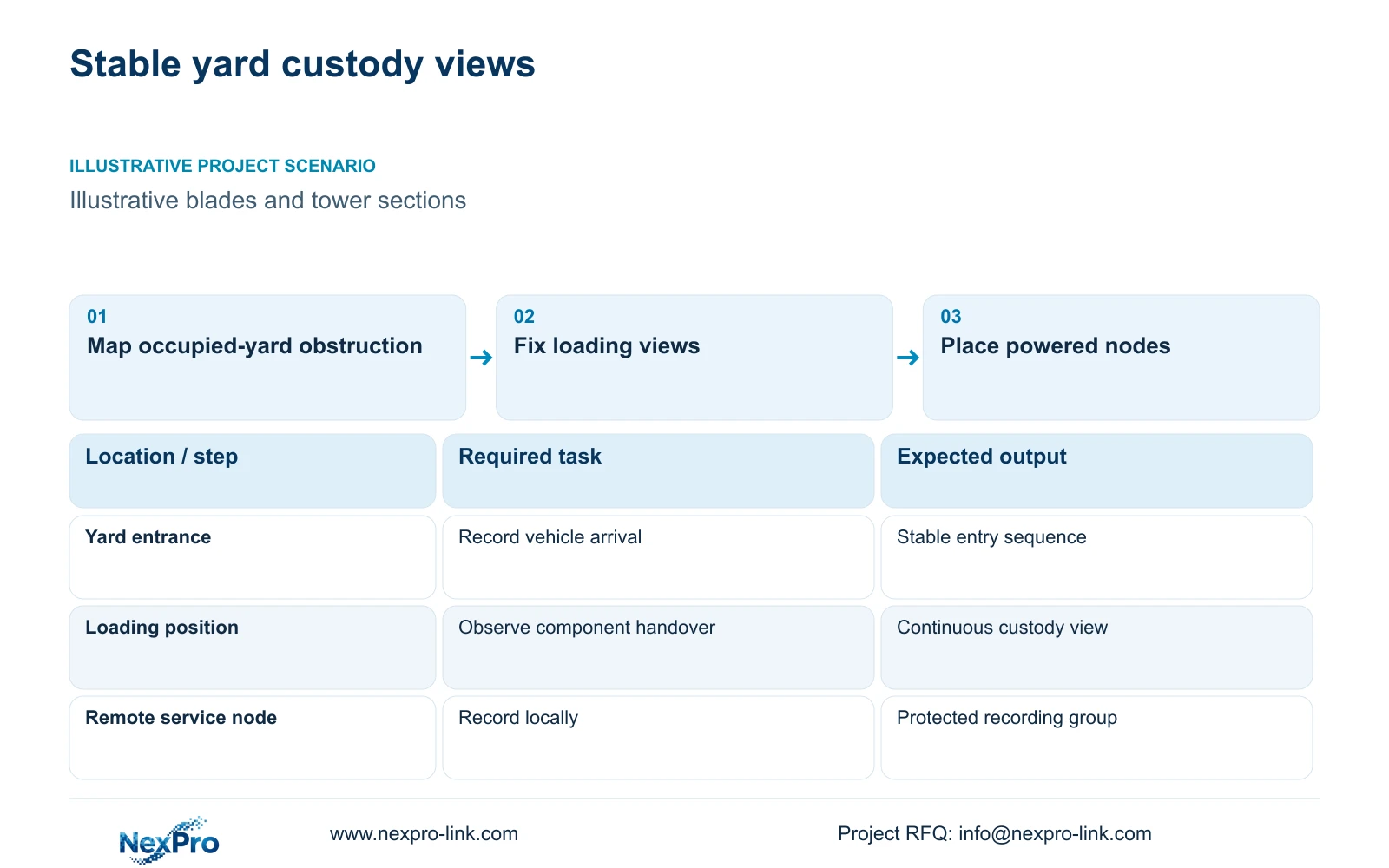
Illustrative project scenario: Blades and tower sections occupy an outdoor yard far from the guard room. Assume loading positions and the entrance are relatively stable while storage rows change with incoming components. The design should preserve those fixed handover points and identify the storage configurations that could obscure each overview. This is a planning scenario, not a measured yard installation.
Request occupied-yard layouts showing maximum part envelopes, transport routes and candidate mounting positions. Compare views with the parts present, including trailers at the loading position. A clear line across an empty yard is insufficient. Mark any view that depends on a storage row staying empty, then agree who maintains that condition or choose another position.
Section 02
Use continuous custody views alongside overview
Assign fixed views to entry, loading handover and departure where continuous context matters. An overview can show general movement and help operators select a detail view, but it should not be the only record of a release point that becomes obstructed. Define the vehicle or component reference supplied by yard records and the camera IDs used to review its movement.
NexPro-BL2812M55-5MP-DIC-AI lists a 2.8-12mm motorized lens, PoE, IP66 and a 5MP-family output including 2880x1620 at 25fps. Consider it only for a suitable ordinary location and demonstrated scene. The lens is not evidence of pan-and-tilt capability, a guaranteed identification distance or coverage through large parts.
Review mounting access, lighting, weather exposure and the actual temperature requirement before choosing the housing and route. The documented -20 to +60°C field does not establish every outdoor-yard condition. Keep specialist positions separate if exposure or classification requires them. Changes in camera height or pole position also change foundations, access and cabling, so carry those consequences into the quotation.
Section 03
Place fibre endpoints where power and service are available
Locate remote access and recording nodes using actual camera routes, electrical supply and maintenance access. Fibre provides a data connection; it does not carry the remote node's AC protection from the guard room. List local camera supply, switch, recorder and necessary optical equipment under the applicable power circuit. Ordinary rack equipment should remain in a suitable service environment.
CASE05 illustrates three local 32-camera nodes connected through a campus backbone. Its topology supports a discussion of distributed yard groups, but its building routes are not yard distances. Its illustrative copper links are 41-76m including declared service allowance. Any longer yard route needs its own termination and backbone decision rather than inheriting those lengths.
The Fluke guidance distinguishes a typical 90m copper permanent link from a 100m complete channel. Confirm the applicable link type and actual test scope, including patch cords. Quote fibre lengths, optics, local cabinets, power work and trench or tray construction separately. An inexpensive camera line cannot offset omitted remote-node dependencies.
Section 04
Separate local recording traffic from remote viewing
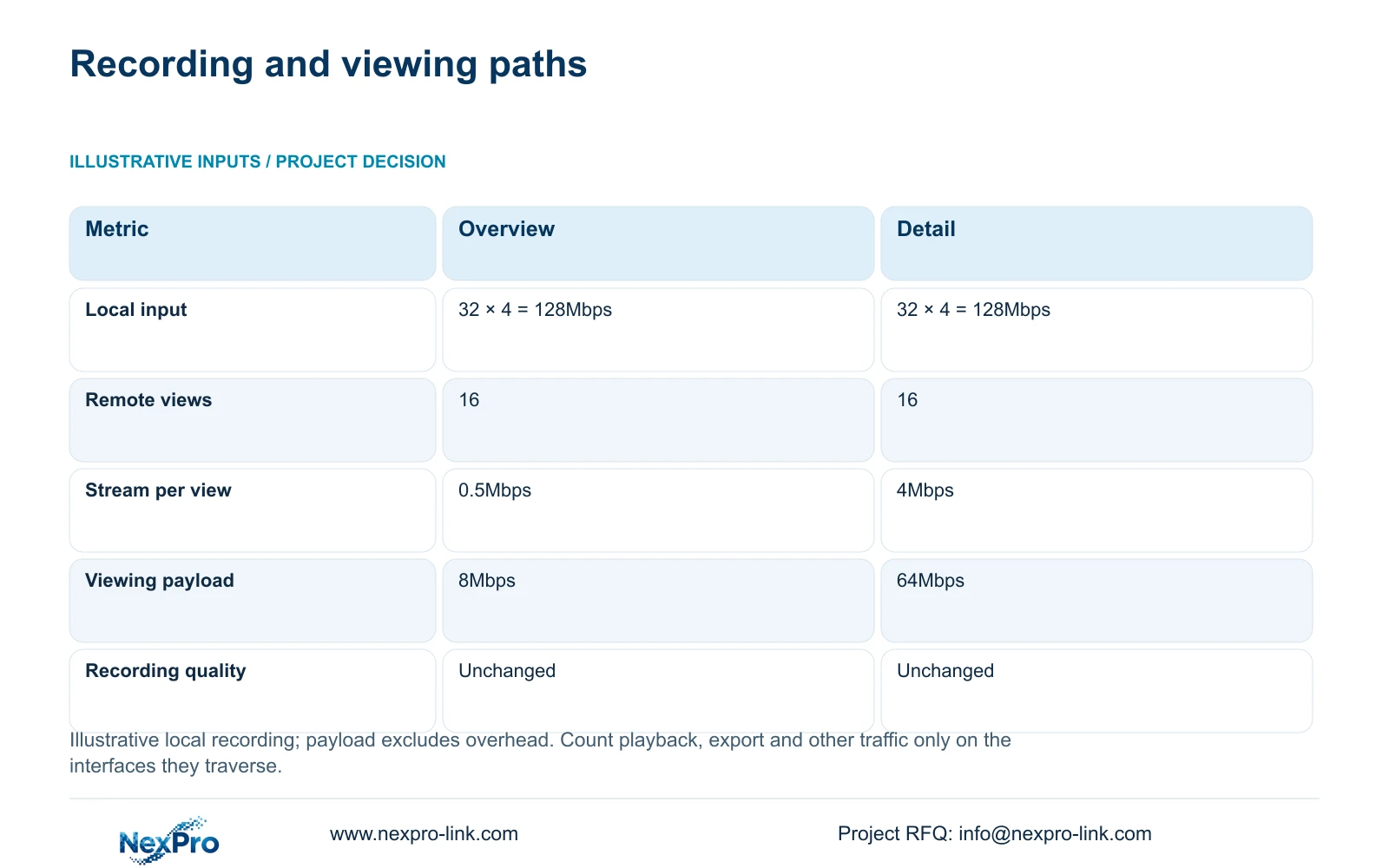
For the illustrative network calculation, 32 local main streams average 4Mbps each. Local recorder input is recorder_Mbps = 32 × 4 = 128Mbps in both options. Sixteen cameras are viewed remotely at once. Option A uses assumed 0.5Mbps overview streams: viewing_Mbps = 16 × 0.5 = 8Mbps. Option B uses 4Mbps detail streams: 16 × 4 = 64Mbps.
The decisive difference is the operator branch. Both options retain the assumed 4Mbps local recording streams. An approved low-bandwidth overview can reduce the viewing payload without silently lowering recorded quality, provided the selected camera, recorder and client support that workflow. These are design assumptions, not universal substream compatibility or guaranteed remote performance.
Count traffic at each interface by its actual route and direction. Add playback, export and other users where they share the link. If the recorder is central rather than local, recording streams may also traverse the yard backbone and the table must change. Protocol overhead and operating headroom require separate allowance; the payload totals alone do not select the final link.
| Metric | Overview workflow | Detail workflow |
|---|---|---|
| Local recorder input | 128Mbps | 128Mbps |
| Concurrent remote views | 16 | 16 |
| Remote stream per camera | 0.5Mbps | 4Mbps |
| Remote viewing payload | 8Mbps | 64Mbps |
| Local recording changed | No | No |
Section 05
Recommend distributed recording with qualified viewing options
Use local recording near suitable yard access groups where this fits the supply and service plan. Provide low-bandwidth overview for routine situational awareness and a verified route to detail playback or live views. This keeps the custody recording requirement independent from how many pictures the guard room displays simultaneously.
NexPro-NVR4449-4K lists 320Mbps input and four SATA bays up to 18TB per drive. It is a capacity candidate, subject to the selected stream modes and operating workflow. Its channel count does not establish all-4K decoding or RAID. The client and any decoder need their own concurrent-view check, particularly if operators request more detail windows.
Change the architecture if the owner requires central recording, if remote service access is impractical or if a permitted cabinet cannot be supplied with suitable local power. Compare the complete civil, network and electrical scope before choosing. A supplier proposing fewer nodes may move demand onto longer links or central infrastructure; those transferred costs and failure consequences should remain visible.
Section 06
Make the yard package measurable before ordering
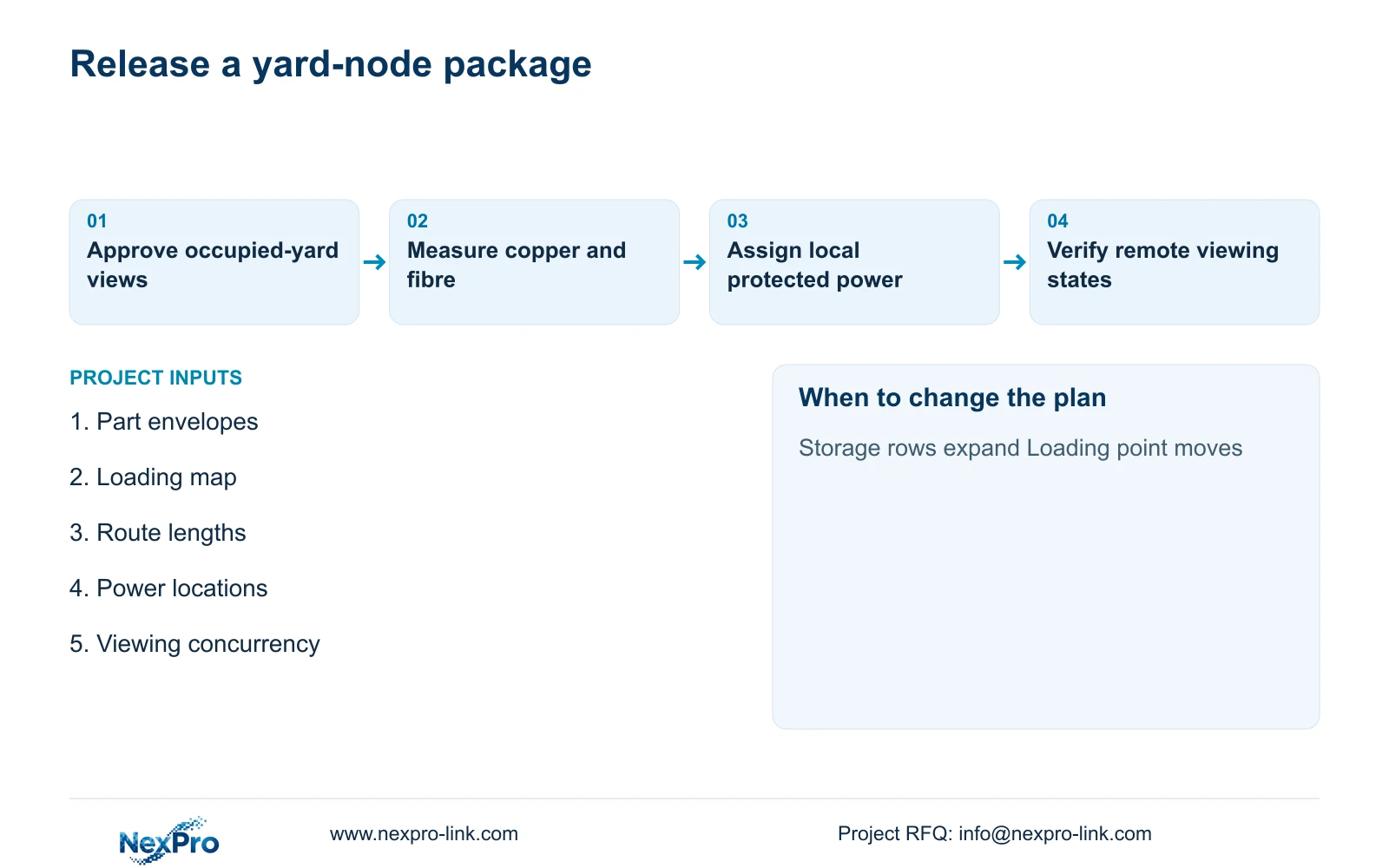
Issue a task-based view schedule with maximum component envelopes, loading locations and mounting references. Pair it with a link schedule identifying copper drops, fibre endpoints and powered cabinets. State which items are new, retained or optional. The local contractor should own actual route measurement and installation, while the system owner approves custody and viewing acceptance.
NexPro-Link's factory project and BOQ support scopes can assist with model matching, technical documents and coordinated equipment preparation. For a remote yard, location labels and node-based packing can help keep cameras, optics and accessories aligned with the installation schedule. Final outdoor construction, service access and electrical protection remain project-specific responsibilities.
Demonstrate occupied-yard visibility and local recording during an agreed backbone interruption before acceptance. Verify the required operator views after the connection returns. Recalculate the affected links and power nodes when storage extends, a loading position moves or simultaneous review demand increases. Keep additional civil work and operational downtime identifiable when comparing revisions.
Section 07
Buyer questions
Can a remotely controlled camera replace every fixed custody view? Only if the accepted task remains continuously recorded. A camera looking elsewhere during a handover cannot provide that missing view later. Define any movable-camera role separately from fixed release evidence.
Does fibre eliminate the need for a remote UPS? No. The remote camera supply, switch and recorder still depend on their local electrical circuit. Select backup at the nodes whose duties must continue.
Should 128Mbps be added to every fibre link? Only where those recording streams actually cross that link. With local recording, a guard-room branch may carry viewing and export traffic rather than the entire recording input.
Section 08
Define the yard views and powered nodes
Send the occupied-yard layout, stable loading and entry tasks, measured routes with available power locations, and simultaneous viewing requirements to info@nexpro-link.com for a scoped CCTV package discussion.
Engineering references
These sources support the general planning principles. Always use the selected product's current datasheet and applicable project standards for final design.