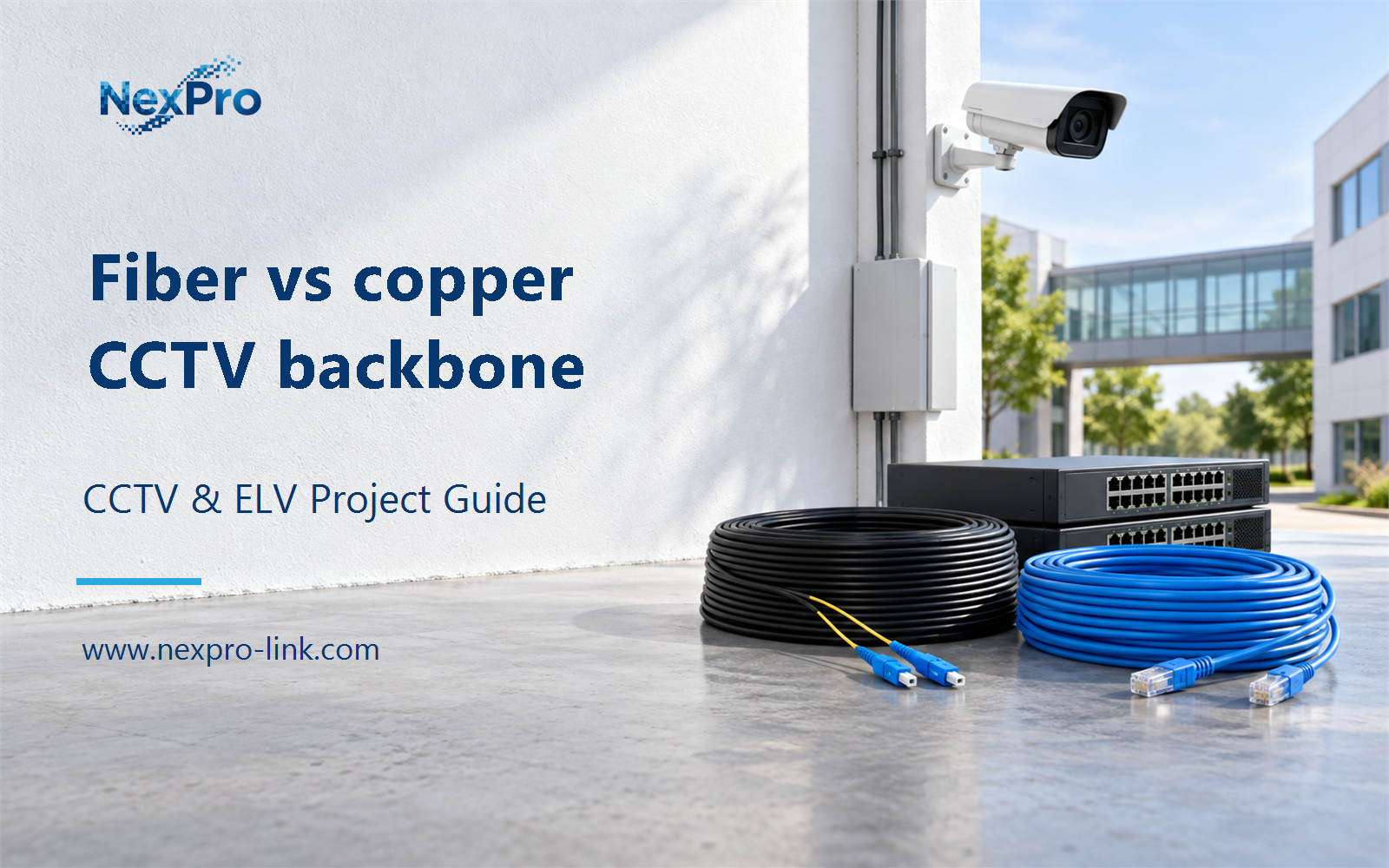
Plan fiber vs copper CCTV backbone with practical guidance on map the building-to-building requirement and check connectors and termination. NexPro-Link project guide.
Section 01
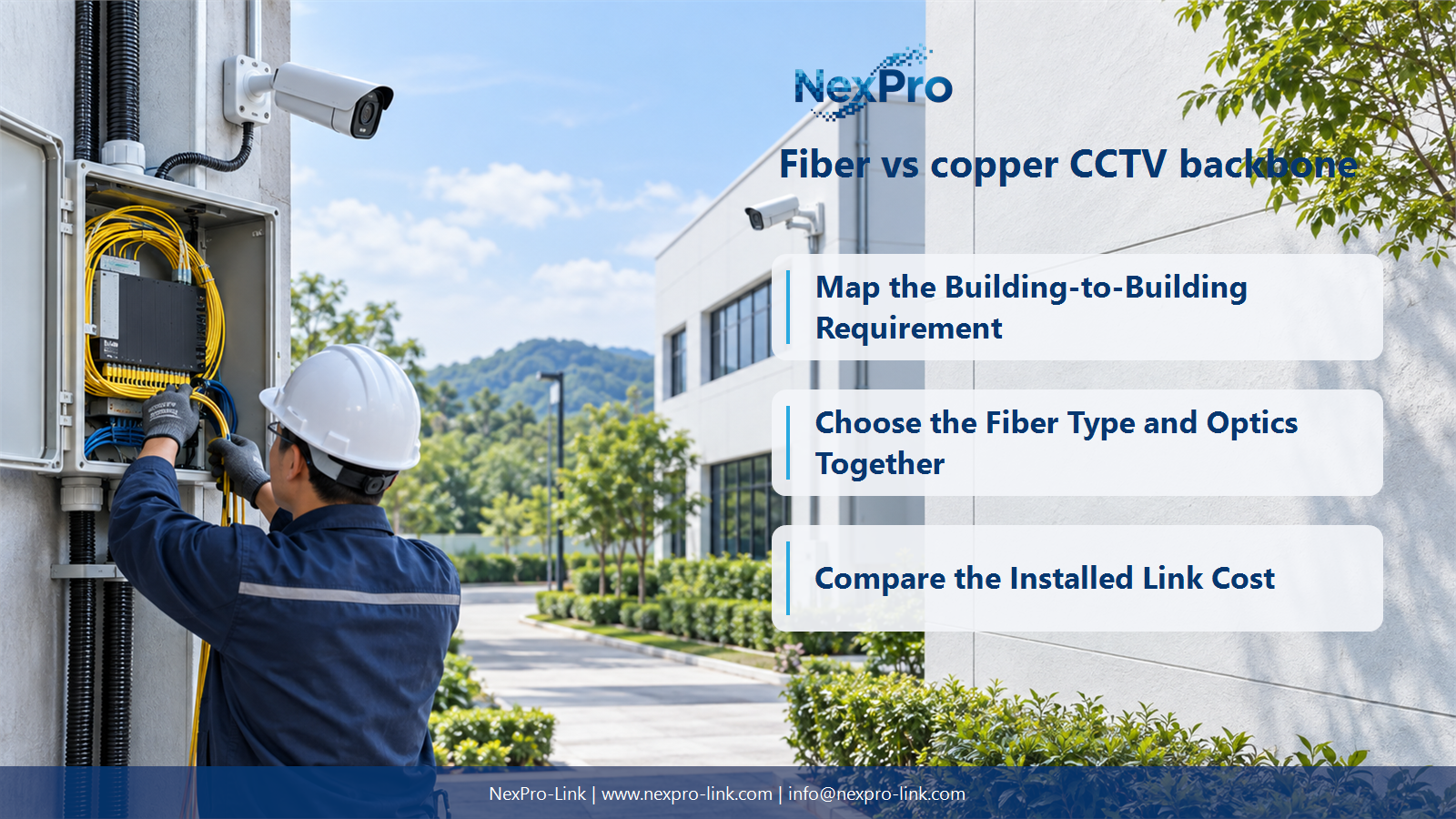
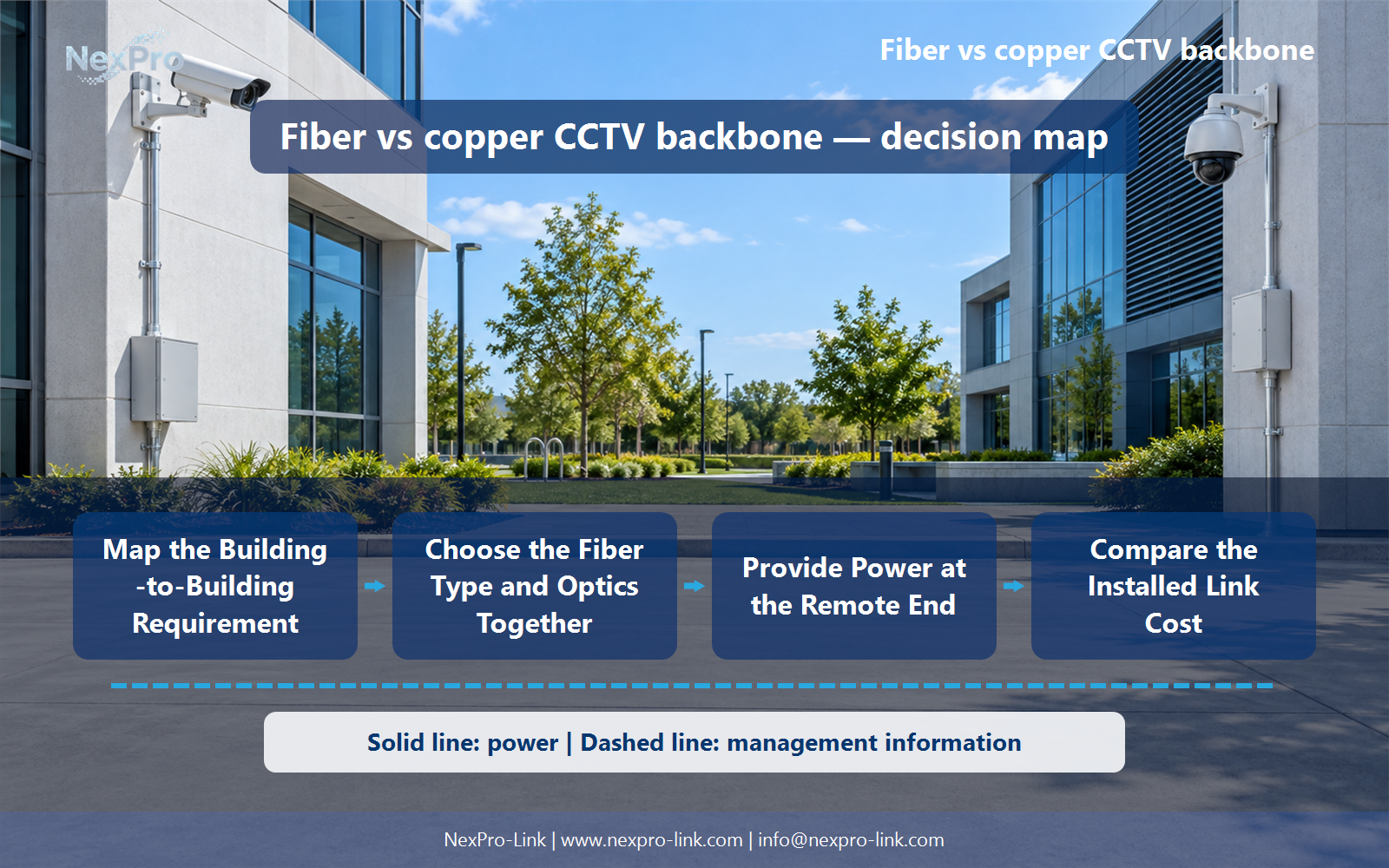
Map the Building-to-Building Requirement
It can support suitable longer data links and avoids a conductive data path when using an appropriate all-dielectric arrangement. Distance, electrical environment and route conditions drive the choice. Fiber still needs compatible endpoints and does not remove the need for local camera power.
Turn the answer into a working record using Buildings, Distance, Exposure, Route, Local power.
| Decision area | Buyer question | Required output |
|---|---|---|
| Map the Building-to-Building Requirement | Why is fiber often considered between buildings? | It can support suitable longer data links and avoids a conductive data path when using an appropriate all-dielectric arrangement. |
| Compare Copper Within Its Application | When can copper remain appropriate? | Copper can suit supported channel lengths and environmental conditions, particularly for local powered endpoints. |
| Choose the Fiber Type and Optics Together | Are single-mode and multimode components interchangeable? | No. |
Section 02
Compare Copper Within Its Application
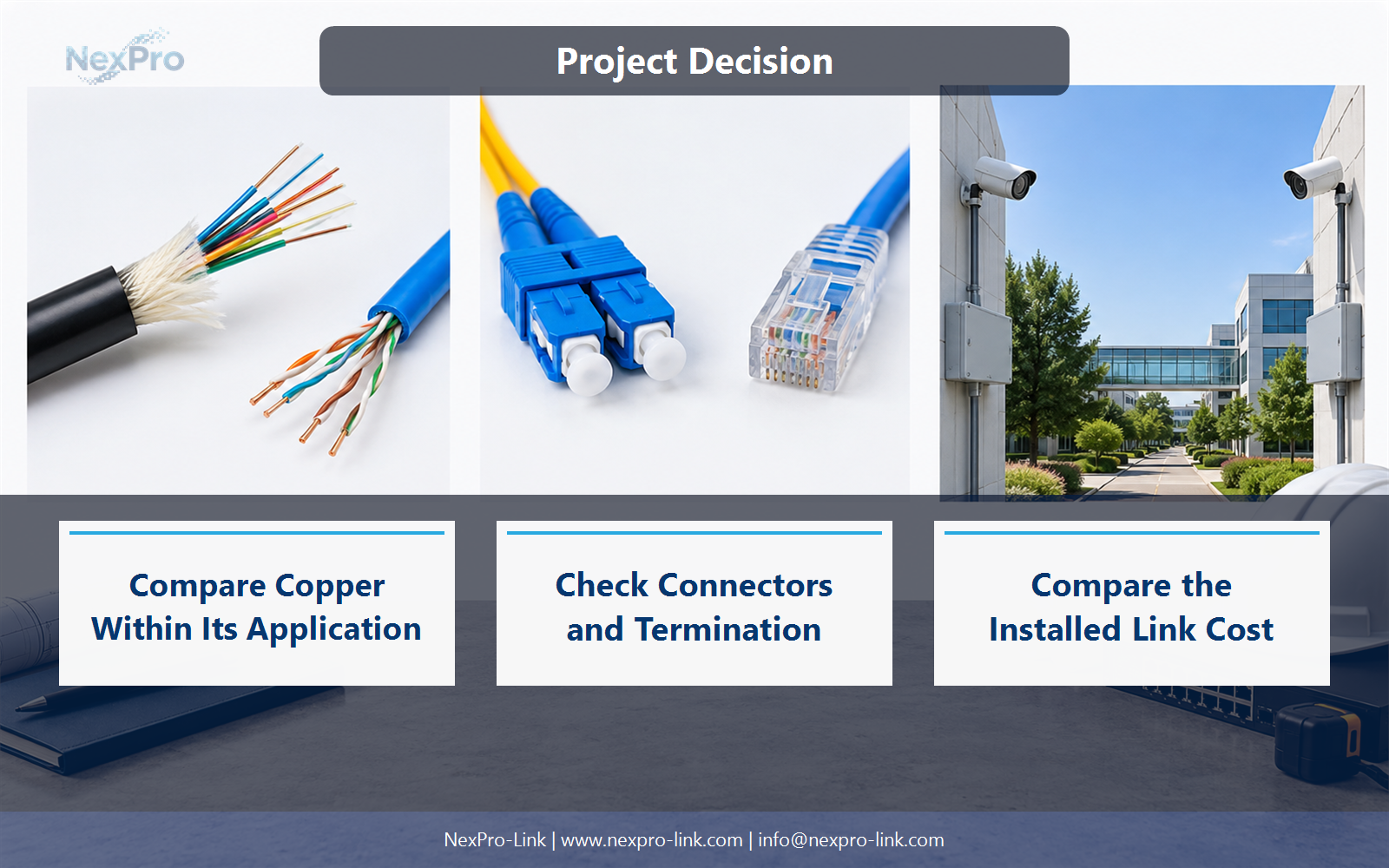
Copper can suit supported channel lengths and environmental conditions, particularly for local powered endpoints. Check the actual routed channel, grounding context and equipment requirements. Do not extend a conventional channel beyond its supported conditions merely because the calculated video bitrate is low.
Use Segment, Channel length, Environment, PoE need to compare options on the same basis. Keep product capability, project assumption and operating responsibility in separate columns.
Section 03
Choose the Fiber Type and Optics Together
No. Match fiber type, supported reach, wavelength, interface speed and optical budget at both ends. OM3 or OM4 describes a multimode fiber category, not a complete link specification. Select the cable and transceivers as one supported optical path.
The project output should make Fiber, Optic, Wavelength, Rate, Reach, Budget traceable from input to acceptance.
- Confirm the answer to: Are single-mode and multimode components interchangeable?
- Record the project fields: Fiber / Optic / Wavelength / Rate / Reach / Budget.
- Keep product capability, project assumptions and site responsibility in separate records.
Section 04
Check Connectors and Termination
No. Connector form describes the physical interface, not all optical characteristics of the cable or transceiver. Match connector type, polish where relevant, polarity and fiber count. Include patch panels and patch cords in the route rather than ordering only the trunk cable.
Record End, Connector, Fiber count, Polarity, Patch lead before selecting a product family. That makes later substitutions possible without silently changing the operational requirement.
Section 05
Provide Power at the Remote End
Provide a supported optical endpoint, local network distribution and an appropriate power source for the cameras. A PoE switch with suitable uplink capability may combine some roles; a converter may require separate devices. Include enclosure conditions and backup power in the zone design.
Review Optical endpoint, PoE supply, Cabinet, Power, Backup with the party that will operate or maintain the system.
Section 06
Compare the Installed Link Cost
Include cable routes, termination, active endpoints, power, testing and maintenance rather than cable price per metre alone. Fiber may change the need for intermediate powered nodes. Use actual project quantities and rates; there is no universal crossover price for every building link.
Use Option, Cable, Endpoints, Power nodes, Testing, Service as the handoff between design and procurement.
Engineering references
These sources support the general planning principles. Always use the selected product's current datasheet and applicable project standards for final design.