Factory security design starts with the events the owner needs to retrieve. A zone brief connects those events to camera views, recording, power and accountable delivery scope.
Section 01
Define what each view must show
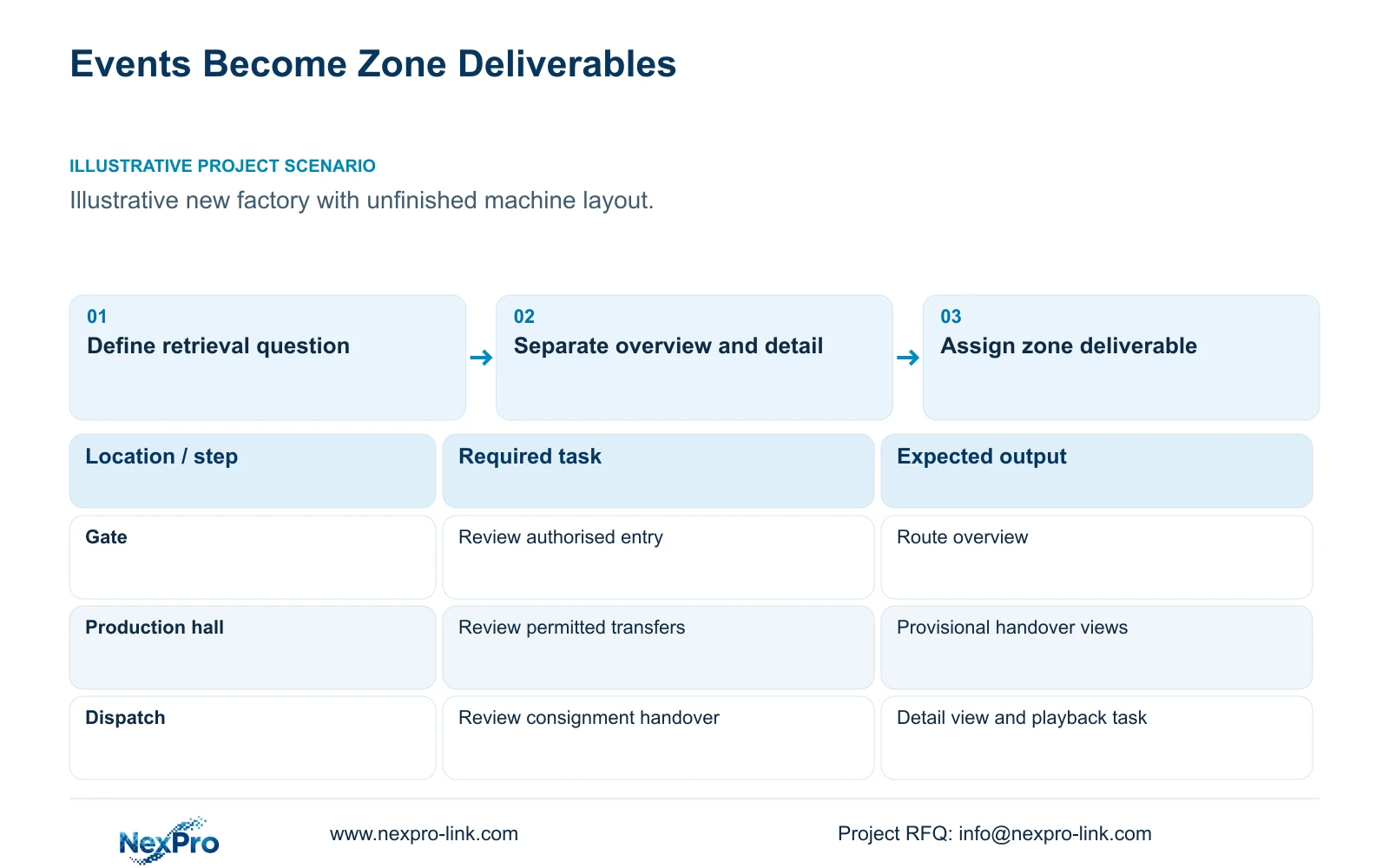
Start factory security system design by defining the event to retrieve in each zone. Agree what the recording must show, who will review it and how long it must remain available. Then distinguish overview views from detail views. An overview can establish where a movement occurred; a closer handover view may be needed to understand which material changed custody. Buying identical cameras before settling those tasks leaves the most important image requirements unresolved.
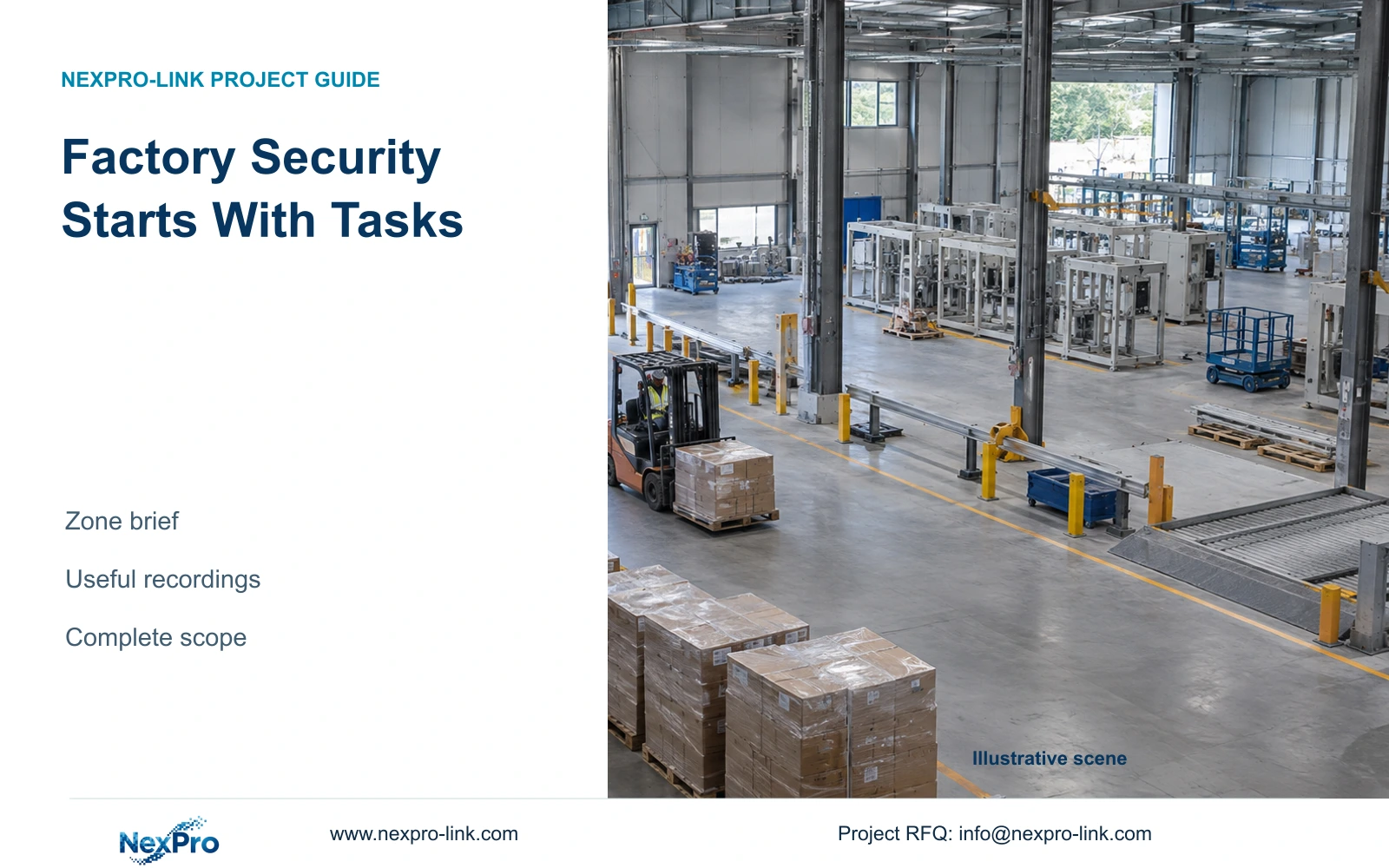
Illustrative project scenario: A new factory needs gate, production-hall and dispatch coverage before its equipment layout is final. Assume the gate position is fixed, while machine rows and dispatch staging lanes remain provisional. The owner wants to review authorised access and material transfers. These are planning assumptions, not a completed customer project or a claim that ordinary security cameras can inspect machining quality.
Write each requirement as a question an operator should answer from playback. At the gate, that might be whether a delivery entered the authorised route. At dispatch, it might be whether a consignment passed through the designated handover position. Mark fixed building features separately from movable equipment so the engineer knows which views can be designed now.
Section 02
Separate security and process monitoring
Give security review, process observation and machine safeguarding separate entries in the brief. A production manager may want to review the sequence of a material transfer, while a security manager needs to investigate access to the same area. Those tasks can sometimes share footage, but neither establishes that the camera can detect a dimensional defect or trigger a protective machine stop.
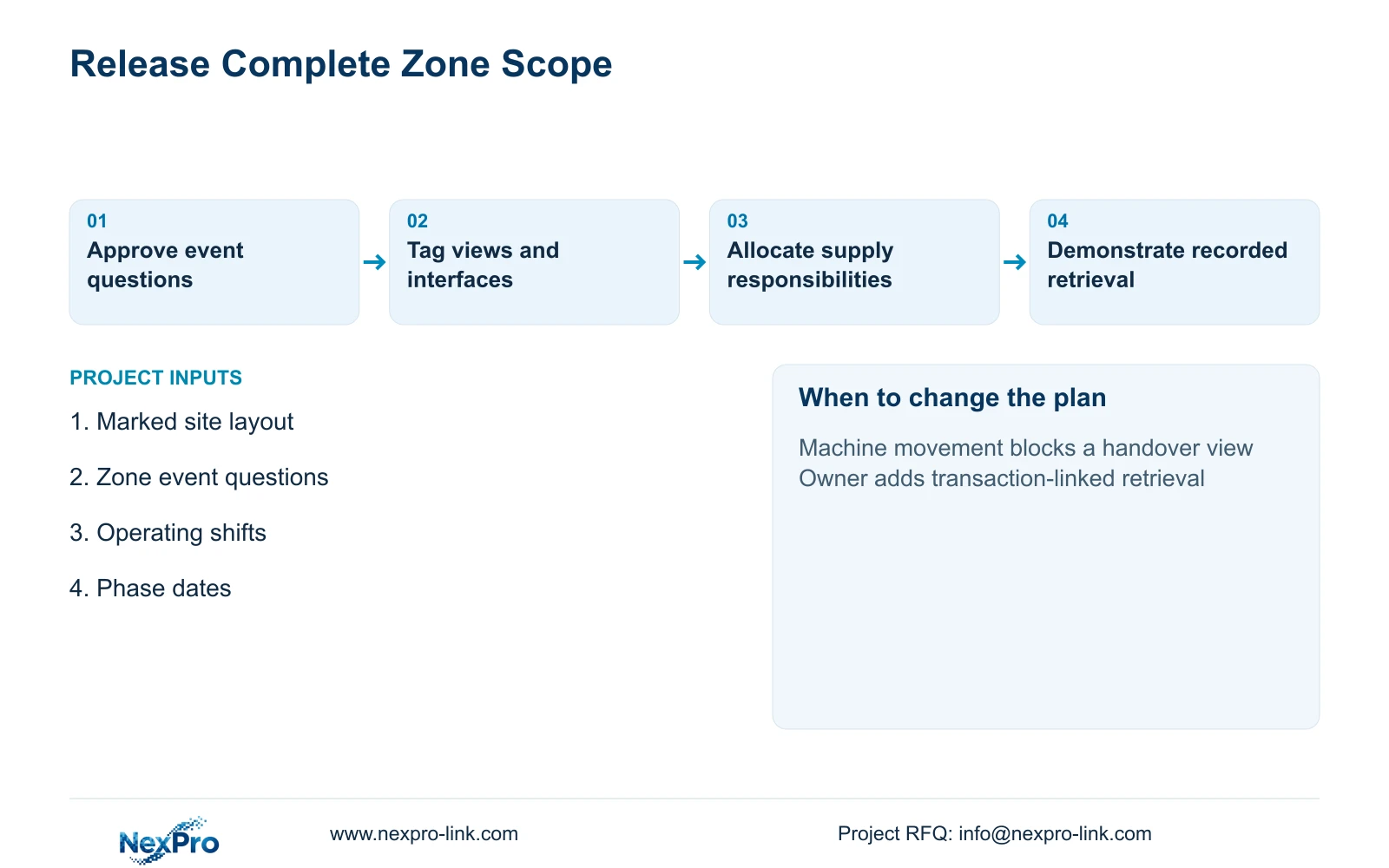
For the provisional production hall, specify permitted transfer routes and the objects that could obstruct them. Ask the process team to identify machine envelopes, maintenance access and likely storage positions. If a future machine blocks the handover view, the design response may be a different mounting position or a dedicated detail view, rather than a resolution upgrade.
Operating shifts also affect the acceptance scene. A daytime view beside an open loading door does not demonstrate the required night-shift recording. Identify the relevant lighting states before model selection. Any specialist inspection or safeguarding requirement should remain with the responsible specialist team, with ordinary CCTV supporting only the agreed security task.
Section 03
Turn each zone into a deliverable
A zone deliverable should connect the retrieval question to a view reference, equipment tag, recording policy and acceptance action. The illustrative CASE01 schedule assigns four cameras to gate overview, six to material and tool stores, ten to permitted machine-hall transfers, four to common routes, six to dispatch and two to equipment-room approaches. Its total of 32 follows the example task schedule; it is not a camera density rule.
For dispatch, ask the owner to approve the handover location before the engineer finalises the detail view. The installer then confirms mounting access and the cable route. The operator should retrieve a staged transfer using the agreed camera name and time reference. A successful live image alone would leave that deliverable incomplete.
Carry supply responsibility into the same schedule. For example, identify cameras and the recorder as supplier-provided, an approved owner network as retained, mounting and cable installation as installer-provided, and transaction integration as optional. Each interface needs a named project owner. This makes missing accessories and unresolved network access visible before they become commissioning problems.
Section 04
Minimum operational package vs additional integration
Choose the baseline around a complete camera-to-recording path. It needs suitable cameras, working links, recording storage, authorised retrieval and the power arrangements required by the outage objective. Additional management or integration is justified when it serves a defined operation, such as locating dispatch footage from a transaction reference. Keep the recording outcome constant when comparing the options.
The decisive difference in this matrix is the added workflow and its dependencies. Integration introduces an interface owner, configuration work and potentially additional computing or protected power. It does not replace a missing camera view. Apply the method row by row: assign each item to supplied, retained, installer-provided or optional, then identify one accountable owner per interface.
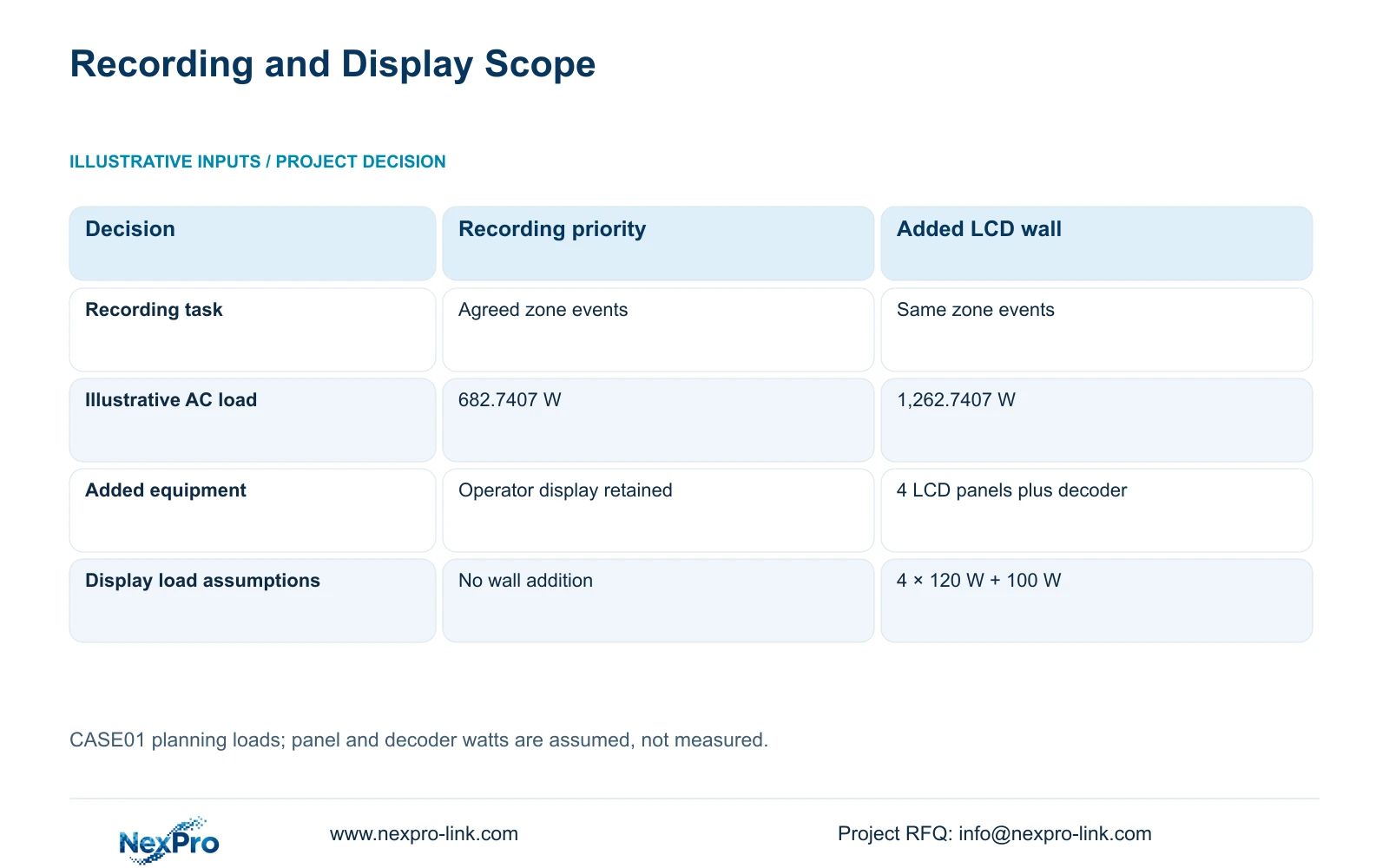
CASE01 also shows why optional display scope belongs outside the recording baseline. Its recording-priority load is 682.7407 W. Adding four LCD panels at an assumed 120 W each and a decoder at an assumed 100 W gives 682.7407 + 4 × 120 + 100 = 1,262.7407 W. These are illustrative design loads, not published measured consumption. The extra display equipment leaves the original recording task unchanged.
| Decision | Complete recording package | Recording plus integration |
|---|---|---|
| Recording outcome | Retrieve agreed zone events | Retain the same zone events |
| Hardware identity | Exact models and project tags | Same tags plus approved interfaces |
| Network and power | Account for every required node | Include added servers and interfaces |
| Software and access | Viewing, playback and authorised export | Add justified transaction-linked retrieval |
| Procurement basis | Complete equipment and installation split | Additional scope with interface ownership |
Section 05
Select the package that preserves the task
For this unfinished factory layout, recommend a zone-based recording package with separately identified overview and handover views. Preserve the gate and dispatch outcomes first, while recording provisional hall positions as controlled assumptions. Add a permanent wall only if the staffing plan requires simultaneous observation that the agreed operator display cannot provide.
NexPro-NVR4449-4K is a recording candidate for further matching: its published references include 49 channels, 320 Mbps input and four SATA bays supporting up to 18 TB per drive. Its summary distinguishes 49 × 5MP from 9 × 4K. CASE01 assumes compatible 5MP-class streams; channel count alone does not establish every decode arrangement or RAID capability.
Change the recommendation if the owner requires a mandatory platform interface, specialist environmental protection or a different recovery architecture. Compare any NexPro-Link alternative with another supplier against the same accepted views, retention, outage objective and services. A lower equipment total means little if the quotation omits a required interface or transfers installation work to an unappointed party.
Section 06
Prepare the project-ready supply and RFQ scope
Issue the zone brief alongside a marked layout showing fixed and provisional positions. Keep equipment tags consistent across the camera schedule, recorder channel names and packing list. The cost team can then distinguish committed quantities from conditional views and request prices for the actual differences, without treating blank scope fields as free items.
NexPro-Link can support model matching, BOQ development and relevant technical submittals, together with related equipment and project-packing coordination. If OEM labels are required, use the approved location tags on the packing records as well as the equipment schedule. Local mounting, electrical installation and final project acceptance remain assigned in the procurement documents.
Before release, resolve any dependency needed to operate the first package. Confirm who supplies the network connection, who provisions operator permissions and who demonstrates playback. A phased delivery is workable only when the first accepted zone has its complete operating path, even if later hall views are still being decided.
Section 07
Buyer questions
Can camera quantity be provisional in the first quotation? Yes. Separate committed views from conditional positions and identify the layout decision that releases each conditional item. Quote the associated mounting, link and recording implications so a later quantity change has a clear scope.
Does one coordinated supplier mean every device uses the same software? No. Coordinated supply can cover equipment and documentation while individual devices retain separate interfaces. Specify any shared workflow explicitly and verify the selected device, client and firmware combination.
Should all zones have the same retention period? Only if the owner has the same retrieval need across them. Record any zone-specific period and its reason, then size storage accordingly. A shorter period should not be introduced merely to make a proposed recorder fit.
Section 08
Define your first operating package
Send your marked site layout, zone retrieval questions, operating shifts and required phase dates to info@nexpro-link.com so NexPro-Link can discuss the equipment and supply scope for your first complete factory security package.
Engineering references
These sources support the general planning principles. Always use the selected product's current datasheet and applicable project standards for final design.