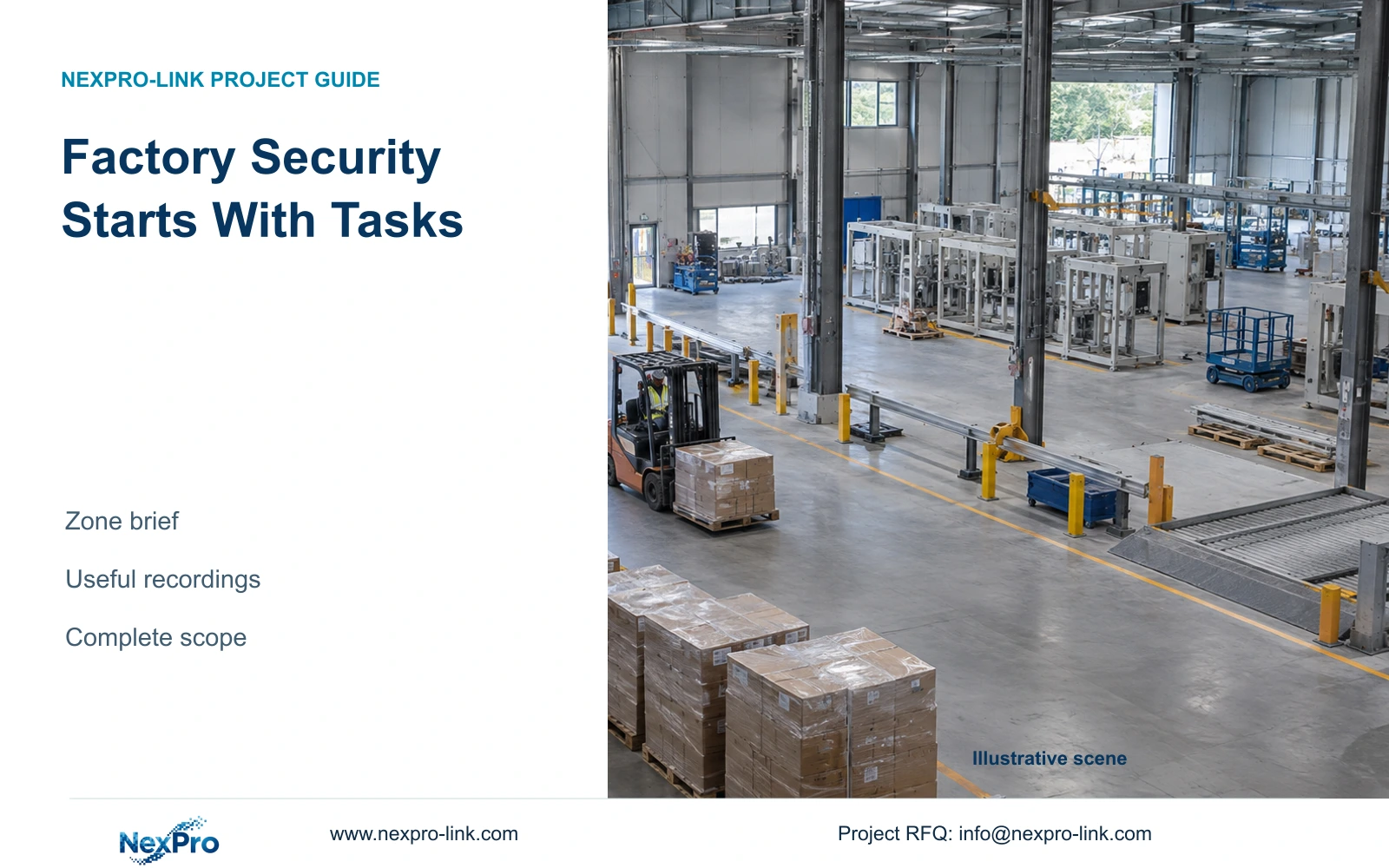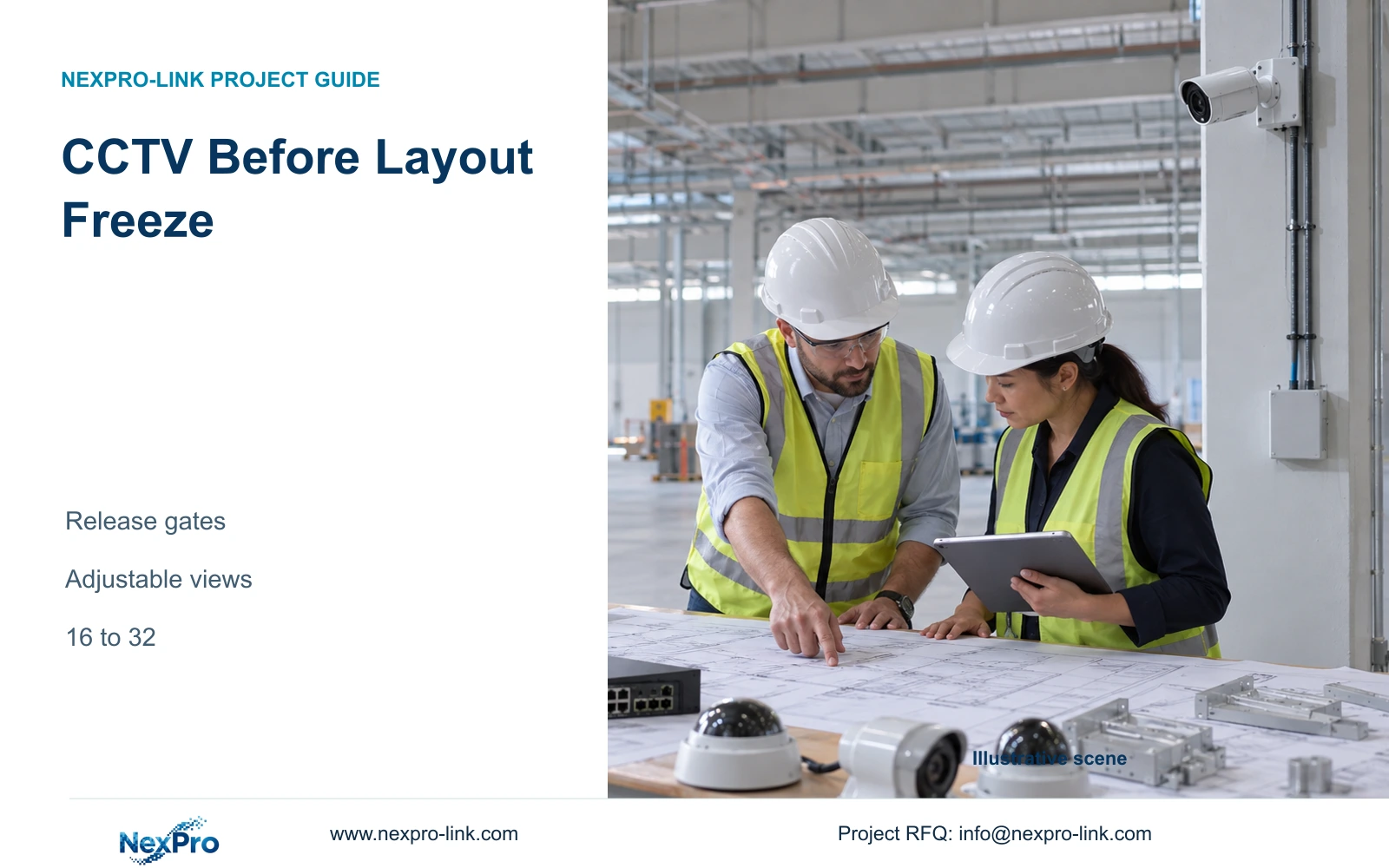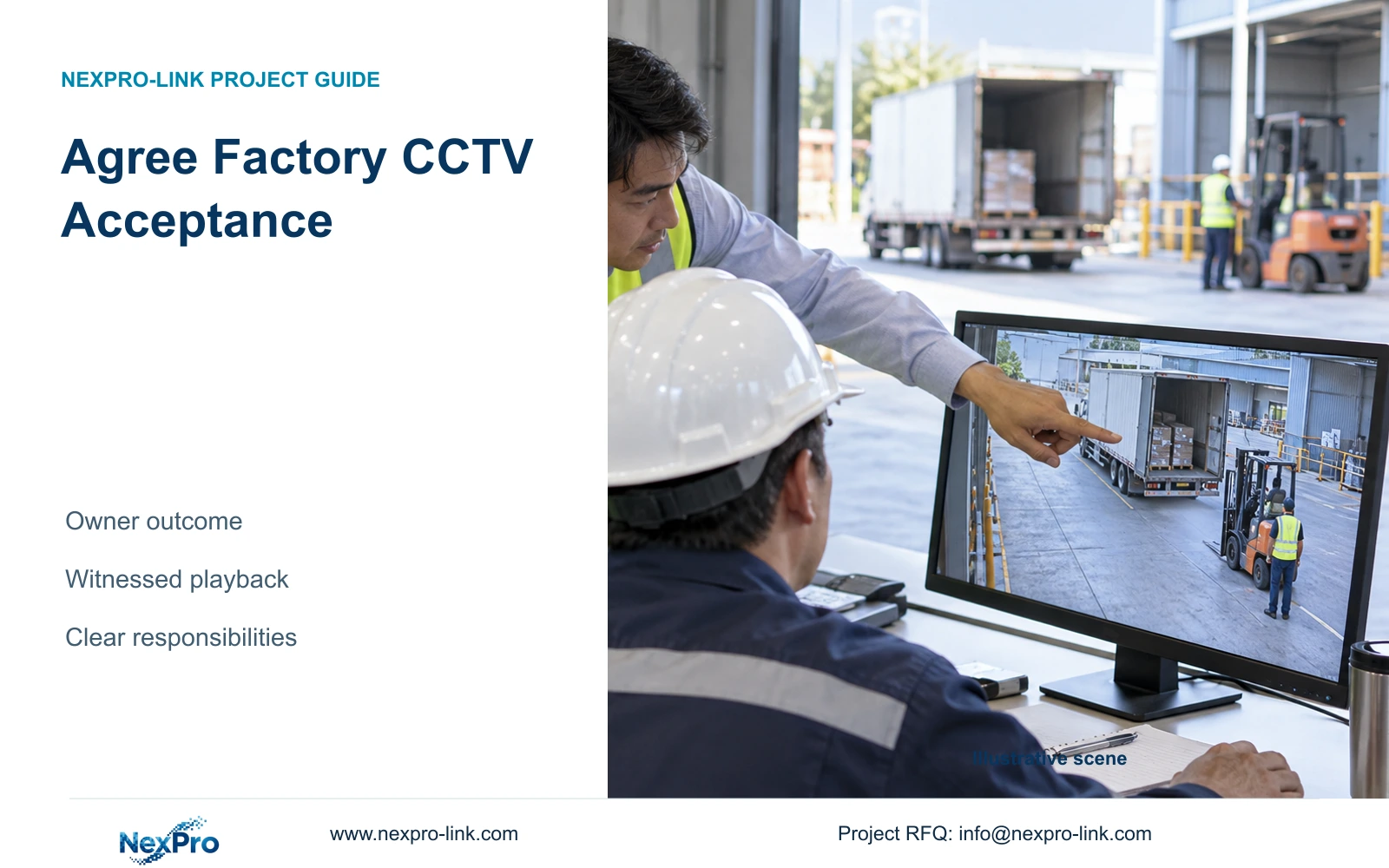
Plan manufacturing plant CCTV design with practical guidance on divide the plant into operational zones and check recorder and retention capacity together. NexPro-Link project guide.
Section 01
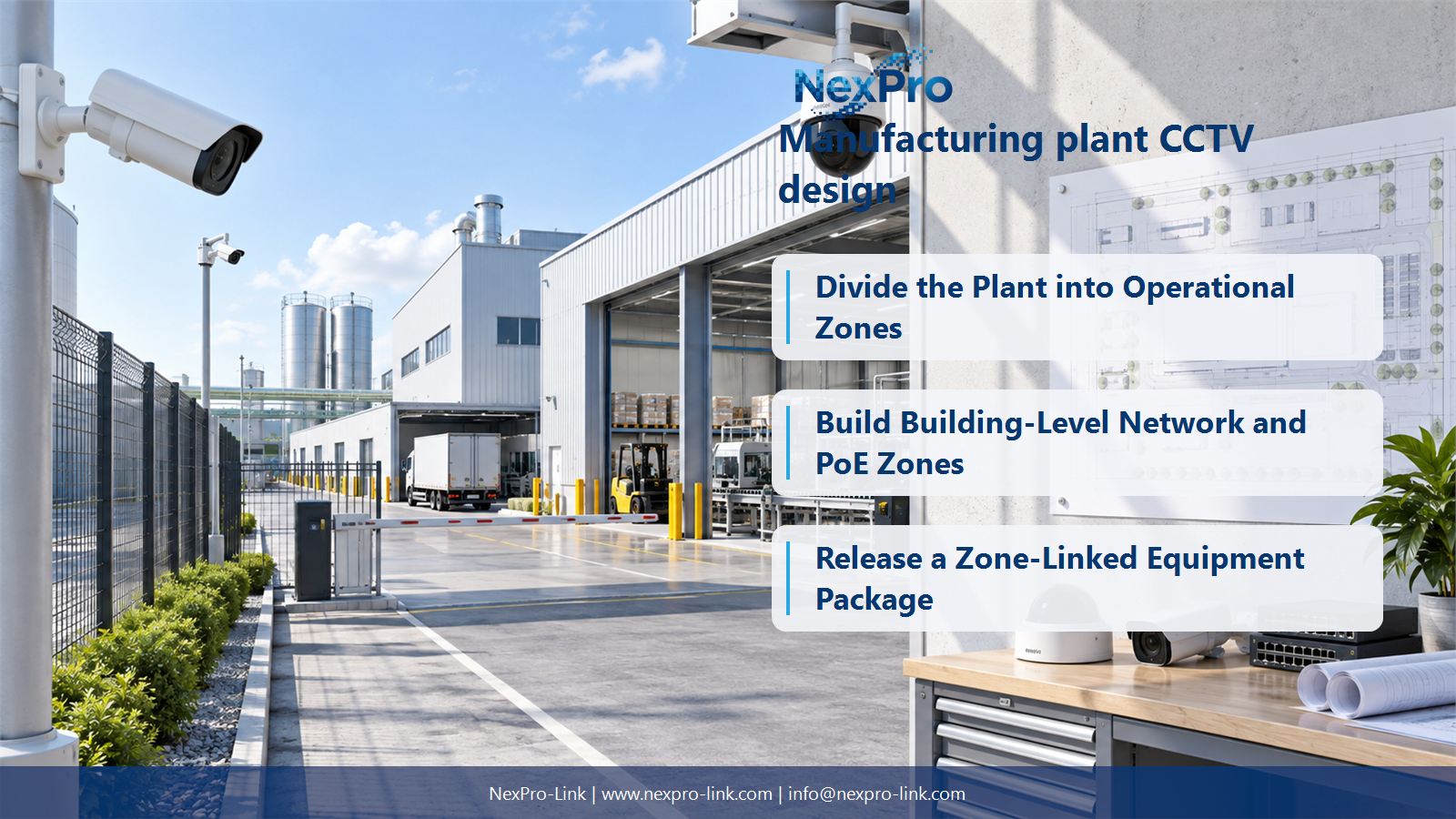
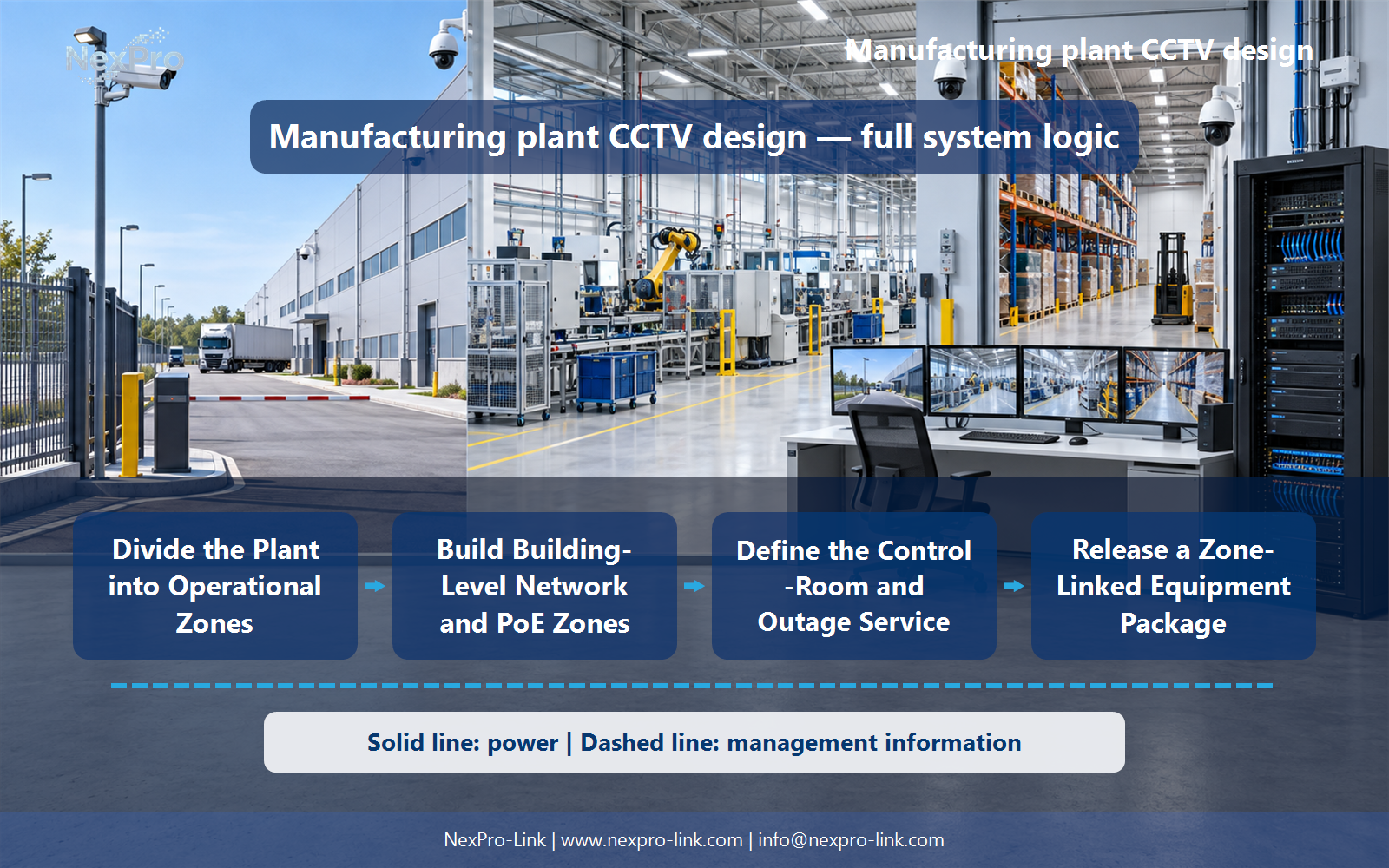
Divide the Plant into Operational Zones
Separate perimeter observation, production oversight, warehouse activity and controlled entrances by their viewing tasks and conditions. A uniform camera specification can waste detail in some areas and miss essential views in others. Connect each zone to a named operational owner and response purpose.
Turn the answer into a working record using Zone, Task, Environment, Camera role, Owner.
| Decision area | Buyer question | Required output |
|---|---|---|
| Divide the Plant into Operational Zones | How should a factory CCTV design be divided? | Separate perimeter observation, production oversight, warehouse activity and controlled entrances by their viewing tasks and conditions. |
| Choose Views for Production and Movement | Can one PTZ replace fixed coverage across the factory? | A PTZ can inspect selected areas but does not continuously observe every direction at once. |
| Build Building-Level Network and PoE Zones | How should factory camera networks follow buildings? | Group access switches around supported copper routes, then connect buildings with an appropriate backbone. |
Section 02
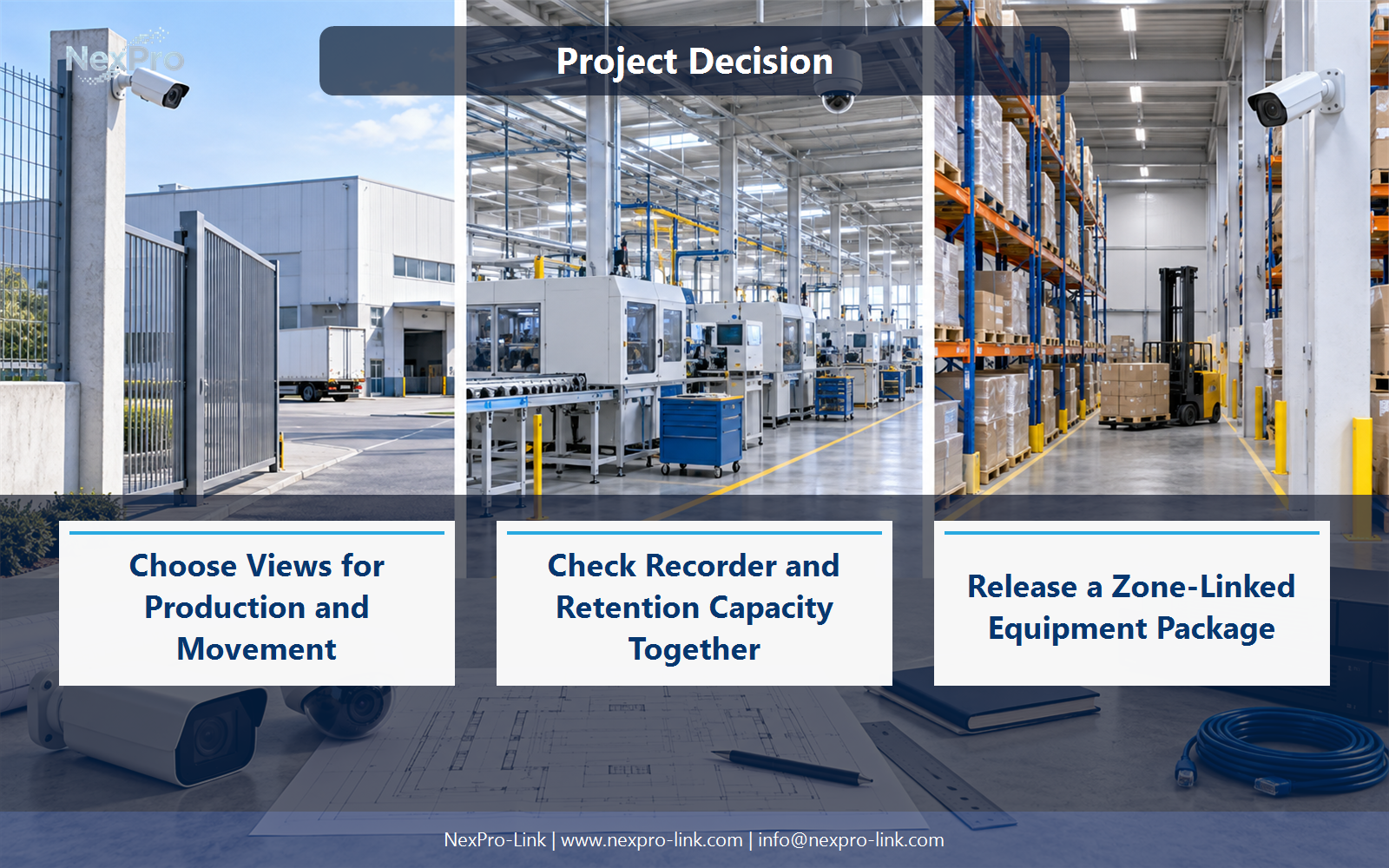
Choose Views for Production and Movement
A PTZ can inspect selected areas but does not continuously observe every direction at once. Keep required fixed views while adding operator-controlled inspection where useful. Select lenses and mounting around machinery, racks and vehicle movement rather than relying on zoom ratio alone.
Use Position, Fixed evidence, PTZ support, Lens, Obstruction to compare options on the same basis. Keep product capability, project assumption and operating responsibility in separate columns.
Section 03
Build Building-Level Network and PoE Zones
Group access switches around supported copper routes, then connect buildings with an appropriate backbone. Calculate each local PoE budget and the traffic crossing each uplink. A central recording room does not eliminate the need for remote cabinet power, protection and maintenance access.
The project output should make Building, Cameras, PoE allocation, Uplink, Local power traceable from input to acceptance.
- Confirm the answer to: How should factory camera networks follow buildings?
- Record the project fields: Building / Cameras / PoE allocation / Uplink / Local power.
- Keep product capability, project assumptions and site responsibility in separate records.
Section 04
Check Recorder and Retention Capacity Together
Not under the stated 4 Mbps, 30-day continuous example. The recording payload is 82.944 TB, while eight equal 8 TB active drives provide 56 TB nominal RAID 5 capacity before other deductions. Change the supported storage arrangement rather than quietly shortening retention or claiming the proposed disks fit.
Record Recording TB, Nominal array TB, Reserve, Capacity gap before selecting a product family. That makes later substitutions possible without silently changing the operational requirement.
Section 05
Define the Control-Room and Outage Service
Identify the critical camera paths, recording and essential operator display. Protect the relevant access switches and backbone as well as central equipment. The full LED wall may be optional during an outage; an essential monitoring position can have a different load and runtime target.
Review Critical zone, Powered path, Display level, Runtime target with the party that will operate or maintain the system.
Section 06
Release a Zone-Linked Equipment Package
Link each camera group to its network zone, recording allocation, storage requirement, display function and power path. Include mounts, cable routes and installation responsibility. NexPro-Link can use these requirements for model matching and equipment-package discussion, with local installation and integration responsibilities stated separately.
Use BOQ line, Zone, Function, Quantity, Interface, Scope as the handoff between design and procurement.
Engineering references
These sources support the general planning principles. Always use the selected product's current datasheet and applicable project standards for final design.