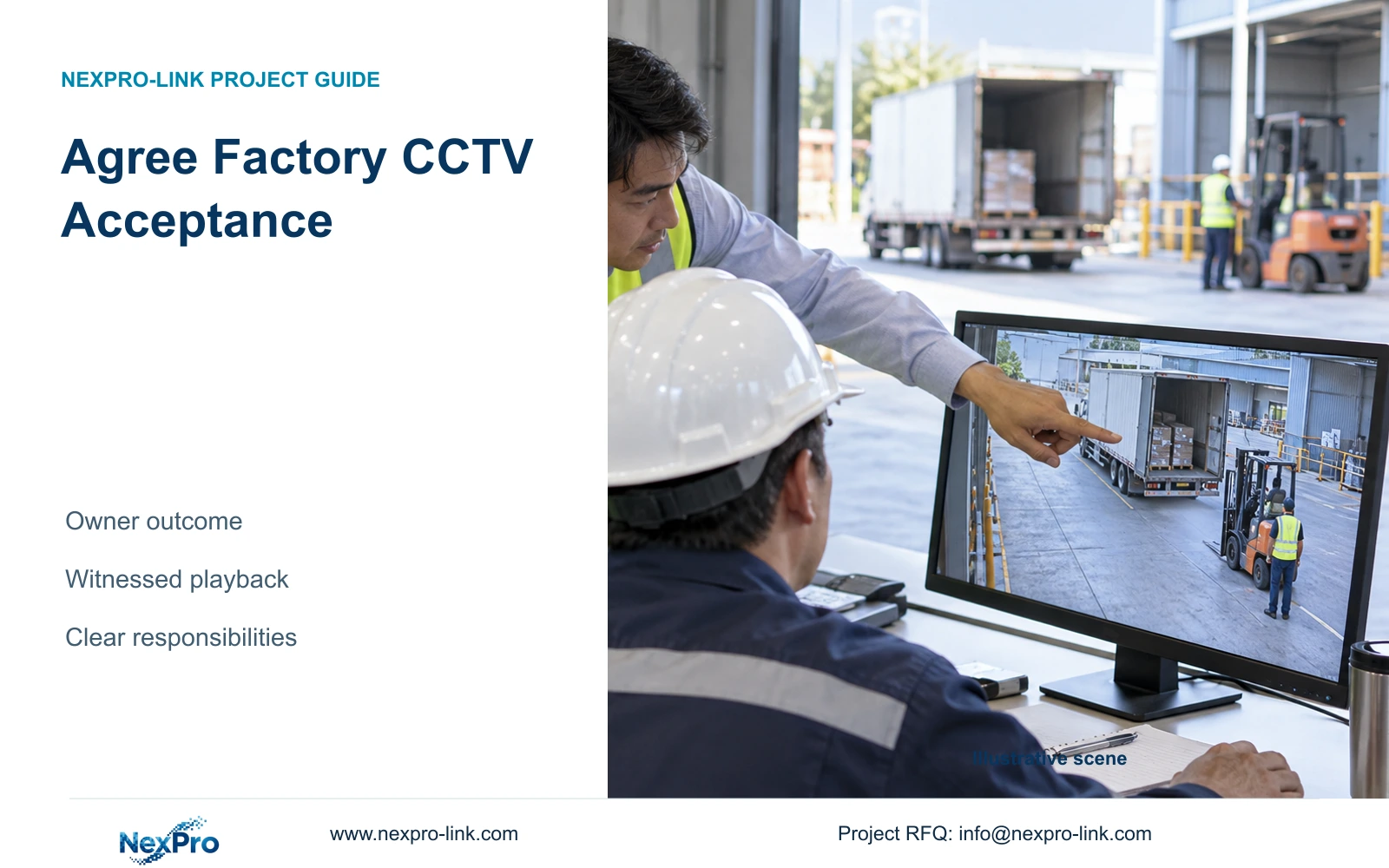
The owner defines the required recording outcome; the project team translates it into an agreed design and witnessed acceptance scene. A data sheet alone cannot prove the installed view.
Section 01
Translate owner needs into acceptance tasks
The owner should define the operational outcome, while the engineer and contractor translate it into a feasible design and an agreed acceptance method. Record that allocation in the project documents, including who witnesses and approves the result. A supplier data sheet supports equipment selection; it cannot establish whether an installed camera records the required event from its actual position.
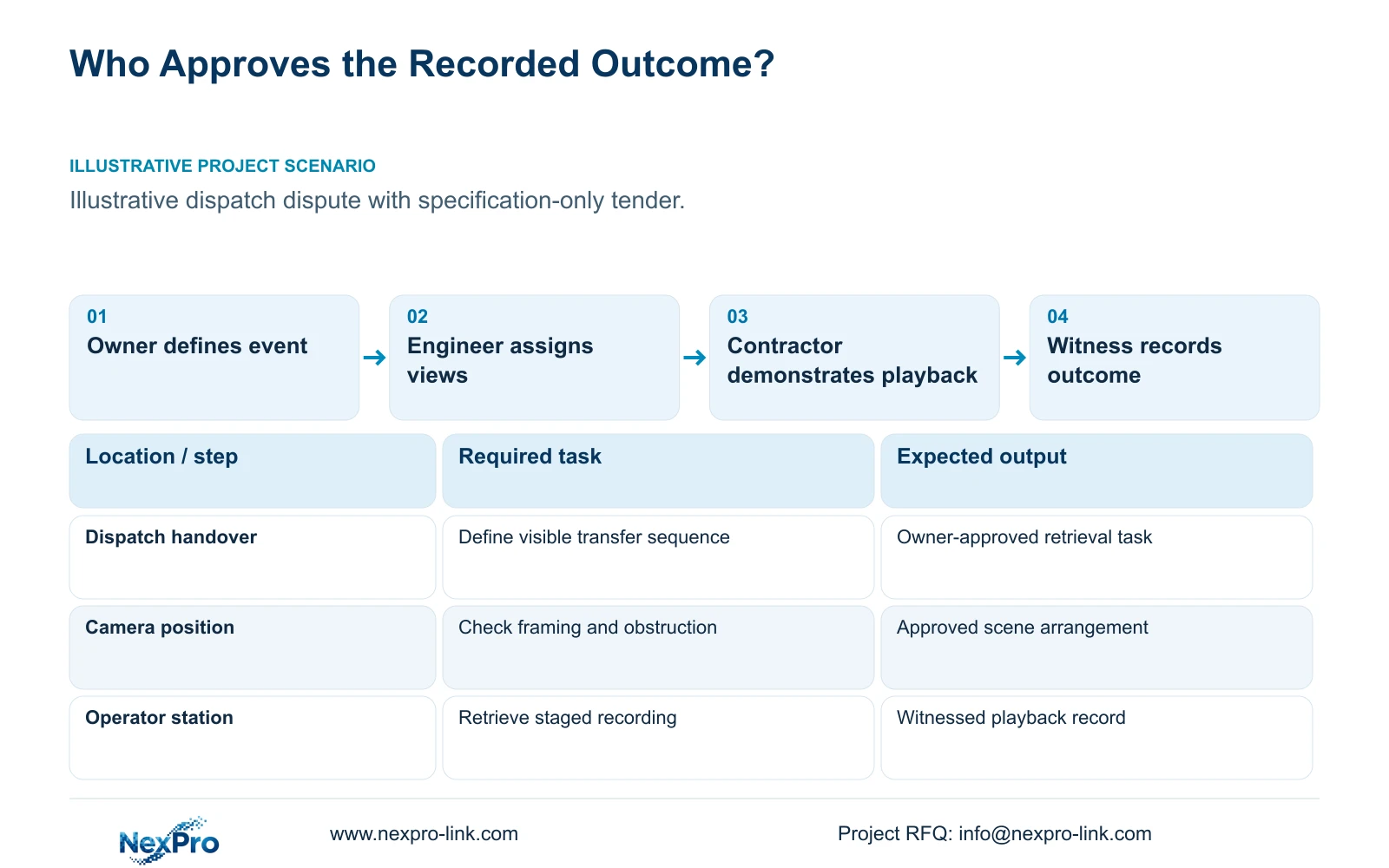
Illustrative project scenario: The owner asks for useful recordings while the tender only lists megapixels and quantities. Assume the concern is a disputed material handover at dispatch in a new factory. The team has an equipment list but has not agreed the transfer position, relevant camera views or playback test. These are hypothetical project conditions, not reported commissioning results.
Replace the vague request with a recorded-image task: an authorised operator must locate the designated transfer and explain its visible sequence using the relevant views. Define the event boundaries and the detail needed for that explanation. Agree this before ordering so a later failure is assessed against a known requirement rather than a newly introduced expectation.
Section 02
Assign design and installation decisions
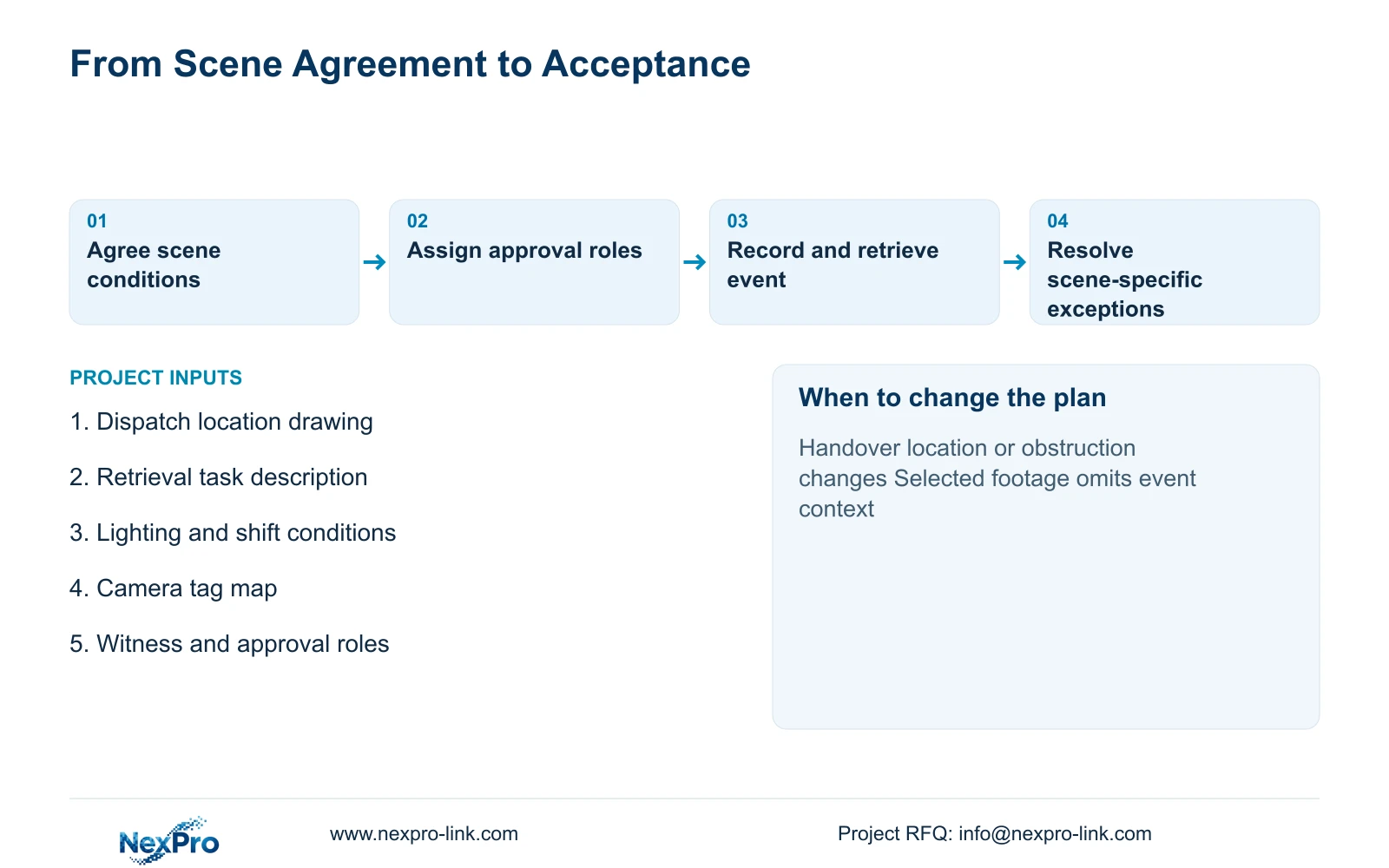
The owner identifies the event, operating shifts and authorised reviewers. The engineer develops the viewing geometry, image settings, recording policy and system resources. The contractor confirms buildability, installs the approved arrangement and demonstrates the recorded workflow. The supplier identifies exact models and documented limitations. Adapt these roles to the actual contract, but leave no acceptance decision dependent on an unnamed party.
For the dispatch example, the owner confirms where custody changes. The engineer determines which overview and detail views support that event. The installer checks whether a proposed mount remains accessible and unobstructed after fit-out. If the staging position moves, the change goes back to the engineer and owner before installation proceeds against an obsolete drawing.
CASE01 separates 32 ordinary security positions from machine inspection and guarding. Its dispatch group contains six illustrative cameras, but that count does not determine which views are relevant to a particular transfer. The acceptance schedule should map the event to camera tags and a retrieval method, while specialist inspection or safeguarding stays outside the ordinary CCTV acceptance scope.
Section 03
Agree a representative acceptance scene
Choose a staged scene that reproduces the condition the owner actually needs to review. For dispatch, use the agreed handover position, a representative load and a permitted transfer movement. Include the lighting state associated with the relevant shift and any normal obstruction that materially affects the view. Obtain site permission and coordinate the demonstration with operations.
Record the scene through the intended recording path, then ask the nominated operator to retrieve and play it back. Compare the result with the stated task: is the full handover visible, are the relevant actions distinguishable, and can the sequence be followed across the selected views? Where the result is unclear, record which part failed instead of reducing the outcome to a generic pass or fail.
Keep a concise acceptance record containing camera tags, configuration reference, scene conditions, selected timestamps and witness comments. The supplied 5MP camera references list 2880×1620 among their output fields, but that specification does not prove the installed scene is adequate. Framing, lighting, obstruction and recording settings must be assessed in the actual demonstration.
Section 04
Video volume in a broad vs targeted event request
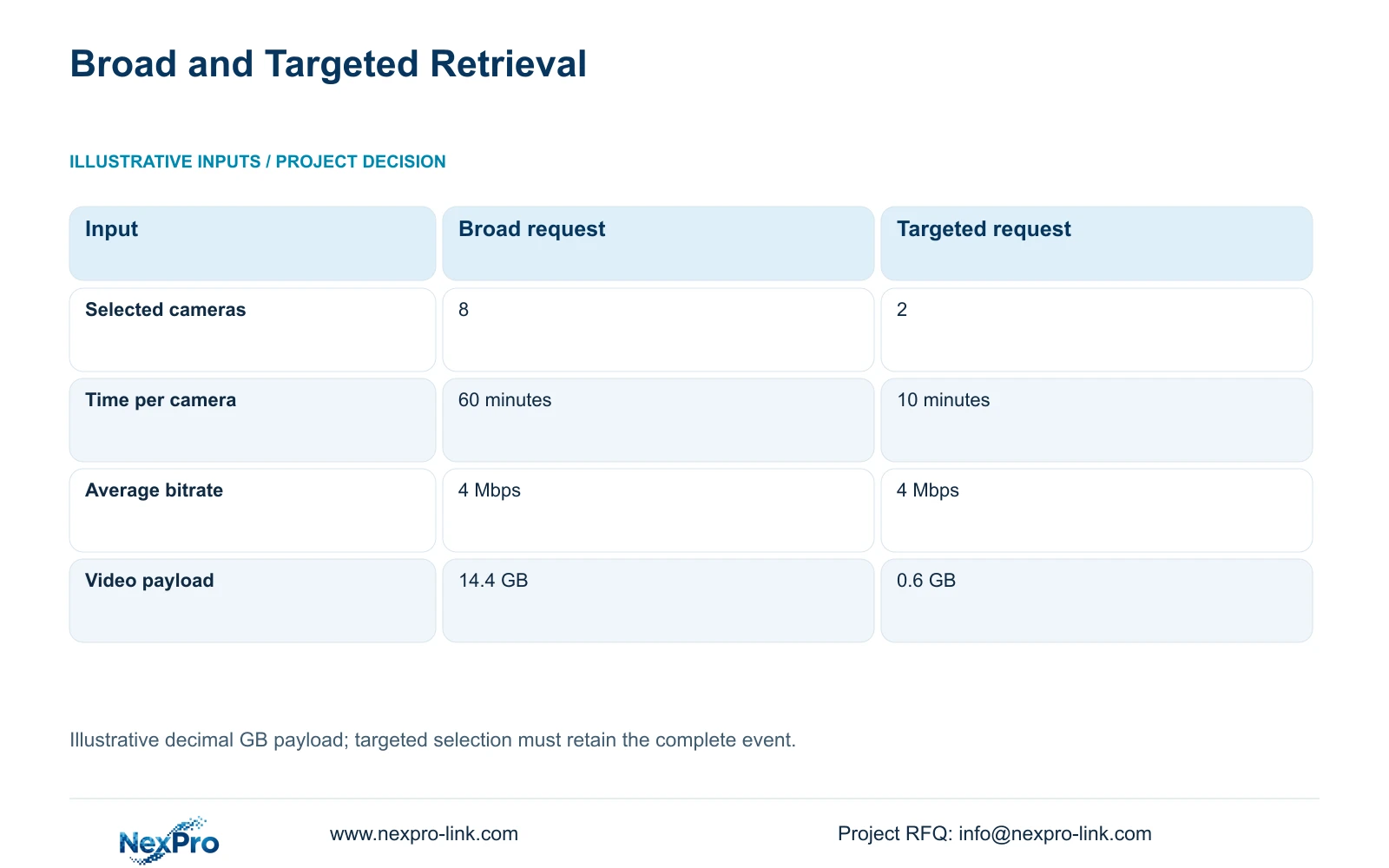
An agreed event map also makes retrieval scope easier to specify. Compare an illustrative broad request for eight cameras over 60 minutes each with a targeted request for two relevant cameras over ten minutes each. Both assume an average 4 Mbps video payload. Use decimal GB and the formula GB = cameras × Mbps × seconds / 8 / 1000.
For the broad request, 8 × 4 × 3,600 / 8 / 1000 = 14.4 GB. For the targeted request, 2 × 4 × 600 / 8 / 1000 = 0.6 GB. These estimates describe selected video payload, excluding additional file overhead or metadata. They do not predict export duration, measured staff-time savings or the legal status of the exported material.
The decisive difference is relevance and event completeness. The smaller selection is appropriate only when those two views and ten minutes retain the required sequence and context. If the handover time is uncertain or movement continues beyond the selected views, widen the request. Authorised access, playback, export and subsequent handling remain separate acceptance tasks.
| Selection input | Broad request | Targeted request |
|---|---|---|
| Cameras selected | 8 | 2 |
| Minutes per camera | 60 | 10 |
| Average video bitrate | 4 Mbps | 4 Mbps |
| Estimated video payload | 14.4 GB | 0.6 GB |
Section 05
Recommend task-based acceptance with a defined witness
Use a written retrieval task and a nominated witness as the acceptance basis, supported by exact equipment specifications. Keep overview coverage, handover detail and export ability as separate results where each matters. This makes corrective action specific: a blocked view requires a geometry review, while an inaccessible export function requires an account or workflow review.
Separate acceptance stages where final operating conditions are unavailable. A bench demonstration can confirm the selected equipment and basic recording workflow; a site demonstration can assess mounting and framing. If final lighting or machine positions are missing, record the unresolved scene and arrange its later assessment. Do not turn a limited demonstration into approval of conditions it never represented.
Apply the same scene and recorded task when considering a NexPro-Link alternative to another supplier. Preserve any mandatory platform or specialist requirement and document deviations before acceptance. Use actual quotations for commercial comparisons, including configuration and local commissioning responsibilities. A compliant equipment field should support the outcome, while the witnessed recorded result establishes whether the installed arrangement meets it.
Section 06
Carry acceptance requirements into supply and handover
Attach the accepted scene description to the camera schedule and relevant quotation lines. Specify who supplies the recorder and storage, who configures permissions and who attends the site demonstration. Where the owner retains a network or client workstation, identify the party responsible for making that retained equipment available for the test.
NexPro-Link can support model matching and technical submittals against the written requirement. Project tags should follow the physical equipment, configuration schedule and packing records so the contractor installs the unit intended for each scene. Any substitution affecting the accepted stream or workflow should be recorded before shipment rather than discovered during the witnessed test.
At handover, give the operator the location map and retrieval procedure used in acceptance. Keep unresolved items tied to the affected scene, responsible party and required action. If later production changes move a handover point or obstruct a camera, review that specific accepted task again. The original acceptance record then provides a useful baseline for the change.
Section 07
Buyer questions
Who should witness the test if the owner has no CCTV specialist? Nominate an authorised representative who understands the operational event, supported by the engineer where needed. Agree the person's approval role before the demonstration so technical attendance is not mistaken for owner acceptance.
Can a sample-camera demonstration replace site acceptance? It can support selection and confirm a defined sample workflow. It cannot demonstrate the final mounting, lighting, obstructions or installed network path unless those conditions are actually represented.
What if a targeted export omits part of the incident? Expand the time range and relevant camera set, retaining the context needed to follow the event. Keep the selection reason in the retrieval record; a smaller payload is useful only when it preserves the required material.
Section 08
Specify the recording outcome before procurement
Send the relevant layout, one representative retrieval task, required scene and shift conditions, and proposed acceptance roles to info@nexpro-link.com so NexPro-Link can discuss model matching and the supporting supply documentation.
Engineering references
These sources support the general planning principles. Always use the selected product's current datasheet and applicable project standards for final design.