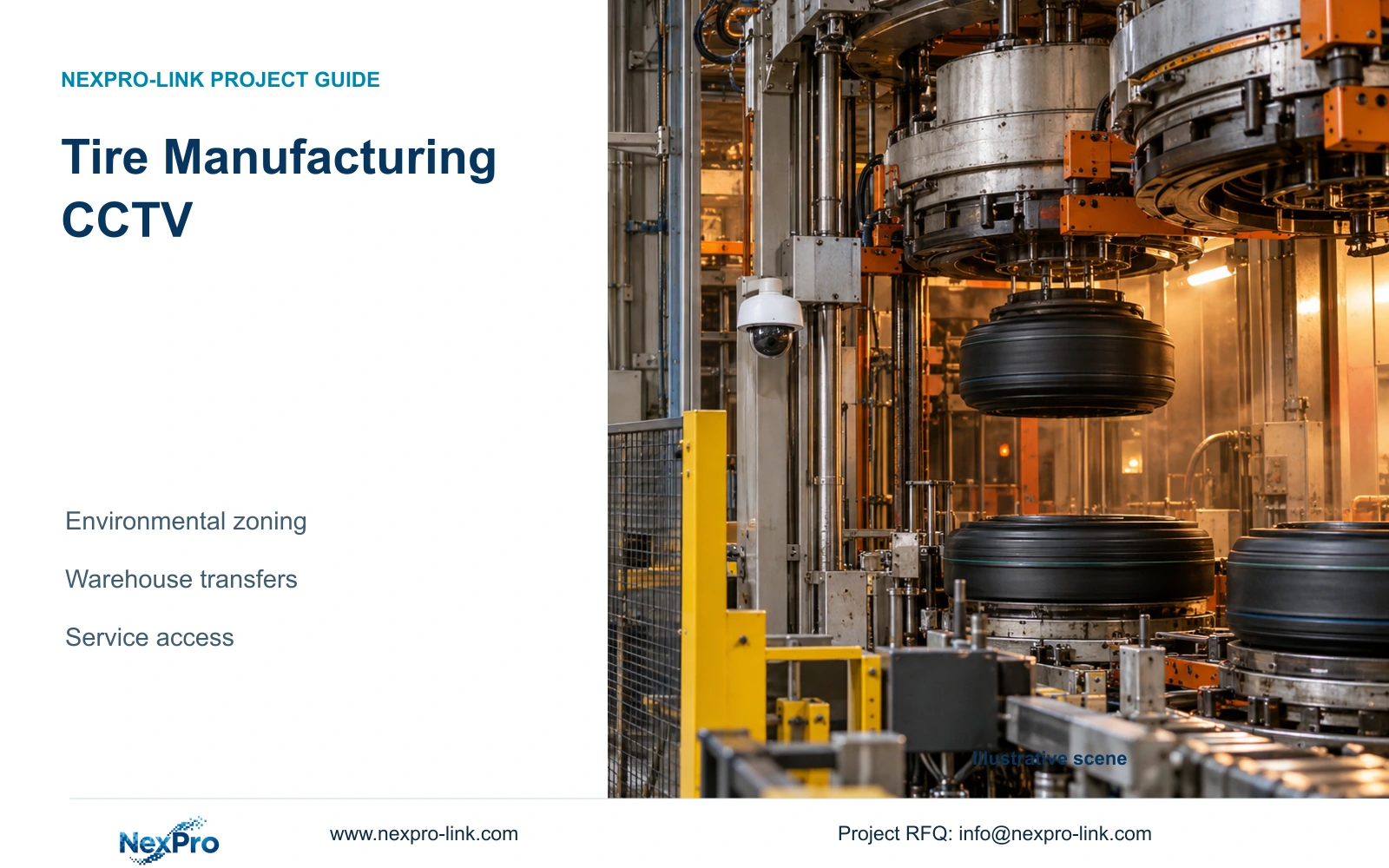
Qualify tire-plant CCTV by mounting location, preserve loading and warehouse visibility, and place recording infrastructure in suitable accessible service spaces.
Section 01
Qualify each mounting location before choosing a camera
Tire manufacturing CCTV should distinguish suitable ordinary warehouse locations from process-facing positions that need separate environmental qualification. Specify the conditions at the camera, its connections and its maintenance position. A building described as warm does not provide enough information to select every camera within it.
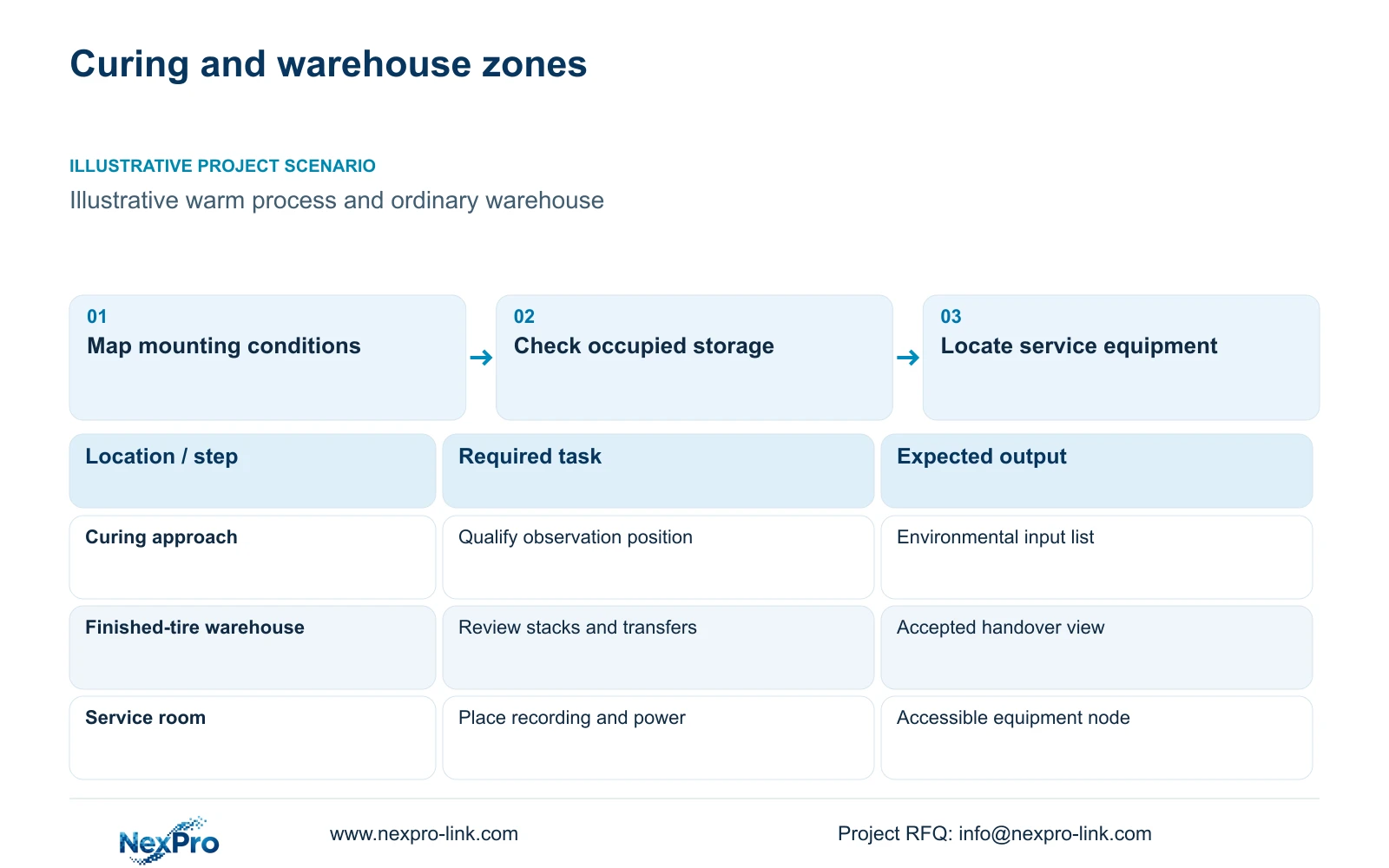
Illustrative project scenario: The tire plant has a warm process area and a normal-temperature finished-product warehouse. Assume the required security tasks concern access near curing operations, transfer into storage and loading at dispatch. Actual temperature, cleaning and exposure information remains to be collected; no particular position is assumed to have passed qualification.
Map the movement from process release to warehouse receipt and truck loading, then mark the proposed camera coordinates. Ask facilities and production staff about normal operation, cleaning cycles and unusual conditions at those coordinates. A camera observing a hot area from a suitable location may have a different requirement from equipment mounted close to the process. Keep any process measurement or protective-system task outside ordinary security recording.
Section 02
Design warehouse views around occupied storage
Stored tires can obscure transfer routes as stack heights and rack occupancy change. Mark normal and maximum approved storage arrangements, forklift travel and pedestrian access on the view plan. Test the proposed camera position with representative stock in place. An empty warehouse image should not settle loading or aisle acceptance.
Use an overview to follow movement between storage and dispatch, with a dedicated handover view where stock is released. If a stack blocks the exchange, consider an angle along the clear route or a second justified viewpoint. Raising every camera may expose more floor area while reducing useful detail at the actual transfer.
Maintenance access must be reviewed alongside coverage. Identify how staff will reach the lens and connections without moving stored goods unexpectedly or entering operating equipment space. Include cleaning responsibility and permitted access windows in the handover schedule. A position that is difficult to maintain can lose its intended view even when the original image was satisfactory.
Section 03
Locate recorders and power equipment in suitable service space
Choose a recorder and network service location from its actual operating, cooling and maintenance conditions. The camera's ingress rating does not qualify an NVR, switch or battery for the same environment. Keep ordinary infrastructure in accessible suitable space wherever the route design allows, then document the connection to each observation point.
The supplied CASE01 offers an illustrative ordinary-area architecture with local camera switches, recording and authorized clients. Its 32-camera basis is not a tire-plant camera count. Use its method to assign equipment to real electrical nodes and list which loads remain protected. A central UPS does not protect remote AC equipment unless the distribution actually reaches it.
Measure individual cable routes after selecting service positions. CASE01's 41 to 76 m continuous links reflect its own assumptions and cannot be copied to a larger curing building. Separate copper drops from inter-building backbone requirements, and specify termination and test methods. Changing the service-room location can improve equipment conditions while creating additional cable or backbone work that needs pricing.
Section 04
Use a location matrix that requires every condition to fit
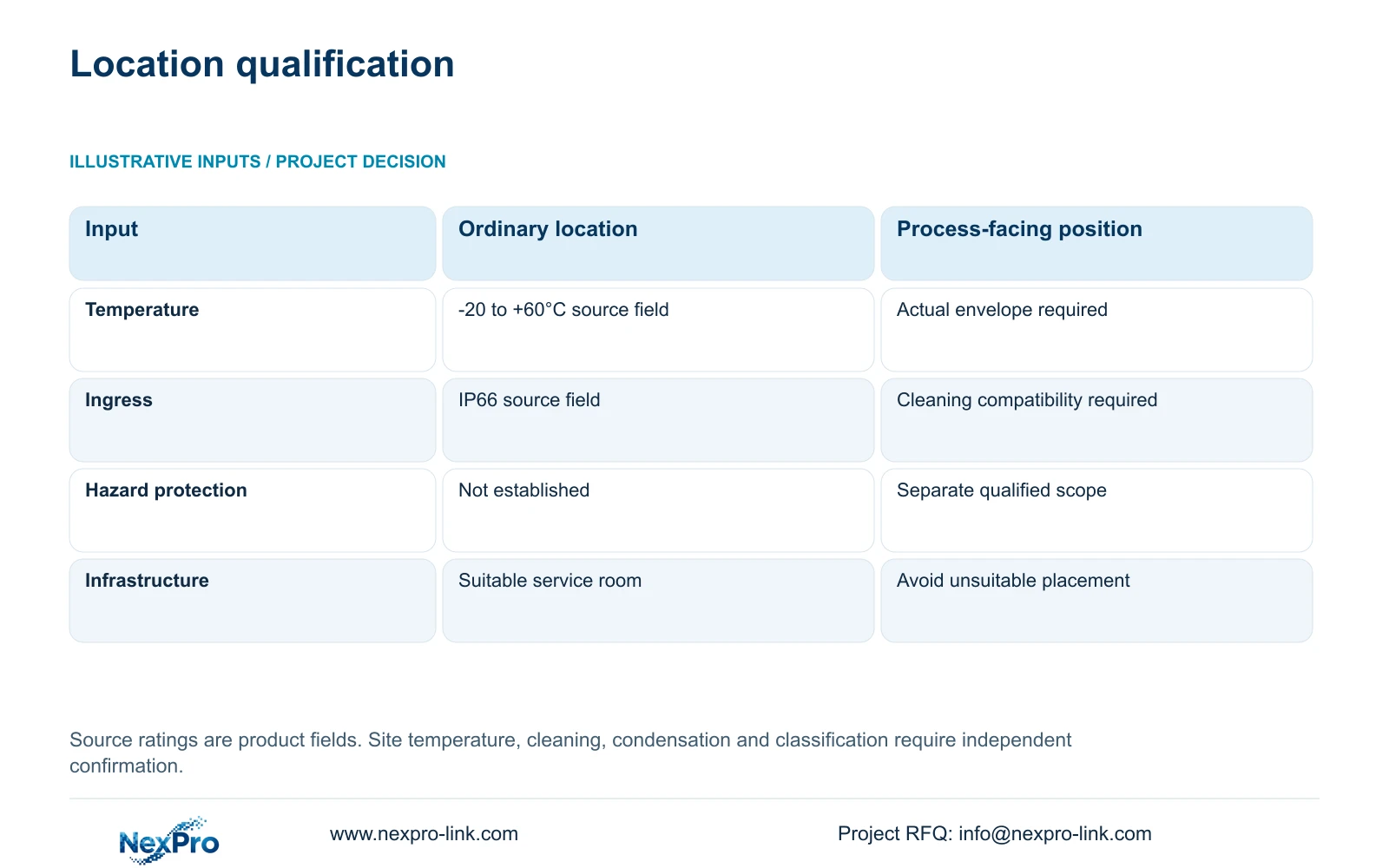
The ordinary 5MP BL2812M and DM2812M source references list IP66 and an operating temperature field of -20 to +60°C. These are quoted product fields, not measured conditions at a tire plant. NexPro-DM2812M55-5MP-DIC-AI also retains its listed 2880×1620 output and Dome family naming; housing shape does not add an impact rating.
Qualification requires location conditions AND complete product scope AND approved installation requirements to fit. The matrix distinguishes a candidate warehouse view from a process-facing position awaiting information. A passing temperature check cannot override unsuitable cleaning chemistry, condensation, mechanical exposure or a classified-area requirement.
The decisive difference is whether the complete location requirement is established. IP66 alone does not establish chemical resistance, washdown compatibility or explosion protection. Where a site has classified locations, its responsible designer must confirm the applicable equipment and current local requirements. Do not infer classification from the industry name or improvise a specialist assembly from an ordinary camera and unrelated enclosure.
| Location or input | Ordinary candidate | Specialist or unresolved scope |
|---|---|---|
| Finished-product warehouse | Check -20 to +60°C envelope | Requalify if exposure changes |
| Curing-facing position | Use only at verified suitable location | Confirm actual operating envelope |
| Cleaning and ingress | IP66 source field | Verify cleaning and material compatibility |
| Hazard classification | Ordinary protection not established | Approved complete specialist scope |
| Recorder and batteries | Suitable accessible service room | Keep outside unsuitable locations |
Section 05
Retain specialist positions while standardizing ordinary coverage
Recommend a normal-area package for qualified warehouse, dispatch and suitable approach views, with process-facing positions listed separately. This allows the buyer to standardize routine security equipment without weakening a specialist requirement or forcing every location into the most demanding specification.
Compare proposals by accepted view and environmental boundary. If one offer includes a qualified process-facing assembly and another includes only warehouse cameras, their totals are not equivalent. Separate specialist equipment, supports, power interfaces, installation and maintenance access so the cost team can compare the same required scope.
Change the recommendation when the viewpoint cannot remain outside unsuitable conditions, when cleaning or storage arrangements change, or when the owner requires an established specialist platform. Ordinary CCTV can document transfers and access; it is not curing-quality inspection, fire detection or process control. NexPro-Link's role can remain focused on the suitable security package and coordinated project documentation while the specialist design stays with its responsible team.
Section 06
Release a zoned equipment schedule with open conditions visible
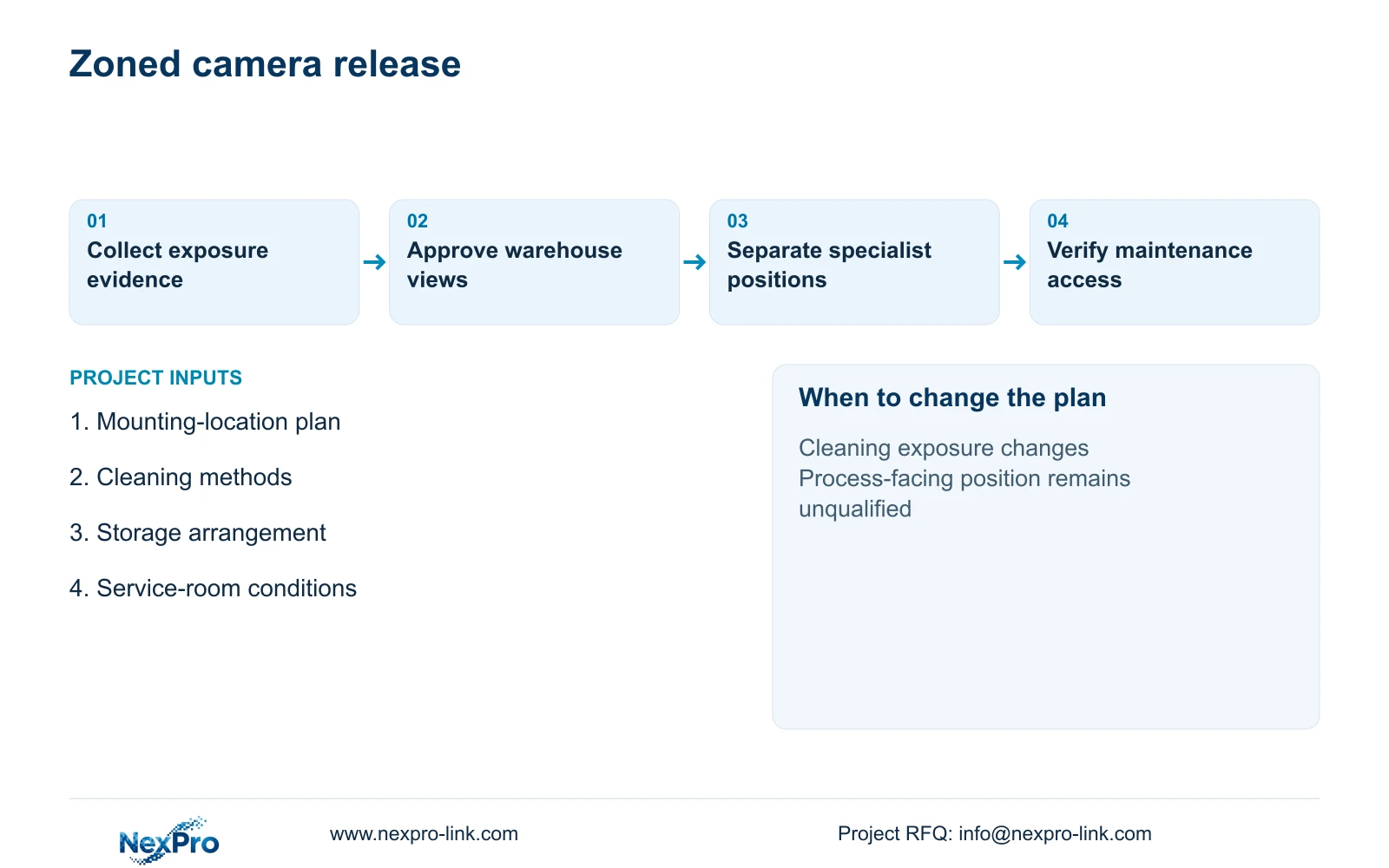
For each view, issue its task, mounting location, environmental evidence, service access and supply status. Mark warehouse equipment as a candidate until its conditions are confirmed, specialist positions as separately specified, and existing approved systems as retained. An unresolved field should identify who supplies the answer and which selection depends on it.
NexPro-Link's factory and warehouse project supply and BOQ support can help coordinate ordinary cameras, recording, protected nodes and relevant technical submittals. Packing labels can preserve zone and view identities for the installation team. Local route construction, electrical work and specialist approval remain separate agreed responsibilities.
Commissioning should include occupied-storage views, the normal loading sequence and the approved cleaning or maintenance state relevant to each camera. Check recorded footage and retrieval, not only live pictures. Preserve the environmental schedule with the handover documents so a later curing-process or cleaning change triggers a deliberate review rather than an undocumented equipment substitution.
Section 07
Buyer questions
Does a warm curing hall automatically require specialist cameras? No blanket conclusion follows from the room name. Confirm the proposed mounting conditions and complete equipment scope. Some suitable approach positions may support ordinary cameras, while process-facing locations need additional qualification.
Can a protective cover settle the cleaning requirement? Only if its complete configuration, materials, connections and maintenance method are appropriate for the stated cleaning exposure. A generic cover does not establish camera-system compatibility or specialist protection.
Should warehouse cameras also detect process or fire hazards? Keep those outcomes in separately specified protective or specialist systems. Security footage may provide visual context, but the ordinary camera references supplied here do not establish those detection functions.
Section 08
Build a location-qualified tire-plant schedule
Send your curing-to-warehouse layout, proposed mounting conditions and cleaning methods, occupied storage and loading plan, and service-room locations to info@nexpro-link.com for a zoned security equipment discussion.
Engineering references
These sources support the general planning principles. Always use the selected product's current datasheet and applicable project standards for final design.