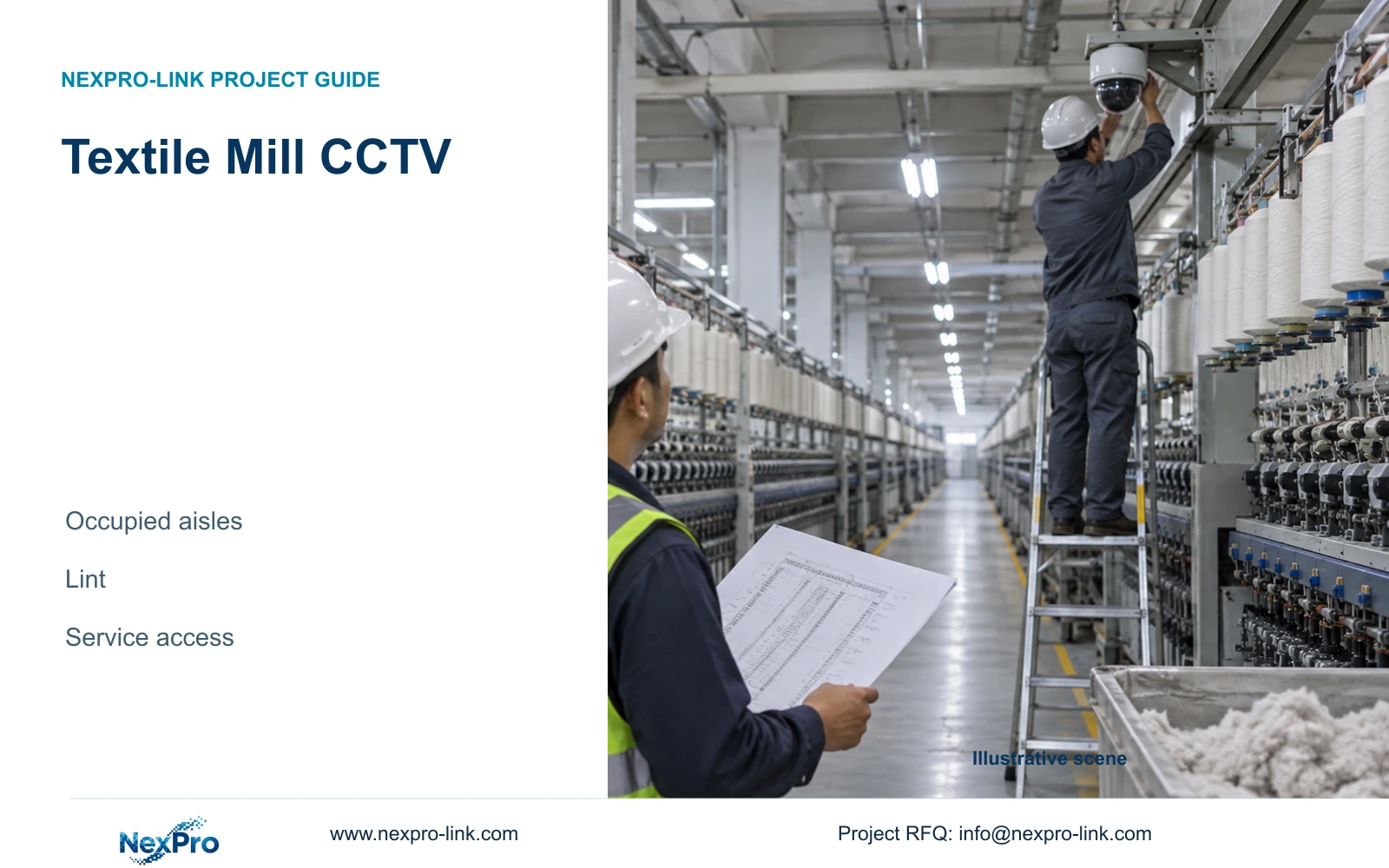
Design textile mill camera positions around installed machinery, lint exposure and reachable cleaning routes, with an explicit comparison of service-access effort.
Section 01
Design views around the occupied aisle
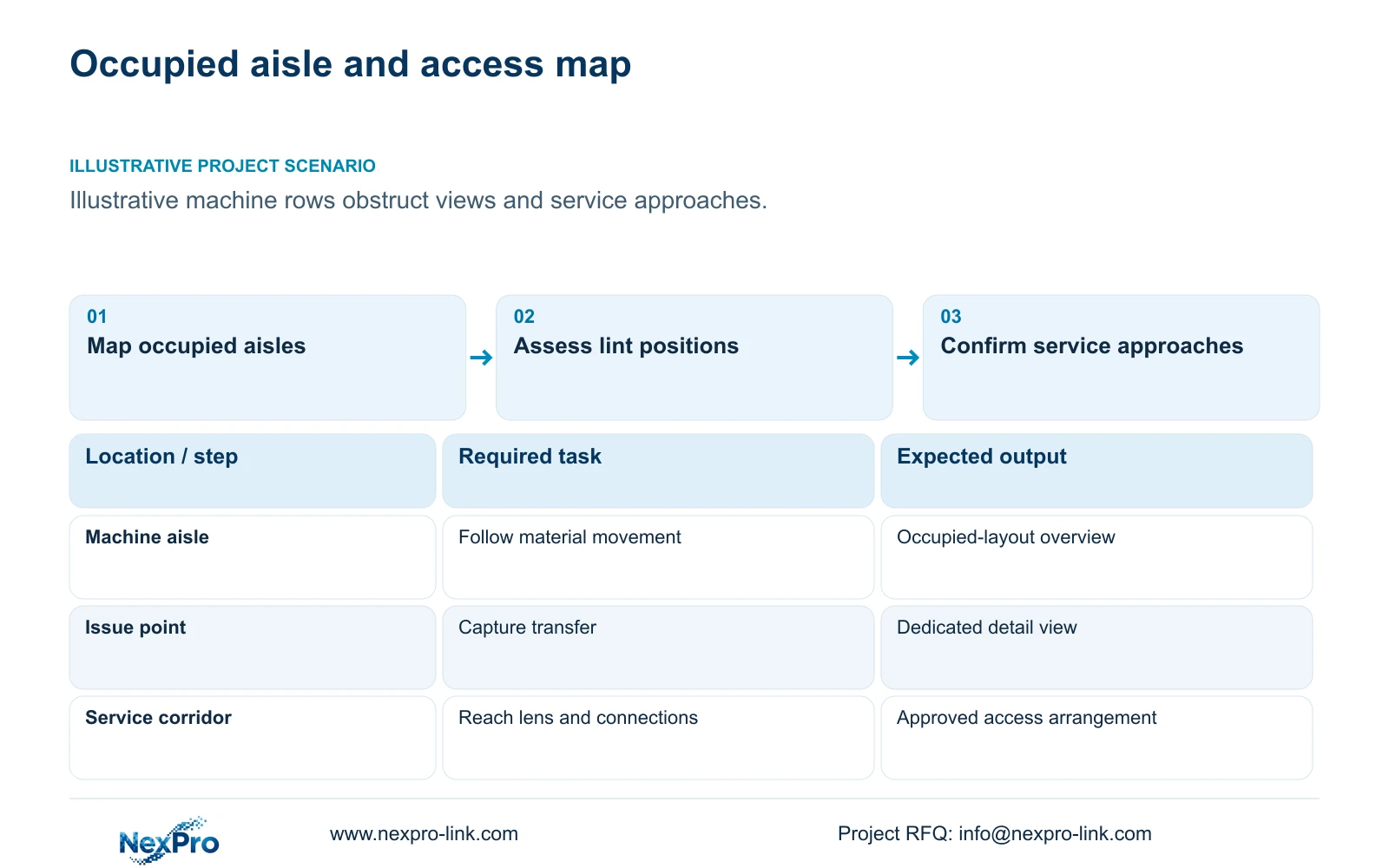
Textile mill CCTV should be positioned against the occupied machine layout and the access route needed to maintain it. A long sightline on an empty floor plan may disappear behind machines, stored rolls or service equipment. Define the material movement or access event required at each aisle, then decide where an overview ends and a dedicated transfer view becomes necessary. Avoid using continuous close observation of workers as a substitute for a clear security task.
Illustrative project scenario: A mill has repetitive long aisles and cameras that become difficult to reach after machines are installed. Assume the project manager can obtain the machine layout, material trolley routes and planned maintenance corridors before camera brackets are fixed. The proposed review checks both visibility and service access in that occupied arrangement. This is a planning scenario, with no claimed installation history or measured maintenance result.
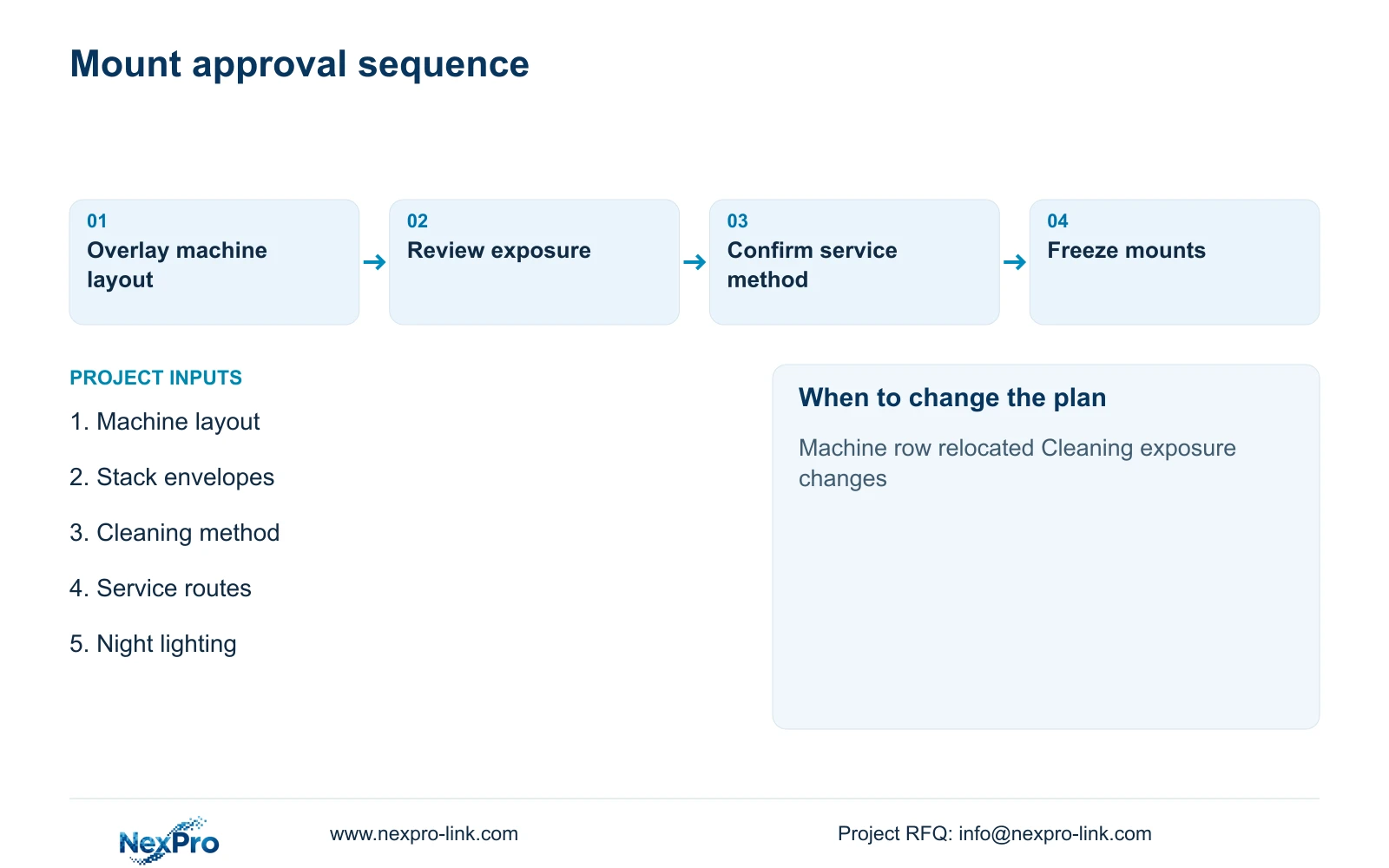
Mark maximum stack envelopes, machine doors and temporary maintenance positions on the drawing. Review night-shift lighting separately from daytime conditions. Where an aisle overview cannot show an issue or return transaction, add a view at that transfer point. The resulting map should explain what each camera contributes and which access route must remain available after production starts.
Section 02
Treat lint and humidity as selection inputs
Describe exposure by position rather than marking the whole mill Indoor. Record where lint accumulates, whether humidity varies, how cleaning is performed and whether the camera sits near an extraction or process discharge. Ask the responsible site personnel to identify any location requiring specialist assessment. Neither a housing appearance nor an ingress rating settles every environmental question.
The supplied ordinary BL2812M and DM2812M specifications list IP66 and a temperature range of minus 20 to plus 60°C for the relevant 5MP references. Those fields support an initial suitability check. They do not establish chemical resistance, compatibility with the mill's cleaning method or suitability for a classified location. Compare the complete location requirements with the complete equipment scope before accepting a candidate.
Prefer a cleaner, reachable mounting position if it still captures the required event. Moving the camera can change its target width, cable route and exposure at the connector, so update those fields together. If environmental suitability remains unresolved, keep the position separate in the BOQ rather than allowing a standard camera allowance to imply approval.
Section 03
Specify how each lens will be reached
For each camera, nominate the service approach, work position and any production coordination required. The installer should confirm whether a bracket can be reached from an established access route without working over machinery or stored material. The site's responsible personnel determine safe access and isolation methods. A position that needs an unavailable access machine should not pass a procurement review simply because the bracket is easy to install before equipment arrives.
Use a camera schedule that distinguishes retained aisle overviews, supplied transfer views and optional alternative mounts. Assign the designer to framing, the installer to physical access verification and the mill team to access windows. Include space to reach connection boxes and cable terminations as well as the optical surface. This makes the service-access arrangement an actual handover document.
A motorized lens can assist framing but does not remove cleaning or physical adjustment work. The NexPro-BL2812M55-5MP-DIC-AI lists a 2.8 to 12mm motorized lens and 2880x1620 main output within its 5MP family. The Dome-family NexPro-DM2812M55-5MP-DIC-AI offers another listed form factor. Choose between them through the required view and accessible installation arrangement, without assuming an impact rating from shape.
Section 04
Compare service effort with declared assumptions
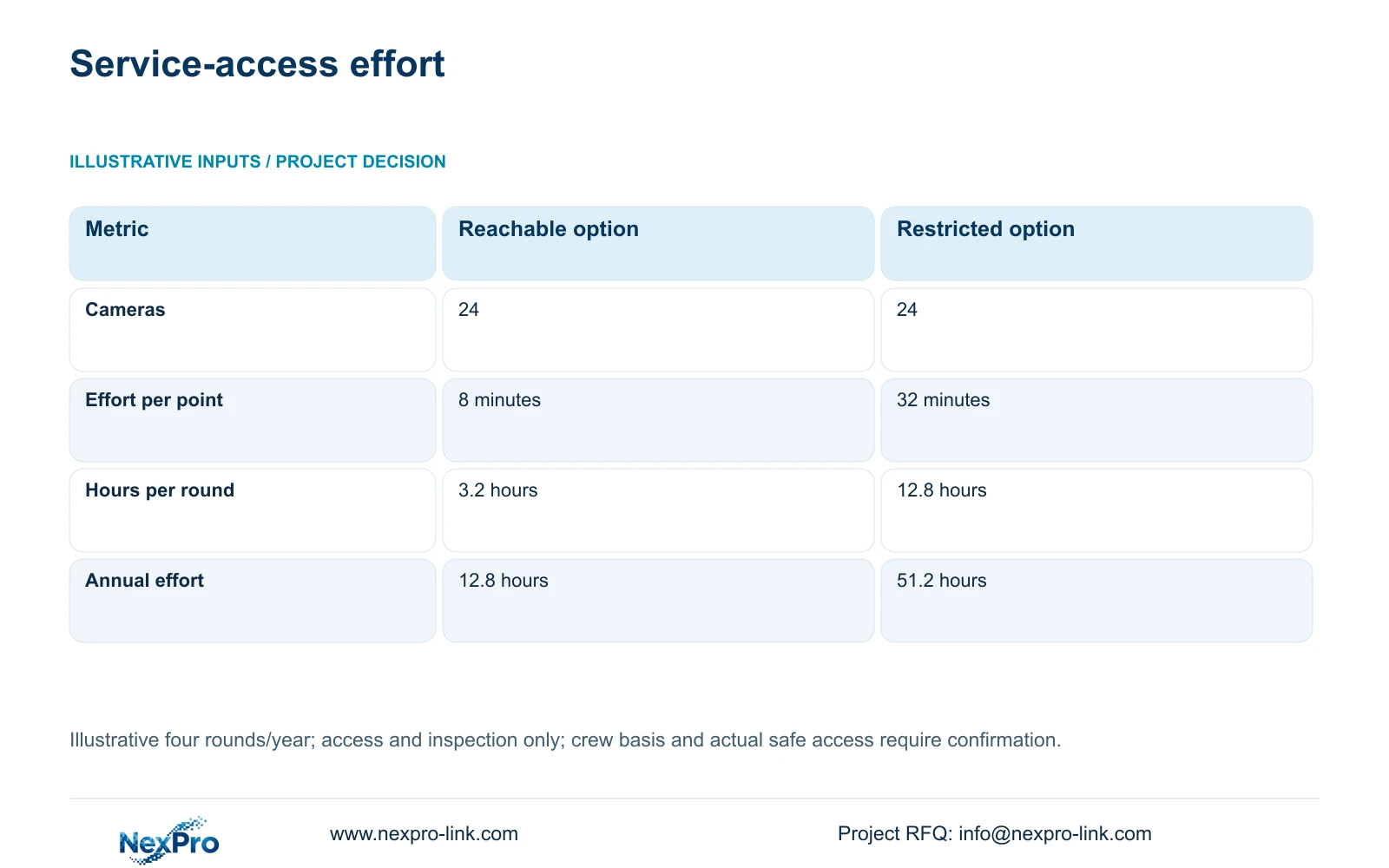
The illustrative service calculation holds camera quantity and frequency constant: 24 cameras and four rounds per year. Option A assumes 8 minutes of access and inspection effort per point; Option B assumes 32 minutes. Calculate hours_per_round = cameras × minutes_per_point / 60 and annual_hours = cameras × minutes_per_point × rounds / 60. These minutes represent assumed access and inspection effort, not a measured cleaning duration.
The results are 3.2 versus 12.8 hours per round, and 12.8 versus 51.2 annual hours. The decisive difference is the assumed access burden, even if the camera purchase prices are identical. The 38.4-hour annual difference can help the project manager request realistic service quotations, but it is not a promised labour saving or evidence of reduced failures.
Replace the assumptions with the mill's actual access plan before commercial comparison. Record crew size, shared access-equipment setup, travel between aisles and shutdown coordination separately where relevant. Four annual rounds are an example, not a universal interval. Lint observations and the owner's maintenance policy should determine the proposed frequency.
| Metric | Option A | Option B |
|---|---|---|
| Camera positions | 24 | 24 |
| Assumed effort per point | 8 minutes | 32 minutes |
| Rounds per year | 4 | 4 |
| Hours per round | 3.2 hours | 12.8 hours |
| Annual effort | 12.8 hours | 51.2 hours |
Section 05
Keep local infrastructure accessible too
Recommend reachable mounts that preserve the accepted occupied-aisle task. Where the best evidence requires a less accessible position, retain it with an explicit service method and price that method. Do not compromise a necessary view solely to achieve the shorter illustrative maintenance time. Reassess the choice when machines move, stack heights increase or cleaning conditions change.
CASE04 provides a separate campus architecture reference: four local recording nodes, each serving 20 cameras, with authorized retrieval across a backbone. That pattern illustrates how recording equipment can stay in accessible rooms while cameras serve production routes. Its 80-camera totals do not belong in the 24-camera maintenance calculation. Local switches and recorders should remain accessible for fault finding without entry into unsuitable production positions.
Carry camera data through local access switching to the recorder and authorized viewing client. Protect the required electrical node separately with an appropriately configured UPS. Revised cable routes need individual length and termination checks; inter-building backbone work remains distinct. An ordinary review screen can support service verification, and a display wall should be considered only if the operating task requires it.
Section 06
Buy mounts and service arrangements together
The procurement issue should pair each viewpoint with its installation and maintenance method. Include mounts, connection protection, cable routes, cleaning instructions supplied with the equipment and an occupied-layout acceptance task. Keep specialist positions visibly separate. Ask competing suppliers to price the same view and access conditions so a low camera price does not conceal different installation or future service work.
NexPro-Link can discuss the camera map, candidate models, related equipment and technical documentation through its Factory & Warehouse project supply and BOQ & Tender Support scopes. Location-labelled packing can help distinguish aisle overviews from transfer positions during installation. The local team still confirms physical access, environmental suitability and the final working image. Retain those decisions with the drawing revision used for the order.
Section 07
Buyer questions
Can maintenance be specified before machines are installed? A provisional plan can use coordinated machine and access drawings. Mark assumptions and require an occupied-layout review before final acceptance. Do not describe provisional access as verified site access.
Does the 8-minute option include two technicians? Crew size is not specified in the example. The result is calculated from minutes per position. Establish whether the site's estimate means elapsed time or person-time before applying labour rates.
Should cameras be moved whenever lint appears? First establish the source, cleaning method and effect on recorded evidence. Relocation is appropriate when it improves exposure and service access while retaining the required view. It may also require new framing and cable checks.
Section 08
Check your occupied-aisle camera plan
Send the machine and material-route layout, proposed service-access routes, lint/humidity and cleaning conditions, and night-shift lighting details to info@nexpro-link.com for a camera-and-mount scope discussion.
Engineering references
These sources support the general planning principles. Always use the selected product's current datasheet and applicable project standards for final design.