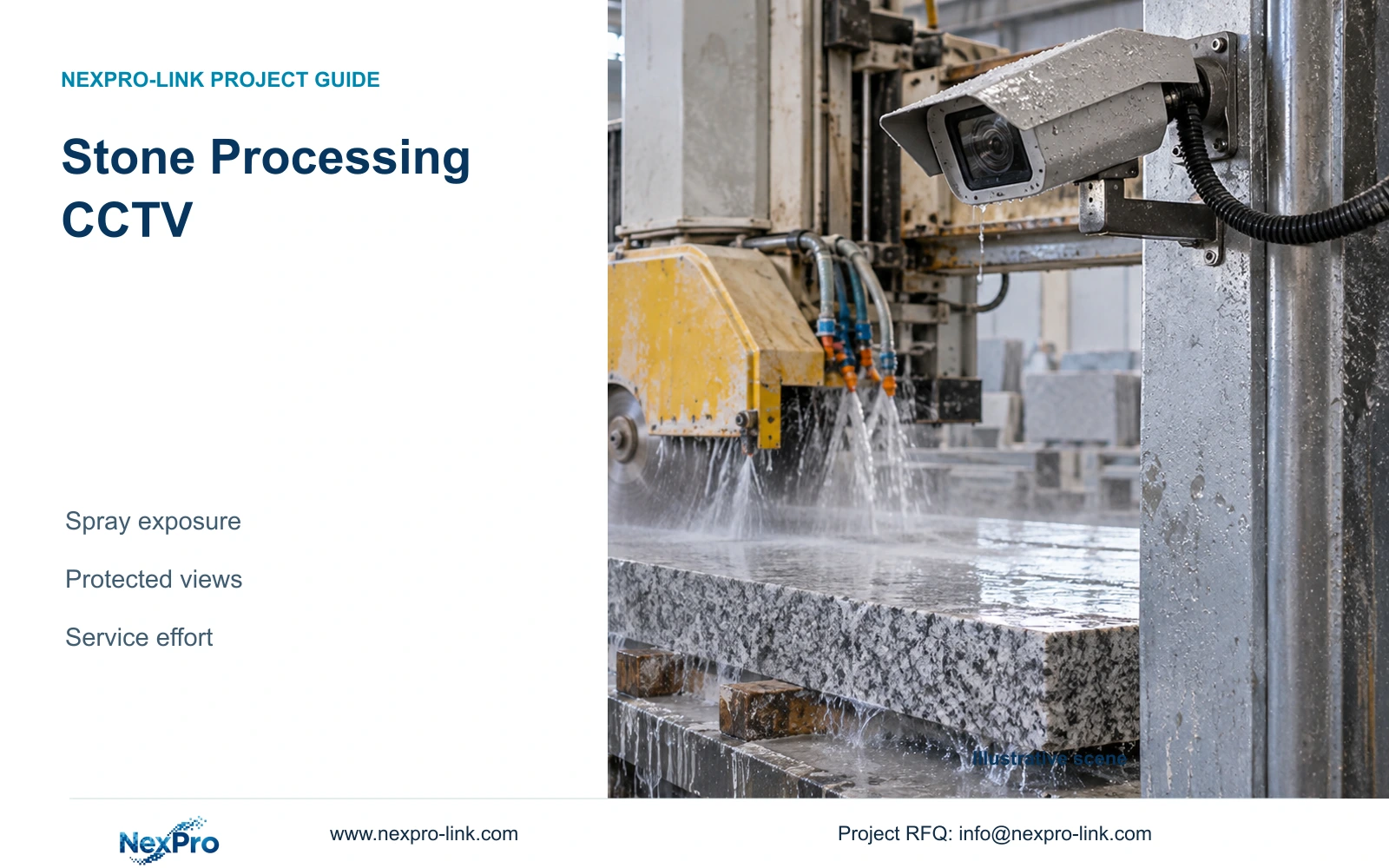
Stone processing CCTV requires a view that survives spray and residue and remains accessible for service. Compare exposure and annual access effort before accepting the mounting plan.
Section 01
Define spray and residue exposure at each proposed position
Move stone processing CCTV views to suitable protected positions where possible, and qualify equipment against the remaining exposure. A generic waterproof description does not establish suitability for repeated industrial cleaning or abrasive deposits. The project manager should approve the observation task and a workable maintenance route together before releasing mounts and cable work.
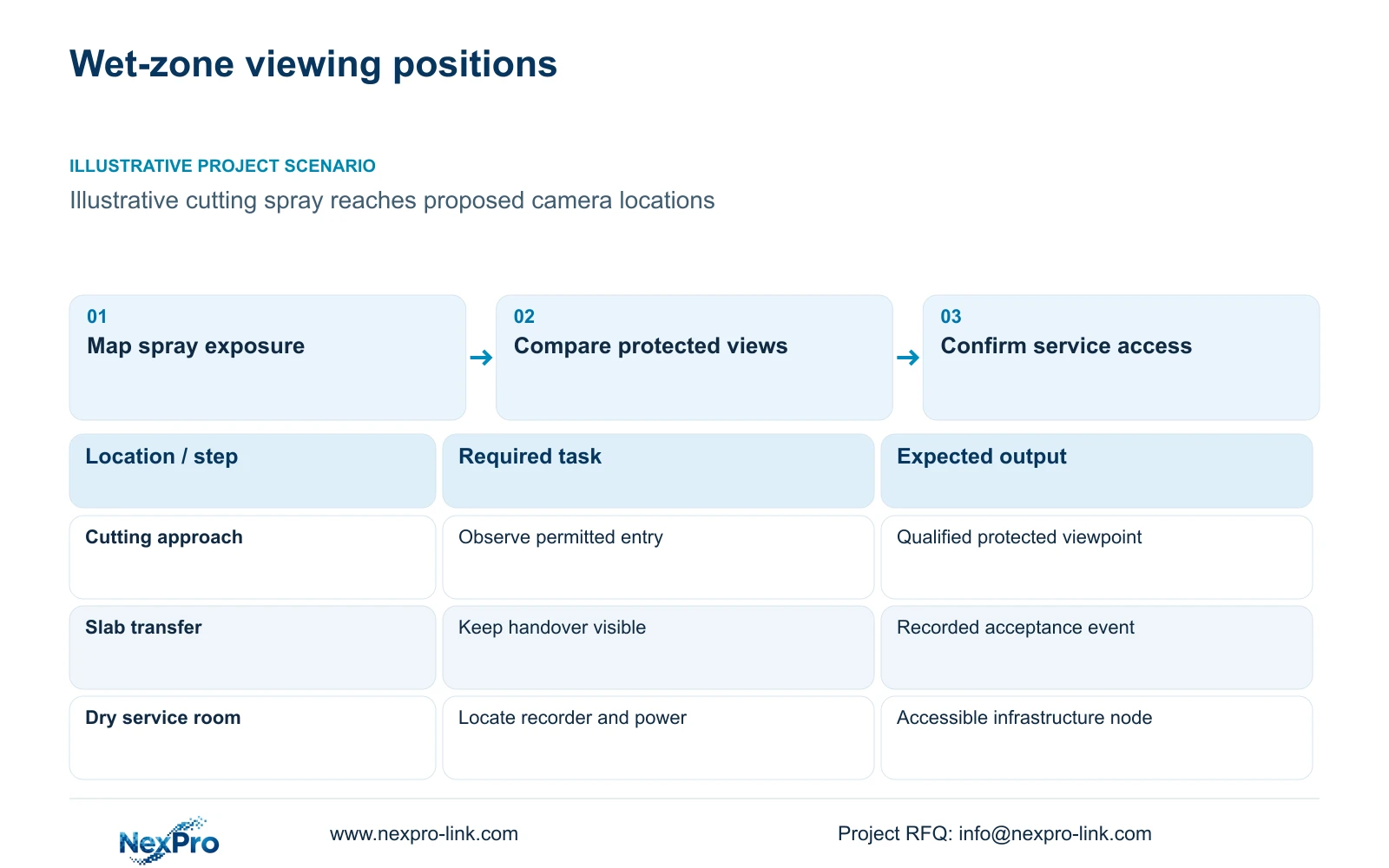
Illustrative project scenario: Cutting operations generate spray and residue near proposed security camera locations. Assume the team is reviewing a cutting-area approach, a slab transfer point and a dry equipment room. Cameras are intended to record access and material handover. The proposed locations and service times are planning assumptions, with no installed performance result.
Describe process spray separately from cleaning spray. Record likely directions, exposure duration, cleaning agents, deposits and access restrictions. Ask the operating team where stock and mobile equipment can obstruct the view. That information determines whether relocation is feasible and which exposed points need a separately qualified camera or protective arrangement.
Section 02
Protect the viewpoint without losing the handover event
Compare a position outside the direct spray path with the originally proposed close position. Keep the same event visible in both options: entry to the handling area, a slab transfer or release to the next route. A protected mount offers little value if the event is hidden behind a machine enclosure or stored slab.
Use a representative recorded-image trial to check the longer or more oblique view. Include normal material handling, wet surfaces and accumulated residue where the site can safely demonstrate them. Agree who approves the picture and who confirms the mounting and cleaning method. Avoid treating a clean commissioning image as proof of sustained serviceability.
The supplied NexPro-BL2812M55-5MP-DIC-AI and DM2812M55 Dome references list IP66, 2880×1620 output, 25fps and a 2.8 to 12mm motorized lens. These are ordinary-area candidates where the complete conditions fit. Their documents do not establish abrasive-deposit resistance, industrial washdown compatibility or a cleaning method for this stone plant.
Section 03
Write the access method into the project scope
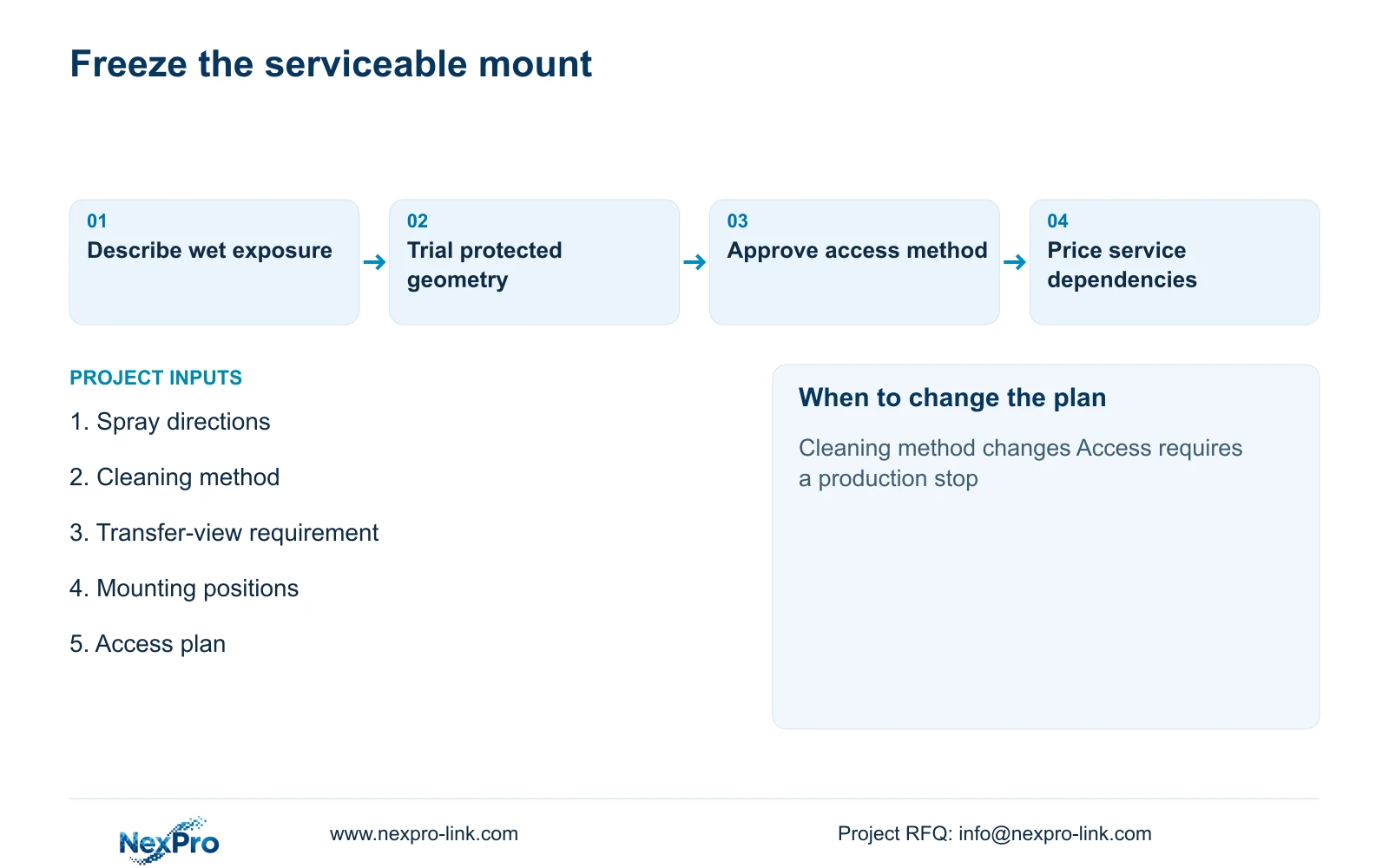
For each camera, record how technicians reach the optical surface, connection enclosure and mount. Identify whether work needs a production stop, approved isolation, access equipment or an escort. The responsible site personnel should define safe access; the CCTV supply schedule should carry the resulting requirements without attempting to invent an isolation procedure.
Separate access and inspection time from actual cleaning, replacement and troubleshooting time. Add mobilisation and access-equipment allowances where they apply. This prevents the quantity surveyor from pricing a quick ground-level wipe for a camera that can only be reached during a controlled shutdown.
Give the service plan an owner. The installer should hand over the final access arrangement and the operating team should confirm who performs routine checks. Include a recorded-image check after service, because cleaning the housing does not demonstrate that the transfer view is clear or that alignment remains correct.
Section 04
Compare annual effort using declared access assumptions
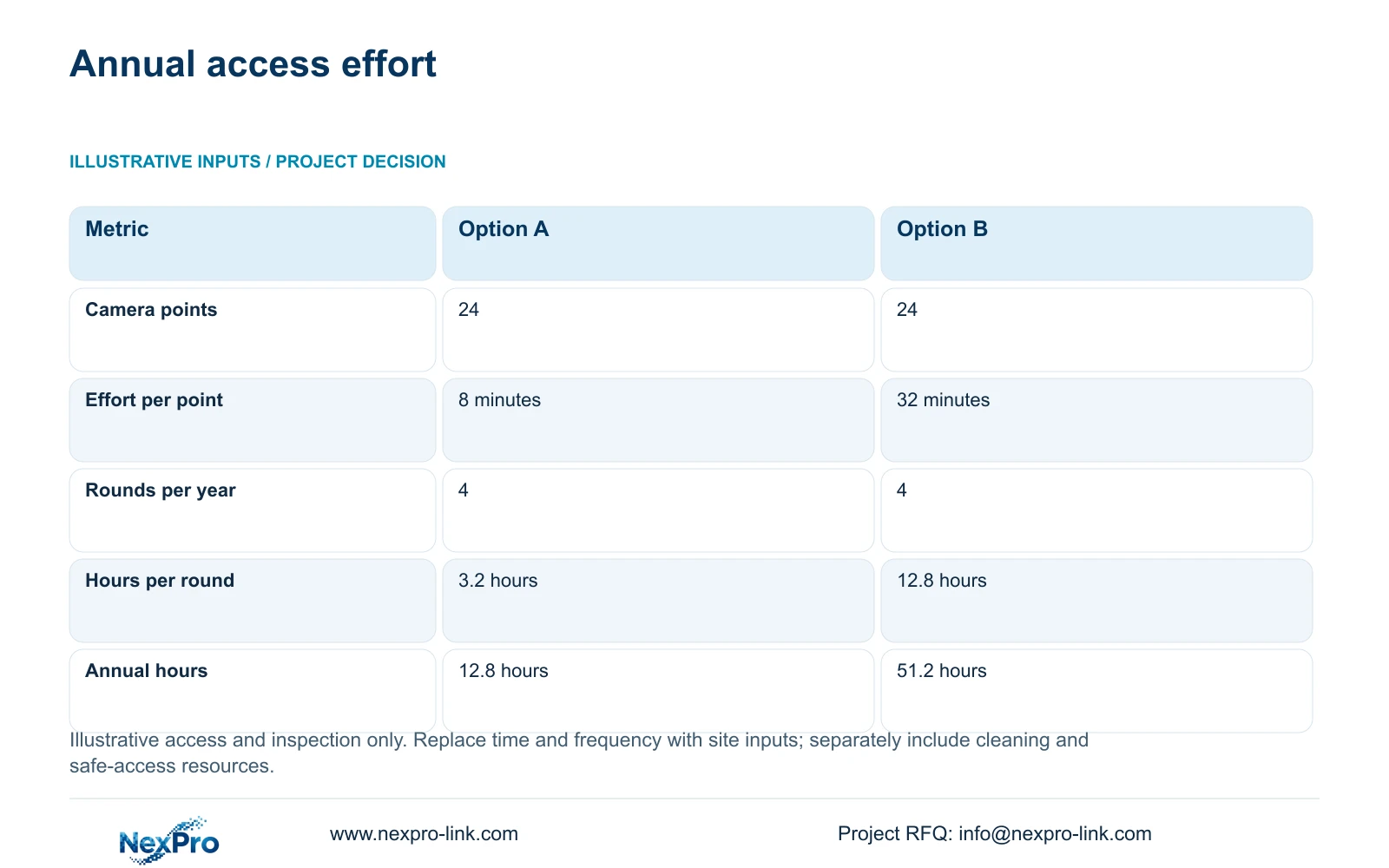
The supplied illustrative comparison uses 24 cameras, 8 versus 32 minutes of access and inspection effort per point, and four rounds per year. Annual_hours = cameras × minutes_per_point × rounds / 60. Option A gives 24 × 8 × 4 / 60 = 12.8 hours/year; Option B gives 24 × 32 × 4 / 60 = 51.2 hours/year.
Per round, the same assumptions produce 3.2 and 12.8 hours. The difference is 38.4 annual hours within this narrow access-and-inspection scope. It shows why a mounting decision can affect service effort even with identical camera prices. Four rounds are an example, not a recommended universal interval.
For a commercial comparison, replace the minutes and frequency with the site's actual plan, then price the separately defined activities. If two people are required, distinguish elapsed activity time from person-hours. These figures are not a promise of labour productivity, fewer failures or a quantified reduction in production downtime.
| Metric | Accessible option A | Difficult-access option B |
|---|---|---|
| Camera points | 24 | 24 |
| Assumed effort per point | 8 minutes | 32 minutes |
| Rounds per year | 4 | 4 |
| Hours per round | 3.2 hours | 12.8 hours |
| Annual effort | 12.8 hours | 51.2 hours |
Section 05
Keep wet-zone infrastructure and service dependencies visible
Recommend the qualified protected viewpoint when it meets the event requirement and can be serviced safely. Where relocation fails the task, retain a separately specified exposed position and include its complete protection, connections and access work. Compare bids on that same boundary, with cleaning provisions and local labour shown explicitly.
CASE01 illustrates a separate normal-area recording and power node. Its 32-camera quantities and cable cuts belong to that reference, not this 24-point maintenance comparison. Use the same discipline to place recorder, switches and batteries in suitable accessible rooms, while measuring the stone plant's actual camera routes and local power circuits.
Select PoE budgets from confirmed device demand and complete switch AC load. Protect only the electrical nodes that must continue during the agreed outage. A viewing monitor remains a client branch; an optional wall should not force the security data path through display equipment. Longer protected routes may add cable or fibre work that must remain visible in the quotation.
Section 06
Freeze exposure, access and equipment responsibilities together
Release a schedule listing the exposure category, required event, proposed mount, access method and responsible party for each point. Mark ordinary equipment as supplied only where qualification is complete. Keep unresolved protective arrangements and site access work separate so their absence cannot be mistaken for inclusion.
NexPro-Link's factory project and BOQ support can help coordinate relevant model references, equipment lists and technical documents. Packing by cutting-area approach, transfer point and cabinet can make those decisions easier to follow at site. The local installer and operating team still approve the installation and ongoing service arrangements.
Before handover, verify recorded playback with representative handling activity and inspect the delivered access arrangement. A revised cutting layout, cleaning method or service route should reopen the affected point. Update mounting, cable and maintenance records together rather than changing only the camera model.
Section 07
Buyer questions
Should the annual-hours comparison include cleaning time? Only if it is explicitly added to the scope. The supplied example covers access and inspection. Cleaning, equipment hire, mobilisation and waiting for production access should be recorded separately.
Can a protective cover solve slurry exposure? Possibly, but its suitability and effect on the image need qualification. The cover may introduce another optical surface and another cleaning task; its presence alone does not approve the complete arrangement.
How should an unknown service cost appear in a bid comparison? Mark it unresolved or request a defined allowance. Do not enter zero, and do not rank bids as equivalent until required access and cleaning work is normalised.
Section 08
Review the wet-zone mounting options
Send your spray and cleaning description, required transfer views, proposed mounts, and site-approved access plan to info@nexpro-link.com for an equipment and service-boundary quotation discussion.
Engineering references
These sources support the general planning principles. Always use the selected product's current datasheet and applicable project standards for final design.