Shielded cable needs an engineered installation around it. Review the actual production route, bonding responsibilities and fibre alternatives before buying factory CCTV cable.
Section 01
Assess the route before choosing shielding
Choose shielded or unshielded CCTV cable from the actual route assessment and a coordinated termination and bonding arrangement. Review separation and fibre-fed alternatives where the route is unsuitable for the proposed copper installation. Shielding alone is not sufficient evidence that a camera link will operate acceptably near production equipment.
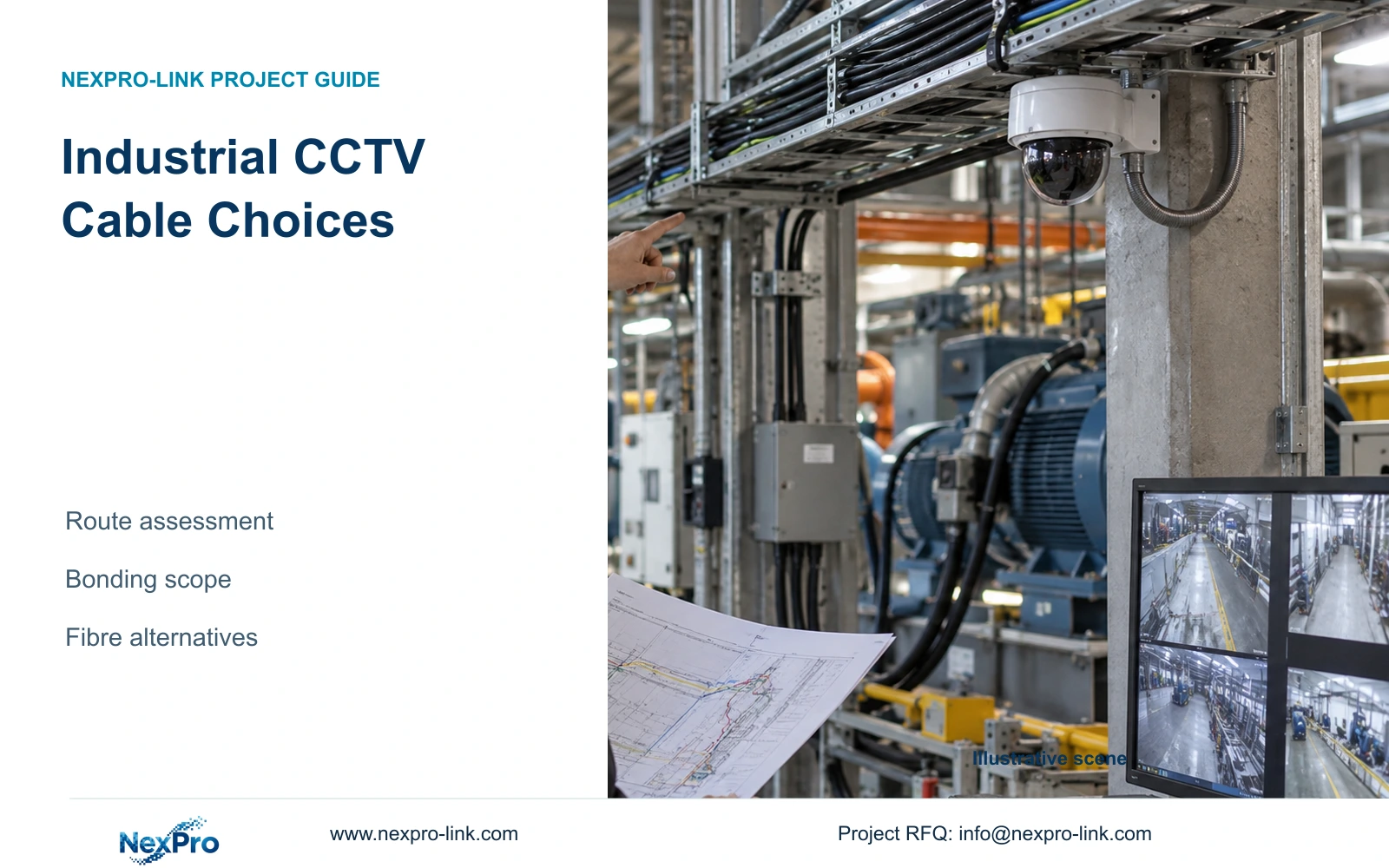
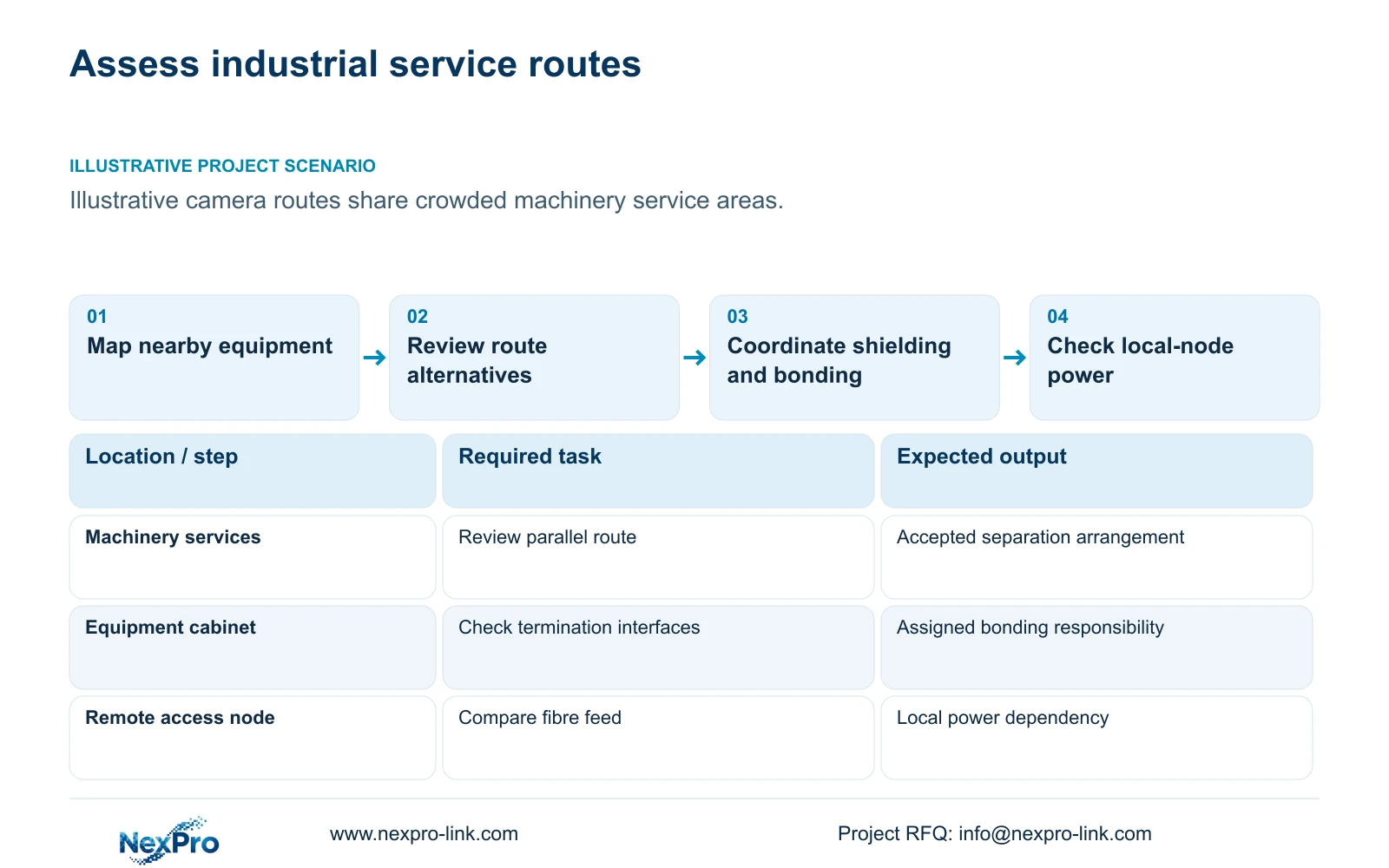
Illustrative project scenario: Proposed camera routes share crowded service areas near production equipment. Assume a CNC project team is reviewing the ordinary security views in CASE01, with some planned trays passing close to machinery service routes. No interference survey or operating test has been completed. The engineer must decide which routes can remain, which should move and which merit a different network arrangement.
Mark the relevant equipment and service routes on the drawing, including the segments where cables would run alongside them and the available alternatives. Ask the electrical and production teams to review actual operating conditions. Record the basis of their route decision instead of assigning a universal separation distance to every factory or treating proximity as proof of a measured problem.
Section 02
Specify the shielded arrangement as a complete installation
If shielded copper is selected, identify the exact cable, connectors, patching components and equipment interfaces in the proposal. Obtain the manufacturer's installation instructions and have the responsible electrical designer establish the applicable bonding arrangement. Do not issue an isolated instruction to ground a screen at a particular end without reviewing the complete installation.
The scope should name who supplies the compatible terminations, who installs the bonding connections and who verifies the finished arrangement. Inspect access at the cabinet and camera end before release. A design that needs an inaccessible connection or leaves essential accessories outside every contractor's package is not ready for installation.
Keep unshielded copper as a candidate where the approved route and application assessment support it. Compare that arrangement with the shielded option on the same camera task, route boundary and acceptance deliverables. If rerouting is necessary, price the new supports and installation access along with the cable. No supplied measurement establishes a performance winner for either construction in this scenario.
Section 03
Compare fibre with its local power dependencies
A fibre-fed access node is a design alternative for an unsuitable shared service route. Show the backbone, optical interfaces and local copper camera links separately. Confirm that the proposed fibre construction fits the physical route and that any metallic elements receive the appropriate project review. Calling the path fibre does not resolve every enclosure or installation condition.
The local camera switch still needs power. Locate it in a suitable, serviceable cabinet and identify its mains supply, any UPS protection and the approved maintenance access. A remote AC-fed node does not inherit backup power from a central UPS merely because its data connects to the main equipment room.
CASE01 groups 32 ordinary cameras into four eight-device power-planning groups and places infrastructure in a suitable service environment. Its 41 to 76 m copper cuts total 1,872 m. Those are illustrative baseline quantities. Introducing a fibre-fed node would change cabinet assignment and copper lengths, so recalculate the affected cut list rather than carrying the original seven-reel quantity into a revised architecture.
Section 04
Keep environmental qualification separate from shielding
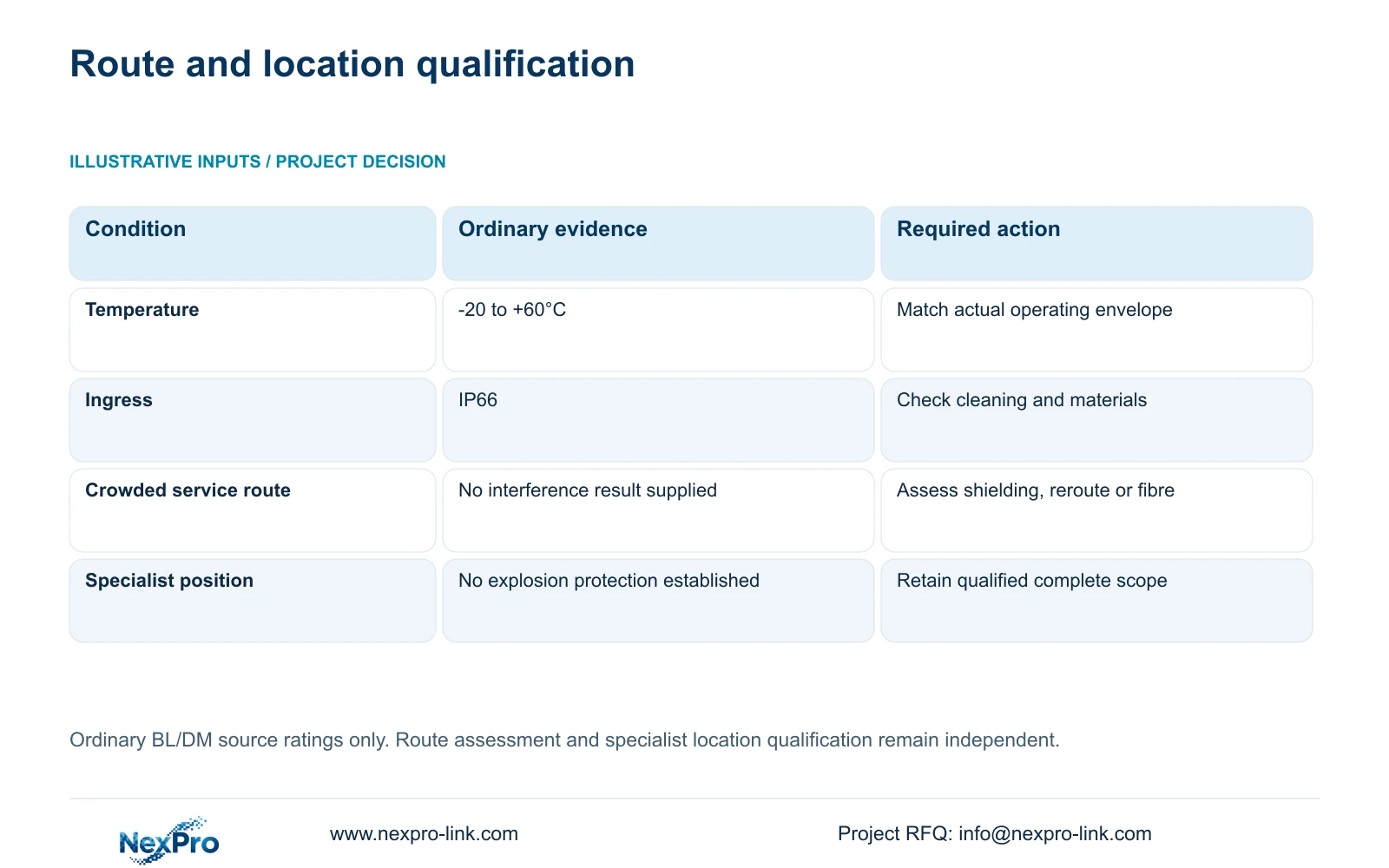
The supplied ordinary-camera references have defined limits. NexPro-BL2812M55-5MP-DIC-AI and the source Dome model NexPro-DM2812M55-5MP-DIC-AI list IP66 and an operating range of -20 to +60°C. Their 5MP source fields include 2880x1620 output and 25fps. These ratings do not establish explosion protection, chemical resistance or washdown compatibility.
Apply the supplied qualification rule as a conjunction: location conditions AND complete product scope AND approved installation requirements must fit. An acceptable temperature field cannot override a missing environmental approval. Likewise, choosing shielded cable does not qualify a camera, connector or cabinet for a specialist position.
The matrix separates plausible review locations without claiming they exist in a completed project. Keep ordinary infrastructure in suitable service rooms and retain specialist requirements where the site assessment identifies them. The responsible designers must verify local requirements and the complete installation scope; this purchasing comparison does not prescribe hazardous-area assembly or protection methods.
| Location or condition | Ordinary scope | Required decision |
|---|---|---|
| Suitable CNC common route | Ordinary security cameras are candidates | Approve route, environment and copper arrangement |
| Crowded machinery services | Shielding performance not demonstrated | Assess reroute, complete shielding or fibre |
| Cleaning or chemical exposure | IP66 is the supplied ingress field | Obtain material and cleaning suitability evidence |
| Classified specialist position | Explosion protection not established | Retain qualified specialist product and installation |
| Service room | Ordinary network infrastructure location | Check access, temperature and power |
Section 05
Choose the smallest arrangement that meets the assessed conditions
Start with an approved route that avoids unnecessary exposure and supports installation access. Select unshielded copper where the documented assessment accepts it. Select shielded copper when its complete arrangement is justified and the project can provide the required compatible interfaces and bonding work. Use a fibre-fed node when that better resolves the route and its associated service requirements.
None of these choices should weaken the required security view. If relocating a camera avoids a troublesome cable route but removes the material-handover scene, review a nearer access node or another mounting position. Preserve the operational task while changing the network path, and record any added power or maintenance responsibility.
Compare current quotations with the same environmental boundaries and contractor services. A basic camera package cannot replace a mandatory specialist assembly simply because it uses PoE or a metal housing. Conversely, ordinary access routes should not acquire specialist equipment requirements without a location-based reason. The quantity surveyor needs both categories identified so costs remain attached to justified scope.
Section 06
Release route decisions with responsibilities and verification
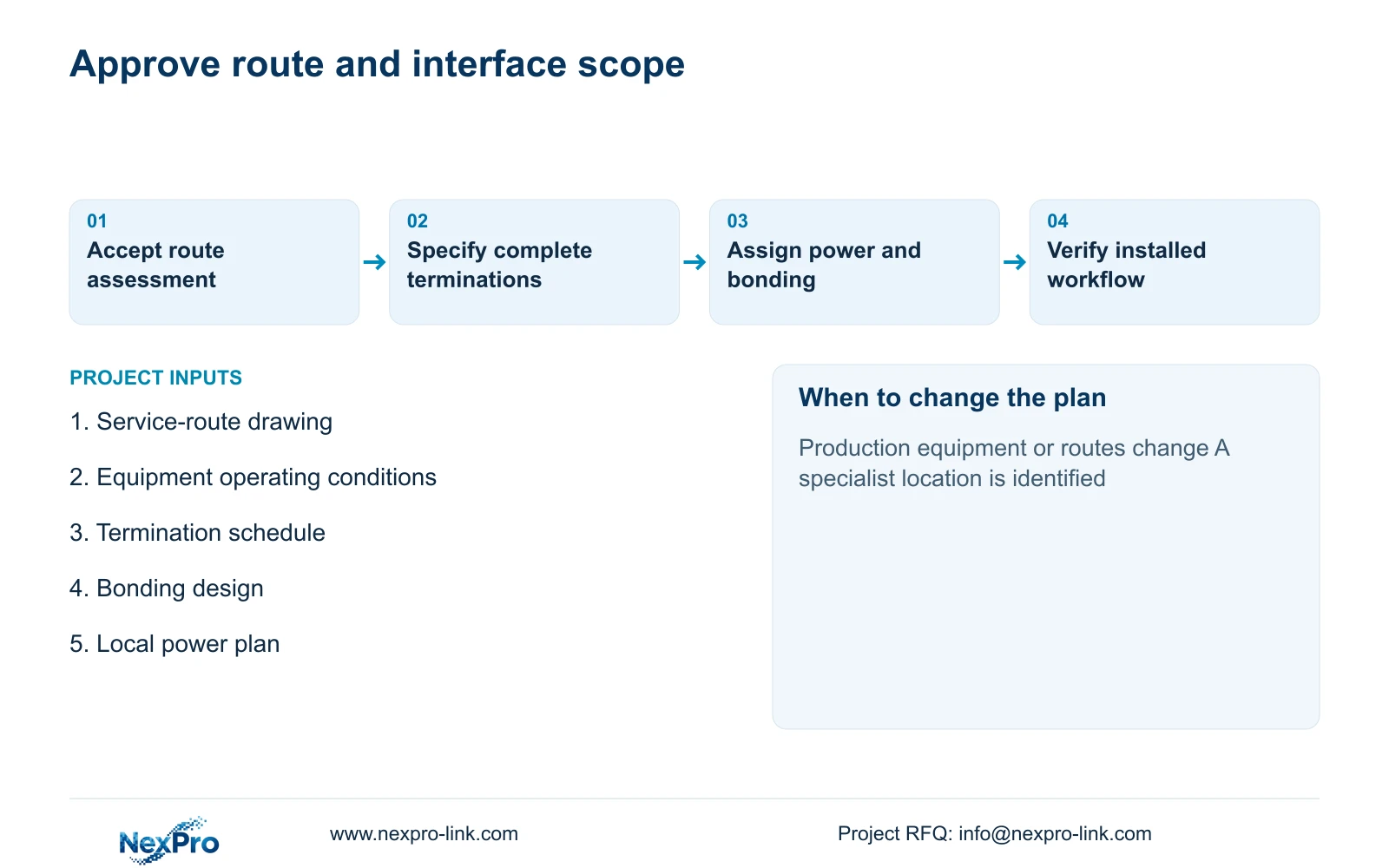
The issue package should show approved copper and fibre segments, cabinet locations, continuous cut lengths and the exact termination method. State the route assessment outcome and any required specialist review. Keep service loops, reel remnants and deliberate reserve separate, especially when a reroute changes only part of the installation.
NexPro-Link's Factory & Warehouse project supply and BOQ support can help coordinate ordinary cameras, relevant network equipment and documented quotation boundaries. The cable construction and shielding capability of every proposed termination component still need confirmation. A generic Cat6 component reference cannot establish that it fits a particular shielded installation.
Ask the local contractor to provide installed link records and an operational check under the agreed production conditions. Fluke guidance supports selecting the correct permanent-link or complete-channel testing scope; those records should be complemented by the actual camera recording check. Define who investigates an unexplained interruption so the owner is not left choosing between a cabling supplier and a network installer after handover.
Section 07
Buyer questions
Should every route near a machine use shielded cable? Use the actual route and operating assessment. Some links may be accepted on an approved unshielded route, while others require a complete shielded arrangement or a fibre-fed alternative.
Does a passing cable report rule out production-related interruptions? It establishes the result for the recorded test scope and conditions. Also check the agreed camera workflow during relevant production operation and investigate interruptions across power, networking and equipment.
Who should approve bonding details? The responsible electrical designer should coordinate them with the cabling and equipment instructions. The installer should not have to invent a bonding arrangement from a cable purchase description.
Section 08
Review the industrial cable route
Send your service-route drawing, nearby equipment information, proposed termination and bonding scope, and remote-node power locations to info@nexpro-link.com to discuss the supported CCTV equipment boundary.
Engineering references
These sources support the general planning principles. Always use the selected product's current datasheet and applicable project standards for final design.