Attach every future management requirement to a trigger, responsible user and testable workflow. Retain local recording until the approved trigger calls for additional scope.
Section 01
Choose software against the administration tasks it must support
Attach every future management requirement to a trigger, responsible user and testable workflow. Retain local recording until the approved trigger calls for additional scope. Price the server, licenses and support then required as separate dependencies. An expansion forecast is not evidence that today's package needs an unspecified enterprise platform.
Choose a Seetong-compatible factory system or an enterprise platform according to required administration, audit, event handling and integration tasks. Separate the hardware manufacturer, recorder model and client software in the equipment schedule. A shared client context does not make all compatible devices one hardware brand or establish identical capabilities.
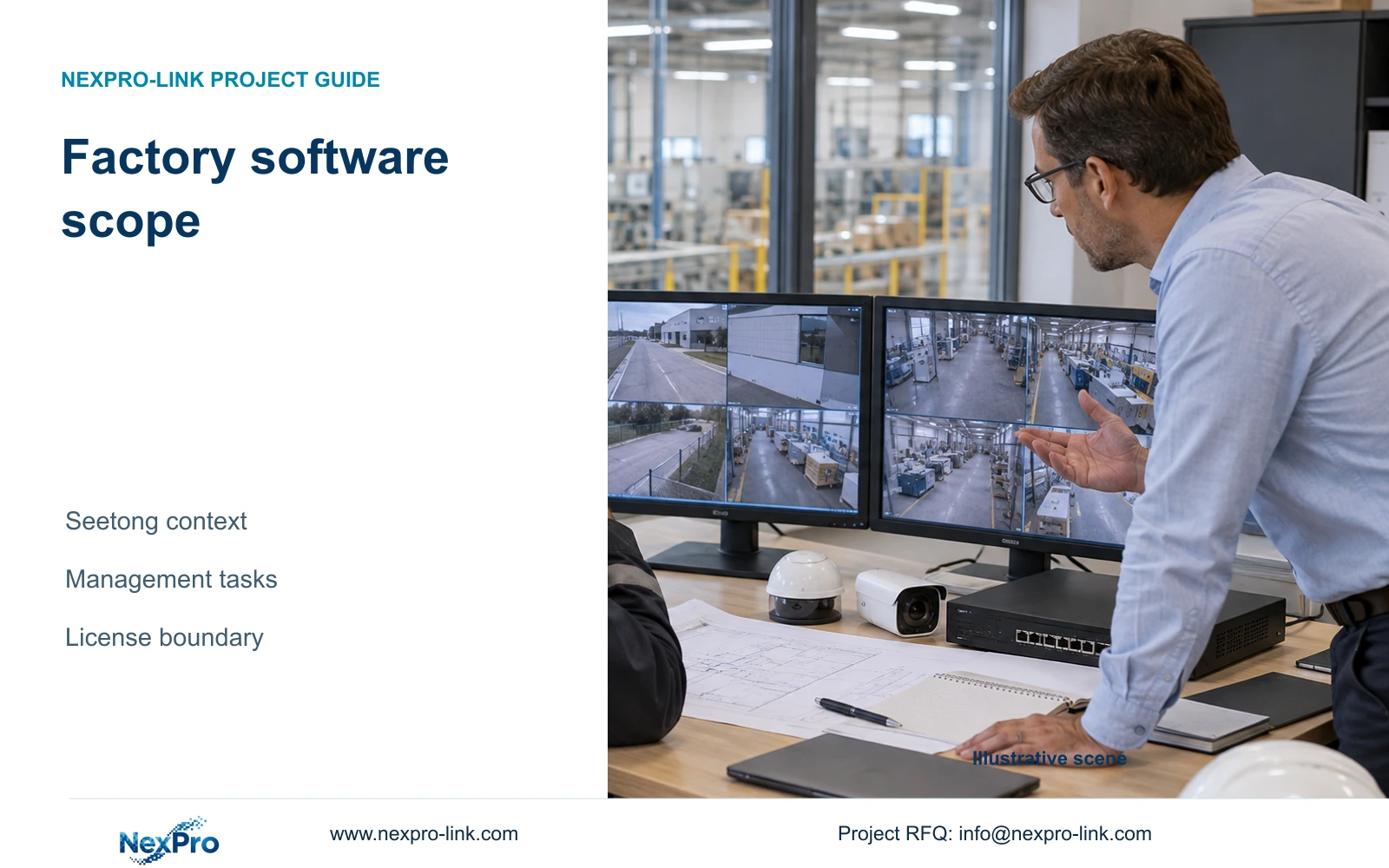
Illustrative project scenario: A plant with simple local recording is offered an enterprise platform for future possibilities. Use CASE01's 32 ordinary-area cameras as the baseline, with local footage retrieval and an operator display. Assume expansion is being discussed but no additional plant, centralized administrator or integrated event workflow has yet been approved.
The initial decision is whether the proposed platform performs a defined job beyond the local package. NexPro-Link's Seetong System page supplies APP and PC-client context, not a guarantee of universal mixed-brand functionality or permanent free cloud services. Record which client version and connection method will support the owner's daily tasks.
Section 02
Turn cross-site ambitions into testable user stories
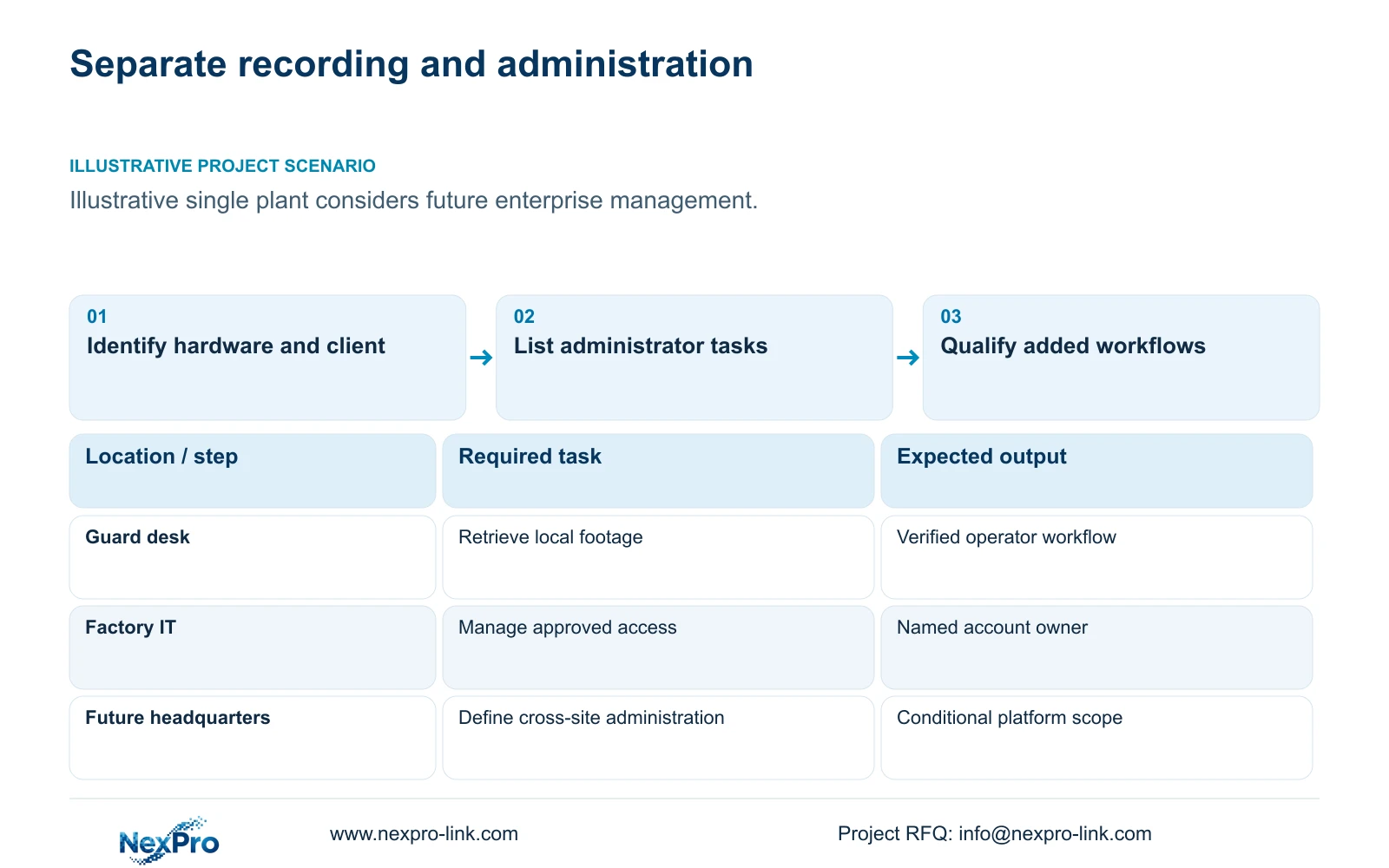
Ask who must administer the system and what changes they need to make. A local guard retrieving a clip has a different requirement from a headquarters administrator changing permissions across several plants. Write each proposed cross-site function as a user story with a named role, affected sites and an expected result.
Useful management inputs include account ownership, permitted camera groups, event routing, export authorization and the records needed to explain administrative actions. Specify the desired outcome without assuming either software route already supports it. Require the offered version to demonstrate that outcome before treating it as an included feature.
Keep unapproved expansion as an option with a trigger. For example, a second plant might prompt review of centralized permissions, while a new access-control workflow might prompt interface qualification. Additional cameras at the same site may instead require recorder or storage expansion. Camera quantity alone does not settle the platform decision.
Section 03
Price the actual software and support boundary
Request a schedule identifying the offered software edition, version, licensed scope and dependencies. For an enterprise proposal, ask whether the quote includes servers, operating environment, implementation, training and ongoing support. Record each as supplied, retained, installer-provided or optional rather than assuming the platform price covers its entire operating chain.
For the local-client route, obtain the same clarity about account setup, remote-access method and support responsibility. Avoid a permanent-free-service assumption in the cost model. If a connection service or client term is unresolved, record that uncertainty and ask the supplier for the applicable arrangement before approving lifetime operating costs.
Assign one owner to each interface. The factory IT team can own approved network access, while the platform integrator owns a qualified software connection and the local installer owns the installed device path. Coordinated equipment supply can simplify procurement, but it does not imply that every device shares software or that local installation is included.
Section 04
Compare a complete local package with justified management additions
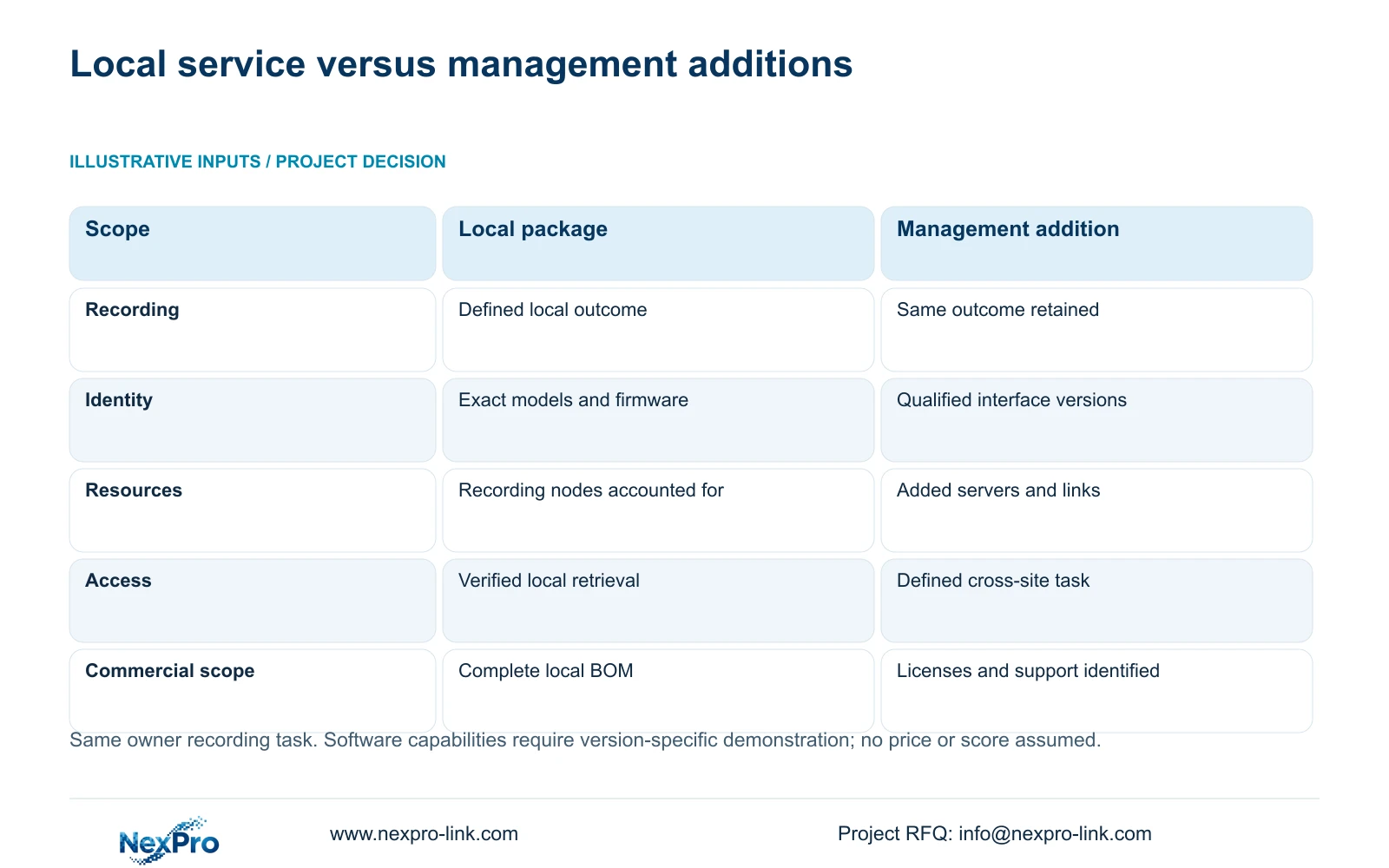
Hold the recording outcome constant while comparing the two scope routes below. The local package must include all necessary camera-to-recording infrastructure and a verified retrieval path. The management route retains that service and adds only the approved administration or integration work. No arbitrary score or invented price is needed to expose the difference.
The decisive distinction is ownership and verification of the additional workflow. If the owner needs cross-site permission changes, the expanded route must include the software, resources and support that make those changes possible. If that task is absent, platform breadth alone does not improve the accepted local recording outcome.
CASE01 illustrates the unchanged physical core: 32 streams at an assumed 4Mbps produce 128Mbps input, with 30-day video volume of 41.472TB. Its four 16TB disks provide a 48.64TB planning video budget after the stated formatting factor and reserve. Adding management software does not remove the need to verify that recording capacity or the supported stream modes.
| Decision | Complete local package | Approved management addition |
|---|---|---|
| Recording outcome | 32 defined views and local retrieval | Same recording outcome retained |
| Hardware identity | Exact models, firmware and project tags | Same plus qualified interfaces |
| Network and power | Required recording nodes accounted for | Added servers and links accounted for |
| Software and access | Verified local roles and retrieval | Demonstrated cross-site or event task |
| Procurement basis | Complete BOM and local responsibilities | Added licenses, resources and support |
Section 05
Select the minimum complete service and define upgrade triggers
For the illustrative single plant, recommend the complete local package as the procurement baseline, subject to demonstrated access and retrieval. Keep the enterprise platform as a separately described option until the owner identifies a function that requires it. This preserves an operating system while leaving a reviewable route for expansion.
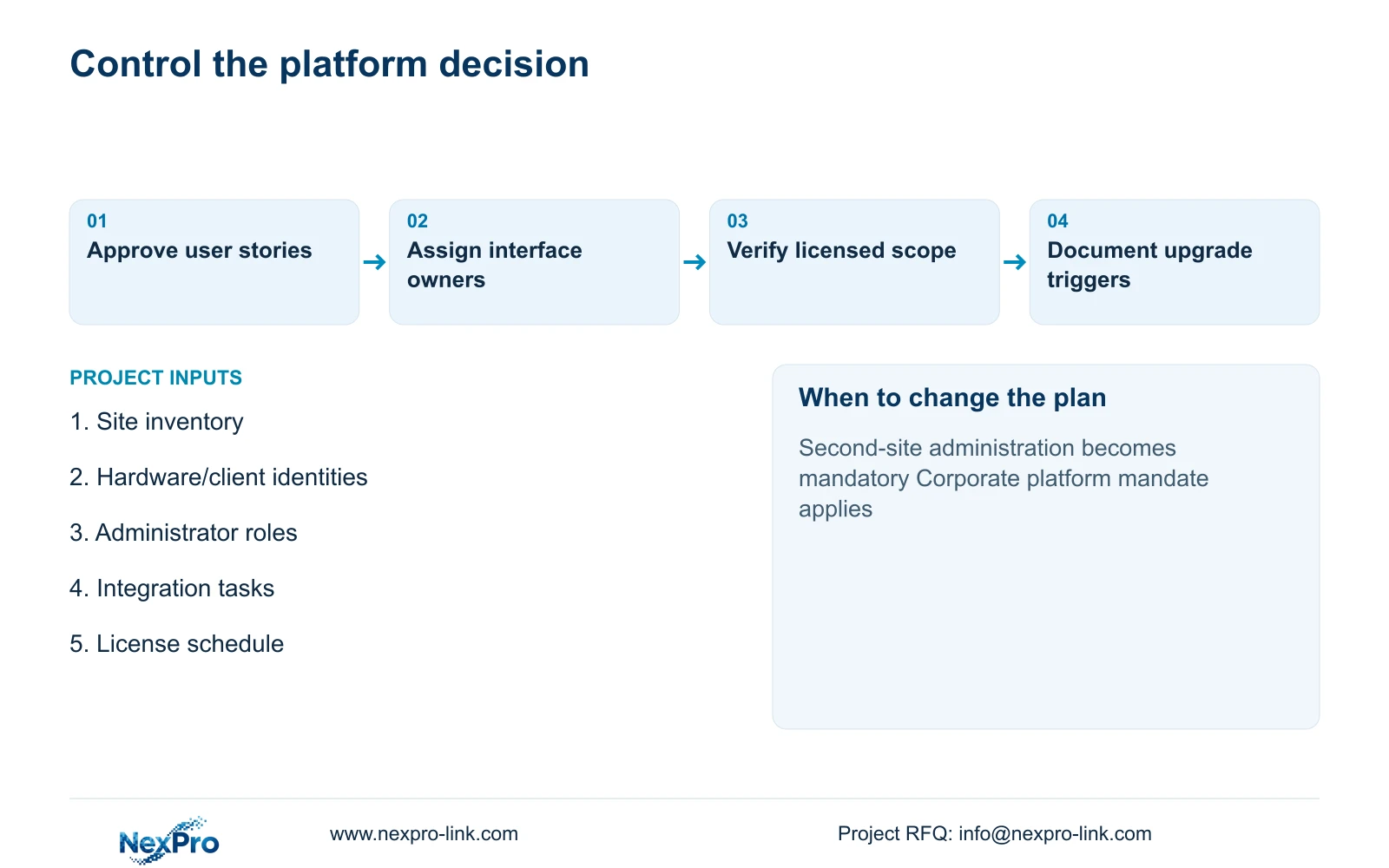
Select the enterprise route when the offered version satisfies mandatory administration, audit or integration tasks that the local arrangement cannot deliver acceptably. The supplier should identify the supporting infrastructure and ongoing responsibilities. An existing corporate platform mandate also changes the decision, even when the local recording hardware could otherwise operate independently.
Test the failure boundary of either option. Loss of the management server or WAN should be evaluated against the requirement for local recording and operator access. Do not infer failover from multiple recorders or dual LAN ports. Record what remains available, what stops and who restores the affected service.
Section 06
Handover the operating roles and configuration identities
The project manager should release a scope delta table linking each software requirement to equipment, licenses and an acceptance demonstration. Keep the exact recorder, firmware and client identities beside the approved tasks. Where mixed-brand interfaces are involved, ONVIF profiles provide an applicability framework, but the required feature path still needs qualification.
Plan handover around operator actions and administrator actions separately. Demonstrate clip retrieval to the guard, account maintenance to the responsible administrator and the escalation route to the support contact. Keep configuration records accessible to the owner without publishing passwords or device credentials in project labels.
NexPro-Link can discuss model matching, equipment lists and technical submittals within its project support scope. Project packing and OEM hardware markings can be coordinated separately; they do not establish ownership or rebranding rights for third-party software. Procurement approval should identify the complete local package, each accepted addition and the conditions that reopen the platform decision.
Section 07
Buyer questions
Does opening several recorders in a PC client make it an enterprise platform? That alone does not establish centralized administration, audit or integration capability. Demonstrate the specific management task on the offered client and versions before classifying the scope.
Can we standardize hardware now and decide software later? Yes, if current recording and access tasks are complete and future interface requirements remain explicit. Avoid promising later platform integration without qualification of the selected hardware and firmware.
Does private-label hardware allow us to rename Seetong? Hardware branding and third-party software identity are separate. An OEM camera or carton arrangement does not establish permission to rename or redistribute a client under a different brand.
Section 08
Define the factory software scope
Send your site and recorder inventory, operator and administrator task list, required integrations or audit outputs, and proposed software/license schedule to info@nexpro-link.com to discuss a complete local package and justified management additions.
Engineering references
These sources support the general planning principles. Always use the selected product's current datasheet and applicable project standards for final design.