A first-quarter factory security review should show whether required events can be retrieved and where service bottlenecks remain, without claiming unmeasured savings or causal results.
Section 01
Review the agreed operating task before counting uptime
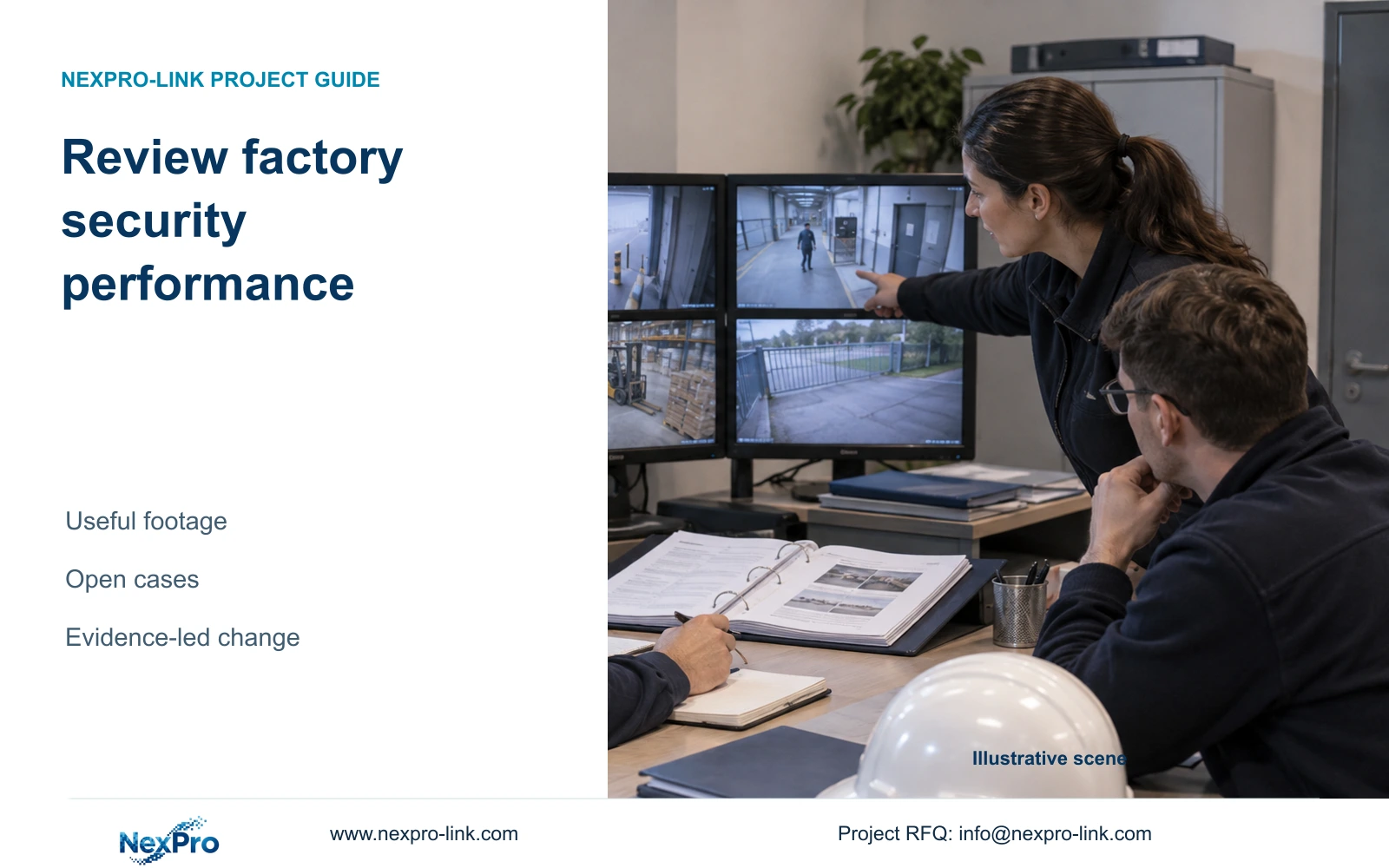
Review factory security performance through actual retrieval outcomes, usable recordings and service records. Define the required task and denominator before reporting a percentage. Camera connectivity is useful context, but it does not prove that an operator can retrieve a clear record of a material handover or site-access event.
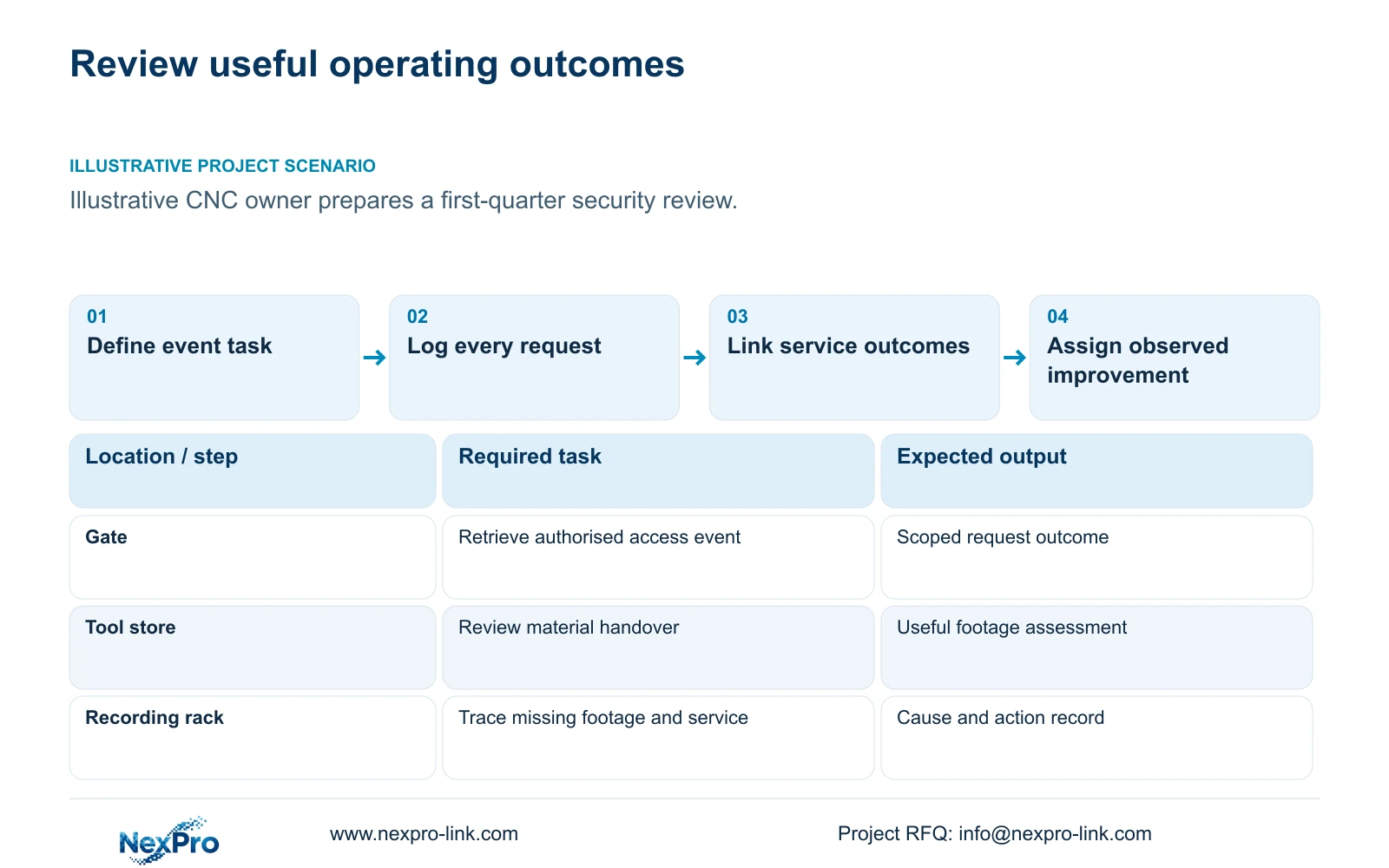
Illustrative project scenario: The owner wants to assess the first operating quarter of the system. Use the supplied 32-camera CNC reference as the planned scope for authorised transfer and access review. Assume the owner wants a repeatable outcome register, not a new equipment catalogue. No quarter of operating results has been measured or supplied.
Choose review tasks from the accepted camera schedule: gate context, tool-store handover, permitted hall transfers and dispatch evidence. For each task, define what counts as useful footage and successful retrieval. Keep real incident requests separate from controlled operator exercises so a training test is not presented as an actual loss investigation or proof of field performance.
Section 02
Record every request and service intervention consistently
Give each retrieval request an identifier, location, event time, requested scope, authorised requester and outcome. Record whether it was completed, partially completed, failed or still open. Capture the reason for an incomplete result, such as an uncertain event time, blocked view, missing recording or an access permission issue. Do not remove difficult requests from the register.
For an operational retrieval completion rate, use completed eligible requests divided by all eligible requests in the same defined period, multiplied by 100. Agree eligibility and treatment of open cases before reporting. Show the numerator, denominator and unresolved count together. This is a measurement method, not a numerical result from the supplied scenario.
Link service work to affected tasks and equipment identities. Record actual diagnosis, access work, parts used and verification, distinguishing elapsed interruption from labour effort. A replacement dispatched, a camera online and a useful recording restored are different events. Consistent records let the team identify the stage causing delay without assigning every problem to the equipment supplier.
Section 03
Keep operational observations separate from causal claims
If incident counts change after CCTV installation, record changes in activity, staffing, reporting and access procedures alongside the count. A quieter dispatch period or a new reporting process can change the apparent trend. A before-and-after chart alone does not establish that surveillance caused a reduction in loss or an improvement in production.
Describe supported outcomes narrowly: an authorised request was completed, a view was obstructed or a service intervention restored recording. Do not convert those observations into an avoided-loss total without an accepted evidential and costing basis. Where finance evaluates a commercial effect, keep its assumptions and supporting records separate from the technical review.
For the CNC reference, CCTV supports review of transfers and access; it does not become machine vision, production-quality inspection or a safety interlock because the quarterly report needs more benefits. Keep the operating boundary intact. The owner can still make a useful improvement decision from documented retrieval gaps without claiming that every operational change came from the cameras.
Section 04
Use a complete outcome register instead of a success-only report
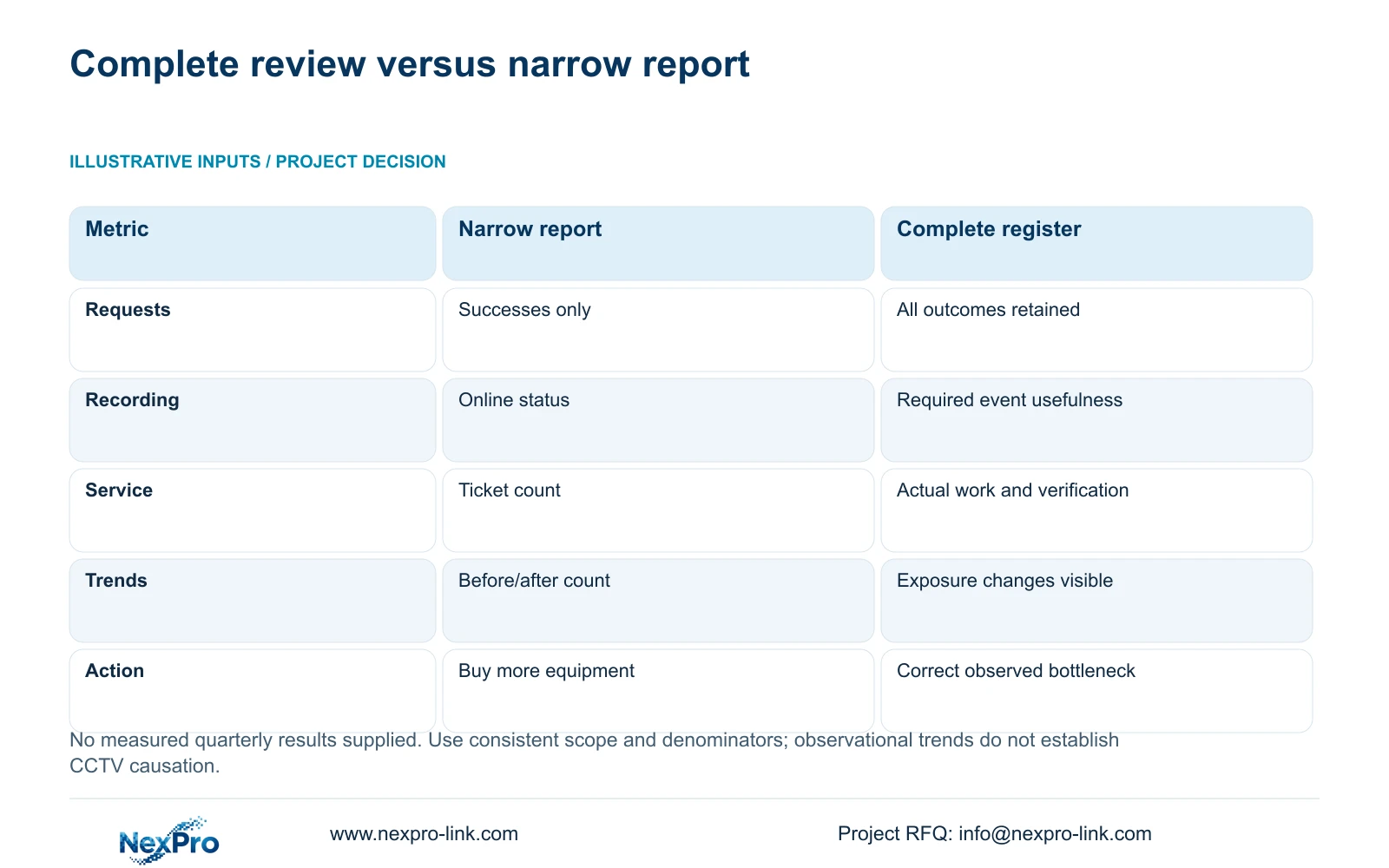
The supplied matrix compares a narrow report with a decision-ready register. The method keeps operating scope and denominators consistent and retains incomplete cases. Its rows define what to record, not fabricated quarterly totals. The decisive difference is whether the report exposes the unresolved work needed to deliver the agreed task.
A success-only list can make retrieval appear effective while hiding requests that failed through missing footage or unclear event references. A complete register distinguishes those causes and assigns the next action. Likewise, uptime should be read beside scene usefulness and recording checks, not substituted for them. An online camera facing a new stack may still fail its accepted purpose.
Keep file volume separate from retrieval effort. Reducing unrelated export content can reduce exported data, but it does not prove a measured reduction in operator search time. Preserve enough event context for the authorised review and measure actual handling time if it is an agreed outcome. Do not shorten necessary evidence merely to improve a report's file-size metric.
| Review item | Narrow report | Decision-ready record |
|---|---|---|
| Retrieval requests | Completed requests only | Completed, partial, failed and open requests |
| Useful recordings | Camera online status | Accepted event task and image usefulness |
| Service work | Ticket count | Actual tasks, labour and verified result |
| Incident trends | Before/after count | Exposure and reporting changes retained |
| Next action | Automatic equipment expansion | Correct the observed bottleneck first |
Section 05
Choose an improvement that addresses an observed bottleneck
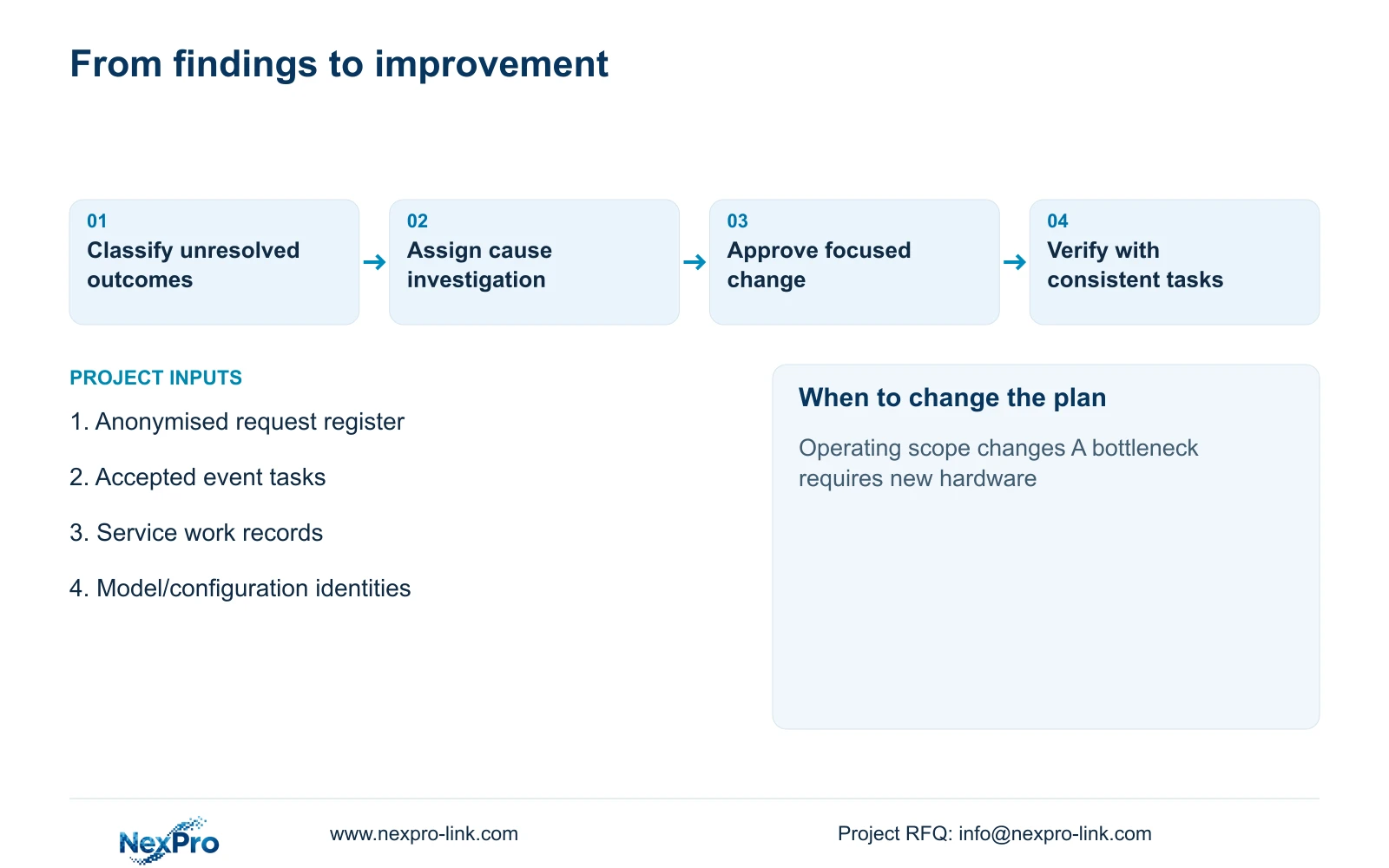
Start with the cause shown by the records. If operators lack reliable event-time references, improve the request process and time alignment. If a stack repeatedly blocks a dispatch view, review positioning and the accepted scene. If footage is missing, investigate schedule, storage and stream conditions. These actions have different owners and do not all require new cameras.
Recommend hardware expansion only when the required task cannot be met by the accepted installation and justified correction. Define the new view or infrastructure requirement, then check its recording, network and power dependencies. NexPro-Link's BOQ support can help organise model matching and a deviation schedule, while the owner approves the changed outcome.
Keep warranty and service decisions tied to confirmed evidence. NexPro-Link's supplied warranty policy identifies a main-equipment baseline, but an operating bottleneck is not automatically a covered product defect. Separate equipment remedy, training, local installation work and service costs. Use actual quotations and recorded work when comparing options rather than assigning invented savings to the preferred proposal.
Section 06
Carry approved findings into the next supply decision
Close the review with a short action register: observed issue, affected task, responsible party, agreed change and verification method. Keep open cases visible at the next review. When an action changes a camera model, accessory or configuration, update the approved equipment family so repeat orders preserve the correction.
NexPro-Link's factory and warehouse supply scope provides an equipment discussion route for cameras, recording, protected nodes and related infrastructure. Share anonymised operational summaries and relevant model identities, not unrestricted factory footage or credentials. The technical discussion should address a defined gap in the required task and identify the evidence needed to confirm improvement.
At the next review, use the same task definitions where the scope remains unchanged. If production routes, staffing or reporting practices change, explain the change before comparing outcomes. The useful result is a traceable decision about what to retain, correct or procure, supported by actual records rather than an unsupported quarterly performance claim.
Section 07
Buyer questions
How should requests still open at quarter-end be reported? Show them as unresolved with their age, reason and owner. Apply the agreed denominator consistently and explain how later completion is recorded; do not silently count them as successes or remove them.
Can operator exercises be included in the review? Yes, as a separately identified evidence set. Exercises can assess retrieval skills and workflow readiness, but should not be reported as real incident outcomes.
Does a lower incident count prove CCTV paid for itself? No. Review exposure, reporting and other operational changes before making causal or financial claims. Technical outcomes can justify improvements without a fabricated ROI figure.
Section 08
Turn review findings into a defined improvement
Send an anonymised retrieval outcome summary, the affected camera roles, relevant model/configuration records and assigned service responsibilities to info@nexpro-link.com to discuss a focused factory equipment improvement.
Engineering references
These sources support the general planning principles. Always use the selected product's current datasheet and applicable project standards for final design.