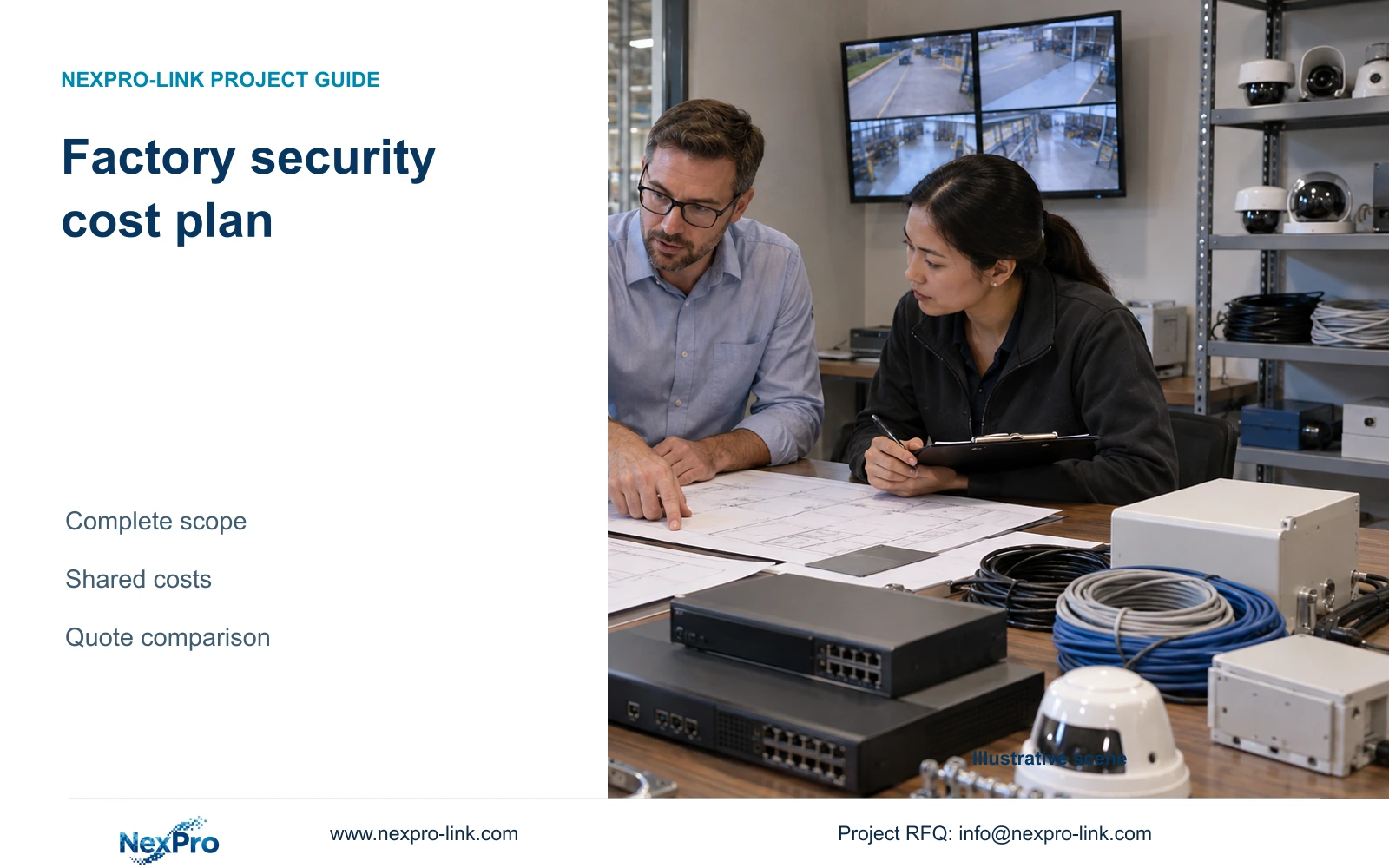
Factory camera-point averages hide differences in routes, mounting and local power. Class-based rates make estimates and expansion decisions easier to defend.
Section 01
Classify points by installation conditions
Use cost per camera point in a factory as a reporting measure after separating installation classes and shared systems. An indoor point beside a cabinet and a remote gate point may use the same camera yet require different supporting work. A single blended rate conceals those differences and becomes unreliable when the next project has another mix of locations.
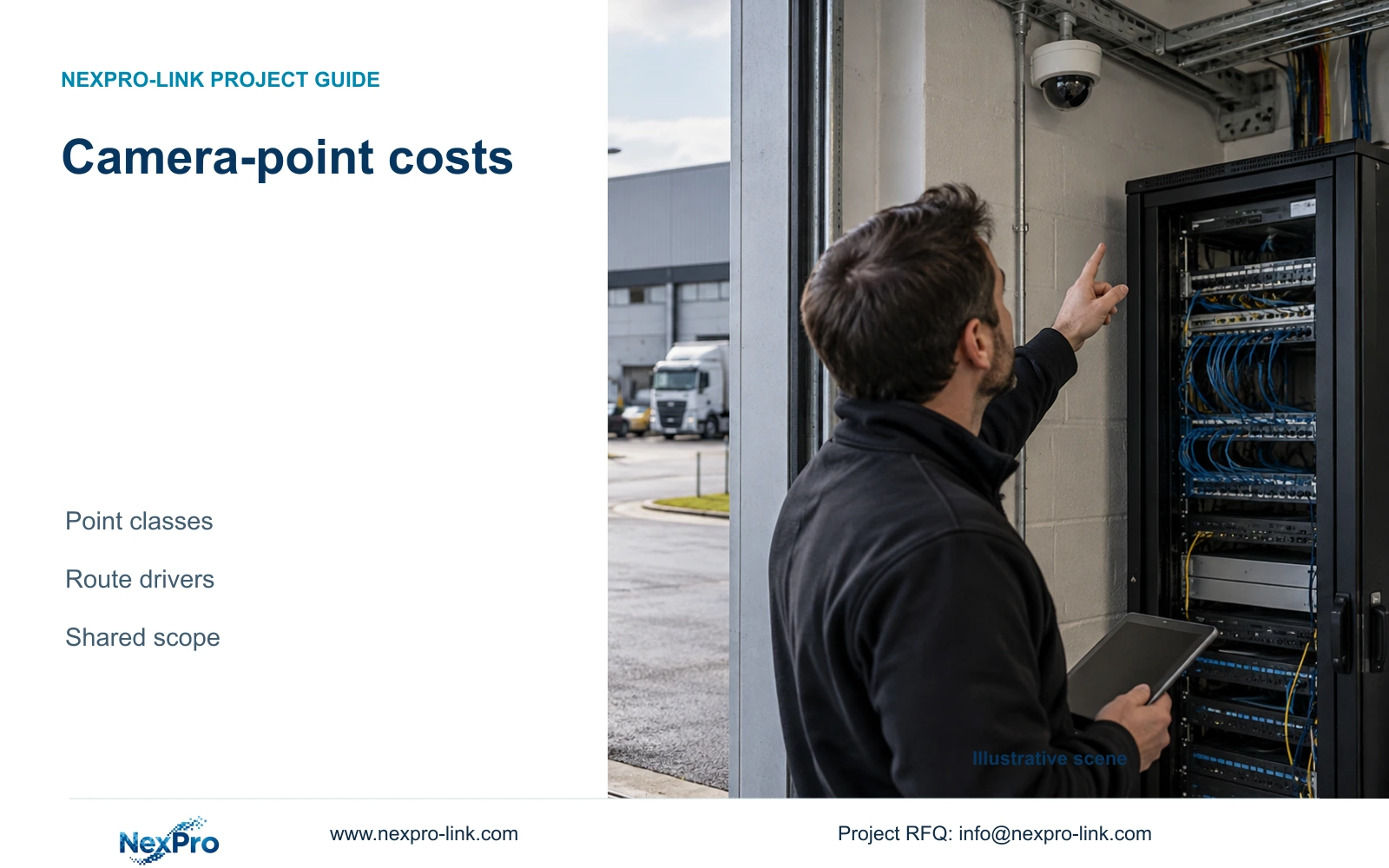
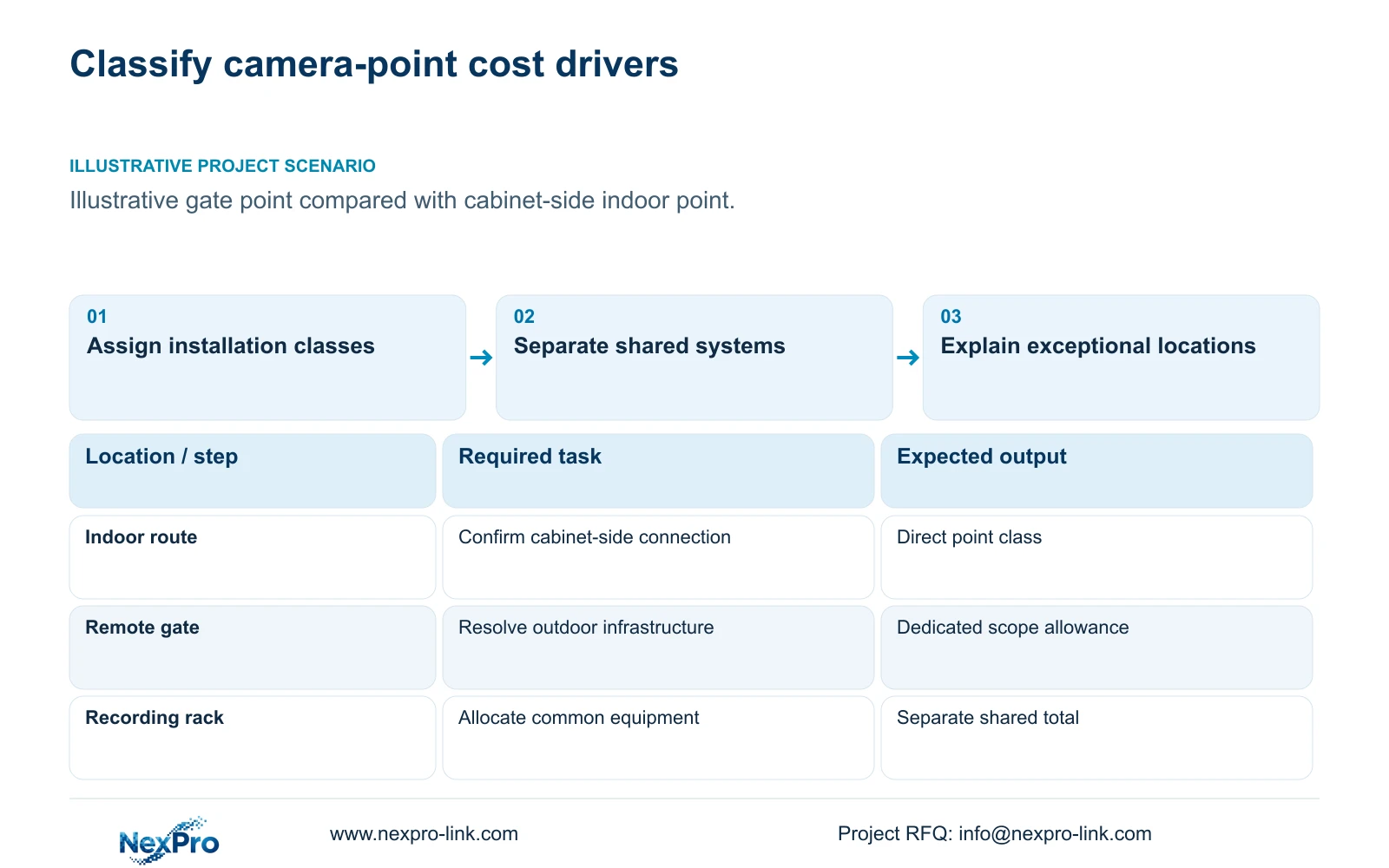
Illustrative project scenario: A remote gate camera is compared with an indoor camera next to a network cabinet. Assume the indoor route uses accessible existing containment, while the gate route needs an outdoor mounting arrangement and a confirmed network and power path. These conditions are planning assumptions to demonstrate classification; no route distance or installed price has been established.
Create point classes using observable attributes: route type, mounting access, cabinet connection and environmental boundary. Keep camera performance requirements in a separate column. The engineer confirms which class each point belongs to, and the quantity surveyor requests a matching rate. This prevents an easier installation class from becoming an excuse to reduce the required view quality.
Section 02
Keep direct point costs separate from common systems
Define the direct point cost as the camera, its mount, local connection, assigned cable route and point-specific installation and testing. Record the recorder, storage, shared cabinet, backbone and common power arrangements separately. Suppliers should state whether a quoted point rate already contains any of these common items, otherwise the cost team may add them twice.
The CASE01 reference contains 32 cameras across gates, stores, machine-hall transfers, common routes, dispatch and equipment-room approaches. One recording node supports the example. Its recorder and four disks form a common service, while each continuous camera cable remains attributable to a location. Dividing that common service equally among 32 points is a reporting convention, not evidence that every added point costs the same amount.
For departmental allocation, select a basis that follows consumption or ownership and reconcile it to the total. Equal allocation may suit a common recording service with identical streams. A dedicated remote cabinet should remain assigned to the zone that requires it. Report both direct class rates and allocated all-in rates so readers know which figure they are using.
Section 03
Explain expensive points with measurable cost drivers
For each outlier, show the specific addition that makes it expensive. A remote gate may require a local network node, an outdoor route or a different mount. A high-level indoor point may require restricted access and lifting equipment. Ask the responsible contractor to identify quantities and work conditions instead of assigning an unexplained difficulty percentage to the camera rate.
CASE01 supplies an illustrative cable range of 41 to 76 m per point, including its stated 6 m service and termination allowance. The total is 1,872 m for 32 links, with a feasible seven-reel cutting plan using 305 m reels. Even within this bounded example, the individual cable quantities differ. The average cable length cannot replace the actual takeoff when ordering continuous cuts or pricing a particular point.
Use a location comparison to decide what can be standardized and what needs separate pricing. The decisive distinction below is the infrastructure required to deliver the view. If a gate connection later requires another topology, revise its class and supporting scope; do not force it into the indoor rate simply because both locations use an ordinary security camera.
| Cost driver | Indoor cabinet-side point | Remote gate point |
|---|---|---|
| Route basis | Accessible containment assumption | Outdoor route to be surveyed |
| Mounting scope | Standard accessible mount assumption | Outdoor support to be confirmed |
| Network dependency | Existing cabinet capacity check | Backbone and local-node decision |
| Power dependency | Assigned PoE port and budget | Local protected-power boundary |
| Pricing treatment | Direct class rate | Direct rate plus dedicated infrastructure |
Section 04
Normalize totals before deriving a point average
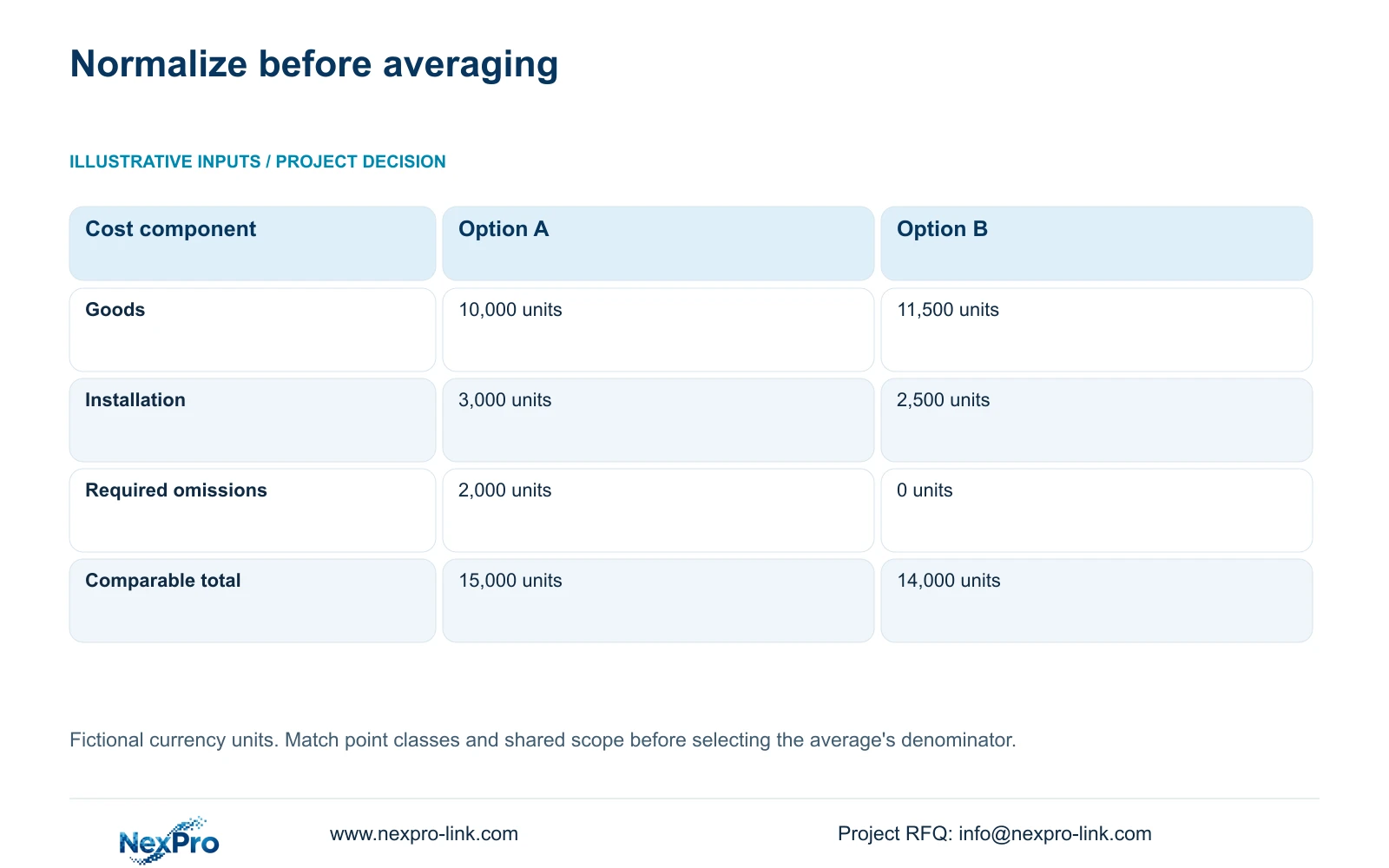
A useful average starts with a comparable numerator. Consider the supplied fictional currency-unit example: Option A has goods of 10,000 units, installation of 3,000 units and required omitted scope of 2,000 units. Option B has goods of 11,500 units, installation of 2,500 units and omitted scope of zero. These are teaching inputs, not market quotations for the gate or indoor point.
Apply normalized_total = goods + installation + required_omitted_items. A_total = 15,000 units and B_total = 14,000 units; difference = A_total minus B_total = 1,000 units. The goods-only comparison favors A, but the complete-scope comparison favors B. Any average calculated from the original goods prices would carry that omission into the reported camera-point rate.
Only divide by the agreed accepted point count once both totals cover the same classes and common services. State whether the denominator includes retained points, newly installed points or every operational camera. Replace monetary inputs with matched quotations and avoid combining this fictional example with CASE01 as if it were a priced 32-camera project. The two examples have different declared purposes.
| Component | Option A | Option B |
|---|---|---|
| Goods | 10,000 units | 11,500 units |
| Installation | 3,000 units | 2,500 units |
| Required omissions | 2,000 units | 0 units |
| Comparable total | 15,000 units | 14,000 units |
Section 05
Use class rates for additions and the average for reporting
Recommend a class-based estimate for procurement and an all-in average for summary reporting. When the owner asks for another indoor point, price its direct work and check the common resources it consumes. When the owner asks for a remote gate view, evaluate the dedicated infrastructure first. Neither addition should automatically inherit the existing site's blended average.
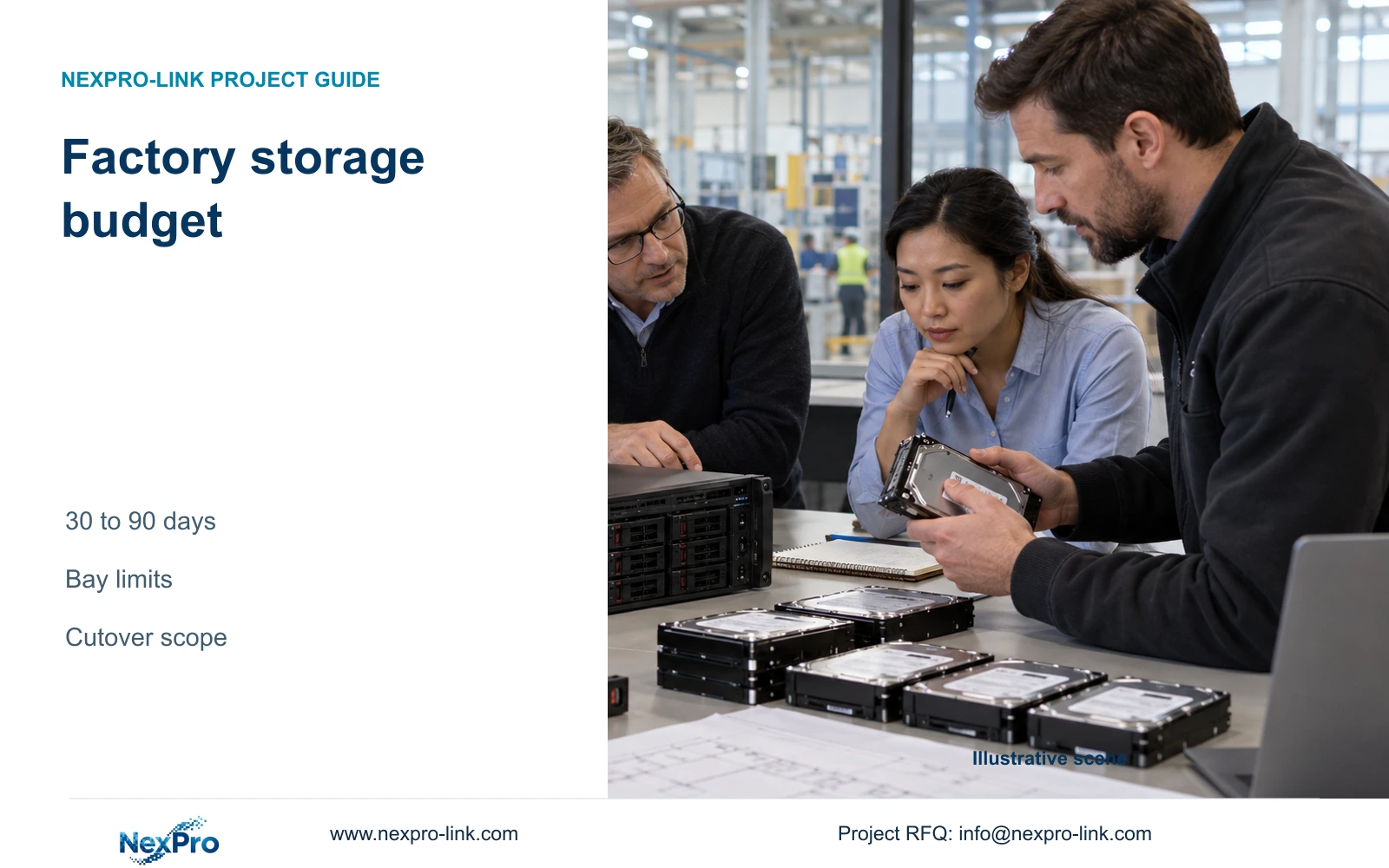
The NexPro-NVR4449-4K reference illustrates a shared resource with discrete limits: four SATA bays, up to 18 TB per drive and 320 Mbps input. Spare camera channels alone do not establish spare storage or every supported resolution mode. A point that crosses a resource limit can trigger a separate shared-system adjustment, which should remain visible rather than being hidden in an inflated camera rate.
Change the estimating basis when the site mix, containment, access windows or required interfaces differ materially. Preserve mandatory environmental and platform requirements in every brand comparison. A low class rate has value only if its scope still includes the necessary connection, usable recording and acceptance work. Do not infer installed savings from the camera unit price alone.
Section 06
Request rates that can be traced back to locations
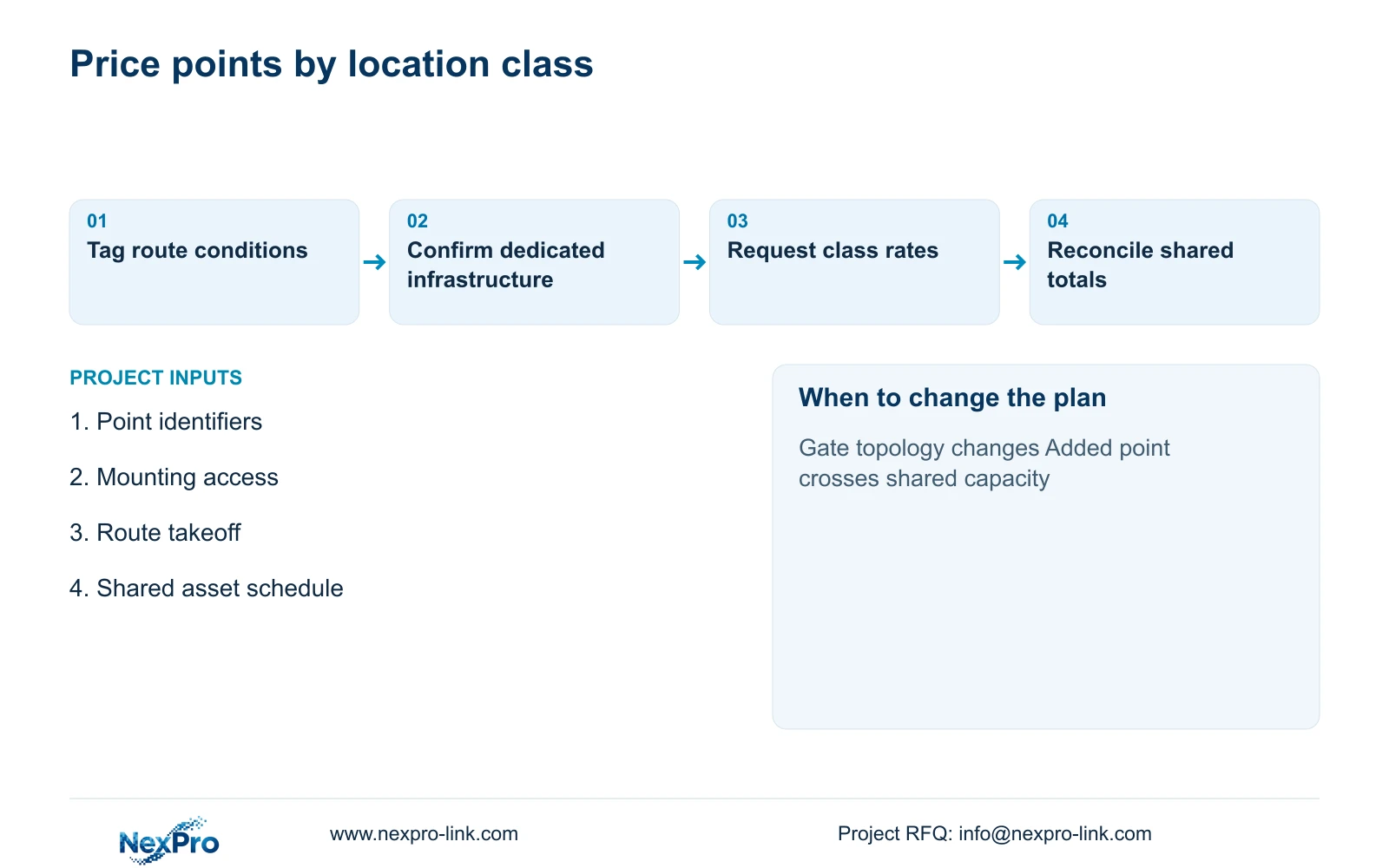
Prepare a point schedule with a location identifier, observation task, installation class, route basis and supplying party. Add a separate shared-cost schedule and a list of exclusions. Ask bidders to price class quantities and identify any exceptional locations individually. This produces a cost comparison that can survive drawing changes without losing its connection to the original quantities.
NexPro-Link can discuss model matching and a coordinated equipment list through its BOQ and tender-support scope. The local installer should supply site-access assumptions, containment work and installation rates. Where project packing is useful, align carton or kit labels with the same point identifiers so the equipment schedule remains recognizable at installation.
Before approval, reconcile the class totals, shared items and options to the overall project amount. Record unresolved gate-route or cabinet-capacity questions beside their allowances. A subsequent survey can then replace those assumptions directly, rather than requiring the owner to guess which part of a blended point rate has changed.
Section 07
Buyer questions
Is a factory-wide camera-point average ever useful? It is useful for summarizing a defined project or tracking comparable repeat scopes. Keep the location mix, shared-cost boundary and denominator beside it. It should not be transferred unchanged to a site with different routes or access conditions.
Should retained cameras be included in the denominator? Use the denominator that matches the report's purpose. New-installation unit costs should identify newly installed points. A whole-system operating measure may include retained cameras, but must say so and show the retained work separately.
Can a difficult point be moved to reduce installation cost? Yes, if the engineer confirms the revised location still supplies the required evidence and remains suitable for the environment. Price the changed mount and route, then repeat the view acceptance check before approving the saving.
Section 08
Build a location-based camera cost schedule
Send your camera location schedule, route and mounting assumptions, shared-equipment list and quotation currency/delivery basis to info@nexpro-link.com to discuss class-based equipment scope.
Engineering references
These sources support the general planning principles. Always use the selected product's current datasheet and applicable project standards for final design.