Compare supported battery expansion and UPS replacement using the same installation boundary: space, connection work, service interruption and disposal responsibilities. Keep product eligibility separate from site readiness.
Section 01
Determine whether the change concerns watts or minutes
Compare supported battery expansion and UPS replacement using the same installation boundary: space, connection work, service interruption and disposal responsibilities. Keep product eligibility separate from site readiness. A nominally smaller goods price is not the completed upgrade when necessary local work or a supported battery arrangement is missing.
For a factory UPS budget, first determine whether the protected load exceeds the UPS output rating or whether the same load needs to run longer. A capacity upgrade addresses W and VA constraints. A runtime upgrade addresses the supported battery configuration and discharge performance. Buying a larger kVA unit without checking its battery arrangement leaves the duration question unresolved.
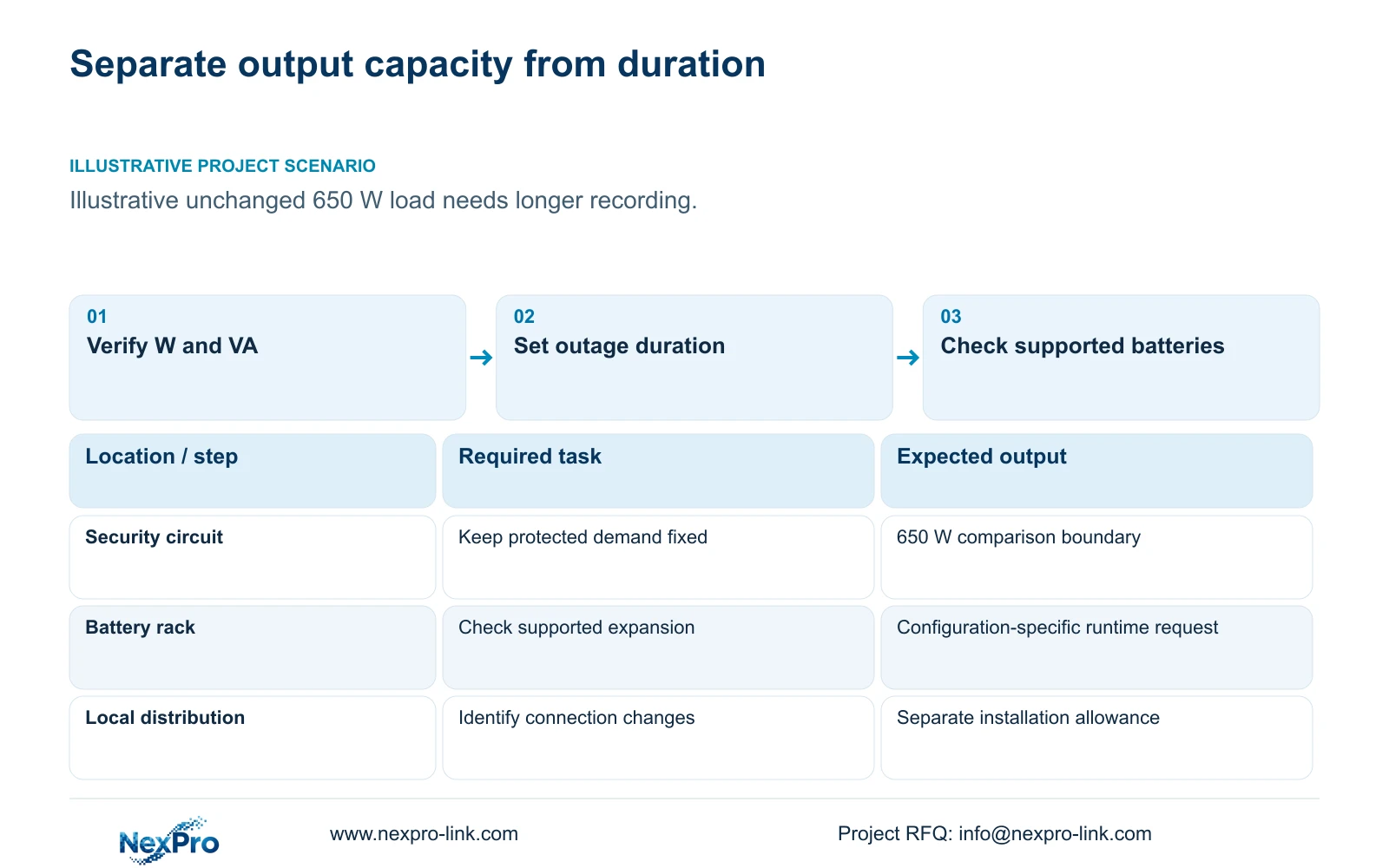
Illustrative project scenario: The project needs longer recording through outages but its running load has not increased. For the supplied teaching comparison, assume a protected AC load of 650 W and a change from 30 to 60 minutes. This is a separate calculation boundary from CASE01, whose recording-priority package has an illustrative 682.7407 W load.
List every device on the protected circuit, including PoE switches, recording equipment and necessary network links. Camera power already included in a switch's complete AC input must not be added again. Record normal demand and the operating conditions that may increase it. The cost decision should follow that load boundary rather than the number of cameras or the existing UPS label.
Section 02
Compare exact UPS and battery configurations
The NexPro-Link rack online series lists SP1KR(S) at 1 kVA/900 W, SP2KR(S) at 2 kVA/1800 W and SP3KR(S) at 3 kVA/2700 W. These are quoted output-capacity references. They do not specify the battery energy available in every offered variant or establish a runtime at 650 W. Request the exact UPS, battery arrangement and supported expansion method together.
W and VA require separate checks, consistent with the APC/Schneider UPS buying guide. If the project adopts CASE01's assumed power factor of 0.9 and 80% rating-utilization target, the standalone 650 W demand requires rated_W ≥ 650/0.8 = 812.5 W and rated_VA ≥ 650/(0.9 × 0.8) = 902.7778 VA. SP1KR(S) is a capacity candidate under those assumptions, subject to the actual load and electrical fit.
If the installed model meets capacity but cannot support the battery configuration needed for one hour, replacement may still be necessary. That is a configuration constraint, not evidence that 650 W inherently needs a higher output rating. Compare the supported retained-UPS route and a replacement package using the same duration, battery conditions and acceptance method.
Section 03
Include battery installation and service conditions
A battery quotation needs a site-work boundary. Identify cabinet or rack space, mounting, connection accessories, distribution changes and access for service. Assign electrical work and protection design to the responsible local team. An apparently inexpensive battery addition can require extra installation work, while a replacement UPS may require planned interruption and reconnection of the protected circuit.
CASE01 makes the protected boundary tangible: PoE access equipment, recorder and disks share the recording-priority load, with specified core, router and operator equipment. Its optional LCD wall adds a separate display load. If the owner adds that wall while requesting longer runtime, both watts and minutes change and the retained-capacity recommendation must be reviewed.
Keep battery supply, installation, testing and future replacement as separate lines. Ask who provides runtime evidence and who performs the agreed acceptance check. Confirm delivery and handling requirements with the selected supplier rather than assuming a general equipment shipment covers every battery accessory or local installation responsibility. Written scope makes the two procurement routes comparable.
Section 04
Translate the duration target into an energy request
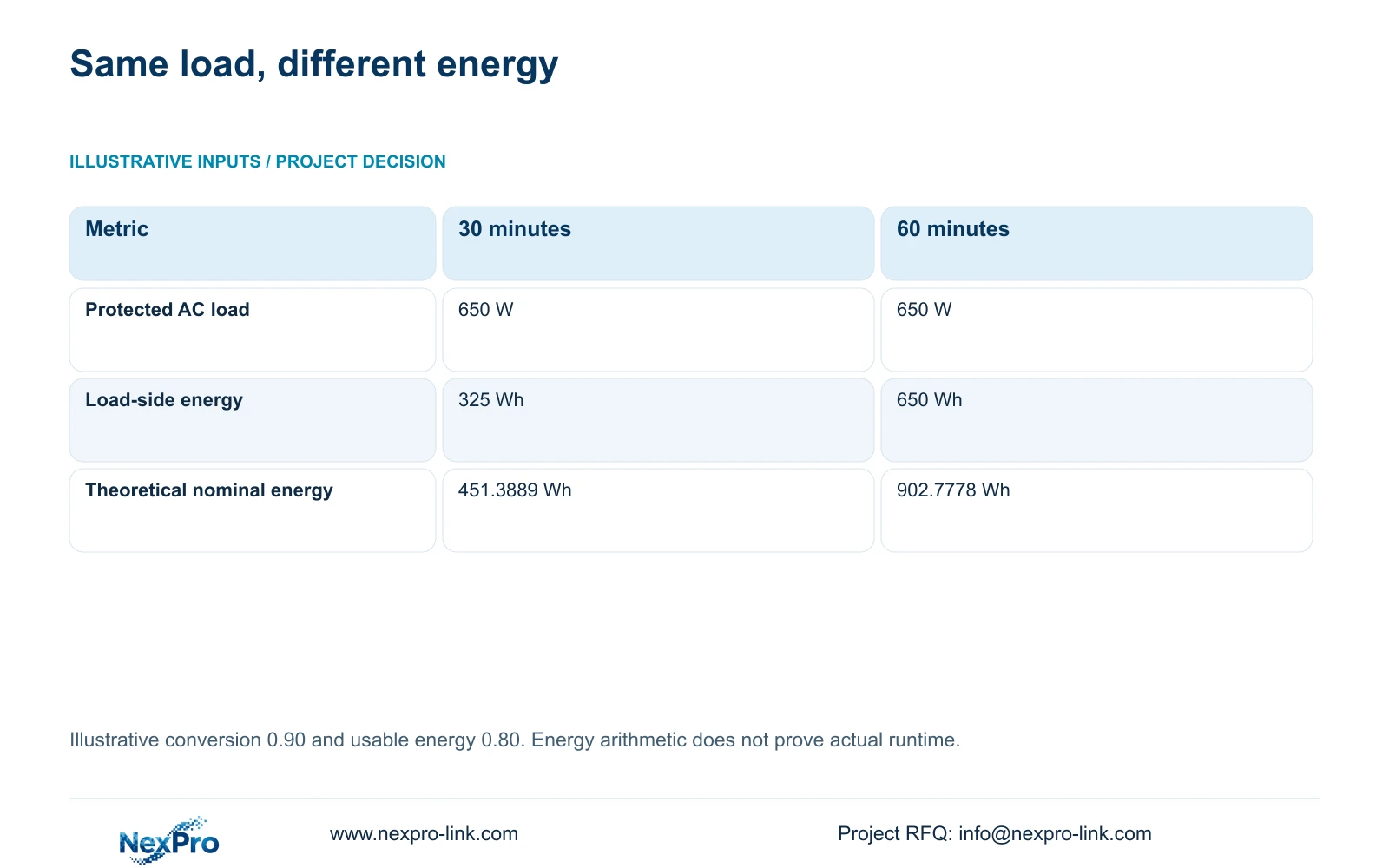
For the illustrative 650 W AC load, use load_Wh = P_W × minutes/60. At 30 minutes the load-side energy requirement is 325 Wh; at 60 minutes it is 650 Wh. The power demand remains 650 W in both options. The decisive numerical change is twice the delivered energy for twice the operating period.
With the supplied illustrative battery-to-load factor of 0.90 and usable stored-energy fraction of 0.80, nominal_battery_Wh = load_Wh/(0.90 × 0.80). The theoretical results are 451.3889 Wh for 30 minutes and 902.7778 Wh for 60 minutes. These are planning requests, not promised product runtimes or proof that a battery with the same nameplate energy will complete the task.
Obtain a runtime curve for the proposed supported configuration at the relevant load and conditions. Temperature, aging, discharge rate, BMS limits, UPS self-consumption, initial charge and recharge affect the result. Do not transfer a default 960 Wh field from another selected variant across these models. Confirm the actual battery supplied with each offer before comparing its minutes or price.
| Metric | 30-minute option | 60-minute option |
|---|---|---|
| Protected AC load | 650 W | 650 W |
| Target duration | 30 minutes | 60 minutes |
| Load-side energy | 325 Wh | 650 Wh |
| Theoretical nominal battery energy | 451.3889 Wh | 902.7778 Wh |
Section 05
Prefer supported runtime expansion when capacity still fits
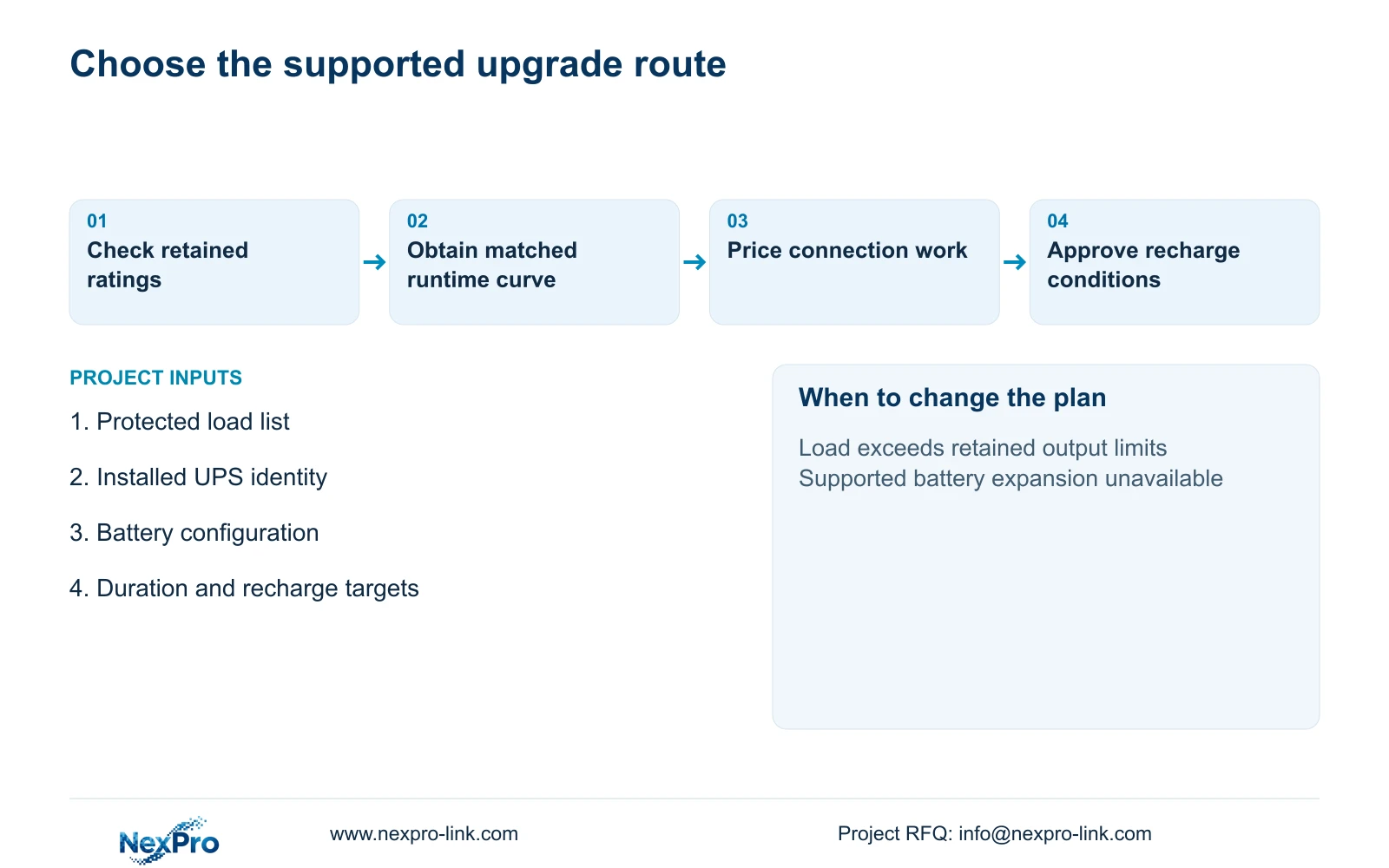
For an unchanged load within the verified output limits, investigate a manufacturer-supported battery configuration first. Retaining suitable equipment can avoid unnecessary replacement work, but no cost advantage is established until both routes are quoted. Compare supported expansion with replacement on battery energy, demonstrated duration, recharge behavior, service access and installation scope.
Choose a capacity upgrade when measured demand, apparent power, startup conditions or approved future additions exceed the retained unit's limits. Choose replacement for runtime reasons when supported battery expansion is unavailable or unsuitable for the installation. Reject an unsupported battery combination even if its nominal Wh looks attractive. Compatibility and the offered curve are procurement requirements.
Include the second-outage condition in the owner decision. A one-hour target after a full charge may not describe another outage shortly after restoration. Ask the supplier to identify recharge assumptions and any operational restrictions. A larger battery can change readiness and service requirements, so the price comparison should reflect the required recovery pattern as well as the first event.
Section 06
Request evidence that matches the priced package
Issue a comparison schedule naming the retained UPS, proposed battery configuration, load boundary and duration target. Include rated W and VA as separate acceptance fields. Require the runtime evidence to identify the configuration and conditions it covers. A curve for another battery arrangement is insufficient support for the package being purchased.
NexPro-Link can discuss its rack online capacity references and coordinate an equipment quotation against the declared project inputs. The local team should confirm electrical connections, distribution and installation access. If a quotation contains optional communications or monitoring equipment, identify its role and include any required setup rather than assuming it is necessary for the duration calculation.
Before placing the order, reconcile the battery and accessory quantities to the exact offered configuration. Retain unresolved runtime or recharge questions as approval conditions. The resulting cost comparison should tell the owner whether expenditure buys more output capacity, more operating time or both, and which site work is necessary to realize that change.
Section 07
Buyer questions
Does a 2 kVA UPS always run longer than a 1 kVA UPS? No duration follows from those ratings alone. Compare the exact batteries and runtime curves at the same protected load. A higher output rating can be useful for capacity while leaving the required operating period unproven.
Can the load-side Wh figure be used as the battery purchase specification? Use it to describe delivered-energy demand, alongside load and duration. The supplier must select a supported battery arrangement and provide runtime evidence; conversion losses and discharge constraints make the load-side number insufficient by itself.
What if the load estimate excludes a remote switch? First determine its actual supply circuit. If it must remain operating and has separate mains, include its local protected-power arrangement. A central UPS does not protect equipment that is outside its electrical supply path.
Section 08
Compare capacity and runtime upgrade routes
Send your protected AC load list, existing UPS/battery configuration, required outage and recharge targets, and local installation boundary to info@nexpro-link.com for a supported configuration discussion.
Engineering references
These sources support the general planning principles. Always use the selected product's current datasheet and applicable project standards for final design.