Price the move to longer retention as a sequence: preserve required old footage, prepare the supported destination, cut over and verify new retention. Separate reusable disks from new equipment and paid migration work.
Section 01
Hold recording quality constant when extending retention
Price the move to longer retention as a sequence: preserve required old footage, prepare the supported destination, cut over and verify new retention. Separate reusable disks from new equipment and paid migration work. If the transition cannot preserve the required history, retain that exception before ranking the expansion cost.
A factory storage budget for longer retention must include the disks, supported recording architecture and any power or migration changes needed to deliver the same evidence. Increasing the period from 30 to 90 days triples video volume under unchanged stream settings. It does not establish that the selected recorder can accommodate three times the installed disks or capacity.
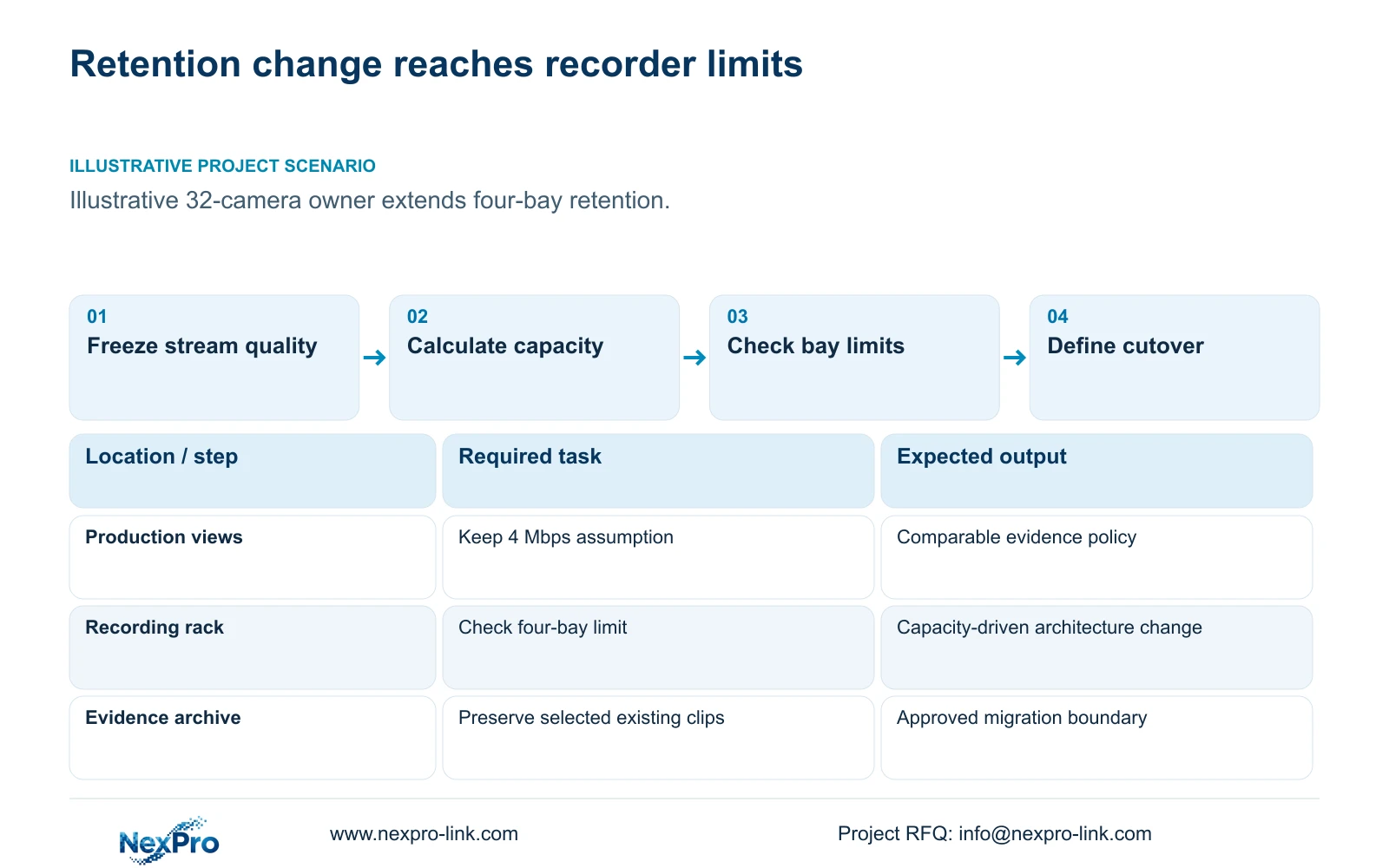
Illustrative project scenario: The owner extends retention after the initial four-bay recorder selection. Use CASE01's hypothetical 32-camera CNC factory, with an assumed average 4 Mbps per camera and continuous recording. The original design uses four 16 TB disks for a 30-day objective. The proposed 90-day requirement is a change to this planning baseline, not an account of an installed customer system.
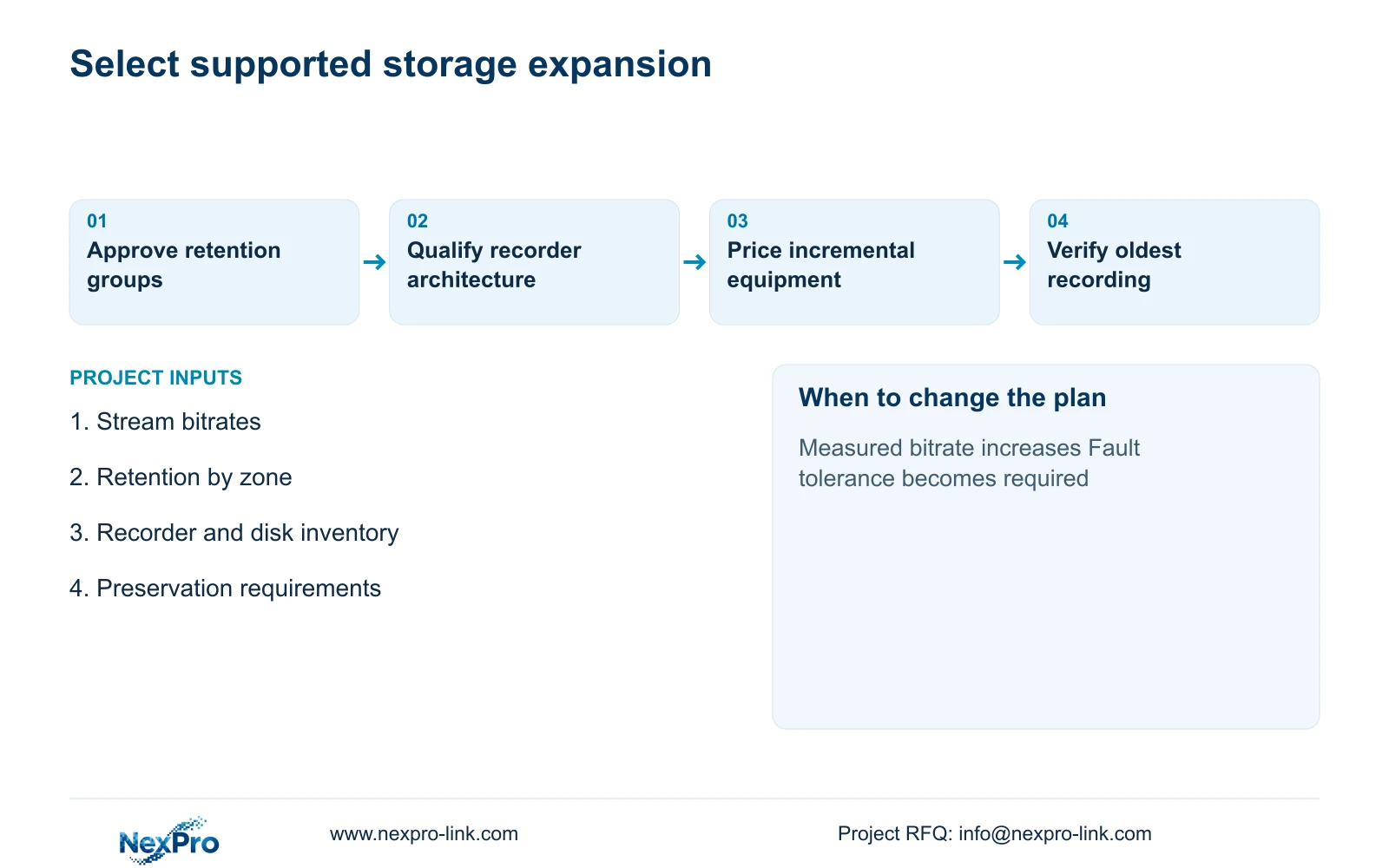
Freeze the comparison's image mode, frame rate, recording hours and stream groups before requesting revised prices. If a bidder reduces bitrate or changes to event recording, identify that as a separate policy alternative. The owner must approve its effect on evidence before its smaller storage requirement can be compared with the continuous-recording baseline.
Section 02
Compare video demand with the available recording budget
Use decimal TB consistently. The illustrative formula is video_TB = cameras × average_Mbps × 10^6 × 86,400 × days / 8 / 10^12, equivalent to 0.0108 × cameras × average_Mbps × days. Keeping 20% of usable space free gives usable_required = video_TB / 0.80. This free-space assumption is a planning choice, not a measured recorder requirement.
CASE01 applies a separate 95% formatting and overhead factor to raw capacity. Four 16 TB disks provide 64 TB raw, 60.8 TB after that factor and a recording budget of 64 × 0.95 × 0.80 = 48.64 TB. Compare the 30-day video demand of 41.472 TB directly with 48.64 TB. The reserve is already included in that budget and must not be deducted again.
The NexPro-NVR4449-4K reference lists four SATA bays with up to 18 TB per drive. At that listed bay limit, 72 TB raw gives an illustrative 54.72 TB recording budget under the same factors. It remains below the 60-day demand of 82.944 TB. Larger disks within this recorder's stated limit therefore cannot solve the extended-period requirement alone.
Section 03
Price the recorder and migration changes separately
Ask the engineer to produce a supported architecture before the quantity surveyor prices the change. The eight-bay NexPro-NVR8864-4K reference offers another capacity boundary, with up to 18 TB per bay and 320 Mbps input. Eight such drives give 144 TB raw and an illustrative 109.44 TB recording budget. That accommodates the stated 60-day video volume, but remains below 124.416 TB for 90 days.
A 90-day scheme consequently needs another supported arrangement, such as distributing approved streams across recorders or selecting a separately qualified storage platform. Confirm each node's allocation and capacity individually. Unused capacity on one independent recorder cannot compensate for a shortfall on another unless the architecture actually supports that recording path.
The change schedule should identify new or replaced recorders, compatible disks, rack space, network connections and commissioning. Preserve existing footage through an agreed migration or parallel-operation plan before disk initialization. If additional equipment changes the protected AC load, revise the UPS request using the selected configuration. Bay count alone does not establish RAID, automatic failover or simultaneous decoding capacity.
Section 04
See where longer retention crosses hardware limits
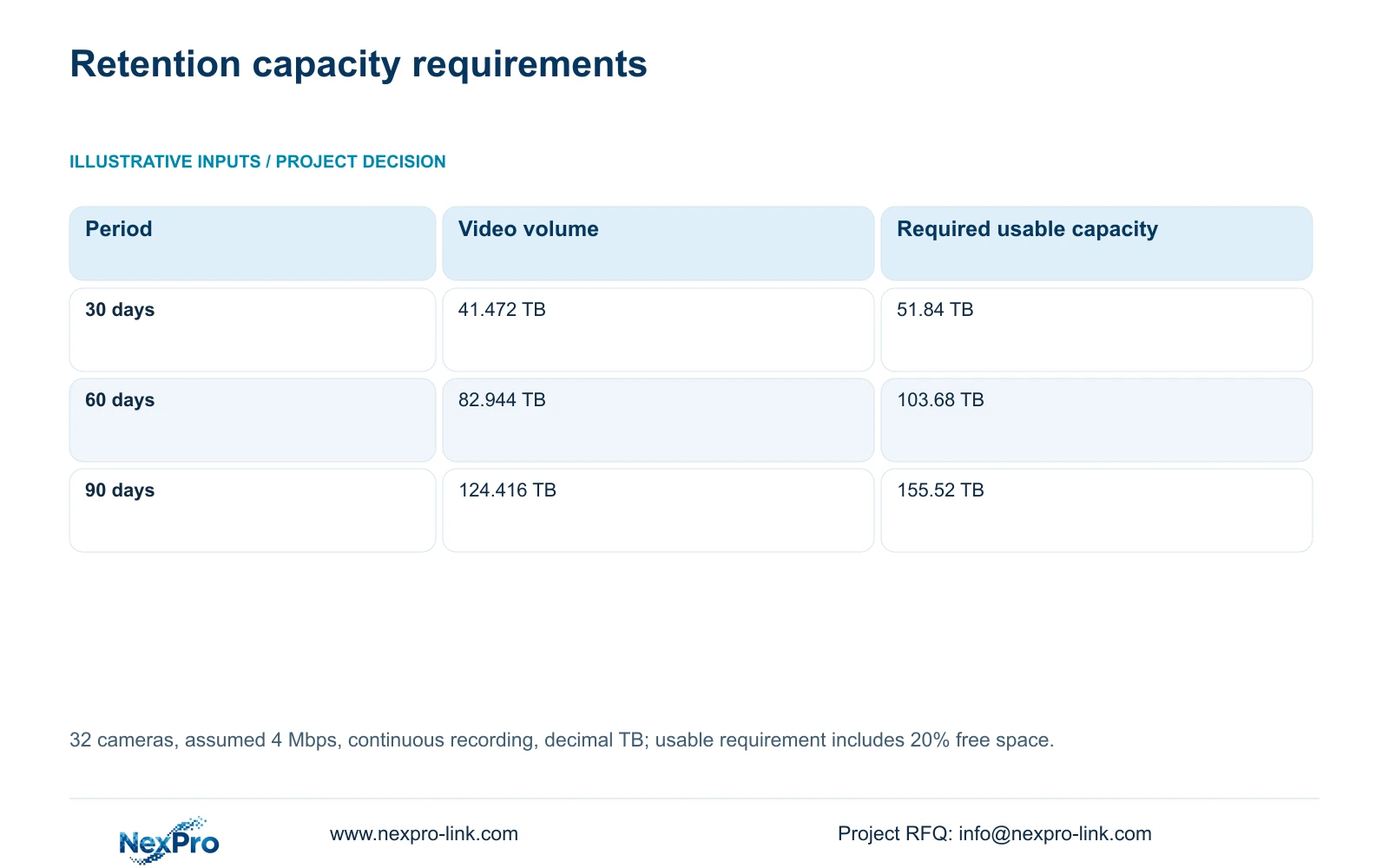
For 32 cameras at an assumed 4 Mbps continuously, video_TB = 0.0108 × 32 × 4 × days. The results are 41.472 TB at 30 days, 82.944 TB at 60 days and 124.416 TB at 90 days. Dividing each by 0.80 produces required usable capacities of 51.84, 103.68 and 155.52 TB respectively.
The decisive difference is the capacity threshold, rather than the arithmetic multiplier alone. The original four-disk installation supports the 30-day teaching demand. The eight-bay reference at its listed drive limit can support the 60-day capacity calculation, subject to exact hardware and stream qualification. Its 136.8 TB after the 95% factor remains below the 155.52 TB usable requirement for 90 days.
Do not describe the cost change as three times the original storage invoice. Recorder replacement, additional connections and cutover work can make acquisition cost non-linear. Conversely, some existing network equipment may remain unchanged because the same 32 streams still produce 128 Mbps of assumed recording payload. The project team must verify the authorized retention purpose and applicable local requirements; no universal factory retention period is assigned here.
| Metric | 30 days | 60 days | 90 days |
|---|---|---|---|
| Video volume | 41.472 TB | 82.944 TB | 124.416 TB |
| Required usable capacity | 51.84 TB | 103.68 TB | 155.52 TB |
| Relative video amount | 1 | 2 | 3 |
Section 05
Recommend a qualified retention architecture
Retain the original four-bay baseline when the owner confirms 30 days meets the approved purpose and measured stream demand remains within its recording budget. For 60 days, request a qualified larger-capacity configuration rather than merely replacing four disks. For 90 days, compare architectures that demonstrably provide the required capacity and retrieval workflow before ranking their prices.
A tiered retention policy may reduce the scope if the owner has different purposes for different zones. For example, selected transfer views could have a longer approved period while ordinary circulation views retain the shorter period. Treat this as a changed requirement with named camera groups, not as an equivalent cheaper offer for 90 days everywhere. Recalculate from each group's bitrate and period.
Keep archive and fault-tolerance decisions explicit. An incident archive preserves selected evidence; it does not automatically satisfy continuous rolling retention. If disk-failure tolerance is required, obtain a supported arrangement and recalculate capacity after its overhead. No RAID allowance is included in the supplied multi-disk arithmetic, so a resilience feature cannot be added without changing the capacity basis.
Section 06
Build an expansion quotation with a cutover boundary
The revised BOQ should show the existing baseline, accepted retained equipment and incremental work. Include exact recorder and firmware references, proposed disk models, node allocations and the retention assumptions behind each capacity line. Ask for storage and recorder prices separately so the owner can see whether the change is driven by disk quantity, architecture or site work.
NexPro-Link's BOQ and tender-support scope can help match recorder references and document deviations against the requested period. The local project team should define footage preservation, installation access and acceptance testing. A useful quotation also identifies who checks the oldest available recording and verifies export from each required node after the cutover.
Keep unresolved measured bitrate, extra metadata and supported storage inputs attached to the cost plan. Close them before committing to an architecture with little capacity margin. The final procurement decision should state the selected retention period and evidence policy together, so a later adjustment cannot silently trade image quality for days.
Section 07
Buyer questions
Does a longer retention period require faster camera links? With unchanged camera count and stream settings, retention increases stored volume rather than incoming video payload. A changed storage architecture may create different network paths or retrieval traffic, so those links still need separate checking.
Can we reduce bitrate instead of adding storage? Only after testing the recorded evidence at the proposed setting and obtaining approval for the revised quality. A lower bitrate changes the comparison basis and should not be presented as the same evidence requirement at a lower cost.
Should old disks be formatted during the recorder upgrade? Agree the preservation and migration plan first. Formatting or initialization can affect existing footage. Record which evidence must remain accessible and assign the party responsible for copying and verifying it before storage changes.
Section 08
Request a retention expansion comparison
Send your camera stream schedule, required retention by zone, existing recorder/disk configuration and footage-preservation boundary to info@nexpro-link.com for a capacity-matched equipment discussion.
Engineering references
These sources support the general planning principles. Always use the selected product's current datasheet and applicable project standards for final design.