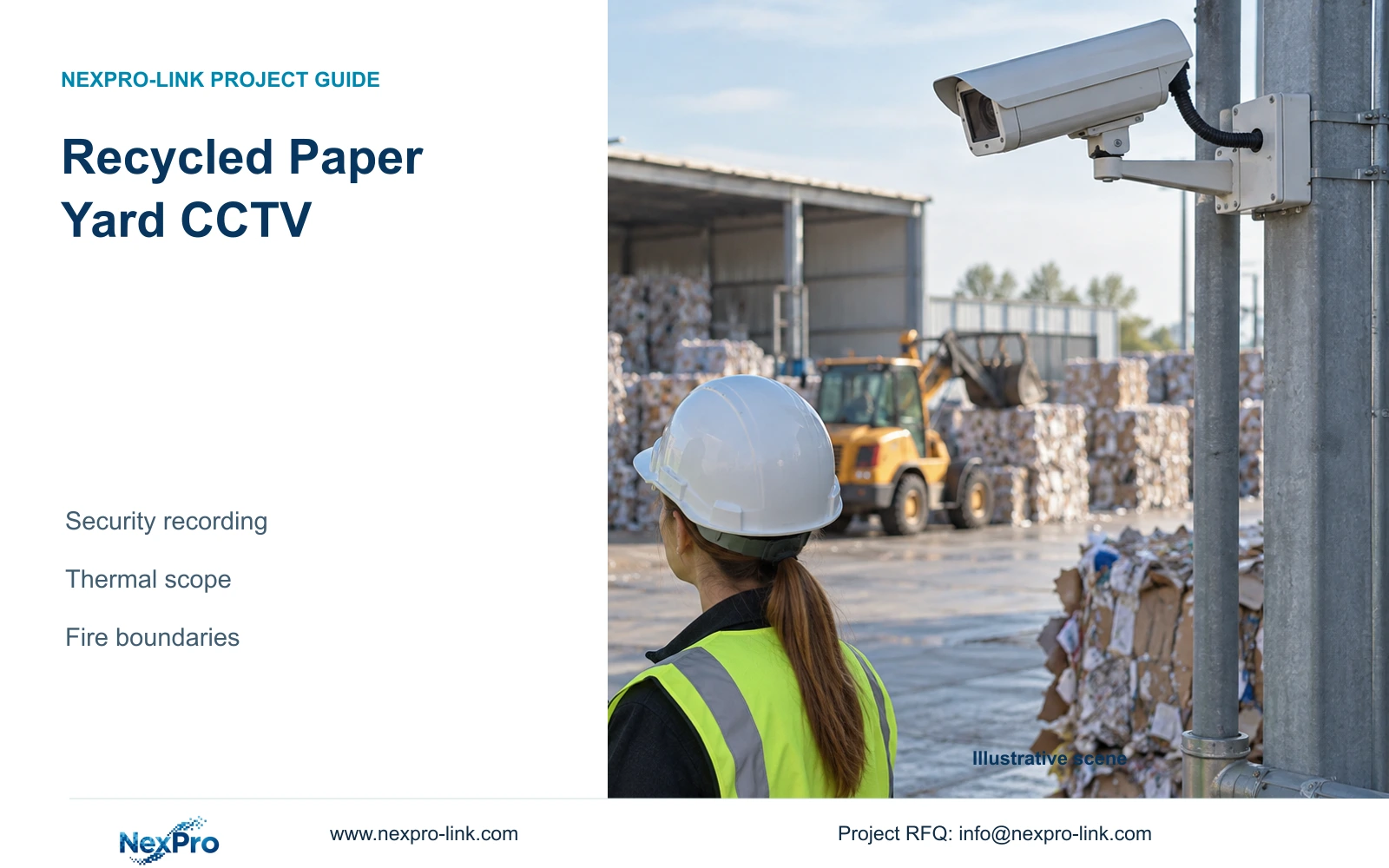
Recycled paper yard CCTV can support access review and visible-event context. Thermal measurement, smoke analytics and required fire detection need separate specifications, acceptance and responsibilities.
Section 01
Separate security recording from fire-detection requirements
Recycled paper yard CCTV should specify security recording separately from any thermal, smoke-analysis or fire-detection capability. Ordinary cameras can provide visible context for access and handling events, but they do not replace the site's required fire-safety design. A product name or general analytics label does not establish temperature measurement, a detection function or its acceptance for the intended protective role.
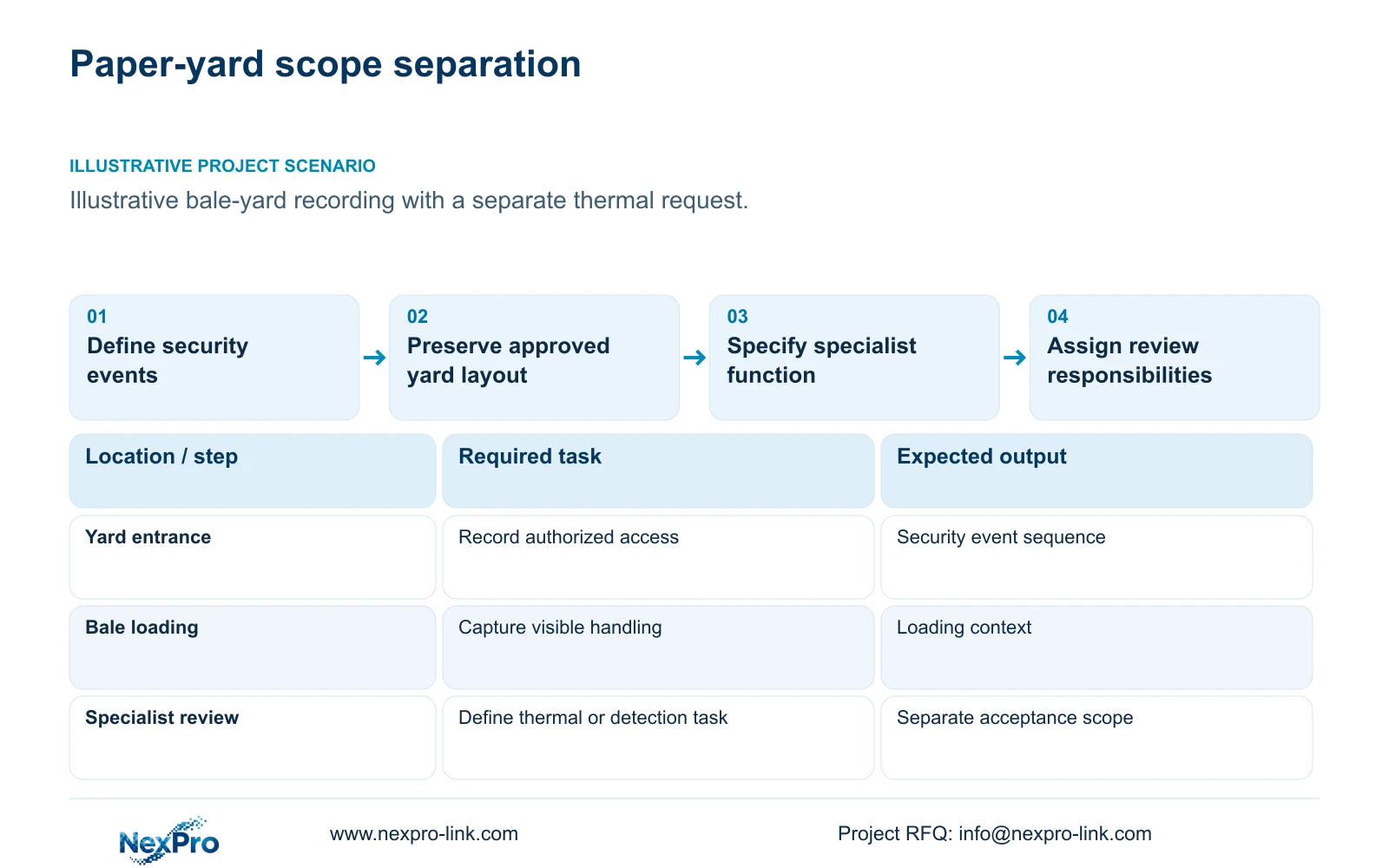
Illustrative project scenario: The yard asks for cameras to watch paper bales and wants to discuss thermal options. Assume, for planning, that the owner wants access footage, loading context and the ability to review a visibly unusual event. A separate specialist discussion is needed if the owner also expects automatic temperature alerts or an input to the fire response arrangement.
Write each objective with an owner and acceptance method. Security staff may accept a retrievable clip showing a vehicle or bale movement. The responsible fire-safety team defines any required detection and response scope and verifies current local requirements. Keep these decisions separate so a camera quotation cannot silently change a protective system's intended function.
Section 02
Preserve the yard's operating and hazard-control layout
Obtain the current bale layout, maximum stack heights, handling routes and approved access restrictions. Design the camera view around that arrangement. Do not relocate stacks or occupy an access route solely to improve an image without the operating and responsible safety teams' acceptance. Security equipment should observe the approved yard rather than redefine its protective layout.
Check sightlines with maximum stacks and handling equipment present. A distant overview may show activity on an exposed face while missing another side or an internal event. Record those blind areas. PTZ inspection, if separately specified, also leaves areas unobserved while pointed elsewhere; its presence does not establish continuous coverage of every stack.
Review camera supports and service access against normal traffic and maintenance conditions. Identify deposits, weather and cleaning methods that can obscure the lens. If a dust-handling location requires specialist qualification, retain its actual requirements. Ordinary equipment is not upgraded by adding an industrial or fire-observation label to the drawing.
Section 03
Define observable events and the review workflow
Give ordinary views specific duties: record authorized entry, reconstruct loading or provide context around a visible event. Name cameras after yard zones and access points used in operating records. Agree a common time basis and a retrieval route. A reviewer should be able to connect a reported time and location with the relevant recording without searching an unexplained grid.
If an operator notices an unusual visible condition, the response follows the site's approved procedure. Define who receives the report and how the footage is retained for review. Do not represent continuous recording as guaranteed continuous human attention, or assume that a mobile notification establishes a dependable safety response.
For any proposed thermal option, request its exact capability before pricing: thermal imaging, temperature measurement and a defined alert function are distinct scope questions. Obtain the supported configuration, placement limits, interfaces and acceptance method from the relevant specialist. The supplied ordinary NexPro camera sources establish none of those thermal or smoke-detection functions.
Section 04
Qualify location and function independently
Use the supplied location method: conditions AND complete product scope AND approved installation requirements must fit. Then confirm the required function separately. An environmentally acceptable ordinary camera may still lack a requested detection capability; a specialist function still needs a suitable mount, connections and operating environment.
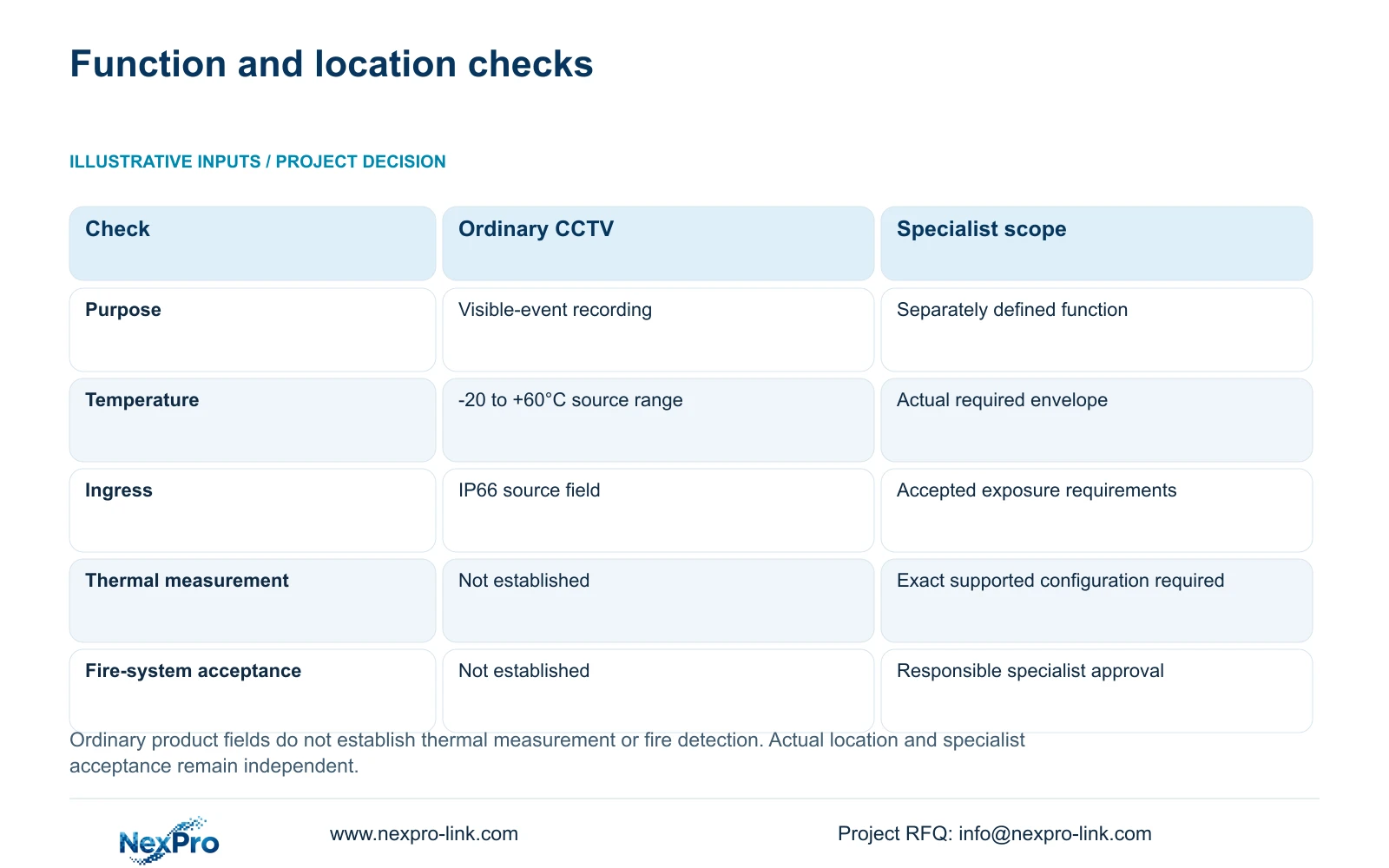
The ordinary BL2812M55 and DM2812M55 references list IP66 and -20 to +60°C. Their 5MP-family source retains 2880x1620 output and 25fps, with a 2.8–12mm motorized lens. These fields support discussion of suitable security viewpoints. They do not establish thermal measurement, explosion protection, chemical resistance or a fire-system role.
The decisive difference in the table is the evidence and responsibility required for each function. Keep the ordinary recording package where its task is accepted, while preserving specialist scope where necessary. A higher ingress rating or metal enclosure does not fill a missing functional approval, and an optional thermal quotation must not be presented as an approved replacement for required detection.
| Decision | Ordinary security package | Separately specified specialist scope |
|---|---|---|
| Purpose | Access and visible-event context | Defined thermal, alert or detection task |
| Temperature envelope | Source range: -20 to +60°C | Actual complete operating requirement |
| Ingress and cleaning | IP66 field; exposure checked | Accepted location and cleaning compatibility |
| Explosion protection | Not established by ordinary PDFs | Applicable complete scope where required |
| Acceptance owner | Security recording task owner | Responsible specialist design team |
Section 05
Budget recording without claiming detection performance
Recommend ordinary access and loading recording with a clear retrieval workflow, plus a separately defined specialist option if the owner has a valid thermal or detection objective. Change the ordinary layout when stack geometry or access routes remove the accepted view. Change equipment scope when actual location requirements exceed documented ordinary capability.
CASE01 supplies an illustrative ordinary recording reference, not a paper-yard deployment. Its 32 cameras at 4 Mbps average produce 128 Mbps input and 41.472 TB over 30 days. Video_TB = cameras × average_Mbps × 10^6 × 86400 × days / 8 / 10^12. Four 16 TB disks provide 48.64 TB recording budget using 64 × 0.95 × 0.80, with formatting and reserve already included.
Any specialist stream, additional metadata or changed retention must be assessed in the actual recording architecture. Confirm supported modes, playback and export separately. Locate ordinary disks, switches and batteries in suitable service spaces, and protect the actual local camera-power and recording nodes if continuity is required. A functioning recorder does not establish that a safety alert will occur or reach a responder.
Section 06
Keep the specialist interface visible in the quotation
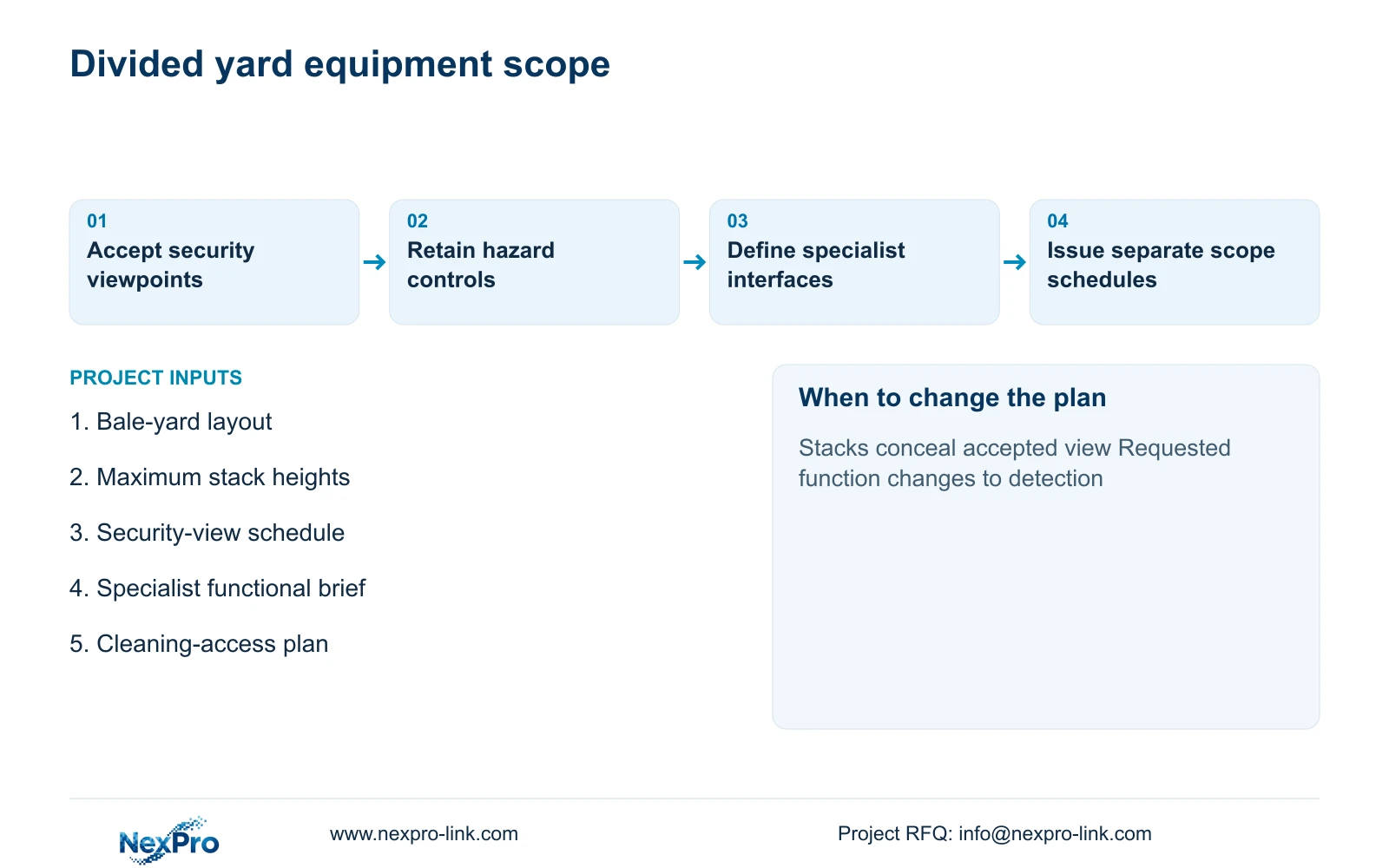
Prepare two linked scope schedules where needed. The security schedule lists views, stream settings, retention, local power and maintenance access. The specialist schedule identifies the requested function, equipment configuration, acceptance owner and any interface with site response systems. Mark retained protective equipment explicitly so it cannot be removed by an ambiguous combined-package substitution.
Compare competing offers against these same boundaries. Preserve the existing fire-safety design, required specialist approval and local services. Do not compare an ordinary-camera price with a quotation carrying a separately accepted detection scope and then claim equivalent coverage. Obtain matched current quotations only after the functions and responsibilities align.
NexPro-Link can discuss supported ordinary CCTV selection, BOQ coordination, technical documents and project packing through its factory-supply and tender-support scope. Specialist capabilities absent from the supplied library remain requirements for separate confirmation. The delivery objective is a serviceable security recording package with honest interfaces, rather than an unsupported promise that cameras protect every bale from fire.
Section 07
Buyer questions
Does the word thermal establish temperature alarms? No. Request the exact model's supported measurement and alert functions, configuration limits and acceptance method. Thermal imagery alone should not be treated as an established temperature-alarm workflow.
Can ordinary video help after an incident? It may help reconstruct visible access and handling events within its accepted views and retention period. Hidden areas, unavailable footage and unobserved conditions remain limits; recording is not proof that every event was detectable.
Who should approve a connection to a fire-response system? The responsible specialist team should define and accept that interface within the site's design. The CCTV equipment order must state its own supplied interface scope without assuming approval or protective-system performance.
Section 08
Define paper-yard recording and specialist scope
Send the bale-yard plan with maximum stack heights, required security views, any specialist thermal/detection brief, and maintenance-access conditions to info@nexpro-link.com to discuss a clearly divided equipment quotation.
Engineering references
These sources support the general planning principles. Always use the selected product's current datasheet and applicable project standards for final design.