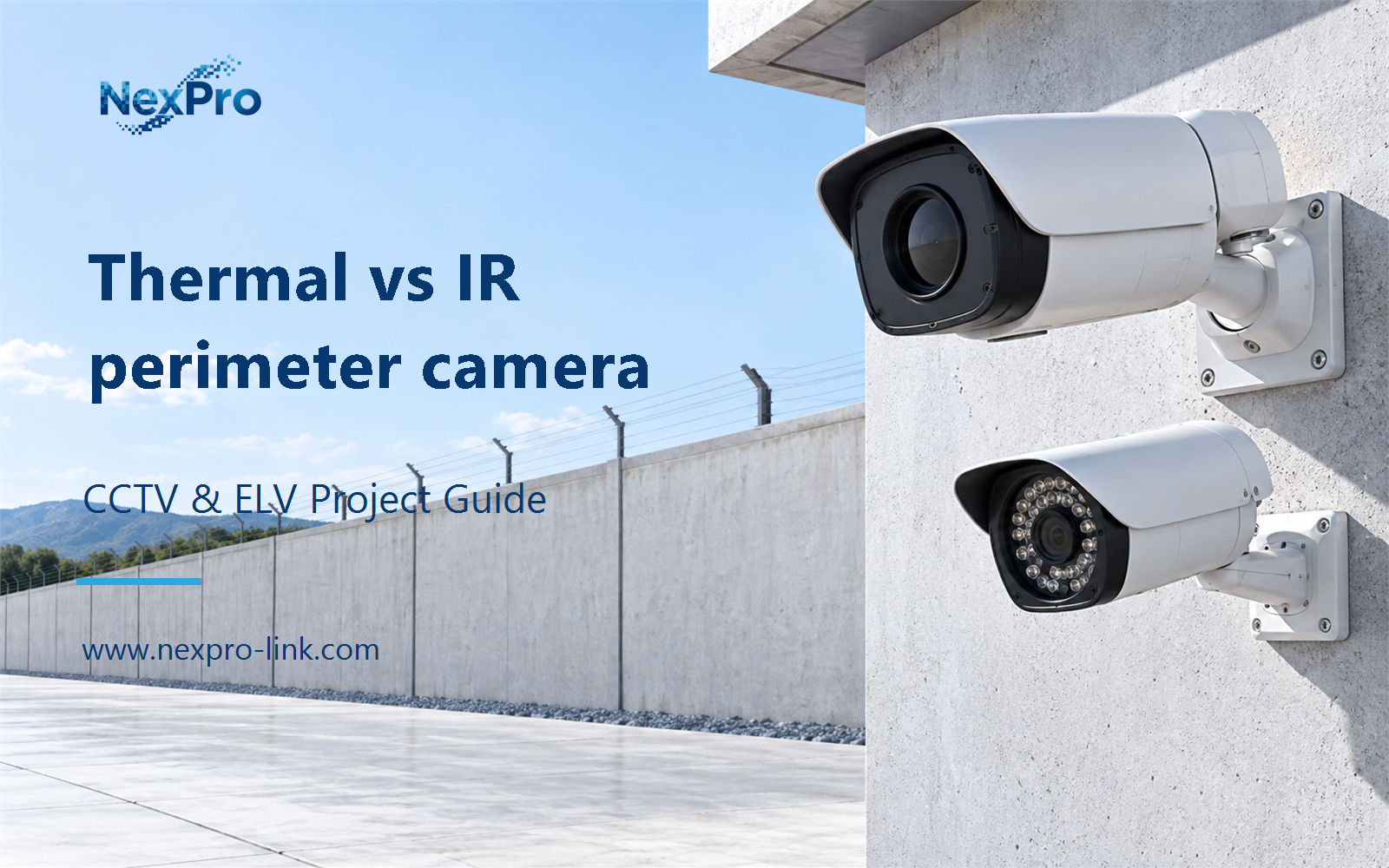
Plan thermal vs IR perimeter camera with practical guidance on define detection and verification separately and separate temperature measurement from security video. NexPro-Link project guide.
Section 01
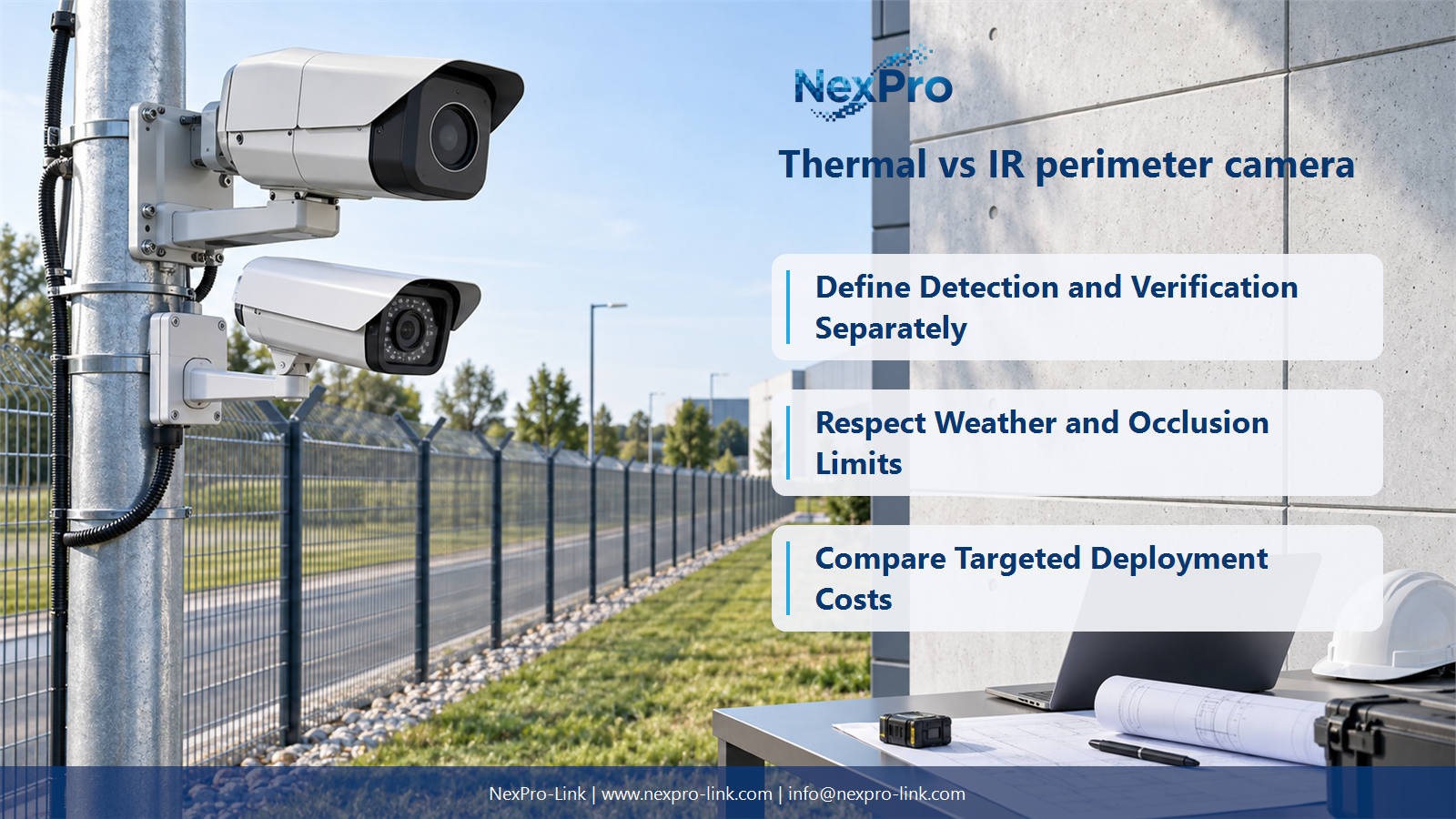
Define Detection and Verification Separately
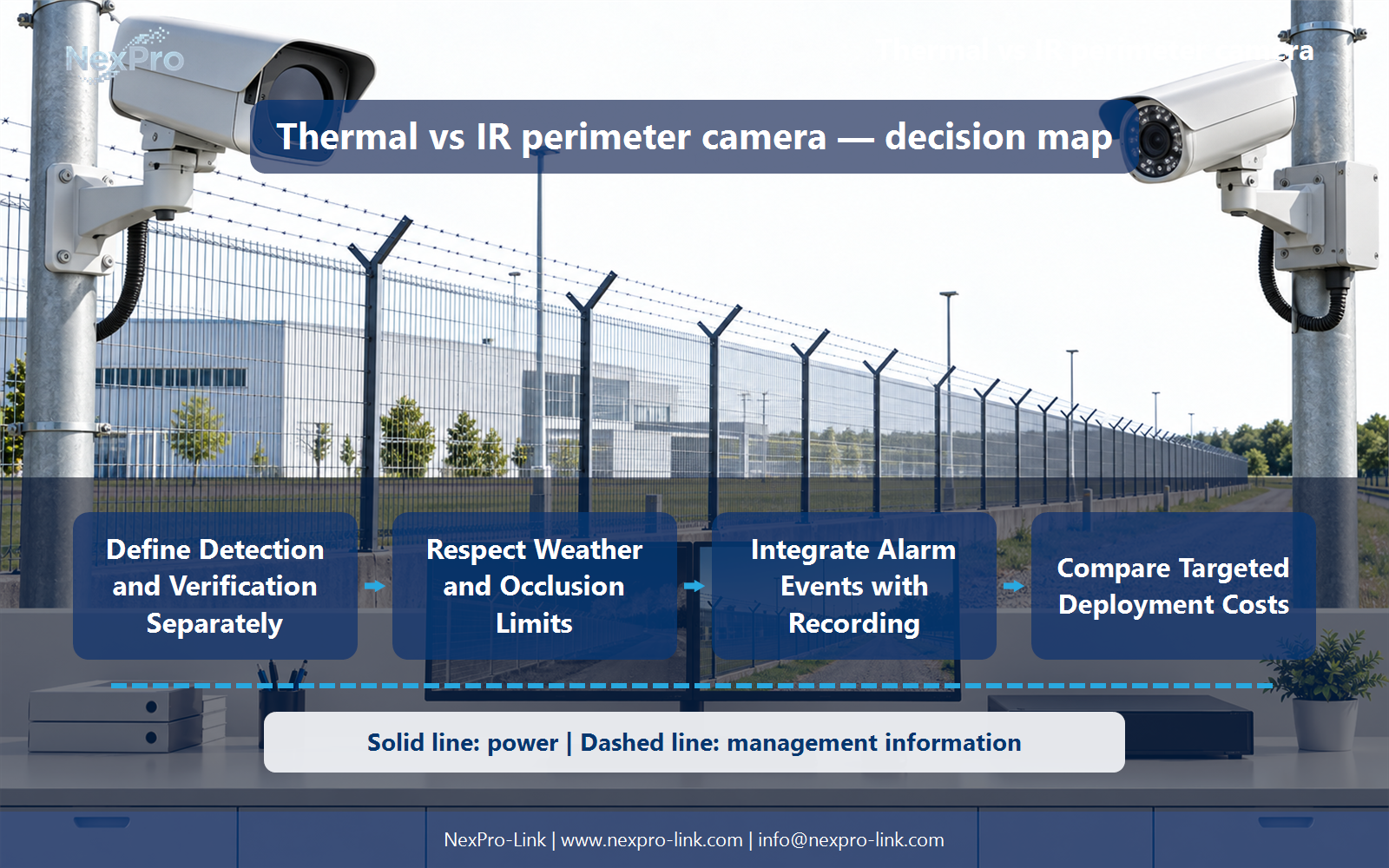
It can support detection when thermal contrast makes a target distinguishable and visible lighting is limited. The operational design should still explain how an operator verifies the alarm and obtains the detail needed for response. Thermal detection and visible identification are complementary tasks rather than interchangeable camera specifications.
Turn the answer into a working record using Threat task, Thermal role, Visible role, Operator action.
| Decision area | Buyer question | Required output |
|---|---|---|
| Define Detection and Verification Separately | When is thermal imaging useful on a perimeter? | It can support detection when thermal contrast makes a target distinguishable and visible lighting is limited. |
| Compare Thermal and Infrared Illumination | Is a thermal camera just an infrared-lit camera? | No. |
| Respect Weather and Occlusion Limits | Can thermal cameras see through fog, glass or vegetation? | Do not make a blanket claim. |
Section 02
Compare Thermal and Infrared Illumination
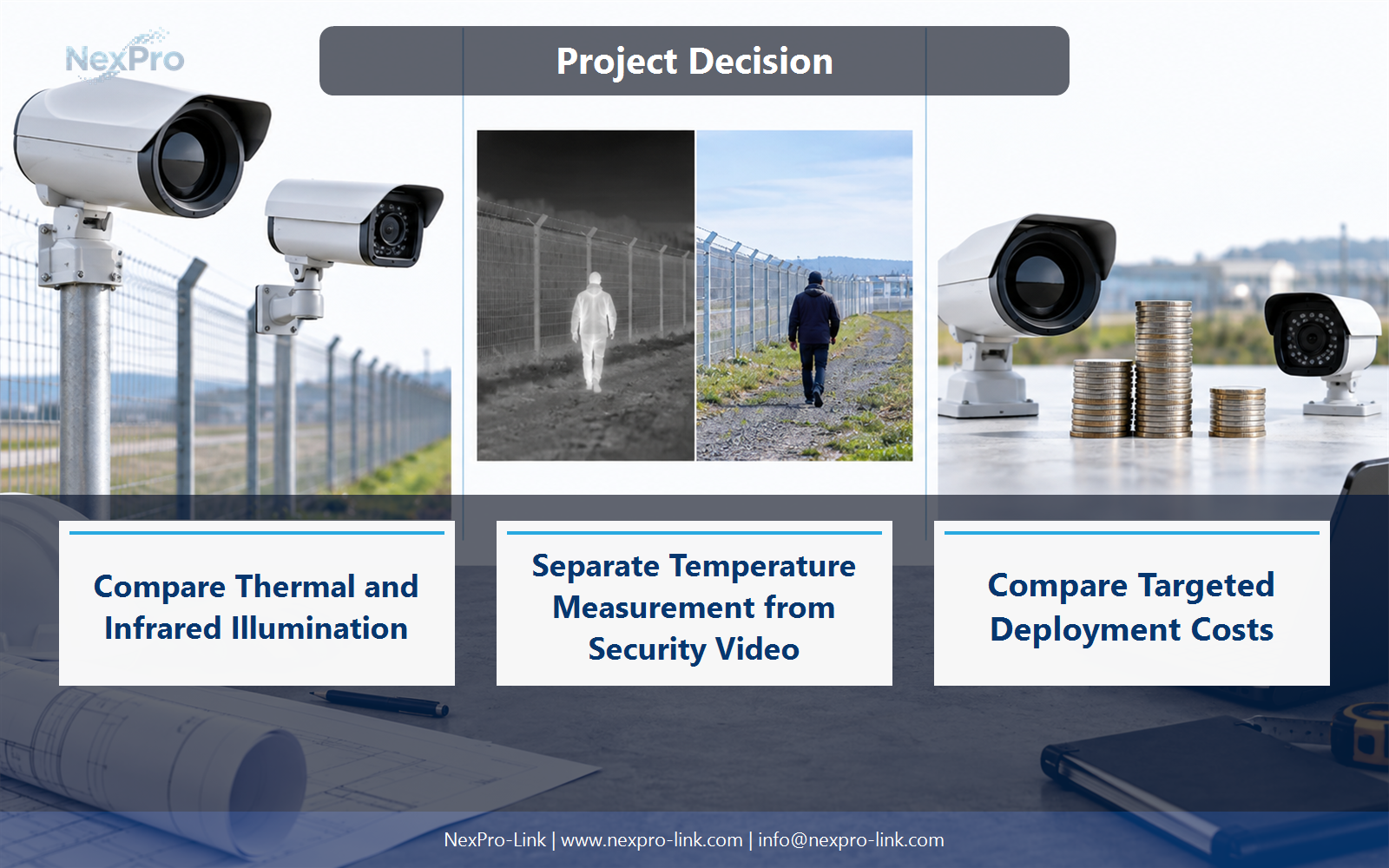
No. Thermal imaging and near-infrared-assisted visible cameras operate through different imaging mechanisms. An infrared illuminator helps a compatible camera see reflected light, while a thermal system responds to emitted thermal radiation in its operating band. Choose according to target contrast and required information, not because both are described using the word infrared.
Use Imaging method, Scene signal, Detail type, Illumination need to compare options on the same basis. Keep product capability, project assumption and operating responsibility in separate columns.
Section 03
Respect Weather and Occlusion Limits
Do not make a blanket claim. Weather, atmospheric path and material transmission can limit the image, while solid obstructions can still block the target. Assess the actual environment and the selected camera's intended use. Positioning and alarm-zone design remain necessary even when thermal imaging performs differently from visible light.
The project output should make Obstacle or condition, Effect to consider, Placement response traceable from input to acceptance.
- Confirm the answer to: Can thermal cameras see through fog, glass or vegetation?
- Record the project fields: Obstacle or condition / Effect to consider / Placement response.
- Keep product capability, project assumptions and site responsibility in separate records.
Section 04
Separate Temperature Measurement from Security Video
No. Temperature measurement and alarm functions require a product designed and specified for that purpose, with suitable installation and response logic. A thermal security image alone is not a certified fire-detection system. Treat any temperature alert as a separately defined function and keep required fire-safety systems independent unless an approved design states otherwise.
Record Function, Required capability, Alarm recipient, System boundary before selecting a product family. That makes later substitutions possible without silently changing the operational requirement.
Section 05
Integrate Alarm Events with Recording
Include event transport, recording of relevant streams, alarm acknowledgement and visible verification at the operator station. Confirm how pre-event context and camera association will work in the selected platform. The useful outcome is a complete response sequence, not a thermal device that produces alarms no one can locate or review.
Review Event, Associated view, Recorded streams, Display action with the party that will operate or maintain the system.
Section 06
Compare Targeted Deployment Costs
Not necessarily. Allocate thermal equipment where the detection problem justifies it and use other views where illumination and target detail make them effective. Compare total mounting, communications, recording and response costs. NexPro-Link can discuss the equipment scope without implying that an ordinary varifocal camera becomes thermal through a software setting.
Use Segment, Detection challenge, Proposed technology, Cost driver as the handoff between design and procurement.
Engineering references
These sources support the general planning principles. Always use the selected product's current datasheet and applicable project standards for final design.