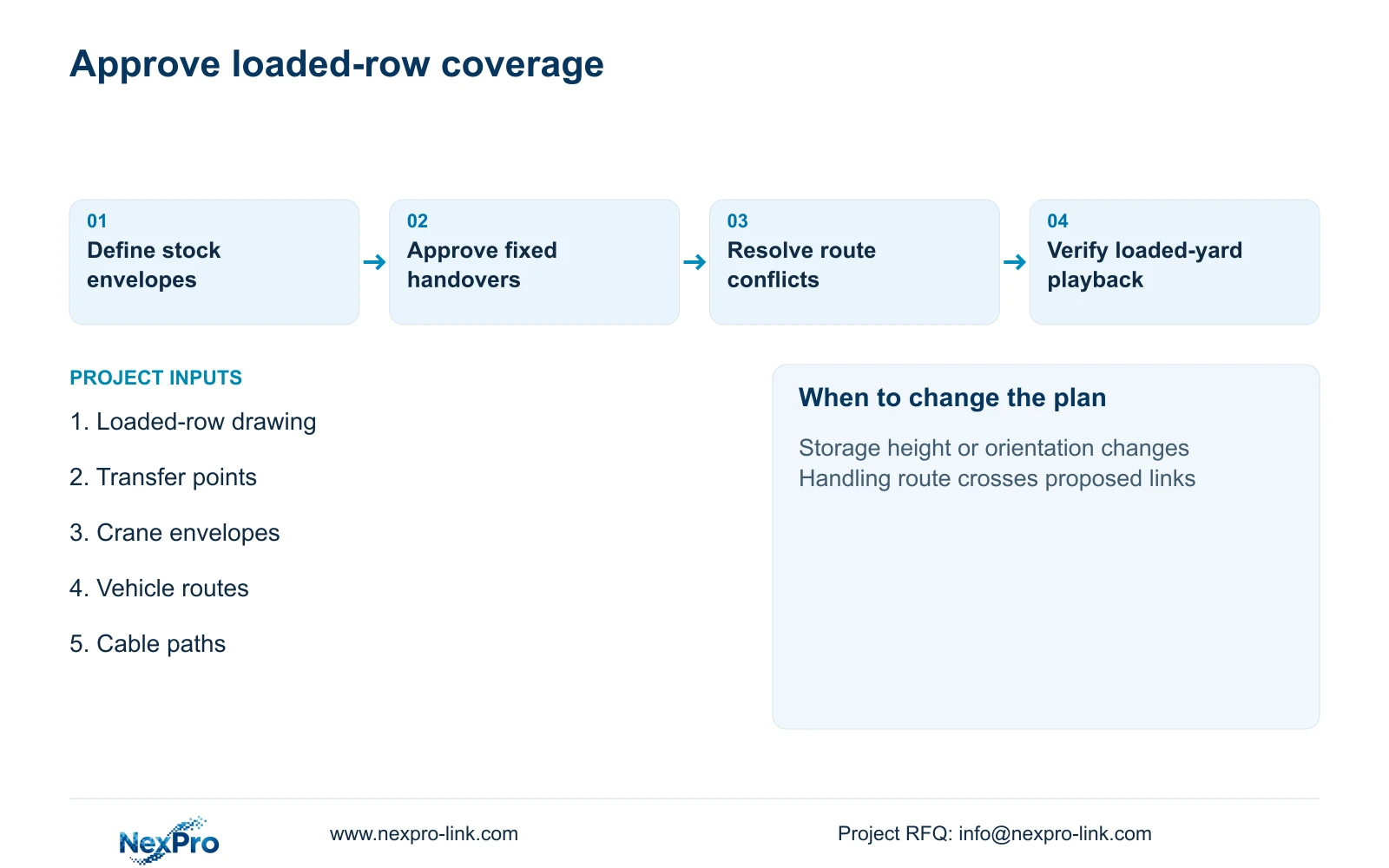
Before approving a new stock-row arrangement, overlay its maximum occupied envelope and the crane team's approved movement/access constraints on the camera drawing. Recheck transfer visibility and service access separately.
Section 01
Design against loaded rows rather than an empty yard
Before approving a new stock-row arrangement, overlay its maximum occupied envelope and the crane team's approved movement/access constraints on the camera drawing. Recheck transfer visibility and service access separately. Refer mount conflicts to the responsible site designer. Preserve the prior accepted view and record which changed row invalidated it.
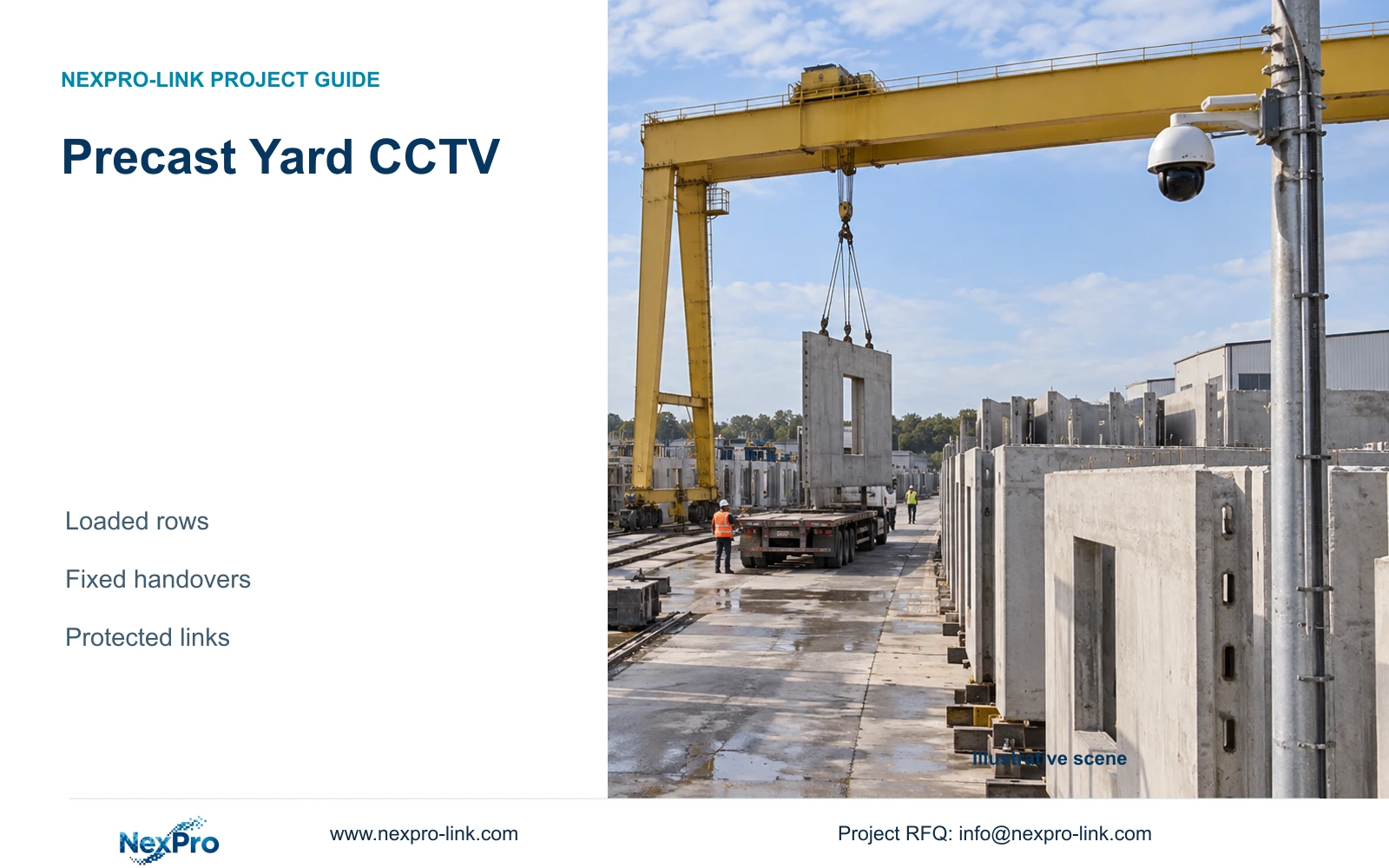
Use fixed views at stable transfer points for precast concrete yard CCTV, with supplementary overview where movement context is needed. Assess sightlines with loaded rows and crane activity before choosing camera quantities. Route links and mounts outside routine handling conflicts. One sweeping PTZ should not be the only record of several simultaneous transfer events.
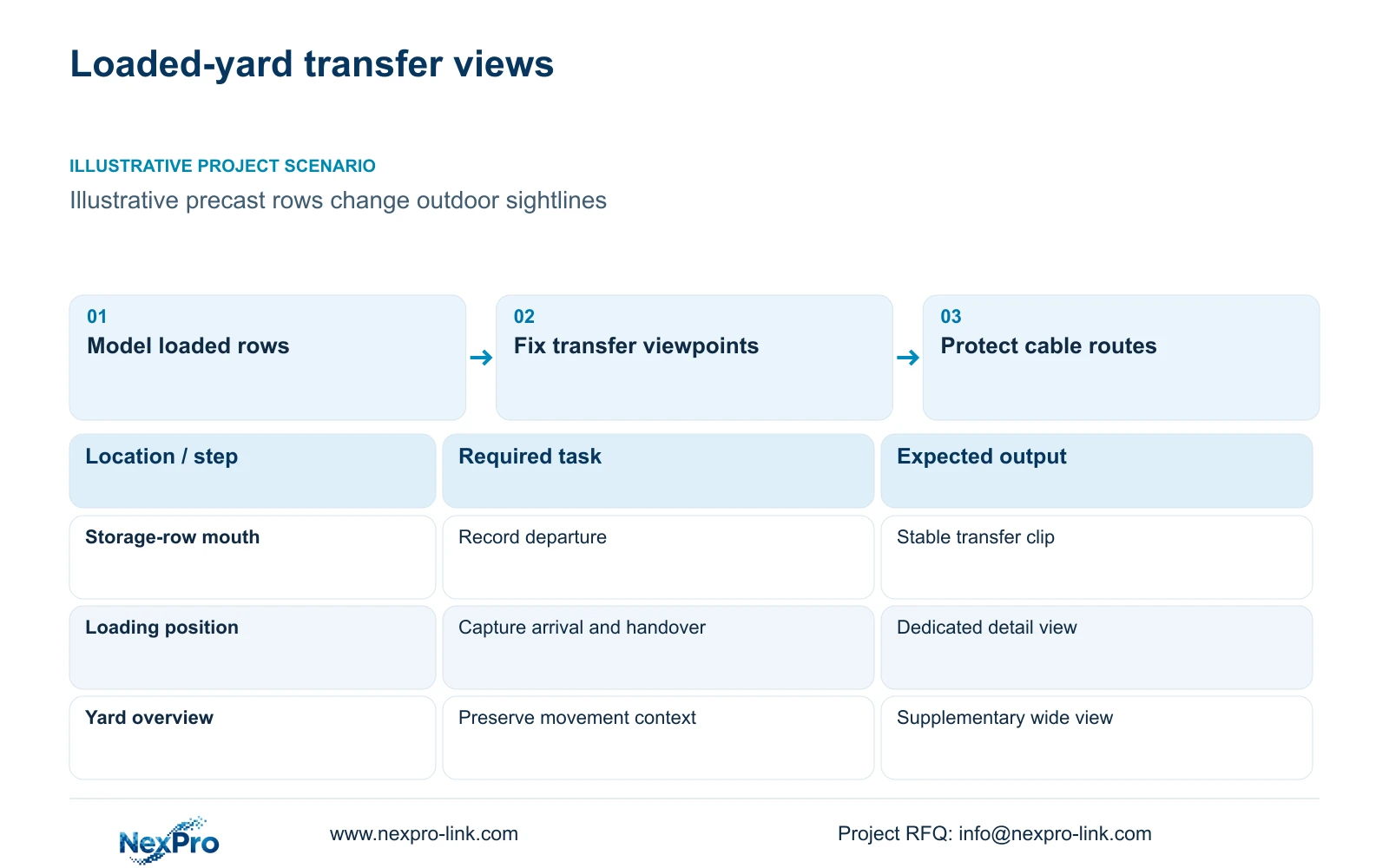
Illustrative project scenario: Large precast elements obscure an outdoor yard differently each week. Assume the planning review includes storage-row mouths, a transfer lane and truck loading positions. Stock arrangements and crane movements are proposed design inputs. The task is to reconstruct material movement, with no claim that CCTV provides lifting control or safety interlocks.
Request typical and maximum storage envelopes, including element height, orientation and approved clear routes. Draw blocked sightlines as well as clear ones. If a critical handover disappears when a row is occupied, move the task to a stable observable boundary or add another qualified viewpoint. Extra pixels cannot see through a stored concrete element.
Section 02
Keep critical handovers continuously in frame
Identify transfer points that remain meaningful when storage changes: departure from a row, arrival at a loading position or movement through a controlled lane. Define the required recorded sequence at each point. A fixed direction can preserve that sequence while an overview shows where the movement came from.
A PTZ may help an operator investigate activity, but its pointing direction should not remove the only critical transfer view. If a bidder proposes PTZ coverage as a substitute for several fixed views, ask how simultaneous events are recorded and demonstrate the proposed operating policy. Do not assume a preset tour provides uninterrupted evidence at every position.
The NexPro-BL2812M55-5MP-DIC-AI reference lists 2880×1620 output, 25fps and a 2.8 to 12mm motorized lens. Motorized lens adjustment supports framing; it does not establish PTZ pan or tilt movement. Use the actual target width and mounting geometry to select a candidate, then test the accepted event during representative handling.
Section 03
Route links outside crane and stock-handling conflicts
Overlay the proposed cable route with crane travel, loading envelopes, stock positions and access routes. Identify every exposed crossing and connection point. The local designer should select appropriate routing and protection; the equipment list should include the resulting supports, ducts, cabinets and installation work.
Measure each camera link along its approved route rather than using straight-line distance. CASE01 illustrates why continuous cuts matter: its 32 links total 1,872 m and use a feasible seven-reel plan with 305 m reels. Those figures are not transferable to this yard. Protected detours, new poles and remote nodes require a fresh length schedule.
Separate local camera copper links from any designed fibre backbone and its powered endpoints. Place recorder, switches and batteries in suitable accessible locations. A network connection to a remote yard cabinet does not establish a protected power supply there. Assign data and electrical responsibilities before the route becomes a priced construction item.
Section 04
Trade horizontal coverage for detail deliberately
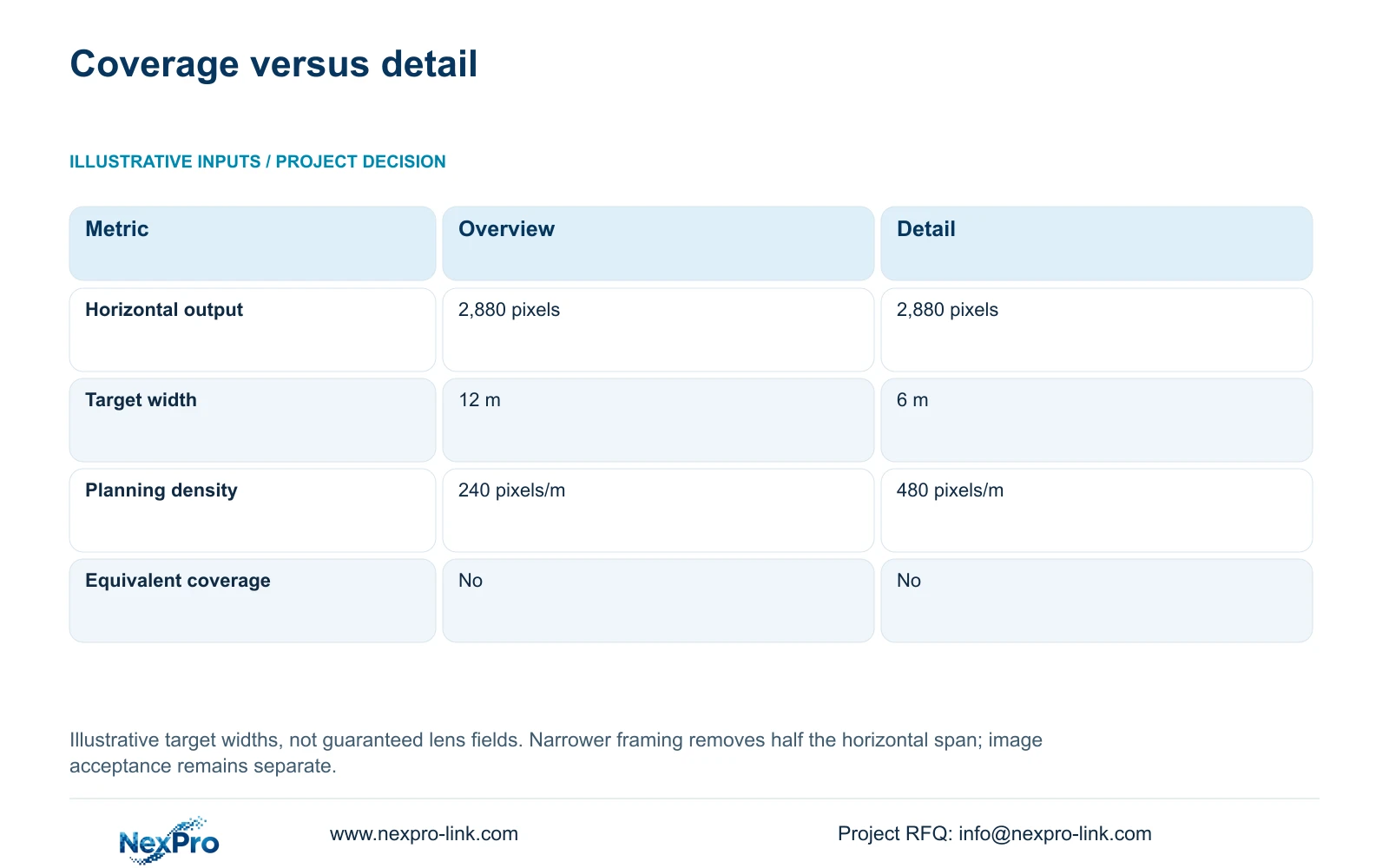
The supplied illustrative comparison uses one horizontal output of 2,880 pixels. Planning_pixels_per_metre = horizontal_output_pixels / target_width_m. Across a 12 m target plane, 2880 / 12 = 240 pixels/m. Across 6 m, 2880 / 6 = 480 pixels/m. These are assumed scene widths, not guaranteed fields of view for a particular lens setting.
The narrower view doubles planning density and removes half of the horizontal span at that plane. It therefore cannot be called equivalent yard coverage. If the owner needs both transfer detail and the wider movement sequence, preserve a separate overview rather than narrowing the only view and claiming fewer cameras are needed.
Pixel density alone does not guarantee recognition or useful image quality. Motion, light, compression, geometry and obscuration still matter. Use the figures to structure a trial at the row mouth or loading position, without assigning an unsupported universal acceptance threshold.
| Metric | Overview option A | Detail option B |
|---|---|---|
| Horizontal output | 2,880 pixels | 2,880 pixels |
| Target width | 12 m | 6 m |
| Planning density | 240 pixels/m | 480 pixels/m |
| Horizontal span | Wider movement context | Half the example span |
| Equivalent area coverage | No | No |
Section 05
Compare the complete fixed-view and overview package
Recommend fixed transfer views plus overview where both tasks are required. Change that basis when the actual yard provides a single stable view that proves both requirements, or when a different approved operating system must be retained. Do not add points merely to fill a uniform grid, and do not remove points because one narrow view has higher density.
Keep recording modes, bitrate and viewing concurrency explicit. CASE01 assumes 32 supported 5MP-class streams at an illustrative 4 Mbps each, producing 128 Mbps total input. A yard schedule with different modes or quantities needs recalculation. The NexPro-NVR4449-4K reference lists 320 Mbps input, but channel count does not prove every decoding layout or redundancy function.
Compare mounts, protected routes, local cabinets, backup-power boundaries and commissioning work alongside camera goods. Include actual PoE demand without inventing camera peak watts. A guardroom monitor may be sufficient for playback and selected live views; a larger display arrangement should be justified by operator tasks rather than yard size.
Section 06
Handover the loaded-yard acceptance conditions
Issue a task schedule showing the transfer event, loaded-row assumptions, target width and approved cable route for every point. State which overview cameras are supplied, which equipment is retained and which investigation views are optional. Identify the person responsible for accepting each recorded event.
NexPro-Link's factory supply and BOQ support can coordinate relevant models, equipment lists and technical submittals against that schedule. Project-labelled packing can associate cameras, mounts and accessories with the yard point identifiers. Local structural, electrical and installation approval remains with the appointed project parties.
At commissioning, review representative loaded rows and normal vehicle positions rather than only the empty yard. Retain photographs or sketches of the accepted geometry. A changed storage envelope or loading lane should trigger a sightline review; a revised handling route should reopen cable and mounting protection.
Section 07
Buyer questions
Can the camera count be finalised before stock arrives? It can be provisionally scheduled using agreed storage envelopes. Acceptance should still include representative loaded conditions, with a clear process for resolving points that lose the required event.
Does a motorized varifocal lens follow a crane? No such movement is established by the supplied lens specification. Treat lens adjustment as a framing function and specify any required tracking or PTZ role separately.
Should cameras be mounted on moving equipment? That requires a separate equipment and installation assessment. This package uses suitable fixed positions; it does not establish approval for moving mounts, their power arrangements or their environmental exposure.
Section 08
Define stable yard transfer views
Send your loaded-row layout, transfer and loading points, crane and vehicle movement envelopes, and proposed cable routes to info@nexpro-link.com for a fixed-view equipment package discussion.
Engineering references
These sources support the general planning principles. Always use the selected product's current datasheet and applicable project standards for final design.