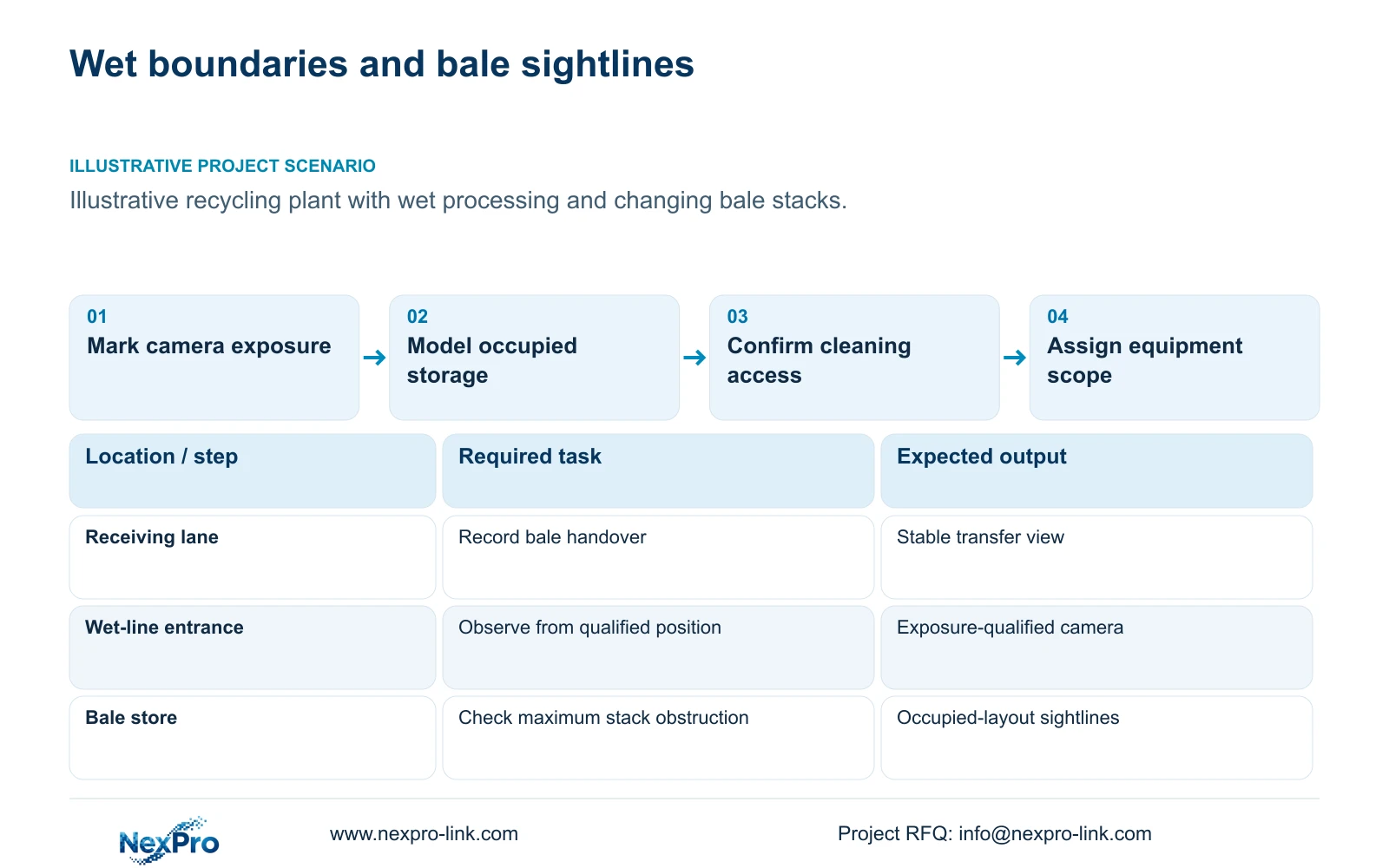
When bale relocation changes the approach to the wet line, review the visible handover and the camera-side exposure as separate consequences. Mark any new trolley obstruction or spray-reaching position on the revised drawing.
Section 01
Separate camera exposure from the area being observed
When bale relocation changes the approach to the wet line, review the visible handover and the camera-side exposure as separate consequences. Mark any new trolley obstruction or spray-reaching position on the revised drawing. Reuse the camera only after both checks pass; retaining the model does not retain the old cleaning or sightline assumptions.
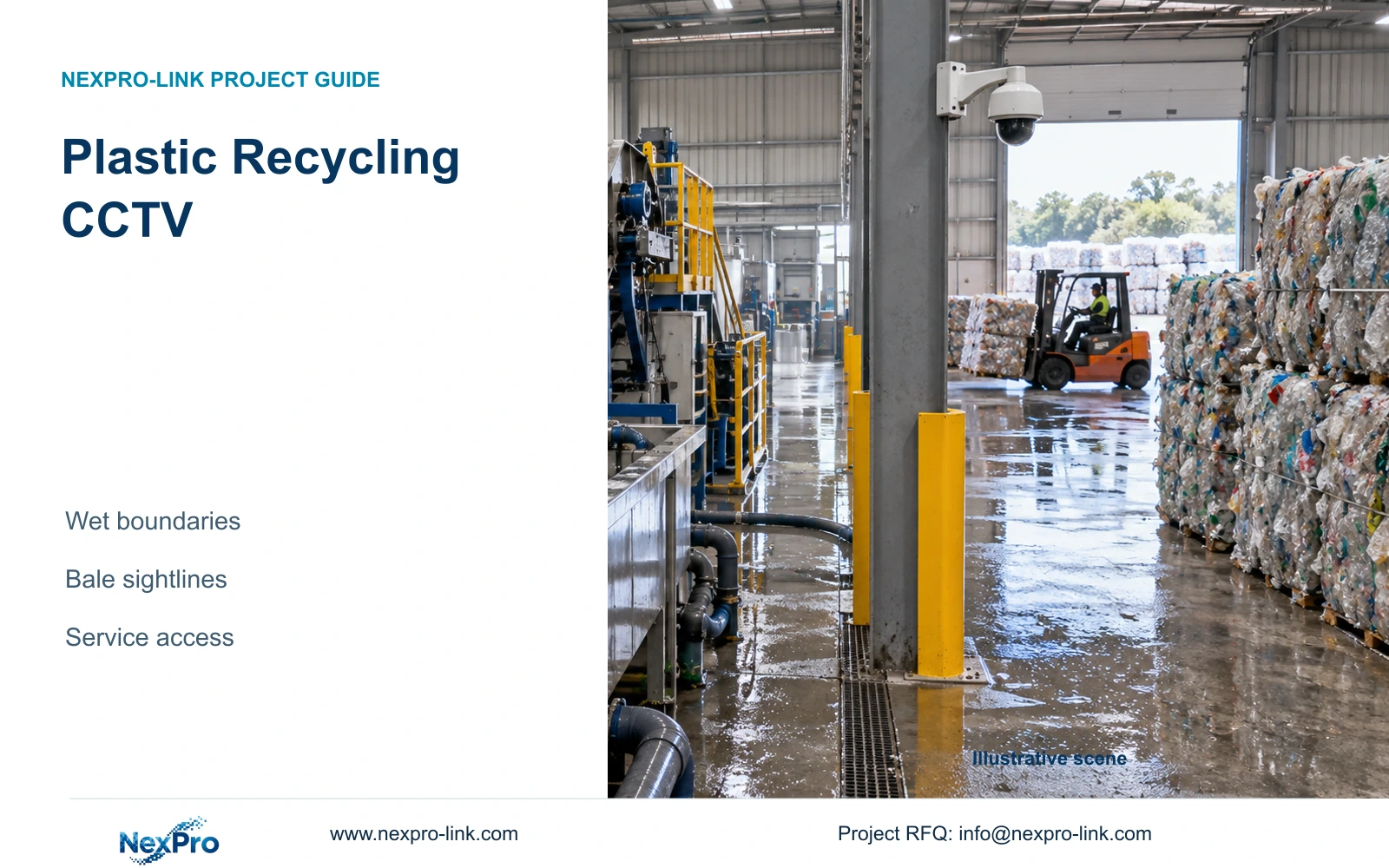
Plastic recycling CCTV should be specified by the conditions at each camera position and the transfer event it must record. Mark wet-processing boundaries, ordinary storage routes and any separately classified locations on the drawing before selecting equipment. A camera watching a wet line from a suitable dry position may have a different requirement from one mounted inside the cleaning envelope. Keep fire detection, process monitoring and machine interlocks under their own specialist scopes.
Illustrative project scenario: Bales and wet-processing boundaries create different camera conditions inside one plant. Assume incoming bales move through storage to a washing area, then processed material returns to ordinary handling routes. These are planning assumptions, not a completed customer project. The engineer needs useful records at receipt, wet-line entry and finished-material release, while temporary piles can obstruct the routes between them.
For every proposed view, record the target event, camera location, cleaning exposure, expected ambient conditions and maintenance route. Obtain the actual classification drawing where relevant, rather than treating every recycling area as hazardous or every covered area as ordinary. Assign business-record ownership separately: stock movements establish material identity, while CCTV supplies visual context. This prevents an equipment quotation from quietly taking responsibility for process quality or safety.
Section 02
Check coverage with storage at its permitted limits
Design storage views against occupied conditions. Ask the operator to mark permitted pile heights, bale-stack footprints, vehicle lanes and temporary overflow locations. Draw sightlines through the fullest credible layout, including a vehicle standing at the handover point. An empty-floor view can look complete while losing the actual transfer as soon as storage fills. The acceptance drawing should therefore show both normal occupancy and the agreed maximum storage arrangement.
Use stable transfer points as the baseline: a receiving threshold, a marked issue lane or the approach to a weighing position. Where one view cannot retain the approach and handover through the occupied layout, consider an opposing view or a separate detail camera. The additional position should answer a named question, such as which load entered the wet line, rather than merely add another broad overview.
Keep image framing and material identification distinct. A close view may show a label under agreed lighting, but an overview should not be promised to read every bale tag. Changes to stack height or the position of a transfer lane should trigger a sightline review before increasing resolution. Moving an obstruction or preserving a clear observation corridor may solve the problem without adding recorder channels, cable runs and maintenance points.
Section 03
Choose mounts that can be cleaned and realigned safely
A maintainable mounting position must preserve the view and allow the agreed service method. Have the local installer and plant operator identify how the lens will be reached, whether production must stop, and where access equipment can stand without occupying a vehicle lane. Record these decisions alongside mounting height and orientation. A high position that sees over piles can still be unsuitable if routine cleaning requires an impractical shutdown.
For ordinary positions, NexPro-BL2812M55-5MP-DIC-AI and the source Dome model NexPro-DM2812M55-5MP-DIC-AI are relevant candidates. Their supplied specifications list a 2.8–12mm motorized lens, 25fps in the 5MP family and a listed 2880×1620 output. Preserve that source field when preparing the submittal. Motorized adjustment can help establish framing, but it does not remove the need for physical cleaning or a stable mount.
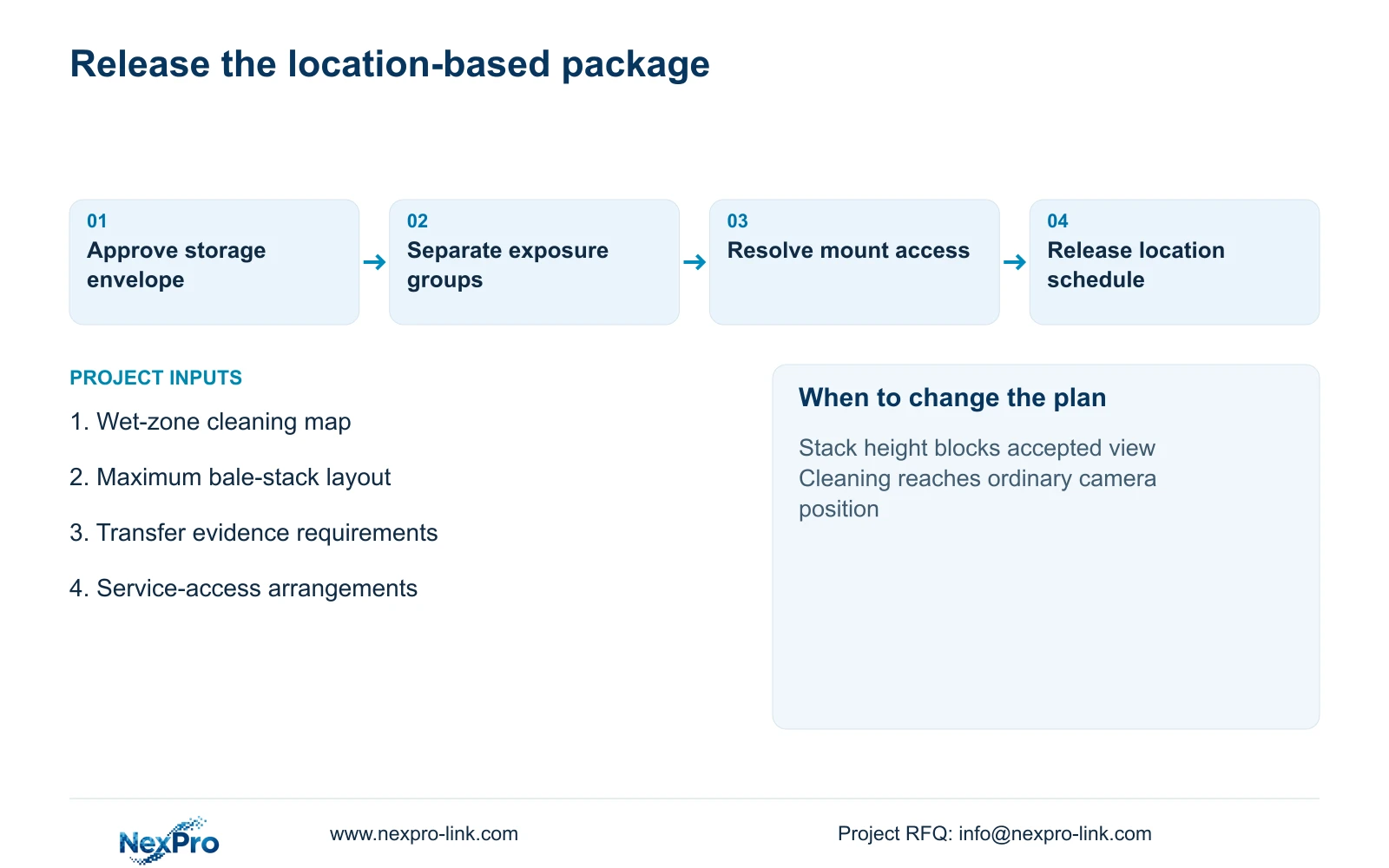
The engineer should issue a mounting schedule with a named view, service access requirement and permitted exposure for each position. The installer owns the proposed fixing and cable approach; the operator approves access arrangements. If the only usable view lies within direct spray, chemical exposure or another unsuitable condition, return to equipment qualification instead of adding an improvised cover and assuming the ordinary camera remains appropriate.
Section 04
Qualify ordinary and specialist positions independently
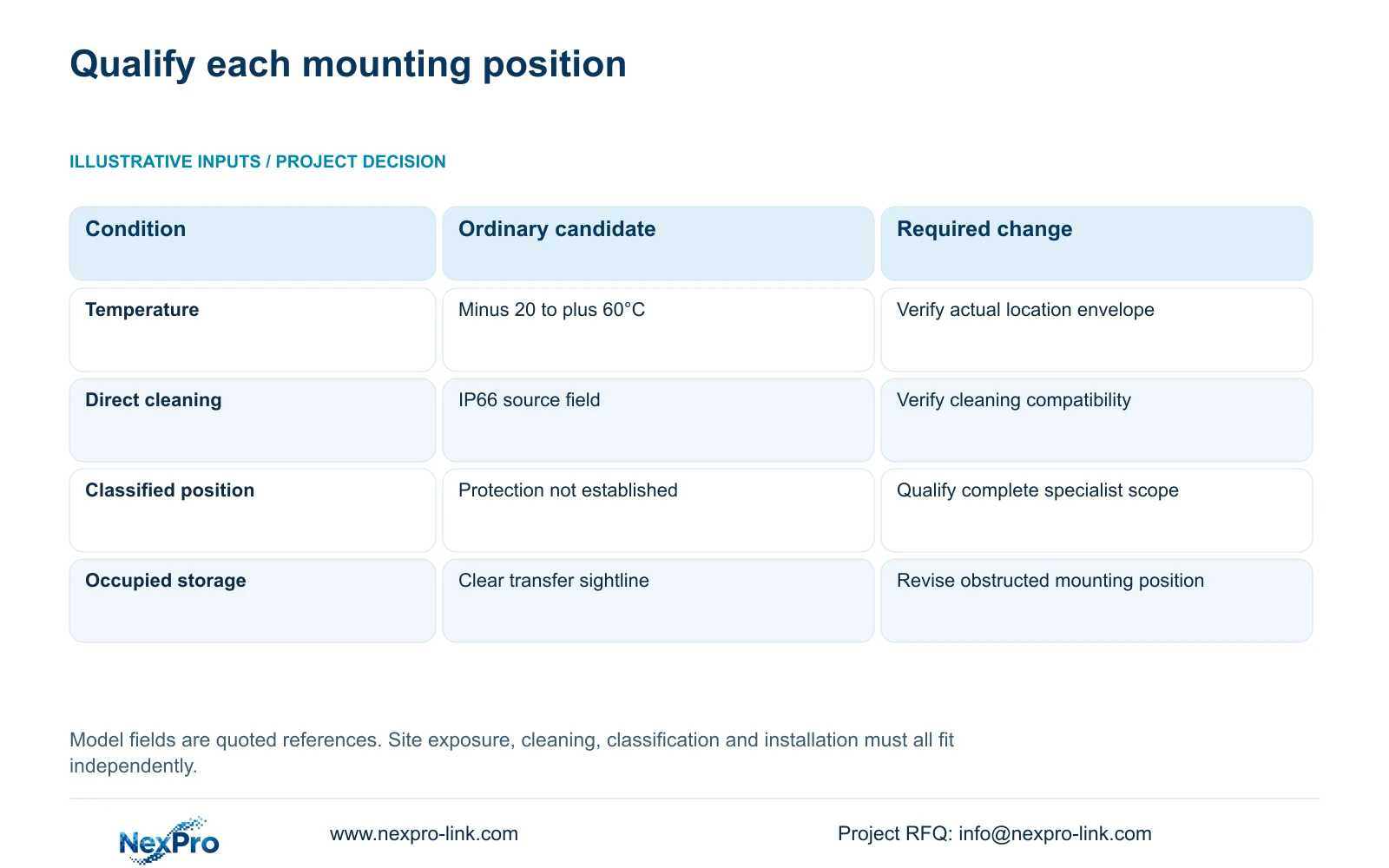
Use a conjunctive qualification method: location conditions AND complete product scope AND approved installation requirements must fit. Passing one field cannot compensate for a missing requirement elsewhere. The ordinary BL2812M and DM2812M references list IP66 and minus 20 to plus 60°C. Those are quoted model fields, not evidence of cleaning-chemical resistance, condensation tolerance or explosion protection.
The decisive difference is the exposure of the complete installation. A dry-side camera observing a wet-line entrance can remain an ordinary-location candidate if all its conditions fit. A camera inside the actual wash zone needs evidence for that cleaning method, its materials and its connections. Where classification applies, the responsible designer must verify the applicable local requirements and complete protective scope before procurement.
Apply the same discipline to occupied storage. A higher alternative mount may restore visibility but introduce a different ambient temperature, cleaning exposure or access requirement. Keep recorders, switches and batteries in suitable accessible service rooms where possible. Specialist equipment can then be priced only at the positions that need it, without weakening the requirement or unnecessarily extending it across the entire plant.
| Position or condition | Ordinary-location option | Specialist or revised option |
|---|---|---|
| Dry-side wet-line entrance | Ordinary camera if complete exposure fits | Relocate if spray reaches mounting position |
| Inside cleaning envelope | IP66 alone is insufficient evidence | Verify cleaning and material compatibility |
| Bale storage temperature | Quoted envelope: minus 20 to plus 60°C | Match the actual required operating envelope |
| Classified location | Explosion protection not established | Qualify complete product and installation |
| Recording equipment | Accessible suitable service room | Separate infrastructure from unsuitable exposure |
Section 05
Keep the recording package proportional to the evidence task
Prefer qualified ordinary cameras at stable transfer points, with specialist positions retained where exposure demands them. Use local recording nodes when the actual building arrangement and failure boundaries justify them. CASE05 supplies an illustrative architecture method from a solar-module campus: three independent 32-camera nodes. Its 96 cameras are not a proposed quantity for this recycling plant, and its ordinary-location assumptions cannot qualify wet-area equipment.
The case also shows why storage should be checked locally. At 32 cameras, an assumed average 4Mbps and 30 days of continuous recording, video_TB = cameras × average_Mbps × 10^6 × 86400 × days / 8 / 10^12 gives 41.472TB per node. Four 16TB disks provide 64TB raw; the illustrative recording budget is 64 × 0.95 × 0.80 = 48.64TB. Compare 41.472TB directly with 48.64TB because formatting and reserve are already included.
For the recycling project, replace those assumptions with the accepted camera schedule and measured or agreed streams. Match recorder modes and playback demand separately from channel count; the NVR4449 reference does not establish RAID or unrestricted 4K decoding. Size PoE from actual device demand, protect each relevant AC node, and measure continuous cable routes. Start with an operator retrieval screen; add a display wall only for a defined simultaneous-viewing task.
Section 06
Price the approved positions and their installation dependencies
Issue the quotation schedule by location, identifying supplied equipment, retained infrastructure, optional views and local work. Include mounts, junction protection, termination method, recorder allocation and the cleaning-access arrangement. Separate any specialist position from the ordinary camera allowance so bidders cannot hide a qualification gap within an average camera price. Unknown installation or maintenance costs should remain open items, not be treated as zero.
Compare alternative suppliers against the same occupied-storage view, transfer event and exposure conditions. Retain required platform integration or specified specialist equipment even when an ordinary camera alternative costs less. A useful deviation identifies exactly what changes and which acceptance task remains satisfied. Without matched quotations and site image checks, there is no supported overall brand winner.
NexPro-Link can discuss camera matching, BOQ conversion, technical submittals and related recording, power and cabling equipment through its factory project and tender-support scope. Project labels and packing can follow the approved location schedule. Local installation, specialist environmental qualification and final acceptance remain assigned to the project parties responsible for those tasks. The handover package should make those boundaries visible beside the equipment list.
Section 07
Buyer questions
Can we approve camera locations before the final bale-storage layout is available? Approve provisional transfer-point views and reserve final alignment until permitted stack footprints and heights are known. Mark affected positions as conditional and avoid releasing their mounts or cable lengths as fixed quantities.
Should every wet-line camera use the same specialist specification? Group positions by actual exposure, including cleaning method and camera-side conditions. A dry observation position and a directly cleaned position may need different equipment, even when both watch the same production stage.
What should a sample demonstration show? Use representative occupied storage and a wet-boundary transfer. Check obstruction, glare, useful event detail and retrieval from the proposed recorder. Record the tested configuration; a clear live picture alone does not demonstrate the complete evidence workflow.
Section 08
Define the recycling plant camera schedule
Email info@nexpro-link.com with your wet-zone and cleaning map, permitted bale-stack layout, transfer-point evidence requirements and proposed service-access arrangements. NexPro-Link can discuss a location-based equipment and quotation scope.
Engineering references
These sources support the general planning principles. Always use the selected product's current datasheet and applicable project standards for final design.