Pharmaceutical material-transfer video can support an investigation without becoming the process record. Define custody views, retrieval permissions and event references before selecting the recording package.
Section 01
Define the custody question the video must answer
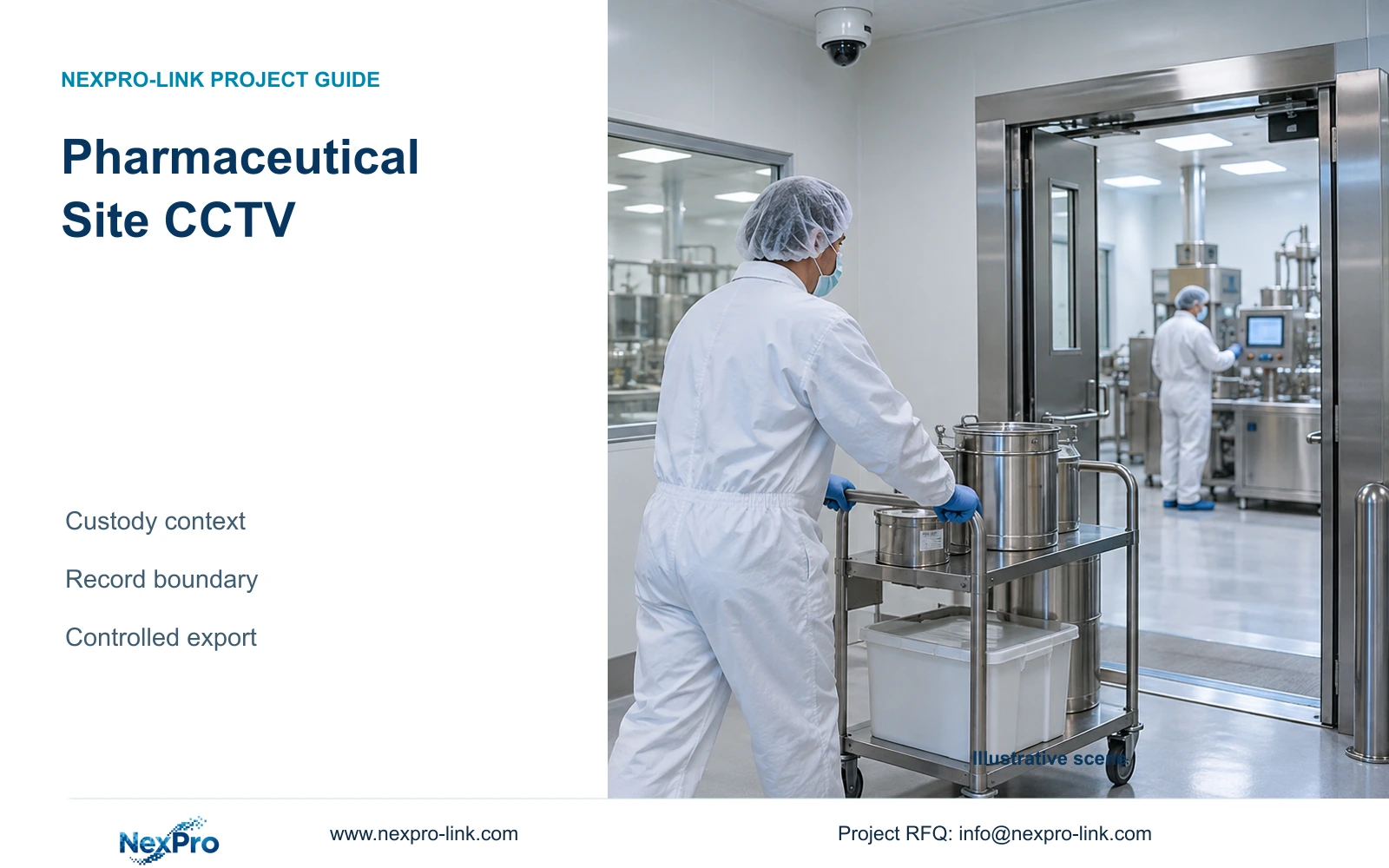
Pharmaceutical site CCTV should provide access and custody context while regulated process records and validation remain with their own systems and responsible personnel. Start with a question such as who moved a container through a transfer point and when. Do not specify a camera as proof of batch approval, product condition or process completion when the intended purchase is ordinary security recording.
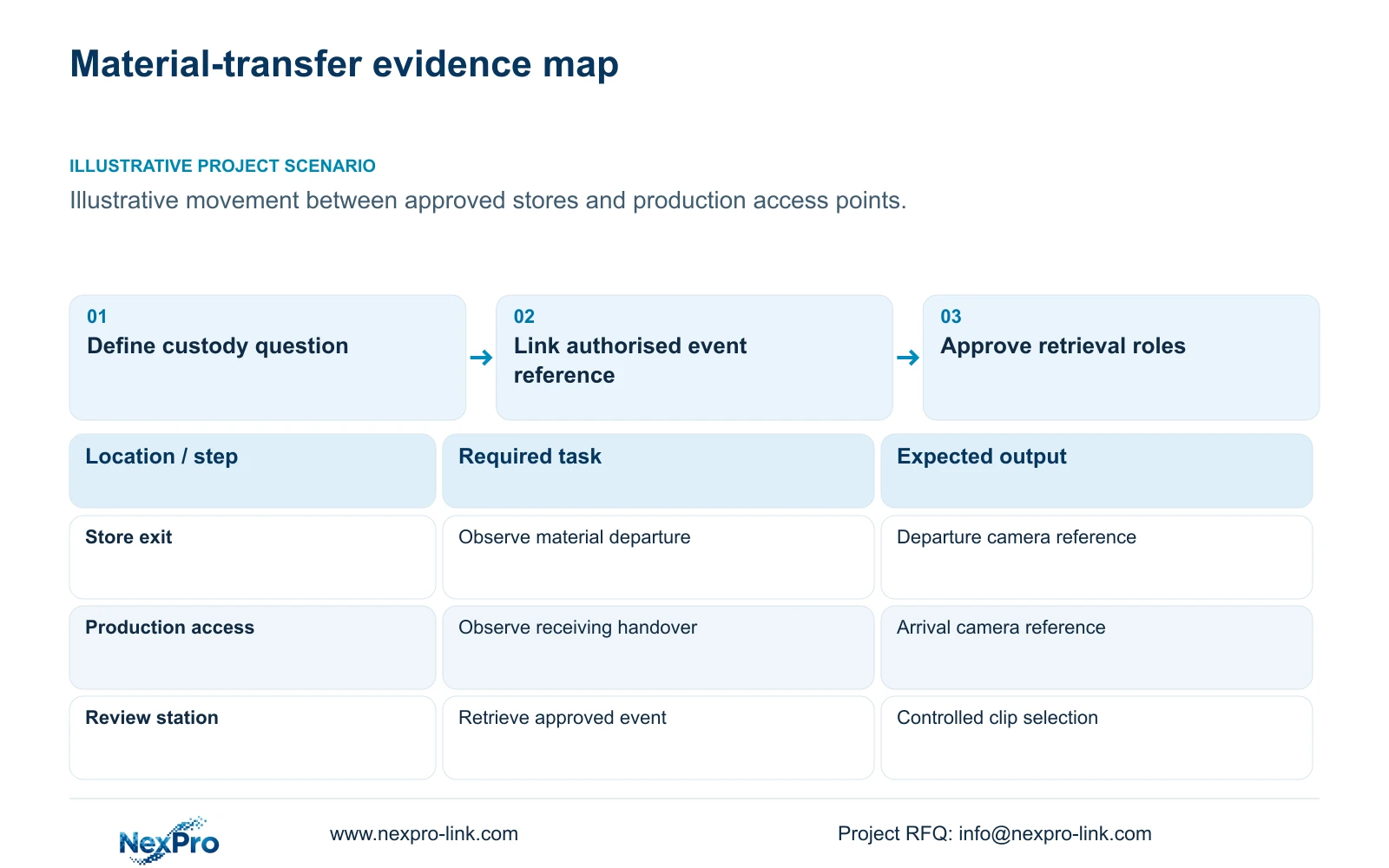
Illustrative project scenario: The plant wants to investigate movement between approved stores and production access points. Assume the project team selects a store exit and a receiving access point as two linked custody views. These are proposed observation tasks, not a client case or a validated workflow. The owner must identify which movements need review and which information the authorised records already contain.
Define the start and end of the physical transfer before drawing camera cones. A useful view might show departure, intermediate handling or arrival, depending on the disputed event. Confirm location classification, cleaning exposure and temperature independently of that task. Suitable ordinary locations may use standard security equipment; controlled or specialist positions require their own approval and installation scope.
Section 02
Keep process records and video linked but distinct
Create a project-method event reference that can be used to locate footage without duplicating the regulated record inside the CCTV system. A transfer identifier, location reference and recorded time can form that link where the owner's procedures permit it. The authorised record remains the source for material status and required approvals. Video contributes visible context that the responsible reviewer interprets alongside those records.
Assign ownership of the link. The material or quality team defines the approved event information; security maintains the camera-to-location schedule; the system administrator supports the agreed time configuration. Record any known time offset during acceptance. If timestamps cannot be reconciled, widen the search and disclose the uncertainty rather than implying an exact match.
A manual event register can be the initial method. Automatic integration is a separate option requiring identified interfaces, supported functions and acceptance tests. A shared product label or basic network connection does not prove that an NVR exchanges approved records with the plant's systems. If the owner intends to use video as part of a regulated record workflow, escalate that scope to the responsible quality and validation personnel.
For US drug CGMP, FDA's Records and Reports Q&A explains that records needed to demonstrate compliance remain available for inspection even when filed outside the quality system. A security label does not exempt footage used in a quality investigation. The owner's quality team must determine the applicable record obligations; this is not a worldwide CCTV retention rule.
Section 03
Approve retrieval and export as separate actions
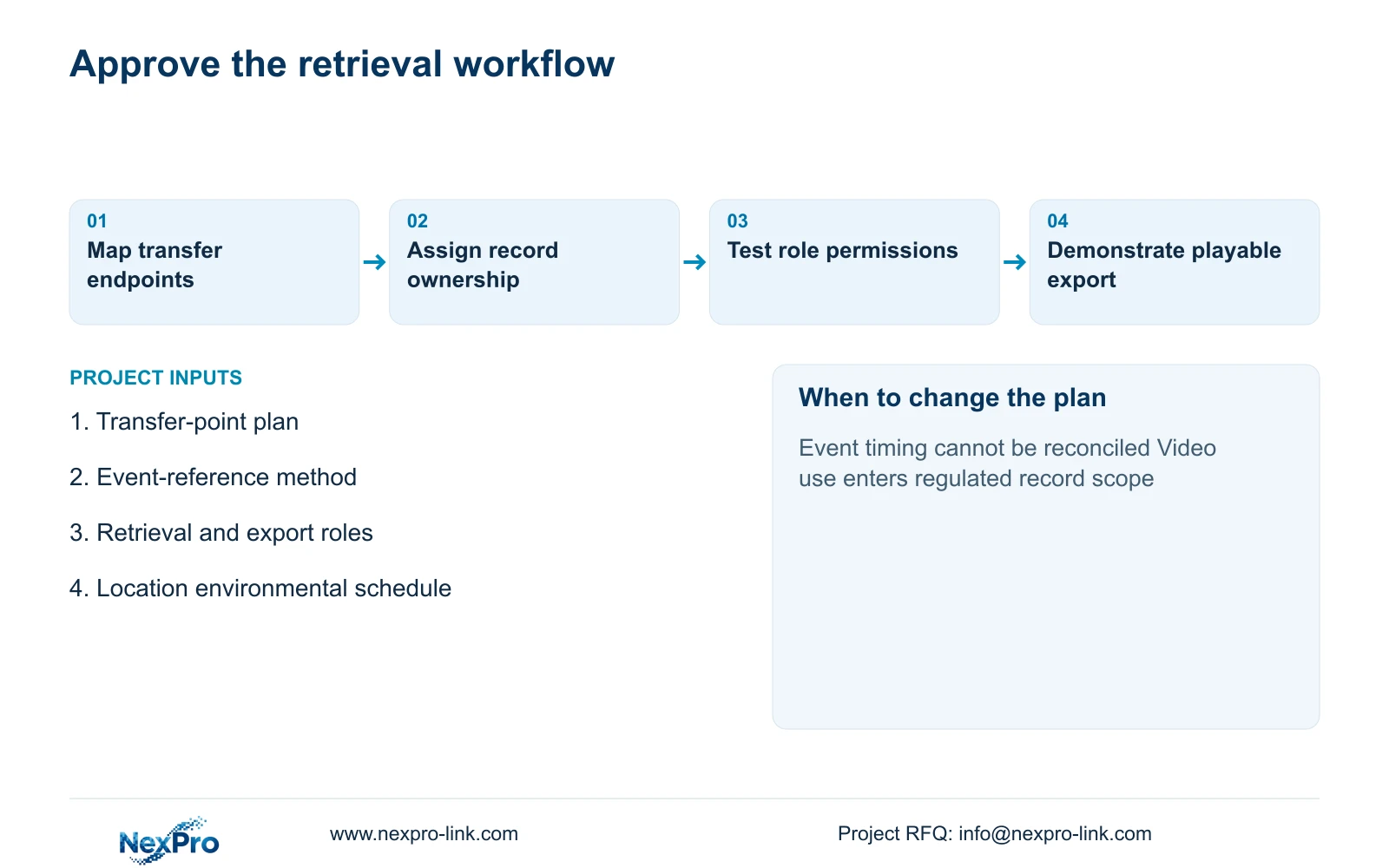
Define who may view live transfers, search recorded events and export clips. Those actions need not share the same permission. A warehouse supervisor may need daily operational context, while an investigation reviewer needs selected playback and a designated custodian handles external release. Translate these proposed roles into a permissions test for the exact recorder or client rather than assuming the required separation exists.
For the illustrative transfer, the requester should provide an event reference, suspected interval, locations and review purpose. An authorised reviewer first checks the linked views and expands the interval if the movement begins earlier or continues elsewhere. Export approval should cover the selected material and recipient. This preserves necessary context without routinely copying unrelated warehouse activity.
Specify a handling record for exported material, including the selected cameras, start and end times, operator and destination. Keep copies in the owner's approved storage and access workflow. These are proposed procurement and operating controls, not a claim that a particular model provides immutable audit trails or that the export has a guaranteed legal status. Verify playback of the delivered files before accepting the export task.
Section 04
Measure the requested payload without trimming the event
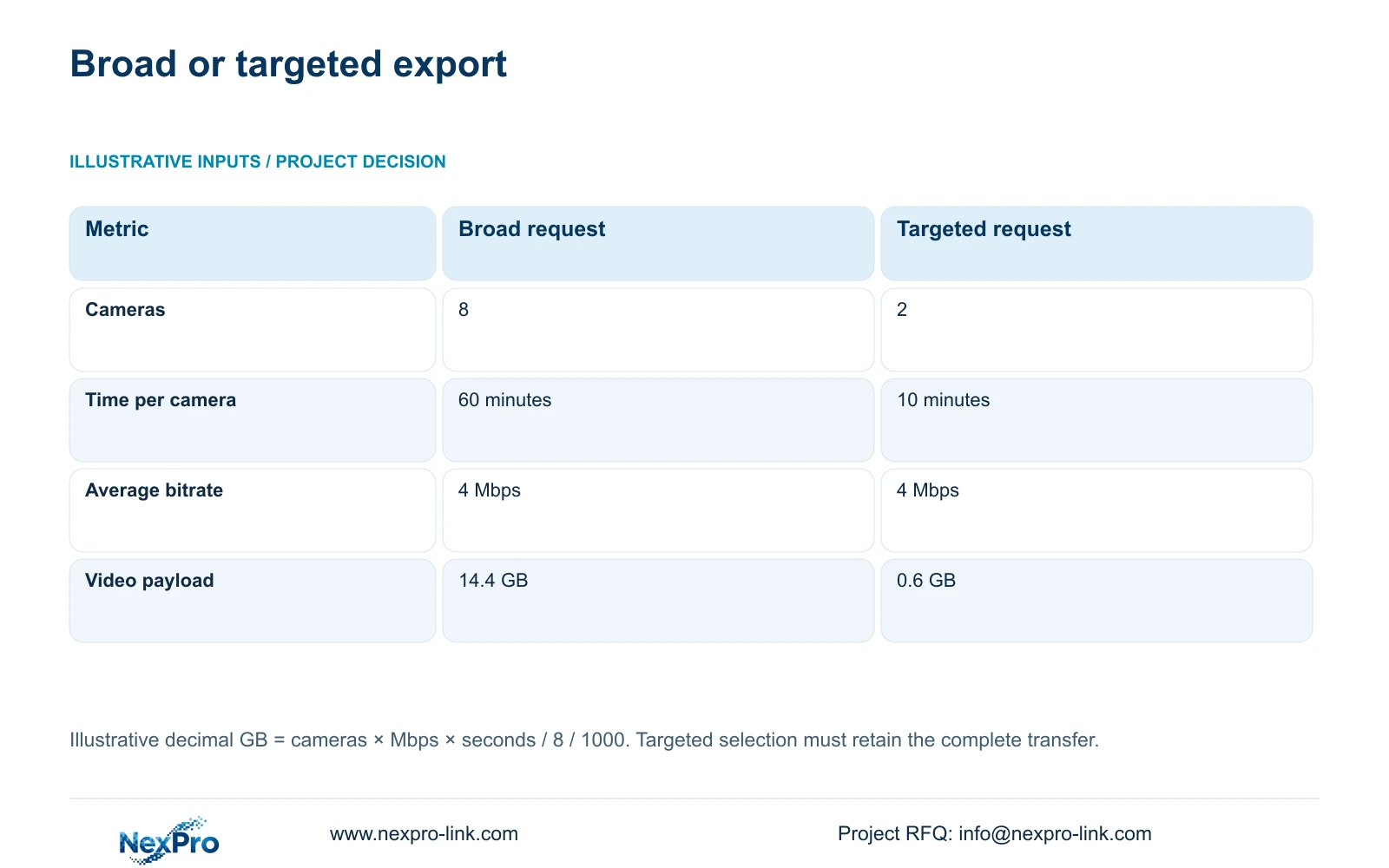
The supplied illustrative comparison uses eight cameras for 60 minutes each at an average 4 Mbps in the broad request. The targeted request uses two relevant cameras for 10 minutes each at the same average bitrate. Decimal payload is calculated as GB = cameras × Mbps × seconds / 8 / 1000. The broad result is 8 × 4 × 3600 / 8 / 1000 = 14.4 GB; the targeted result is 2 × 4 × 600 / 8 / 1000 = 0.6 GB.
The decisive difference is the approved selection, not a change to source recording quality. Both requests use 4 Mbps streams. A time-and-camera map can remove unrelated material from the request, but the 0.6 GB selection is appropriate only when those two views and that interval retain the complete required transfer. A delayed handover or an intermediate stop could justify a wider selection.
These figures estimate video payload rather than final packaged file size or export duration. Container overhead, actual variable bitrate, audio and other selected data can change the result. Do not convert the difference into guaranteed staff-time savings. Use it to specify export destinations and test the workflow while keeping the full original recording available for the agreed retention period.
| Input or result | Broad request | Targeted request |
|---|---|---|
| Selected cameras | 8 | 2 |
| Interval per camera | 60 minutes | 10 minutes |
| Average bitrate | 4 Mbps | 4 Mbps |
| Estimated decimal payload | 14.4 GB | 0.6 GB |
| Acceptance condition | Use when event scope is uncertain | Use when complete event remains included |
Section 05
Choose infrastructure around recording and investigation
The supplied 40-camera chemical-site reference illustrates a system boundary that can inform this project, without prescribing a pharmaceutical camera count. It separates 32 ordinary positions from eight specialist positions and assumes local recording. The useful lesson is to preserve the location split and the retrieval path together: an approved view is ineffective for investigation if its recording cannot be located and exported by authorised staff.
For suitable ordinary positions, NexPro-DM2812M55-5MP-DIC-AI is a Dome-family reference listing 2880×1620 output, 25fps and a 2.8 to 12 mm motorized lens. Its published IP66 and minus 20 to plus 60°C fields do not establish cleanroom, chemical or hazardous-location suitability. Test the actual transfer view with representative handling and lighting; no label-reading distance follows from the model name.
Route camera data through the selected access network to the recorder and authorised client. Size PoE using confirmed device demand and protect the necessary switch, recorder and link equipment on actual UPS circuits. Keep copper routes and specialist transitions separate in the installation scope. Recommend a practical retrieval workstation first; a display wall is optional unless simultaneous monitoring is an accepted operating task.
Section 06
Turn the boundary into a supplier acceptance task
A pharmaceutical CCTV RFQ should state the custody question, required views, retention input and role-based retrieval task. Separate supplied equipment from retained plant systems and local installation work. The expected output is ordinary security supply with any specialist positions independently specified, plus a demonstrated method for locating transfer footage. It is not a promise that CCTV replaces GMP records or receives regulatory acceptance.
NexPro-Link's BOQ and tender support can help match models, prepare technical submittals and identify deviations. Ask for the proposed camera and recorder versions, supported playback/export workflow and any missing permission capability. Compare another supplier against the same scope, retaining mandatory software or integration requirements rather than removing them to create a cheaper camera-only offer.
At acceptance, use a representative transfer reference to locate both endpoints, review the surrounding sequence and export an approved selection. Have the owner confirm that excluded views remain inaccessible to the test role. A changed store layout, event-reference method or intended record use should reopen the affected design decisions. Equipment preparation and project packing can follow the accepted schedule without exposing confidential process information in carton labels.
Section 07
Buyer questions
Is automatic batch-to-video integration necessary at the first stage? Not necessarily. A controlled manual reference can support the initial retrieval task. Quote automation separately when the owner defines its interface, responsibility and acceptance requirements.
Can a smaller export replace the retained original recording? It should not silently change the retention plan. A selected export serves a particular request; the original footage follows the owner's separately approved recording and preservation policy.
What if the recorder cannot separate playback and export rights? Record that as a functional deviation. Consider an approved supervised workflow or a different client architecture, then test the chosen arrangement before procurement approval.
Section 08
Specify a material-transfer investigation package
Email the transfer-point plan, security/process record boundary, retrieval-role requirements and location/environment schedule to info@nexpro-link.com for equipment and workflow scope discussion.
Engineering references
These sources support the general planning principles. Always use the selected product's current datasheet and applicable project standards for final design.