A practical approach to linking batch dispatch events with CCTV footage, covering clock alignment, retrieval permissions, cleaning boundaries and measurable export scope.
Section 01
Use the existing batch record as the lookup anchor
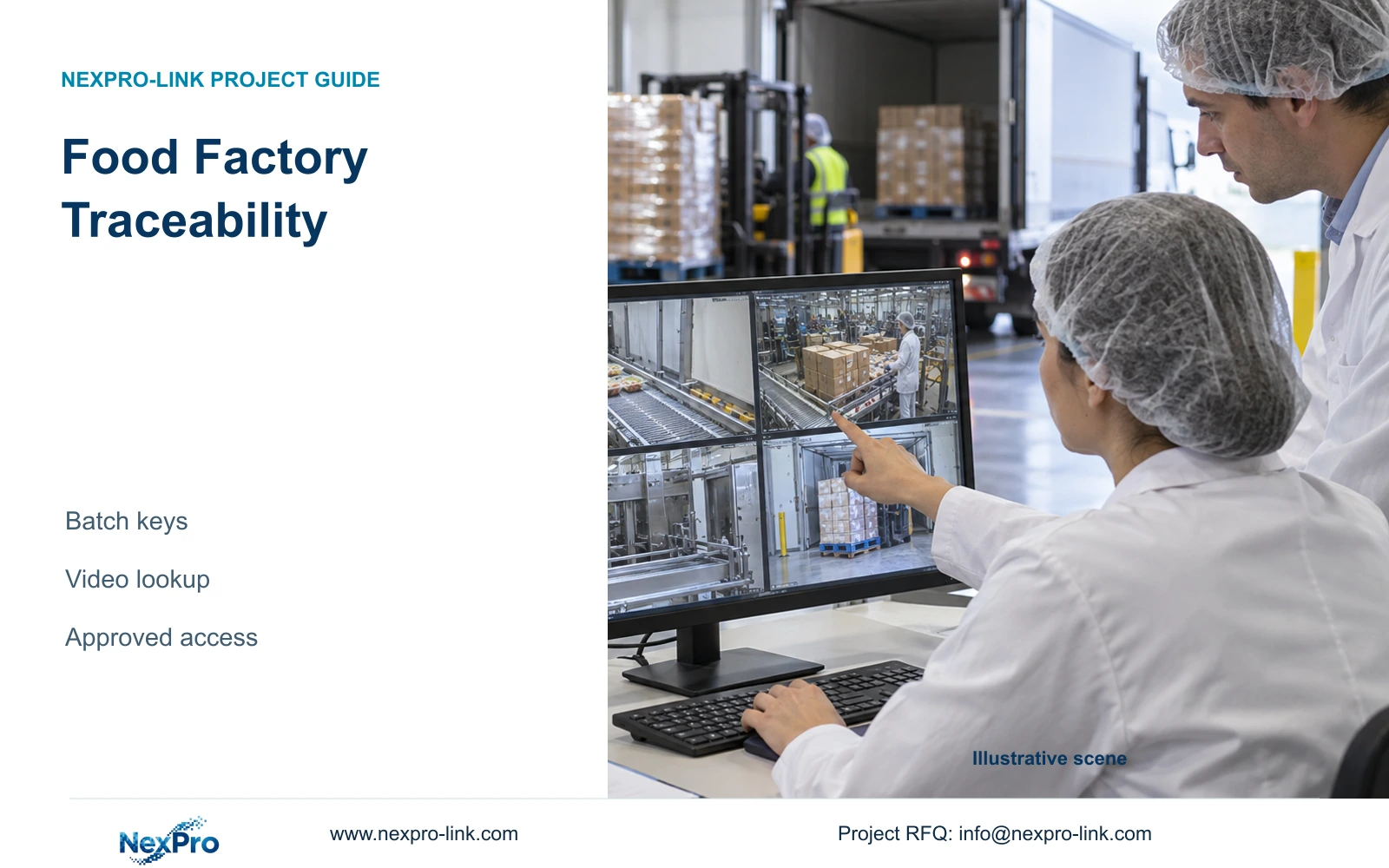
Food factory traceability can use video to help reconstruct a dispatch event when the existing batch record supplies a reliable reference. Begin with a documented time-and-camera lookup. Keep batch identity, quantities, release decisions and corrections in their established records; ordinary CCTV does not automatically create a validated traceability platform. The first project decision is which existing identifier will lead an authorized reviewer to the relevant event.
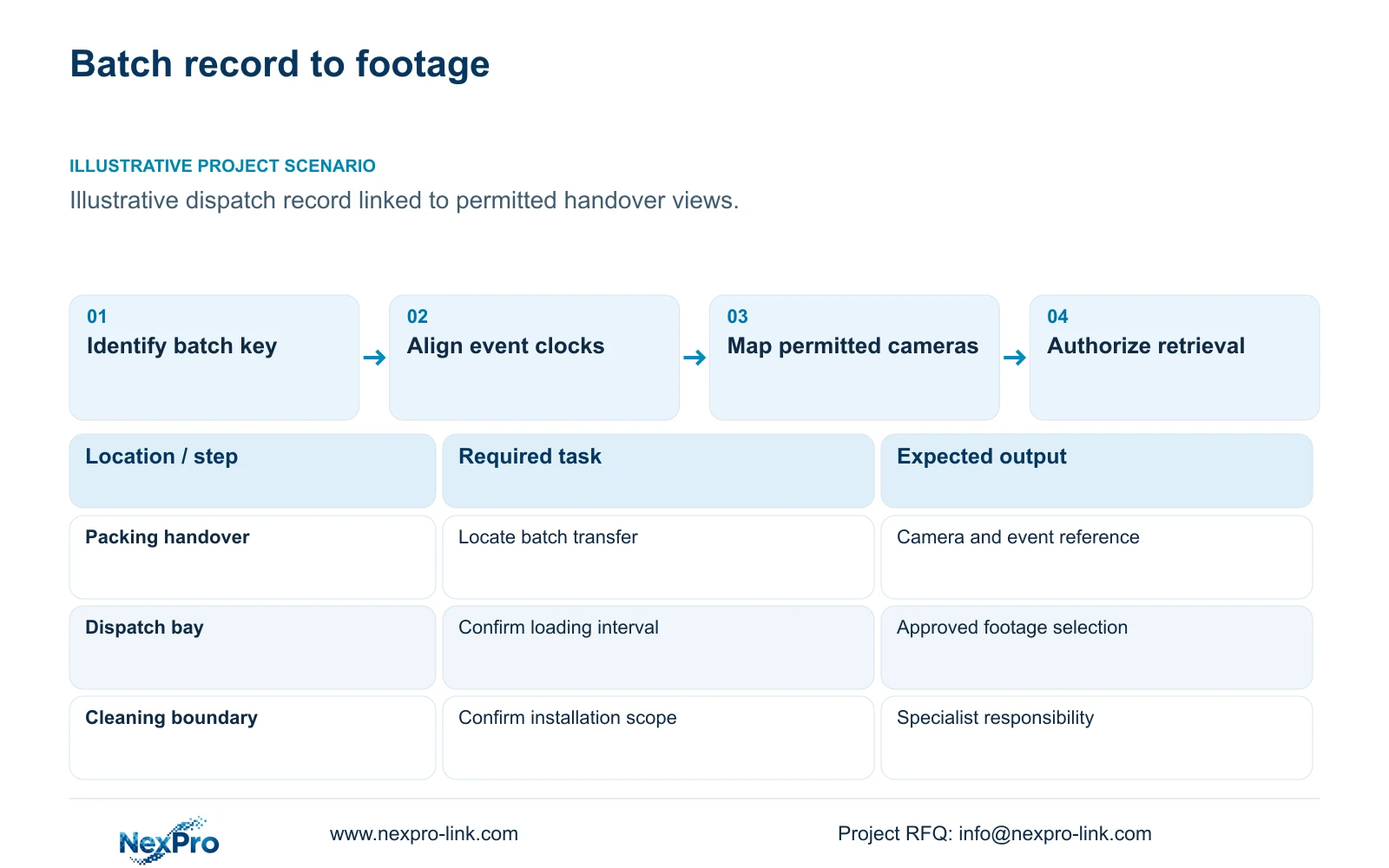
Illustrative project scenario: A quality team wants to open relevant footage from a batch dispatch record. Assume the record contains a batch identifier, dispatch time and loading location. The project manager asks operations to confirm whether that timestamp describes loading, paperwork completion or vehicle departure. Those events may occur at different times, so the answer determines the search window and the cameras worth selecting.
Use the supplied 48-camera food-processing reference as the wider planning context: 40 ordinary security positions and eight specialist cleaning-boundary positions, divided between two 24-camera nodes. A batch may pass several views, but its dispatch lookup should name the permitted packing and loading positions that actually show the handover. Record the hygiene zone and cleaning exposure beside each camera identifier so a useful viewing angle does not lead to an unsuitable installation.
Section 02
Align event timestamps before narrowing the footage
The engineer should establish a common time basis for the batch-record system, cameras, recorders and review client. Document the configured time source, timezone and any daylight-saving behavior relevant to the site. During acceptance, compare a visible, deliberately staged handover with its recorded operational timestamp. Record any offset and determine whether it comes from clock disagreement or from the business event being entered later.
Create a location map that connects the loading-bay name used by operations to camera IDs and recorder channels. Include its revision and effective date. If a packing station moves or a camera is reassigned, retain the historical mapping needed to find older footage. Reusing an attractive camera name without tracking the change can send a reviewer to the wrong location even when every clock is correct.
A manual lookup remains a reasonable baseline when staff can identify the event and select its views consistently. Add a documented interface only when the owner needs a repeatable direct lookup and the participating systems support it. Specify who maintains the mapping, how failed searches are reported and what happens when the time source becomes unavailable. These requirements should precede a software quotation.
Section 03
Approve the viewing route and the installation boundary
Define who can request footage, who can play it back and who can export a copy. A request should carry the batch reference, location, event interval and reason for review. The authorized operator then selects the corresponding recorder channels and records the selection used. Keep the operational record linked to the retrieval reference rather than embedding unrestricted video access in every batch entry.
For ordinary permitted locations, NexPro-BL2812M55-5MP-DIC-AI and NexPro-DM2812M55-5MP-DIC-AI are candidate camera references. Their source specifications list 2880×1620 output, 25fps and a 2.8–12mm motorized lens within the 5MP families. Select the view through a sample scene check; those fields do not establish readable batch labels at an unspecified distance. IP66 also does not establish universal hygienic washdown or food-safety suitability.
Assign the environmental split explicitly. The equipment supplier proposes ordinary camera and recording candidates; the food-factory team defines hygiene zones and cleaning methods; the specialist designer confirms equipment and connections for the eight demanding positions; the local installer implements approved mounts and routes. Keep racks outside unsuitable cleaning exposure. Stream compatibility and the requested playback/export workflow require verification even when basic video connectivity is available.
| Item | Required task | Supply status | Responsible party |
|---|---|---|---|
| Batch record | Provide identity, time and location | Retained | Factory operations |
| Ordinary camera views | Record permitted packing/loading handovers | Supplied candidates | Equipment supplier and installer |
| Cleaning-boundary positions | Meet approved exposure and installation scope | Separate specialist scope | Specialist designer |
| Direct batch lookup | Open documented camera/time selection | Optional interface | Record-system and video-system providers |
Section 04
Measure the selected video without trimming the event
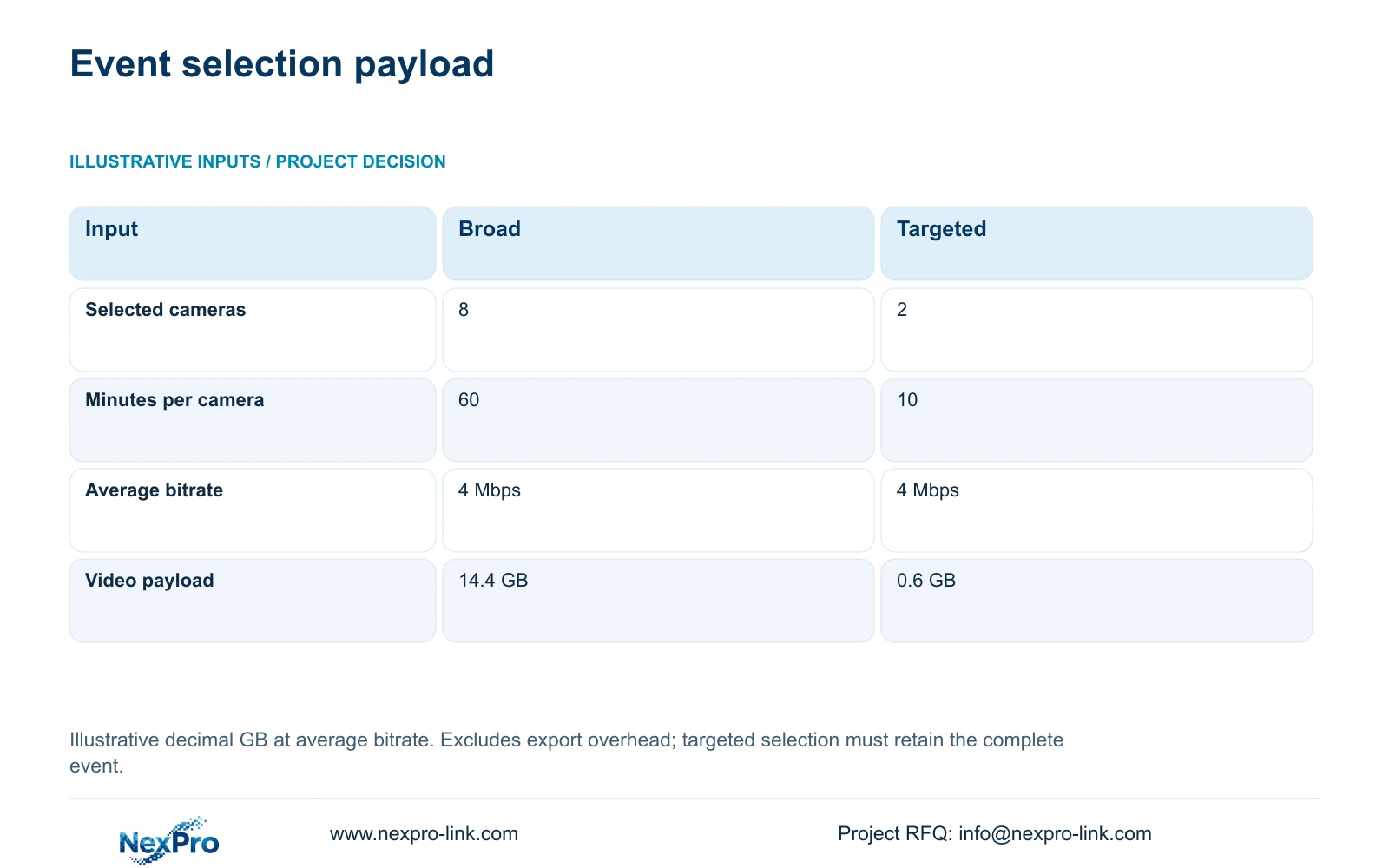
The illustrative broad request selects eight cameras for 60 minutes each at an average 4 Mbps. The targeted request selects two relevant cameras for 10 minutes each at the same bitrate. Using decimal GB, the payload formula is GB = cameras × Mbps × seconds / 8 / 1000. The broad selection is 8 × 4 × 3600 / 8 / 1000 = 14.4 GB; the targeted selection is 2 × 4 × 600 / 8 / 1000 = 0.6 GB.
The decisive difference is the camera-time selection. The smaller request removes unrelated views and intervals only after the mapping identifies the complete required handover. If a pallet waits outside the selected interval, changes bay or returns to packing, widen the request. Preserve enough context to explain what happened before and after the transfer.
These figures estimate average video payload, excluding export-container overhead and additional material. They do not establish export duration, staff-time savings or legal evidence status. They also do not change recording retention: the underlying footage remains recorded under the approved policy. A narrow retrieval request is an operating choice, not a reason to reduce the storage allocation.
| Selection input | Broad request | Targeted request |
|---|---|---|
| Cameras selected | 8 | 2 |
| Minutes per camera | 60 | 10 |
| Average bitrate | 4 Mbps | 4 Mbps |
| Estimated payload | 14.4 GB | 0.6 GB |
Section 05
Choose manual lookup unless an interface solves a defined gap
Recommend an approved manual time-and-camera workflow first when dispatch records provide sufficient event context. It preserves the existing record system and makes missing information visible during a pilot. An interface becomes justified when repeated requests cannot be handled consistently, several locations share ambiguous names or the owner requires direct lookup from an existing application. Require documented behavior rather than assuming an NVR menu supplies that integration.
Check retention independently of retrieval convenience. In the 48-camera reference, each 24-camera node records continuously for 30 days at an assumed average 4 Mbps, producing 31.104 TB of video. Four 12 TB disks provide 48 TB raw per node; 48 × 0.95 × 0.80 = 36.48 TB is the illustrative video budget after formatting allowance and reserve. Compare 31.104 TB with 36.48 TB without deducting reserve again.
The NexPro-NVR4449-4K reference lists 320 Mbps input and four SATA bays, with summary modes distinguishing 49×5MP and 9×4K. Those fields support candidate screening, not a RAID or simultaneous decoding promise. Compare alternative proposals against the same recorded views, retention, specialist positions and retrieval permissions. Retain a mandated platform or required integration where the project depends on it.
Section 06
Release a retrieval schedule that survives site changes
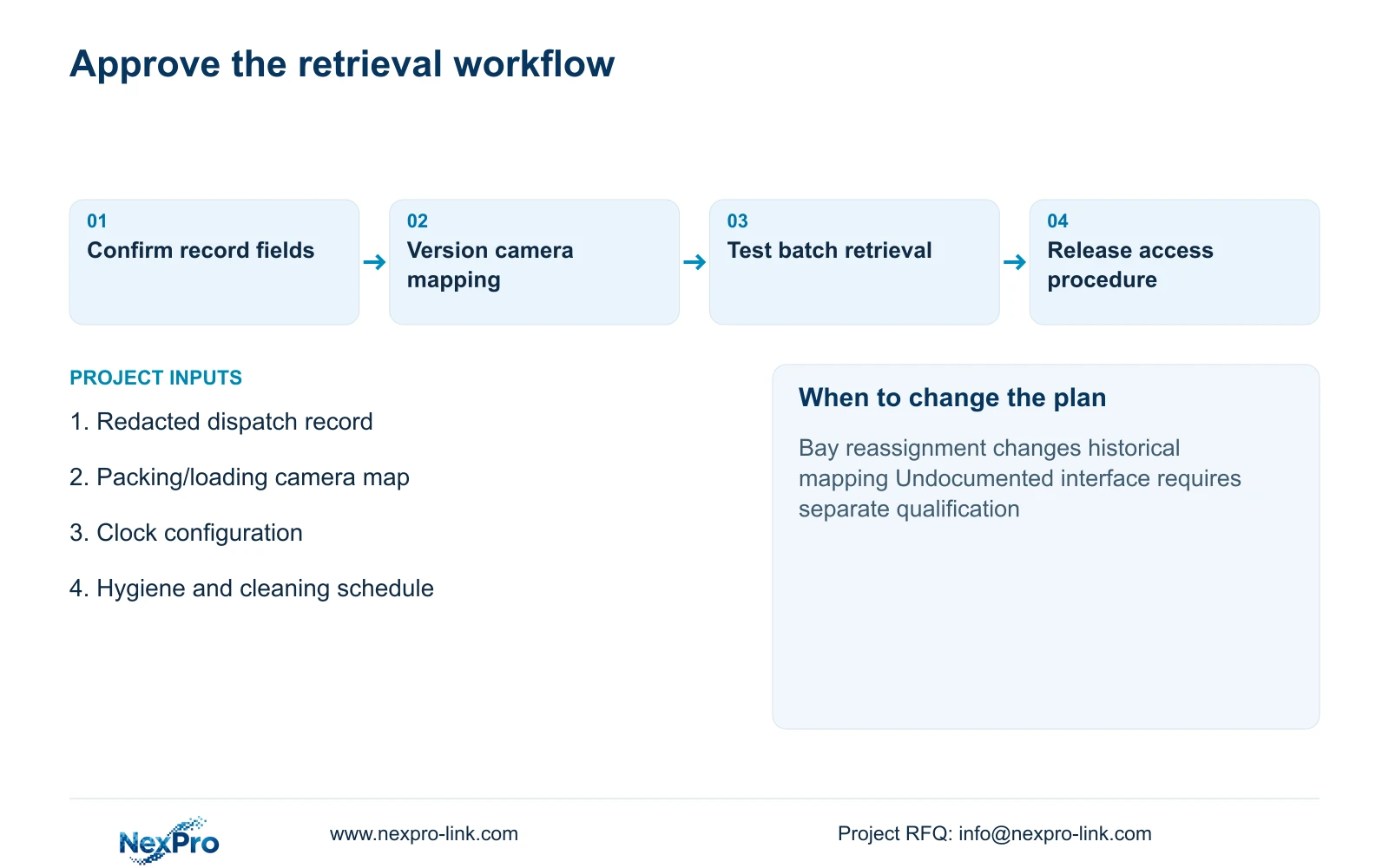
Before procurement, assemble a compact schedule containing camera location, hygiene classification, recorder assignment, batch-event reference and approved retrieval role. Mark ordinary cameras, specialist equipment, retained record systems and optional interface work separately. Price mapping, configuration, training and installation where they are required; an unpriced dependency should remain an open scope item rather than disappear into a hardware total.
Acceptance should follow a representative batch handover from its operational entry to playback and export. Include a location change, a delayed record entry and a request outside the retained period. Confirm that the operator can distinguish unavailable footage from an incorrect search. Hand over the mapping revision, configuration record and a clear procedure for approving later changes.
NexPro-Link's project and BOQ support can discuss model matching, coordinated equipment lists, technical documents and project packing for the ordinary recording scope. Keep specialist cleaning-area approval and local hygienic installation with the appointed project parties. If branded packing is required, use the same approved location identifiers on the delivery schedule so carton labels remain useful during installation.
Section 07
Buyer questions
Can we begin before the batch system offers an API? Yes. A controlled worksheet or request form can carry the batch key, event time, location and camera selection. Pilot that method first. An API should be purchased only after both system providers document the supported lookup and its maintenance responsibilities.
Should the camera read every batch label? Only if label readability is an accepted viewing task. Agree the label size, distance, movement and lighting, then evaluate a representative scene. A useful handover view can support event reconstruction without reliably reading every printed identifier.
What if the incident is found after footage has expired? The batch record can remain available even when its linked video no longer exists. Define that outcome in the retrieval procedure. Where the owner needs selected footage preserved longer, specify a separate authorized archive workflow and its storage scope.
Section 08
Define your batch-video lookup scope
Send a redacted batch dispatch record, the packing/loading camera map, hygiene zoning with cleaning methods, and the required review/retention window to info@nexpro-link.com to discuss a scoped equipment and retrieval proposal.
Engineering references
These sources support the general planning principles. Always use the selected product's current datasheet and applicable project standards for final design.