Use the hygiene drawing and cleaning schedule to control CCTV release. Reopen only affected mounts, connections and views when sanitation conditions change; do not treat IP66 as cleaning approval.
Section 01
Separate hygiene zones before selecting camera locations
A food-processing CCTV schedule should be reviewed again when cleaning chemicals, spray reach, frequency or access arrangements change at a mounting point. Link each camera and connection to the applicable cleaning-method revision. Hold affected assemblies until the facility confirms the new conditions and retain separately accepted ordinary-area work. Security footage remains an access and transfer record, not food-safety certification. The deliverable is an affected-position change review, not a blanket choice of ordinary or specialist cameras.
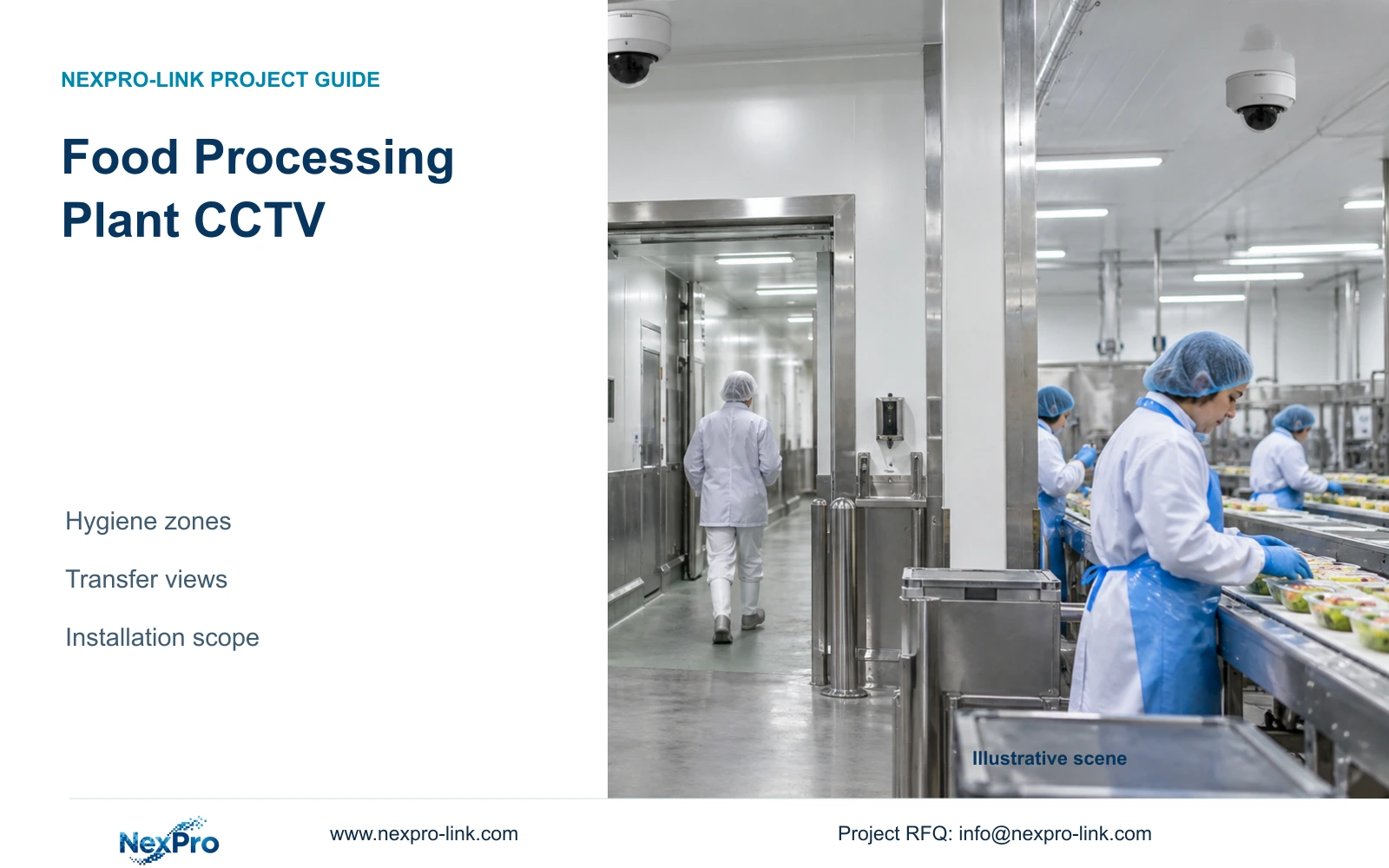
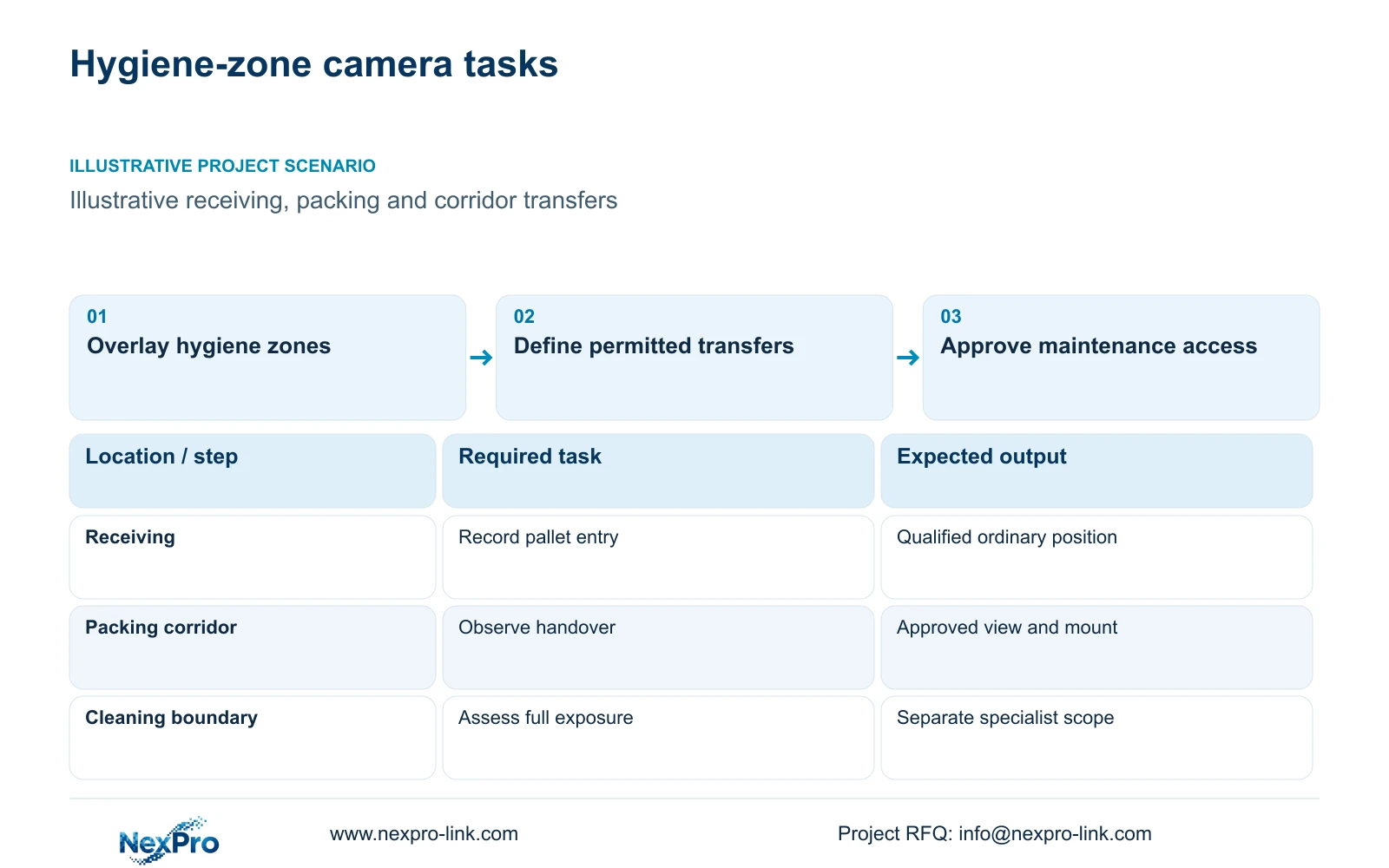
Illustrative project scenario: A food processor needs video at receiving, packing and controlled corridor transitions. Using the supplied 48-camera reference as a planning basis, five groups contain eight ordinary security views each, while eight cleaning-boundary positions require separate qualification. These quantities describe a hypothetical task schedule, not a completed installation or a camera count derived from floor area.
The engineer should overlay proposed mounting points on the hygiene drawing and review them with the cleaning team. Record conditions during production and sanitation separately. A corridor that appears dry during a survey may receive spray during cleaning. Mark uncertain positions as unresolved rather than assigning the ordinary camera family to them by default.
Section 02
Choose views around permitted material handovers
At receiving, define whether the footage must show a delivery approaching, a pallet entering storage or a handover at a specific doorway. Those are different target planes. At packing, identify the point where responsibility changes between teams. The accepted view should include that action and enough surrounding context to explain movement without extending into areas the owner has excluded.
Begin with a fixed view from a suitable general area. Move to a separately qualified position if door leaves, stacked containers or screening prevent that view from capturing the handover. Repositioning can reduce environmental exposure, but it may also increase distance or create an oblique angle. Review an actual recorded transfer before treating relocation as an equivalent substitution.
Use location names that operators already understand, such as receiving door and packing exit, and carry them through the camera schedule and recorder. A technically clear image is difficult to retrieve if the dispatch log refers to one location and the client menu uses an unrelated channel name.
Section 03
Control cleaning revisions at each CCTV assembly
Approve mounting and maintenance access together. The local installer should show how a technician reaches the camera, services its connections and leaves the area ready for operational release. The hygiene team should review exposed supports, penetrations and materials. The equipment supplier needs the resulting restrictions before preparing accessories or a technical submittal.
For the illustrative packing corridor, a maintainable mount outside the cleaning boundary is the preferred starting point. The camera is supplied equipment; penetrations and route sealing belong in the local installation scope; cleaning approval remains with the facility. Any specialist housing should have its own supplier responsibility and documented complete configuration.
Keep network switches, recorders and batteries in accessible rooms that suit their operating and maintenance conditions. This allows disk replacement and routine network work without entering production unnecessarily. The drawing must still identify the cable route and boundary crossing, because moving the rack does not remove the environmental requirements of the camera connection.
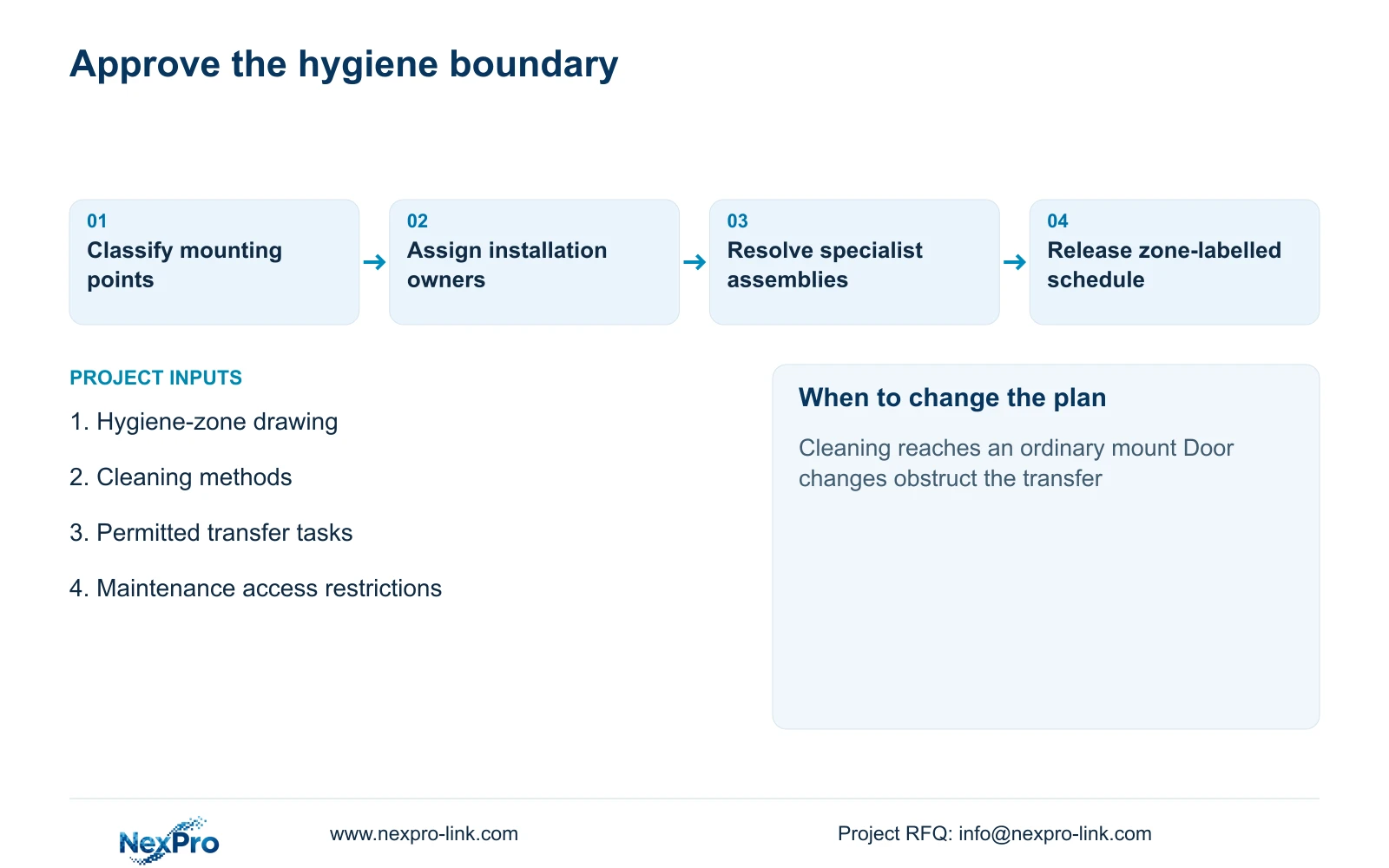
Record the cleaning conditions that formed the original installation decision, then mark which camera, bracket, cable entry and access route the revised procedure reaches. Review exposure and maintainability before comparing a substitute camera. If relocating a mount removes spray exposure but hides the packing handover, both the environmental and recorded-task rows must reopen. Keep the cleaning team's approval separate from the supplier's model document and the installer's reinstatement record.
| Condition / stage | Required input | Decision and evidence |
|---|---|---|
| Spray or chemical regime changes | Cleaning revision and components now exposed | Requalify the affected complete assembly; IP66 does not close chemical compatibility |
| Mount moves outside the boundary | New sightline and receiving/packing handover | Repeat the recorded-task check before crediting relocation |
| Service access changes | Cleaning-team permission and reinstatement method | Assign local responsibility before work release |
Section 04
Use a location qualification matrix rather than one rating
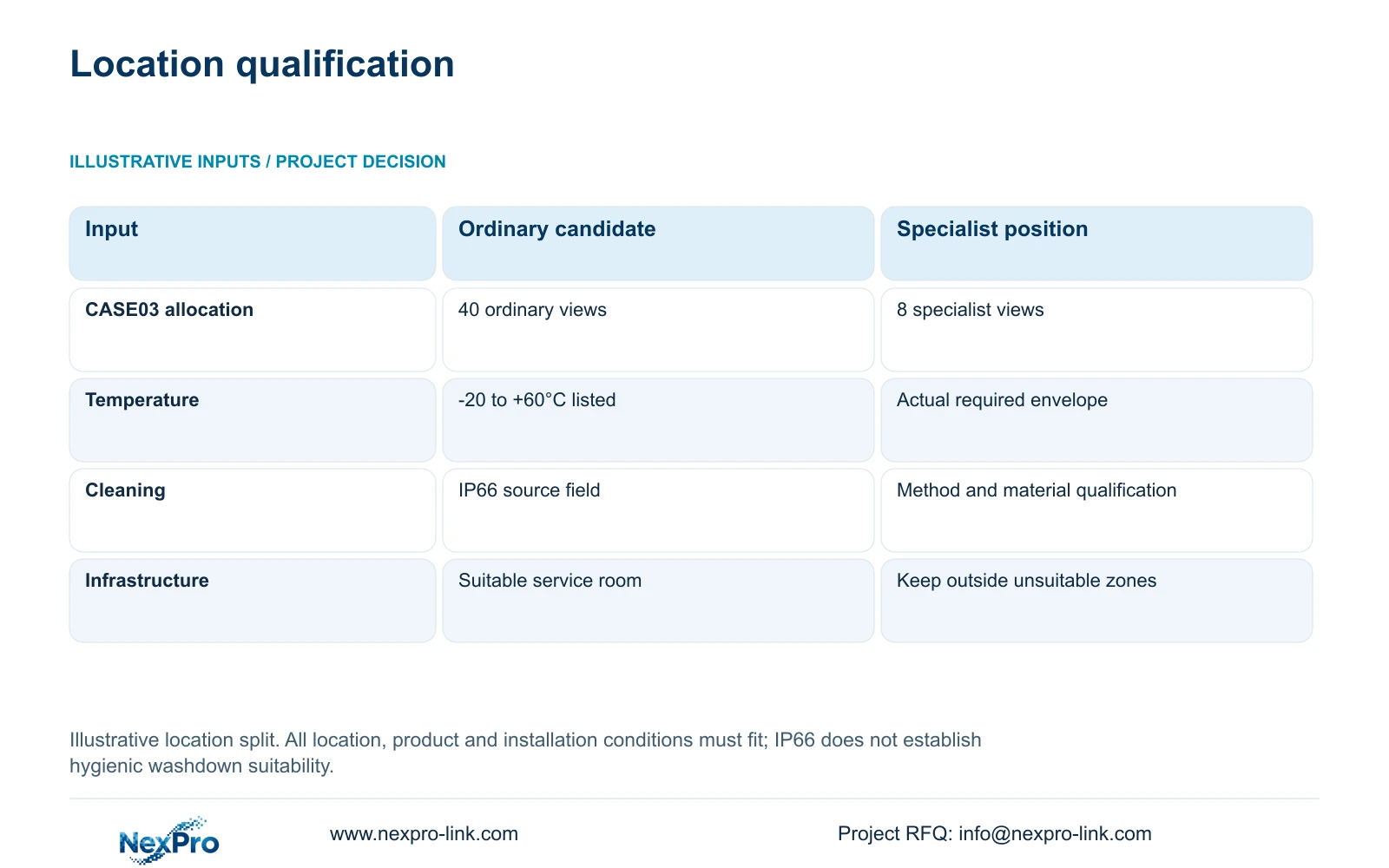
Qualification is conjunctive: location conditions AND complete product scope AND approved installation requirements must fit. Passing one field cannot compensate for an unresolved cleaning or material requirement. The comparison below turns that rule into choices for the hypothetical plant.
The BL2812M and DM2812M ordinary 5MP references list IP66 and an operating range of -20 to +60°C. Their specifications retain the listed 2880×1620 output, 25fps and 2.8–12mm motorized lens range. These fields support normal-area selection discussions. They do not establish chemical resistance, hygienic washdown suitability, explosion protection or a guaranteed recognition distance.
The decisive difference is the actual exposure at the mounting point. A dry-store candidate can proceed after its view and installation are checked. A cleaning-boundary position remains a specialist requirement until the complete camera, connections and mounting scope match the stated cleaning conditions.
| Location or condition | Ordinary option | Specialist or revised option |
|---|---|---|
| Dry receiving position | Check view and -20 to +60°C range | Revise if cleaning reaches the mount |
| Packing corridor | IP66 candidate with approved materials | Relocate or qualify cleaning exposure |
| Wet-cleaning boundary | IP66 alone is insufficient | Document cleaning and material compatibility |
| Condensation transition | Verify clear view through operating cycle | Qualify affected camera and connections |
| Recording infrastructure | Accessible suitable service room | Keep outside unsuitable production locations |
Section 05
Preserve the recording task when comparing package options
Recommend a mixed package: ordinary equipment at qualified normal locations and separately scoped specialist front ends where exposure requires them. CASE03 provides a useful architecture example with two local 24-camera nodes. Its assumed 4 Mbps average streams produce 96 Mbps per recorder. The NexPro-NVR4449-4K is a candidate for matching supported streams, not proof of unrestricted 4K recording or simultaneous decoding.
Compare alternative bids against the same handover views, recording hours, retention and environmental boundaries. Retain a mandatory platform or specialist requirement rather than deleting it to make a quotation appear cheaper. Separate equipment, site materials, installation and acceptance work so the cost team can identify what each offer actually includes.
Backup power should cover each actual electrical node, including camera power through the relevant switches. Do not add camera demand again when complete switch AC input already includes it. Operator playback can use a suitable screen; a display wall is optional and must not become an unexplained dependency in the recording path.
Section 06
Release a zone-based schedule for supply and installation
The procurement schedule should identify each location, its observation task, ordinary or specialist status, cleaning exposure and installation owner. Include a column for unresolved inputs and distinguish supplied equipment from retained items and optional displays. This lets the buyer release qualified ordinary positions without quietly approving the eight specialist positions.
NexPro-Link's Factory & Warehouse project supply and BOQ & Tender Support scopes provide routes for model matching, equipment-list coordination and technical deviations. Project labels and packing can follow the approved zone names, making cartons useful to the installer. Local hygienic installation and final approval remain assigned to the project team.
Before release, check one proposed transfer view, one cleaning-boundary assembly and the operator's search-and-export workflow. Record what was demonstrated and what remains unverified. A changed cleaning procedure, door arrangement or mounting location should reopen the affected schedule rows rather than trigger an undocumented model substitution.
Section 07
Buyer questions
Can we obtain an ordinary-area quotation before the cleaning details are final? Yes. Identify the ordinary positions that are sufficiently defined and keep uncertain cleaning-boundary positions as separate provisional lines. The quotation should state which inputs could change the camera, connections, mounting or installation scope.
Does a dome housing make a camera suitable above a packing operation? Housing shape alone does not establish hygienic suitability or an impact rating. Review the complete mount, exposed materials, cleaning access and the facility's restrictions for that precise location.
Should specialist cameras use a separate recorder? Not automatically. Shared recording is possible only after the exact stream modes and required workflows are verified. Separate recording may be appropriate where platform requirements, maintenance ownership or operational boundaries differ.
Section 08
Define your ordinary and specialist camera scope
Send your hygiene-zone drawing, cleaning-method schedule and permitted receiving or packing handover tasks to info@nexpro-link.com. NexPro-Link can discuss a location-based equipment schedule and the supply interfaces your installer needs.
Engineering references
These sources support the general planning principles. Always use the selected product's current datasheet and applicable project standards for final design.