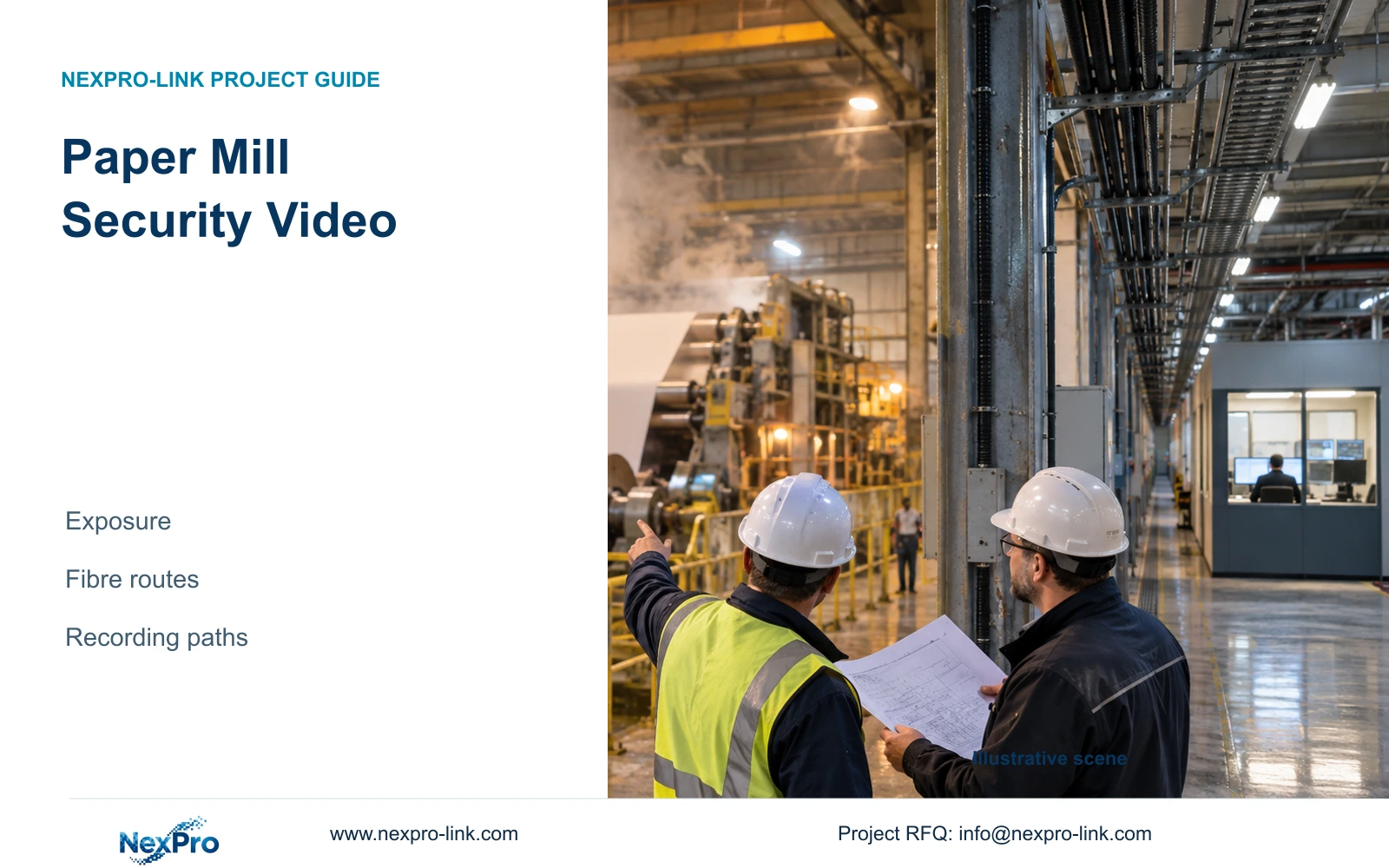
Paper mill security video needs separate decisions for camera exposure, long-distance data paths and accessible storage. A worked comparison preserves 128 Mbps recording while changing operator-view traffic.
Section 01
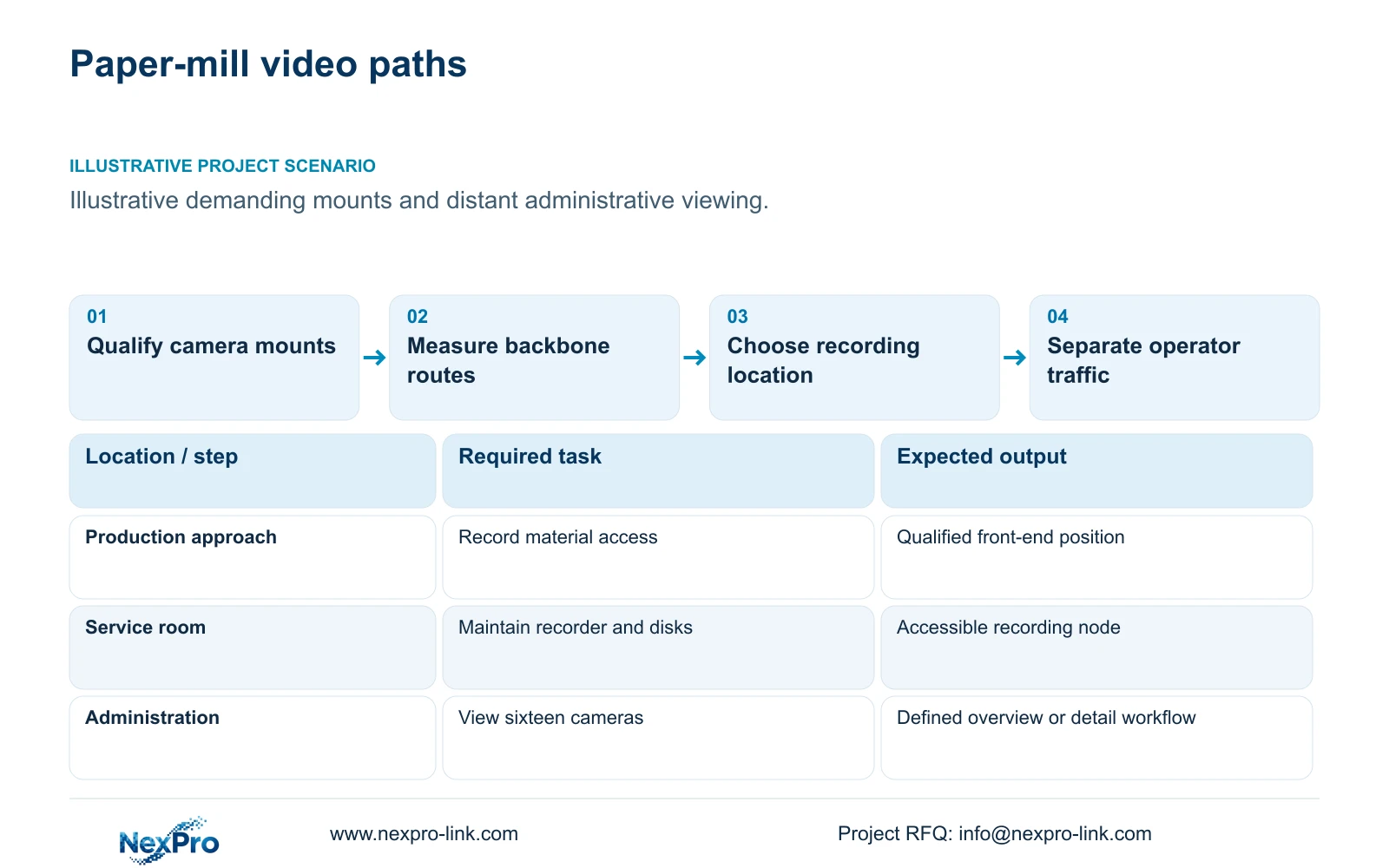
Qualify camera locations separately from network routes
Paper mill security video should treat the camera environment and the long-distance network as separate engineering tasks. Select the front end from conditions at its actual mount, then select the data route and power arrangement from the path to an accessible recording location. Fibre can address a long data route, but it does not make an ordinary camera suitable for heat, moisture or aggressive cleaning.
Illustrative project scenario: The paper mill has demanding production environments and long routes to its administrative recording room. Assume, for planning, that access and material-transfer cameras serve several production approaches while authorized staff review footage from an administrative workstation. The engineer must confirm mount exposure and route lengths; the quantity surveyor must price the intervening cabinets, links and local power.
Record local temperature, condensation, cleaning exposure and service access for each position. Include stock heights and process equipment that may block transfer views. Mark any dust-area classification separately and have the responsible team verify current local requirements. A camera placed near a wet or hot process may have different conditions from one observing its approach from a suitable position.
Section 02
Choose fibre from the actual route and endpoints
Measure routes along the proposed containment, including vertical changes and service allowances. Keep camera access links separate from building or area backbones. The supplied Fluke guidance distinguishes typical 90 m copper permanent links from complete 100 m channels; the actual termination and test method must match the installation. Do not convert a long route into one ordinary copper link by excluding inconvenient portions.
Where the route requires fibre, specify both endpoints, optics, termination and the cabinet environment. A fibre cable quantity without compatible endpoint equipment is an incomplete BOQ. Identify who supplies those components and who tests the path. SP5648 patch panels and DT968MX modules are structured-cabling references, not bulk cable models or evidence that the complete installed link will pass.
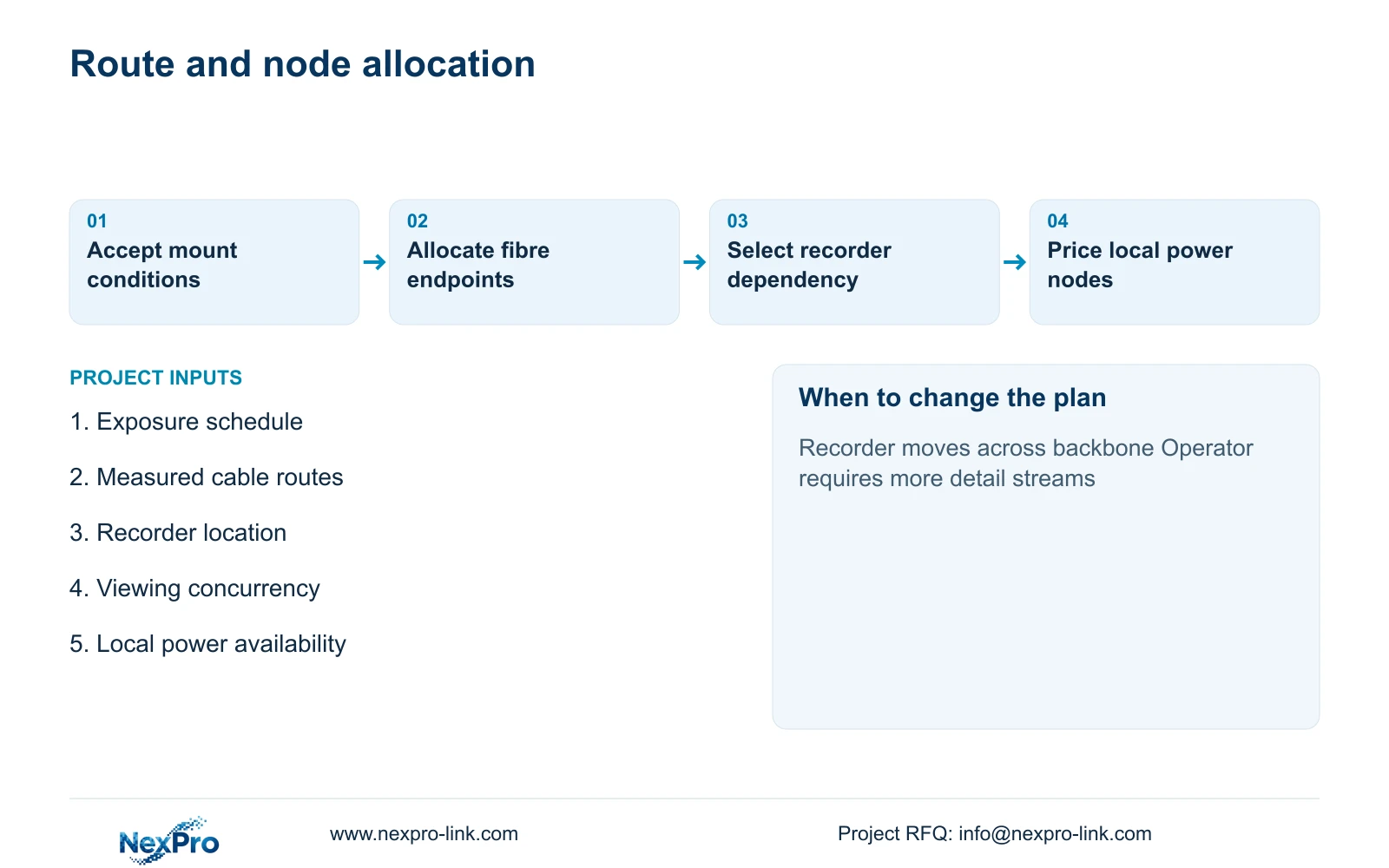
Fibre carries data rather than remote PoE power. A distant access switch needs its own accepted supply arrangement, and camera power must reach the camera through the selected local path. Move ordinary switches and UPS batteries to suitable accessible locations where possible. Price those nodes explicitly instead of assuming the administrative-room UPS protects every remote camera.
Section 03
Choose recording placement by failure consequence and service access
An administrative recording room can simplify disk access and operator support, but streams from distant access switches then depend on the backbone reaching that room. Local recording in a suitable production-area service room changes the dependency: a viewing-link interruption need not interrupt recording if the recording path remains local. Select between these arrangements according to the owner's accepted loss-of-link behavior.
CASE01 supplies an illustrative storage baseline of 32 cameras, 4 Mbps average and 30 days continuous recording. Video_TB = 32 × 4 × 10^6 × 86400 × 30 / 8 / 10^12 = 41.472 TB. Its four 16 TB disks provide 64 TB raw and a 48.64 TB recording budget using 64 × 0.95 × 0.80. Formatting and reserve are already included in that budget.
The NexPro-NVR4449-4K lists 320 Mbps input and four SATA bays up to 18 TB per drive. Confirm actual stream modes, disk compatibility and simultaneous operations separately. Its recording capacity does not establish RAID or all-4K decoding. Arrange access for disk replacement without entering unsuitable process locations, and assign authorized export access independently from physical equipment-room access.
Section 04
Count recording and viewing traffic on their actual paths
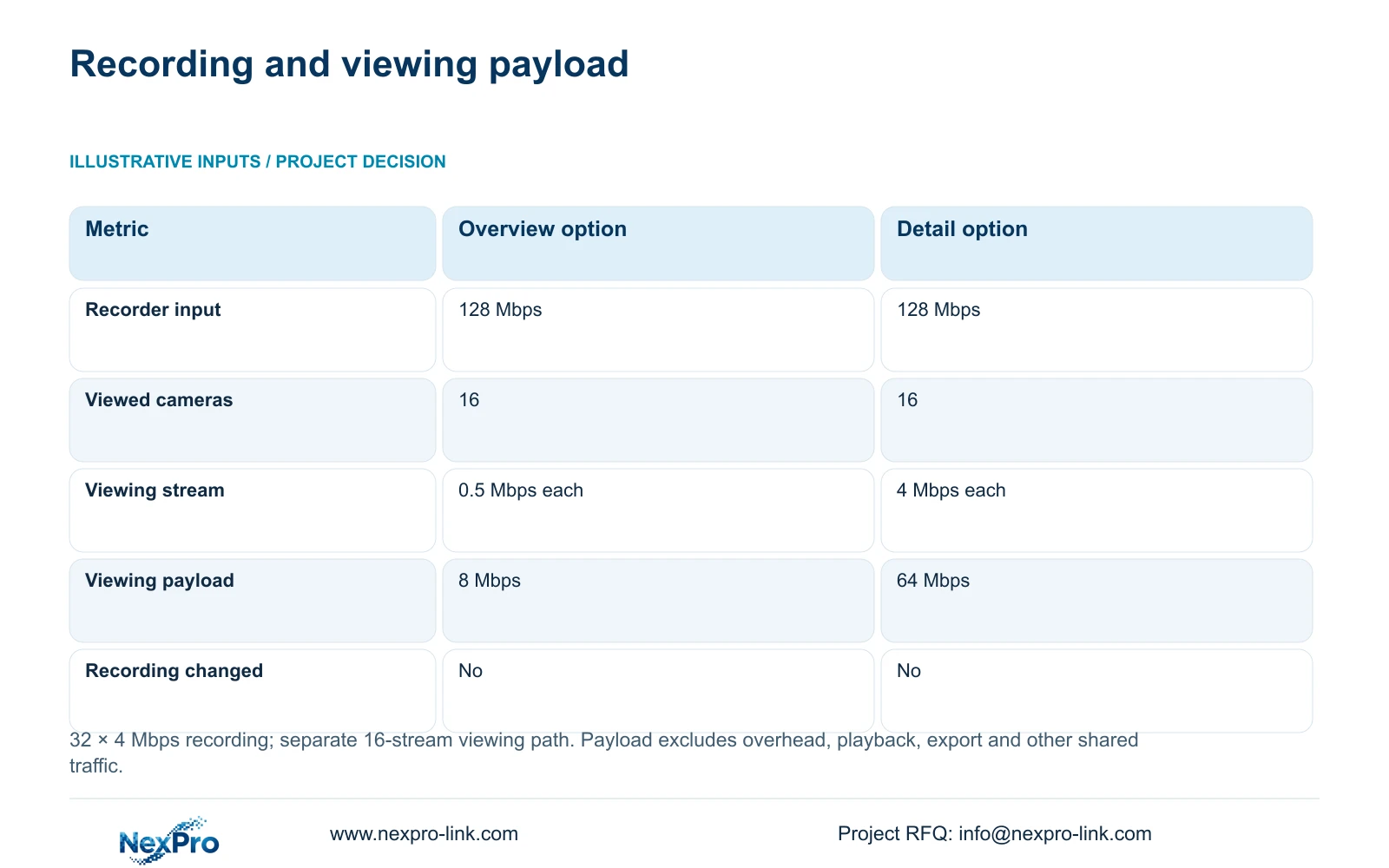
The supplied network example assumes 32 local main streams at 4 Mbps and 16 simultaneously viewed cameras. Recorder_Mbps = 32 × 4 = 128 Mbps. Viewing_Mbps = 16 × stream_Mbps gives 8 Mbps for 0.5 Mbps overview streams or 64 Mbps for 4 Mbps detail streams. These are illustrative video payloads before protocol overhead, not guaranteed link performance.
Both options preserve the 128 Mbps recording input. The decisive difference is the operator-view stream selection, allowing a lower-bandwidth overview where the camera, recorder and client support the intended workflow. Verify that selecting a viewing stream does not change the recorded main stream. No universal substream compatibility is assumed.
Label each interface and count only traffic crossing it. If recording stays local, an administrative viewing link may carry only viewing payload plus actual playback, export and other traffic. If the recorder remains in the administrative room, the long backbone also carries the recording streams. Do not apply the 8 Mbps viewing figure to a path that actually transports 128 Mbps recording.
| Metric | Option A: overview | Option B: detail |
|---|---|---|
| Recorder input | 128 Mbps | 128 Mbps |
| Concurrent viewed cameras | 16 | 16 |
| Viewing stream per camera | 0.5 Mbps | 4 Mbps |
| Viewing payload | 8 Mbps | 64 Mbps |
| Recording quality changed | No | No |
Section 05
Keep environmental and bandwidth changes in separate cost lines
Recommend suitable front-end positions and a route-specific backbone, with recording equipment accessible for maintenance. Use overview streams for routine multi-camera viewing only where that quality meets the operator's task, then provide an accepted detail workflow. If staff need continuous high-detail viewing of all sixteen cameras, retain the 64 Mbps illustrative payload basis rather than pricing an overview-only interface.
For ordinary-area candidates, the BL2812M55 specification lists IP66, -20 to +60°C, a 2.8–12mm motorized lens and the retained 2880x1620 output. It does not establish condensation control, chemical resistance or process inspection capability. Change the front-end selection when the actual location fails qualification; increasing backbone capacity cannot resolve that failure.
Separately revisit power when a remote node or additional equipment is introduced. CASE01's illustrative recording-priority load is 682.7407 W, but that total belongs to its declared single-node arrangement. The SP1KR(S) reference is 1 kVA / 900 W, and runtime requires the exact battery and conditions. Neither the case total nor a model rating proves protection for a different distributed paper-mill layout.
Section 06
Price endpoint equipment and maintenance responsibilities explicitly
Prepare a node schedule listing cameras served, recorder location, actual traffic path, local power source and environmental status. Pair it with a route schedule for copper and fibre. The quantity surveyor can then compare endpoint equipment, containment, installation and testing without treating every metre as the same material or every cabinet as the same service condition.
Keep ordinary operator monitors as the starting point where playback and selected live views meet the task. Any LCD wall, decoder or additional workstation is a separate display branch with its own supported concurrency and load. Do not add a display package to compensate for inadequate recording or an unsuitable camera position.
NexPro-Link can discuss coordinated camera, recorder, power and cabling requirements through its factory supply and BOQ support. The quotation should retain any required specialist front ends or owner platform interfaces. Project packing can follow node IDs, while the local contractor remains responsible for installed routes and acceptance. Compare current bids only after those responsibilities and operating outcomes match.
Section 07
Buyer questions
Will fibre keep cameras operating during a power cut? Fibre provides a data path. The remote switch and camera supply still need an actual protected electrical arrangement. Identify local loads and battery configuration at each node.
Should the administrative room always contain the recorder? No. Compare service access with the consequence of backbone loss. A suitable local recorder may preserve recording during a separate viewing-link failure, but adds local maintenance and power responsibilities.
Does an 8 Mbps overview remove the need for detail viewing? Only if overview quality alone meets the task. Otherwise, specify how operators select detail, playback and export, and count that traffic on the interfaces it crosses.
Section 08
Define your paper-mill video paths
Send the mount exposure schedule, measured route and endpoint plan, preferred recorder location, and simultaneous-viewing requirement to info@nexpro-link.com to discuss a node-based CCTV, fibre and power quotation.
Engineering references
These sources support the general planning principles. Always use the selected product's current datasheet and applicable project standards for final design.