Plan CCTV network topology with practical guidance on start with link and failure domains and managed rings and fiber backbones. NexPro-Link project guide.
Section 01
Start with Link and Failure Domains
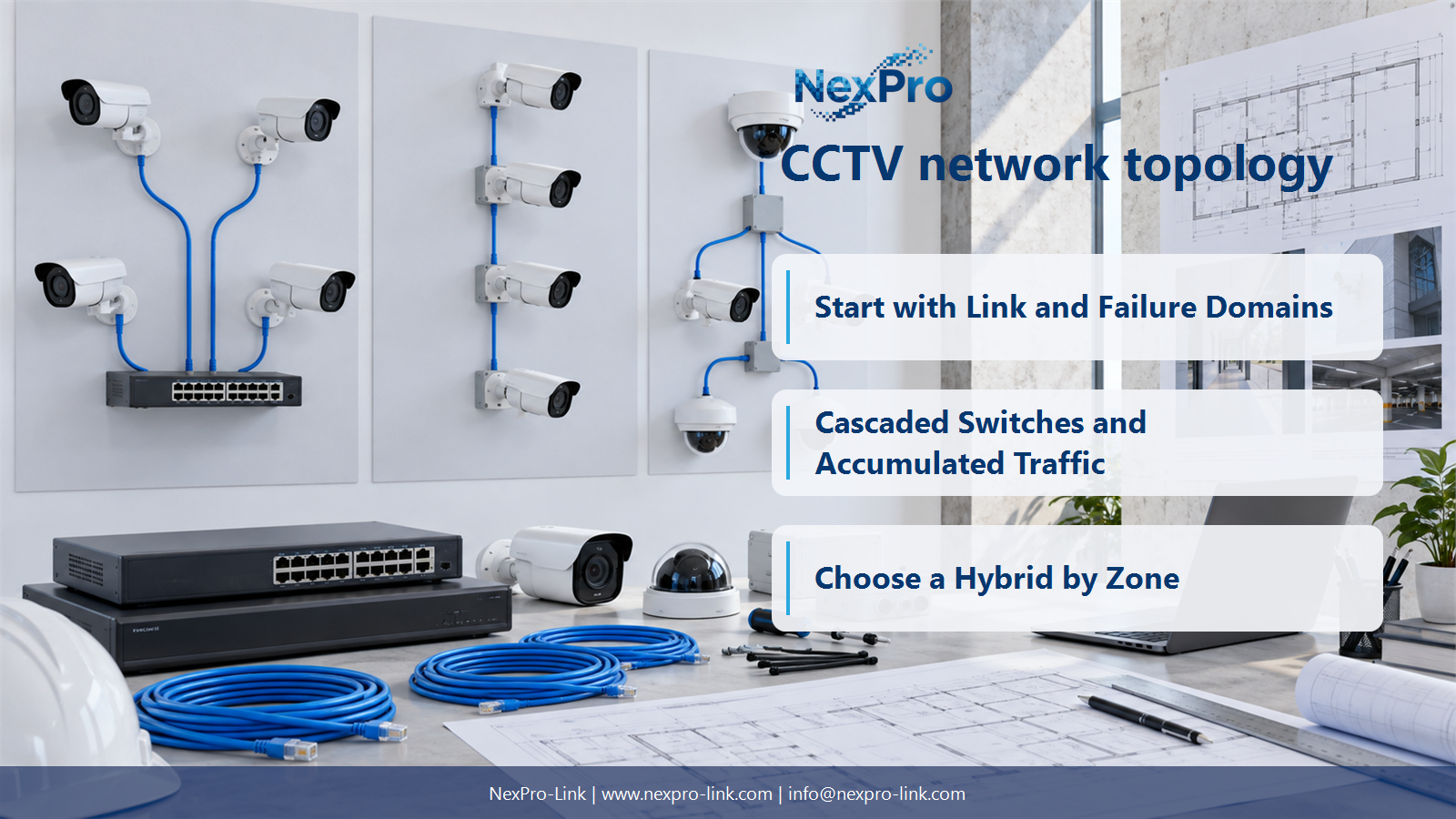
List device locations, cable routes, traffic destinations and the number of cameras affected by each failure. A neat drawing can hide a shared uplink or power dependency. Compare topologies against those dependencies first; the lowest cable quantity may not provide the most acceptable recovery or maintenance arrangement.
Turn the answer into a working record using Node, Cameras served, Upstream link, Shared power, Failure impact.
| Decision area | Buyer question | Required output |
|---|---|---|
| Start with Link and Failure Domains | What information is needed to choose a CCTV topology? | List device locations, cable routes, traffic destinations and the number of cameras affected by each failure. |
| Star Networks for Clear Isolation | Why is a star topology often easier to maintain? | Each access switch has a distinct path back to the distribution point, which makes its link and failure impact easier to identify. |
| Cascaded Switches and Accumulated Traffic | Can CCTV switches be daisy-chained? | Cascaded switches can work when every upstream link carries the combined downstream workload and the failure effect is acceptable. |
Section 02
Star Networks for Clear Isolation
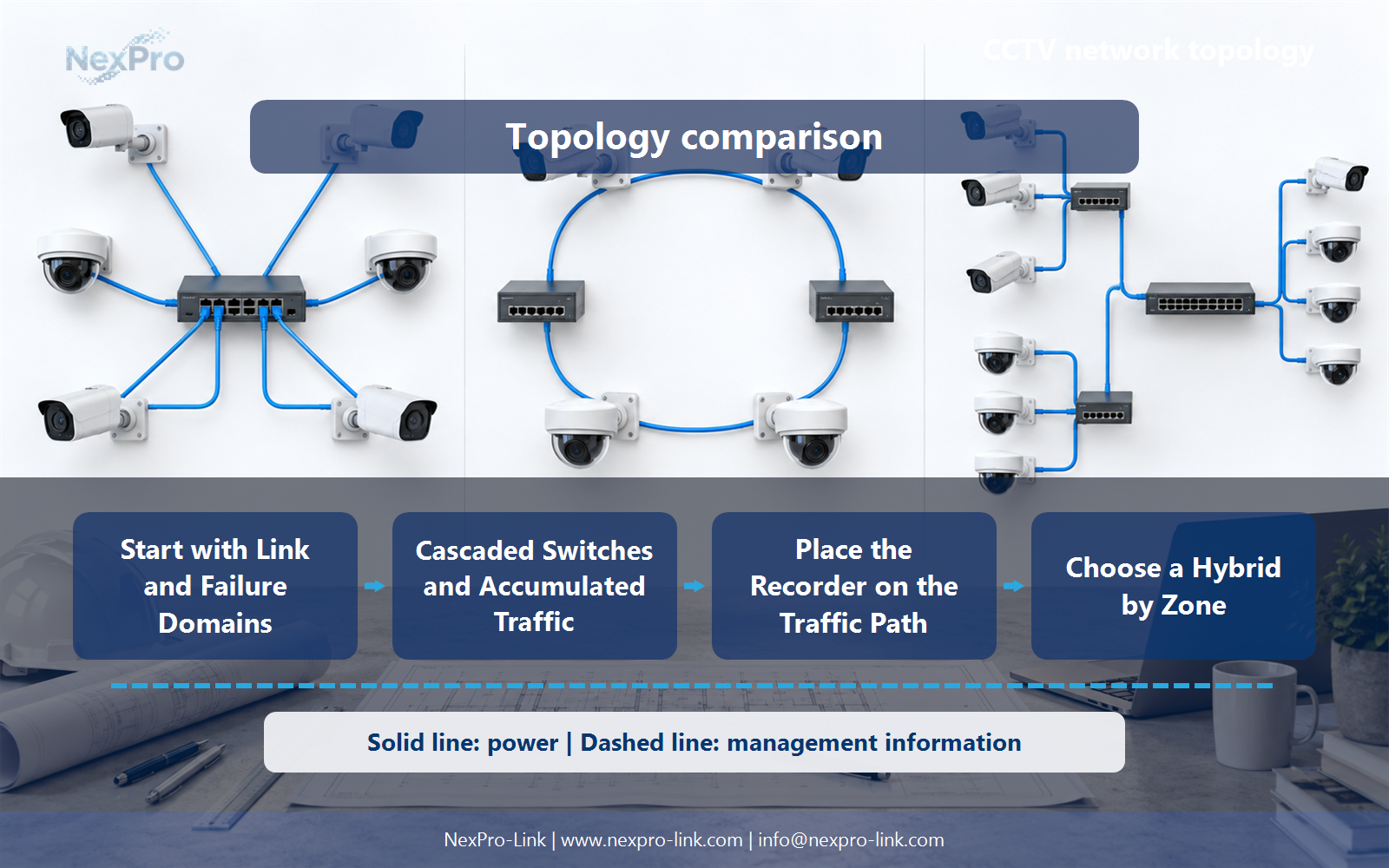
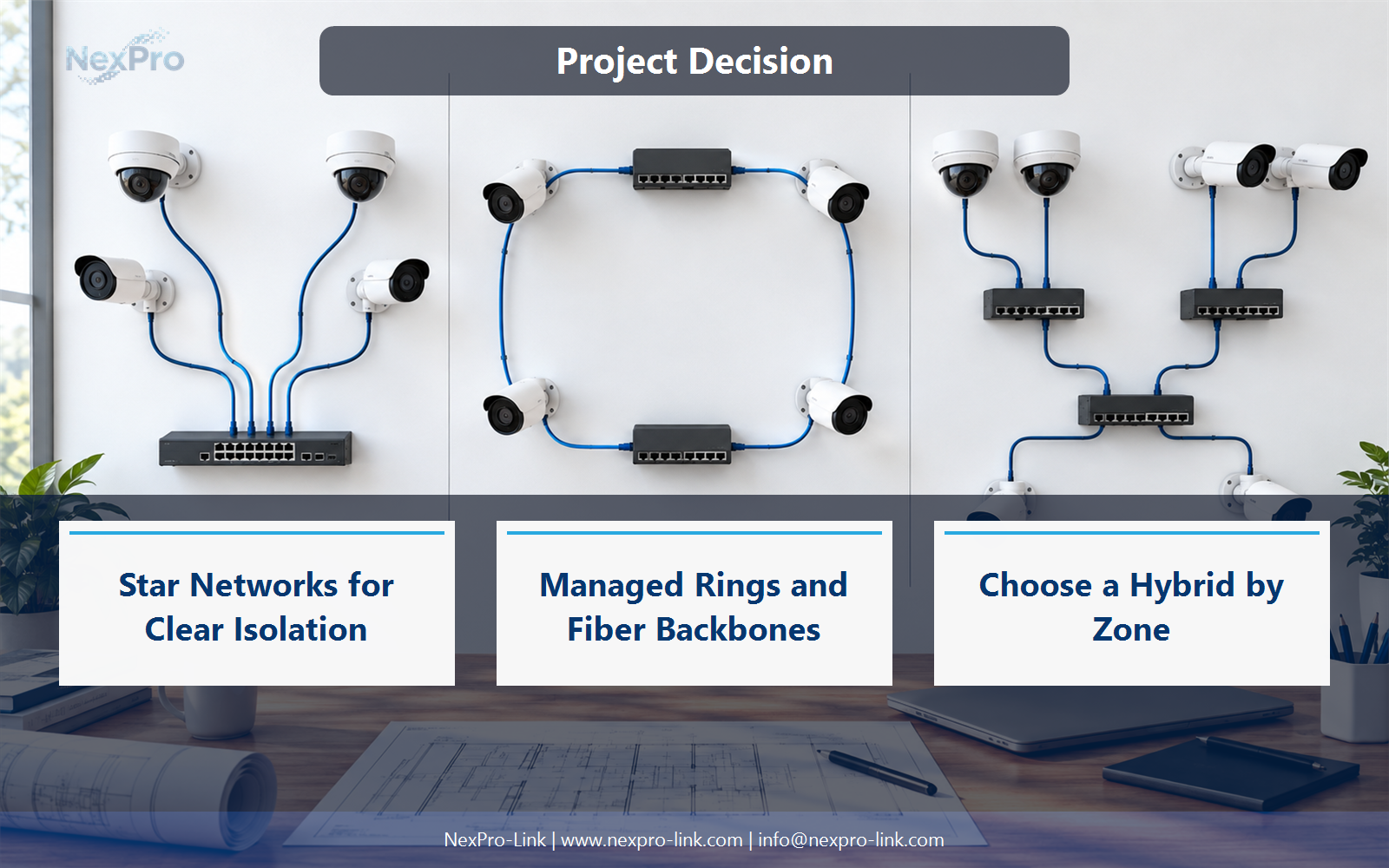
Each access switch has a distinct path back to the distribution point, which makes its link and failure impact easier to identify. The trade-off is more home-run cabling and greater dependence on the central equipment. Evaluate core capacity and power protection rather than assuming a star eliminates single points of failure.
Use Access zone, Home run, Core port, Isolated failure, Shared dependency to compare options on the same basis. Keep product capability, project assumption and operating responsibility in separate columns.
Section 03
Cascaded Switches and Accumulated Traffic
Cascaded switches can work when every upstream link carries the combined downstream workload and the failure effect is acceptable. Cameras themselves do not become Ethernet pass-through devices unless explicitly designed for it. Count hops, power locations and downstream loss, and avoid using an unmanaged loop as a shortcut for redundancy.
The project output should make Hop, Local cameras, Downstream cameras, Carried Mbps, Lost views traceable from input to acceptance.
- Confirm the answer to: Can CCTV switches be daisy-chained?
- Record the project fields: Hop / Local cameras / Downstream cameras / Carried Mbps / Lost views.
- Keep product capability, project assumptions and site responsibility in separate records.
Section 04
Managed Rings and Fiber Backbones
No. The switching design must include a supported loop-prevention or ring-recovery mechanism, with appropriate configuration and a tested recovery objective. Two fiber paths sharing one trench or power source can still fail together. Treat route diversity, switch behavior and restoration time as separate design choices.
Record Segment, Protocol role, Physical route, Recovery objective before selecting a product family. That makes later substitutions possible without silently changing the operational requirement.
Section 05
Place the Recorder on the Traffic Path
Connect it where the necessary recording streams can reach it without exceeding individual links or creating unnecessary transit traffic. Local recording may reduce backbone dependence, while central recording simplifies administration. Check live viewing and playback paths separately because they may add traffic to links that carry little recording traffic.
Review Stream purpose, Source, Destination, Traversed link, Load with the party that will operate or maintain the system.
Section 06
Choose a Hybrid by Zone
Use a hybrid when different zones have genuinely different distance, resilience or maintenance needs. A building may use local copper stars while inter-building connections use fiber and remote sites record locally. Keep addressing, labels and recovery responsibility consistent so the mixed design remains manageable rather than becoming a collection of exceptions.
Use Zone, Preferred topology, Reason, Expansion path as the handoff between design and procurement.
Engineering references
These sources support the general planning principles. Always use the selected product's current datasheet and applicable project standards for final design.