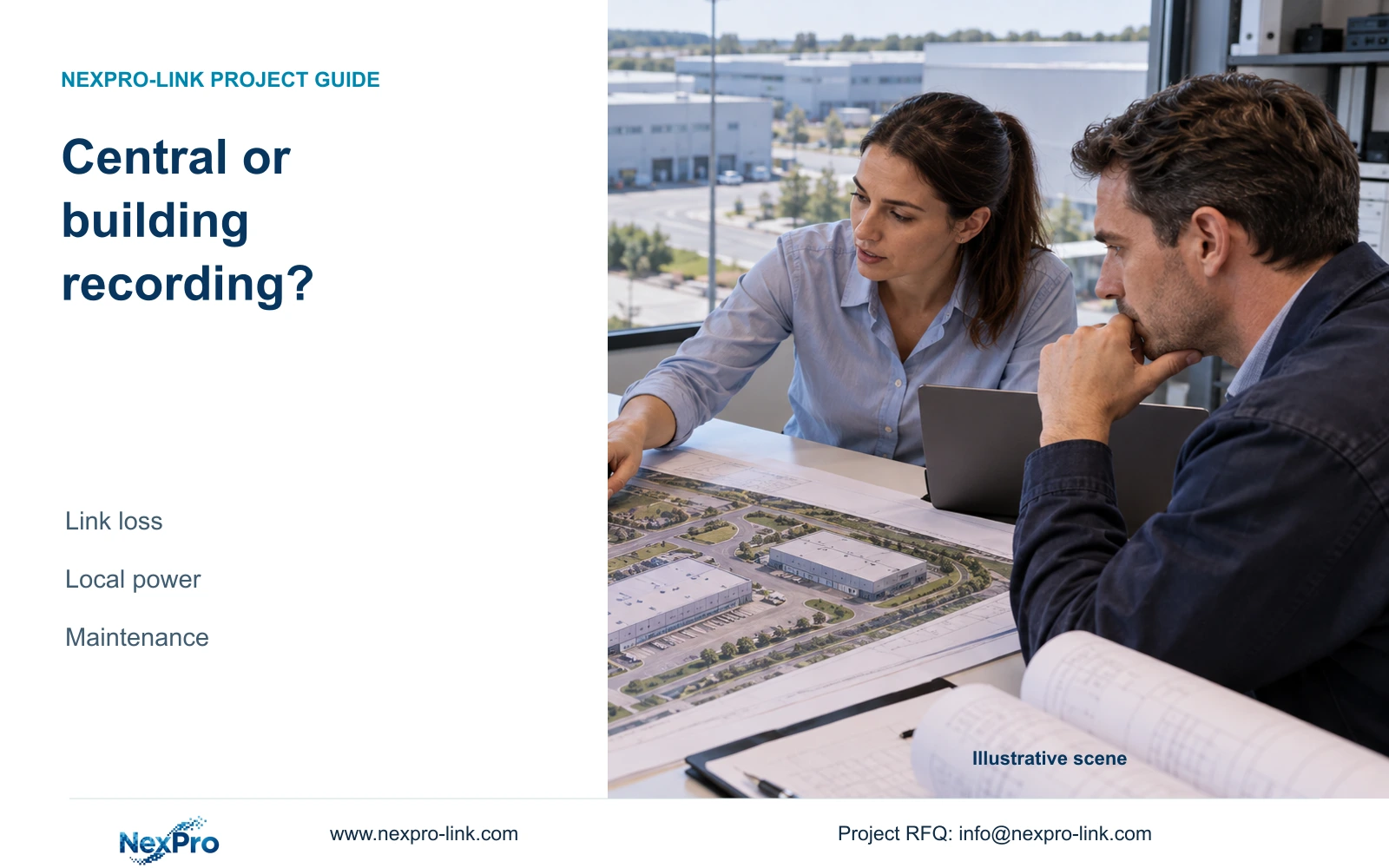
Use a building-by-building maintenance matrix identifying local capture, central viewing and shared dependencies during each planned intervention. Where a common power or backbone action affects several nodes, schedule the accepted interruption explicitly.
Section 01
Choose the behaviour required when a building link fails
Use a building-by-building maintenance matrix identifying local capture, central viewing and shared dependencies during each planned intervention. Where a common power or backbone action affects several nodes, schedule the accepted interruption explicitly. Independently located recorders are not independently maintainable when the same service action still removes their required supply.
Choose building-level recorders when a building must retain footage during loss of its connection to the central security room. Choose central recording when the owner accepts that link dependency and the verified backbone, power arrangements and maintenance model support it. The first decision is the required failure behaviour; recorder quantity follows from that decision.
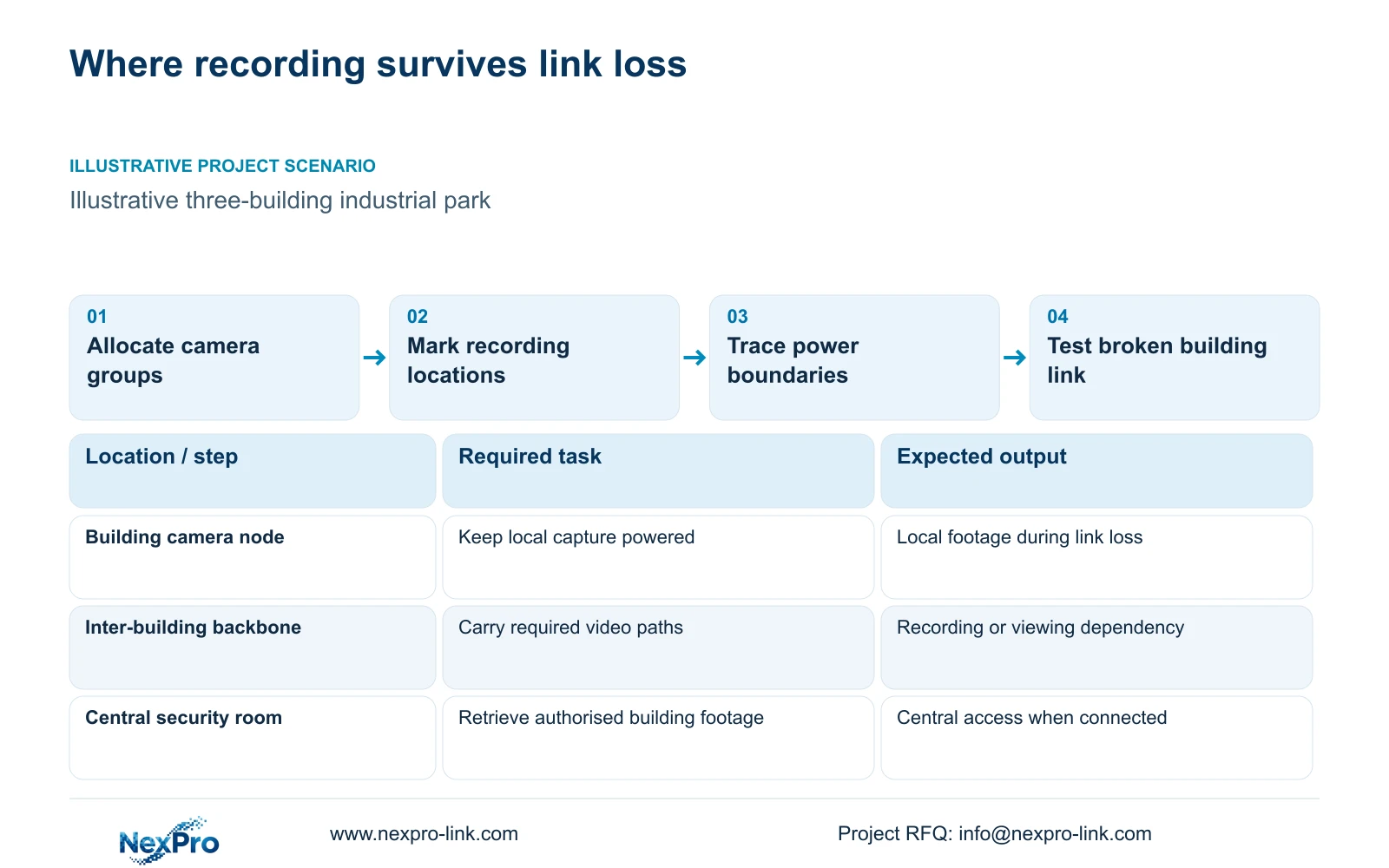
Illustrative project scenario: Three industrial park buildings can send cameras to one central NVR or retain footage on local recorders. For comparison, assume 32 ordinary security cameras across the park, using CASE01's recording demand as a baseline. CASE01 itself has one recording node; extending it to three buildings is a planning variation, with camera allocation and local disk quantities still to be established.
Distinguish lost viewing from lost capture. A disconnected building may continue local recording while central operators cannot see it. Under a central arrangement, the same break may prevent the building's streams reaching the recorder. Any alternative recovery mechanism requires separate documentation and testing; do not assume cameras or software will automatically fill the gap later.
Section 02
Trace power protection inside each recording boundary
Draw the complete local dependency chain: cameras, PoE switches, recorder, disks and any link equipment needed for that recording task. A building-level NVR can preserve capture during backbone loss only while its local camera and recording path remain powered. A central UPS does not protect a remote building's AC-powered switch unless the electrical design actually supplies it.
CASE01 groups camera loads into four eight-camera PoE groups and includes the recorder and drives within its protected node. Use that method to build a separate load list for each proposed building. Do not divide the case's total watts by three and treat the result as a proven local requirement; repeated recorder, disk and link loads change the calculation.
Central recording also needs protected remote camera nodes. Its advantage may be fewer disk-maintenance locations, but the remote switches and building links remain dependencies. Locate recorders and batteries where access, ventilation and service conditions suit the selected equipment. Neither architecture makes an unsuitable outdoor cabinet or inaccessible room acceptable.
Section 03
Count repeated equipment and shared operating work
Prepare the comparison around functions rather than three recorders versus one. Distributed recording repeats chassis, disk administration, local power protection and maintenance visits. Central recording concentrates storage and may require more of the backbone because remote main streams must reach it continuously. Both options still require camera access switching and an authorised operator path.
The NexPro-NVR4449-4K provides a four-bay reference with 49-channel catalogue scope and 320 Mbps input. The NexPro-NVR8864-4K provides eight bays, 64-channel catalogue scope and the same input rating. Their published summaries distinguish 5MP and 4K combinations. Select each node from its assigned modes and retention requirement; an underfilled large recorder is not automatically the best building package.
Have the engineer identify supplied and retained links, the integrator identify installation and testing work, and the cost manager separate recurring support from equipment. Keep licences and central client requirements explicit where applicable. Without matching quotations, neither architecture has a demonstrated cost advantage, and unspecified maintenance work should remain an open scope item.
Section 04
Calculate recording and viewing traffic on their actual paths
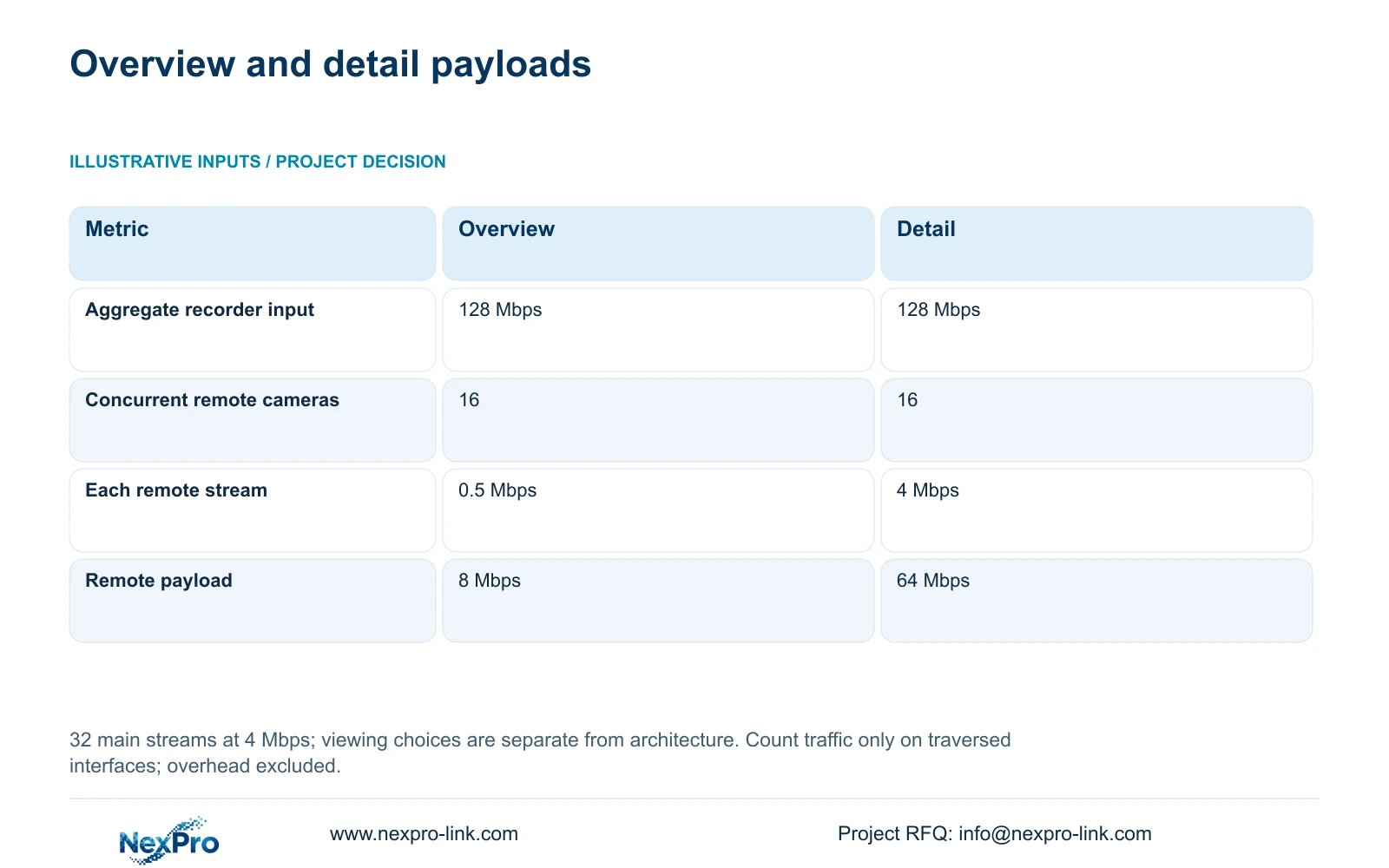
The illustrative video payload uses 32 main streams at 4 Mbps: recorder_Mbps = 32×4 = 128 Mbps. With distributed recording, that is the aggregate input across local recorders, not 128 Mbps into every building recorder. With central recording, each building's main streams traverse its route to the central NVR. Assign quantities before sizing any individual interface.
For a separate operator comparison, assume 16 cameras viewed simultaneously. Viewing_Mbps = 16×stream_Mbps gives 8 Mbps at 0.5 Mbps per overview stream, or 64 Mbps at 4 Mbps per detail stream. Both options keep the main recording streams unchanged. The table compares viewing choices, independently of the central-versus-local architecture decision.
The decisive difference is which traffic must cross the inter-building link continuously. Local recording can keep that link focused on requested viewing, playback and exports. Add protocol overhead and other shared traffic where present, and verify substream selection on the exact client. These payload calculations do not guarantee WAN performance or universal stream compatibility.
| Metric | Overview viewing | Detail viewing |
|---|---|---|
| Aggregate recording input | 128 Mbps | 128 Mbps |
| Concurrent remote views | 16 | 16 |
| Each remote stream | 0.5 Mbps | 4 Mbps |
| Remote viewing payload | 8 Mbps | 64 Mbps |
| Main recording quality | Unchanged | Unchanged |
Section 05
Prefer local recording when link independence is an acceptance requirement
For the three-building scenario, prefer building-level capture if the owner requires footage to continue through a backbone interruption. Retain central viewing as a separate service and document that it may be unavailable during the interruption. This choice creates more managed nodes, so appoint someone to check disk health, time settings and recording status across all buildings.
A central NVR remains reasonable when the site accepts the link dependency, provides a verified backbone and prefers concentrated storage maintenance. Its failure boundary also includes the central recorder and storage location. If the owner requires tolerance of recorder failure as well as link failure, neither basic option establishes that outcome without additional supported architecture.
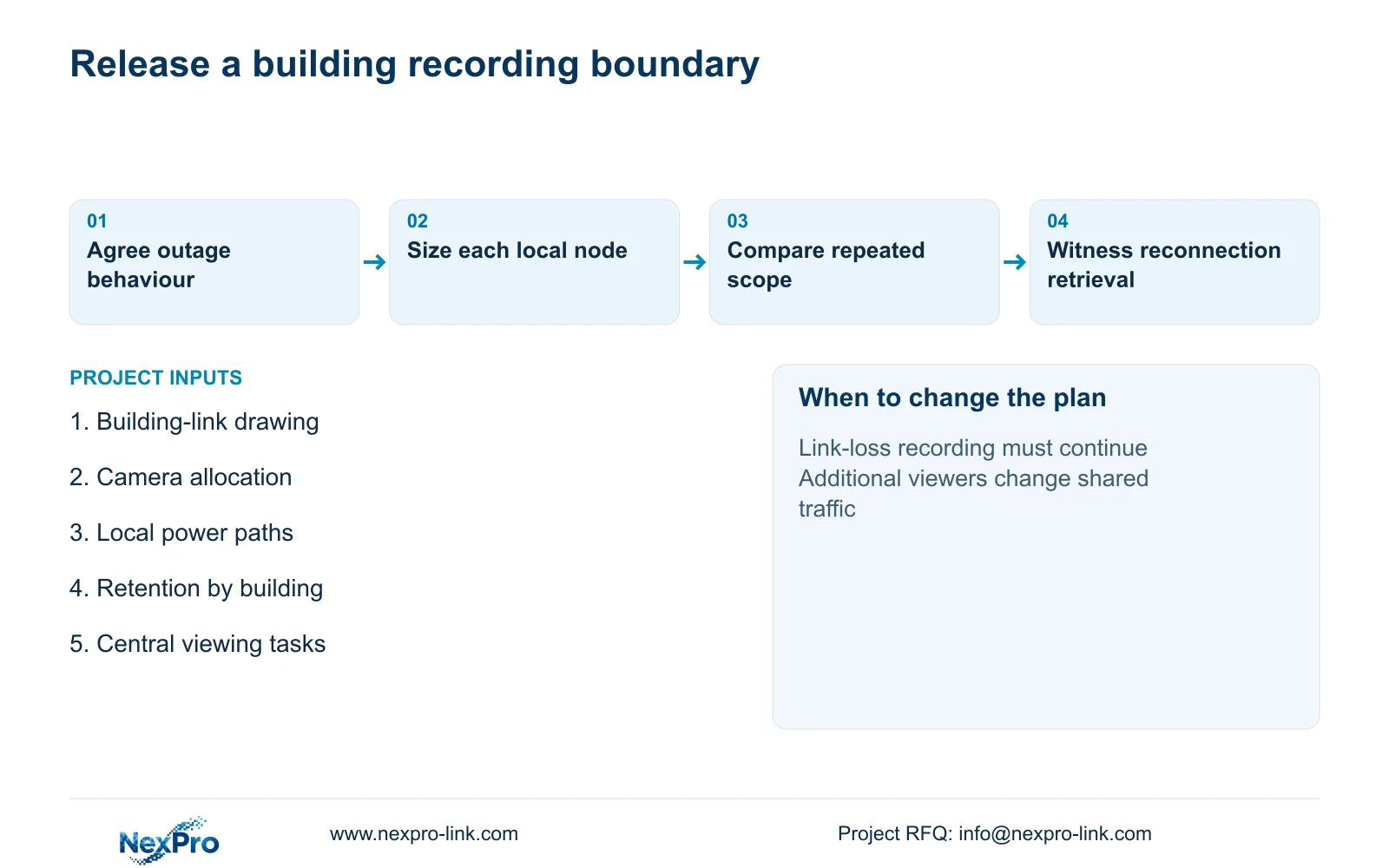
Test the chosen behaviour deliberately during commissioning. Interrupt an approved building link, verify local capture where specified, restore connectivity and retrieve footage from both sides of the interruption. Conduct power-related checks separately. A successful remote live view during normal operation cannot demonstrate how the system behaves when its dependencies fail.
Section 06
Release building schedules with clear ownership and acceptance tests
Issue a recorder and client capacity comparison with firmware scope for each building and the central room. Include assigned cameras, local disk budgets, viewing tasks, authorised users and the link-loss acceptance result required. Storage must fit within each recording node; spare space in another building cannot be counted as available without an explicitly supported arrangement.
NexPro-Link's factory project supply and BOQ support provide routes for discussing recorder selection, protected nodes, equipment schedules and quotation coordination. Building-labelled preparation and packing can follow the accepted allocation. Local fibre routes, electrical installation and site testing remain identified project responsibilities rather than assumptions hidden inside the equipment offer.
Preserve recording and viewing as separate drawing layers through later expansion. A fourth building, additional central viewers or a new retention target can change different parts of the package. Revise the affected node and shared interfaces, then show the commercial difference without repricing unrelated cameras or implying that a new chassis solves every dependency.
Section 07
Buyer questions
Will footage automatically transfer to the central NVR after a link returns? Do not assume it will. Continued local recording and automatic backfill are different functions. If backfill is required, request exact device and software support and include a reconnection test in acceptance.
Can distributed recording use one central viewing client? Potentially, if the exact client supports the recorders, selected streams and permissions. Demonstrate cross-building live view, playback and export independently before approving the operator arrangement.
Should every building receive the same disk quantity? Only when its camera allocation, bitrate and retention demand justify it. Calculate each node separately and check the resulting drive combination against its recorder limits.
Section 08
Compare the park's recording boundaries
Send the building-link drawing, camera allocation by building, required link-loss behaviour, and local power/maintenance arrangements to info@nexpro-link.com for a NexPro-Link architecture and equipment-scope comparison.
Engineering references
These sources support the general planning principles. Always use the selected product's current datasheet and applicable project standards for final design.