Issue a constraint register showing each option's first failed resource, the evidence used and the specific remedy. Recalculate downstream storage, links and protected power after that remedy rather than assuming one disk or recorder change closes everything.
Section 01
Choose the recording location from measured spare resources
Issue a constraint register showing each option's first failed resource, the evidence used and the specific remedy. Recalculate downstream storage, links and protected power after that remedy rather than assuming one disk or recorder change closes everything. Preserve accepted link-loss behavior as a requirement when comparing the revised options.
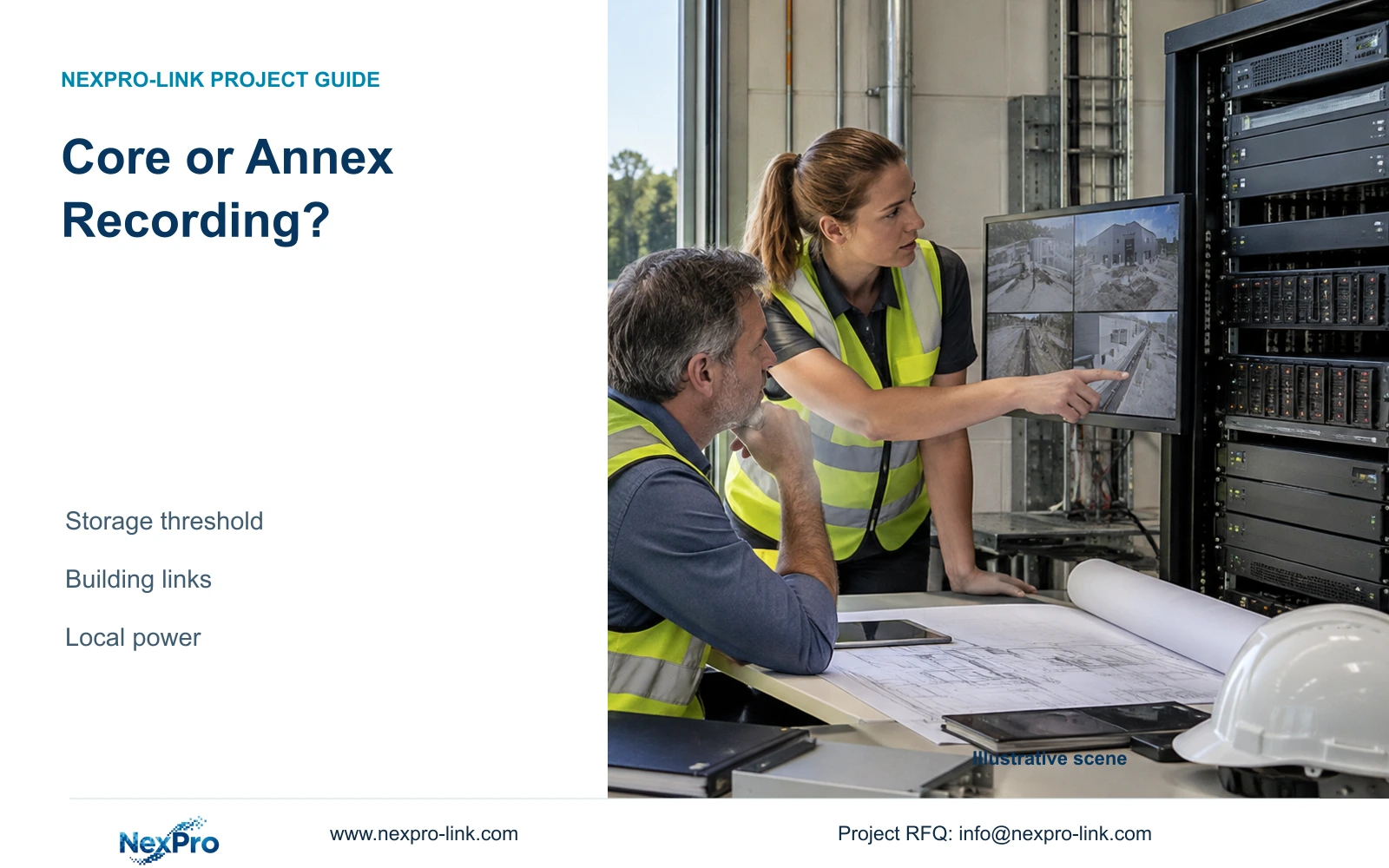
For factory annex expansion, reuse the central recorder only when its supported stream modes, input bandwidth, storage, inter-building path and protected power satisfy the added task. Prefer annex-local recording when preserving footage during backbone loss is required or central upgrades become disproportionate. Spare channel count alone cannot establish either technical suitability or the economical choice.
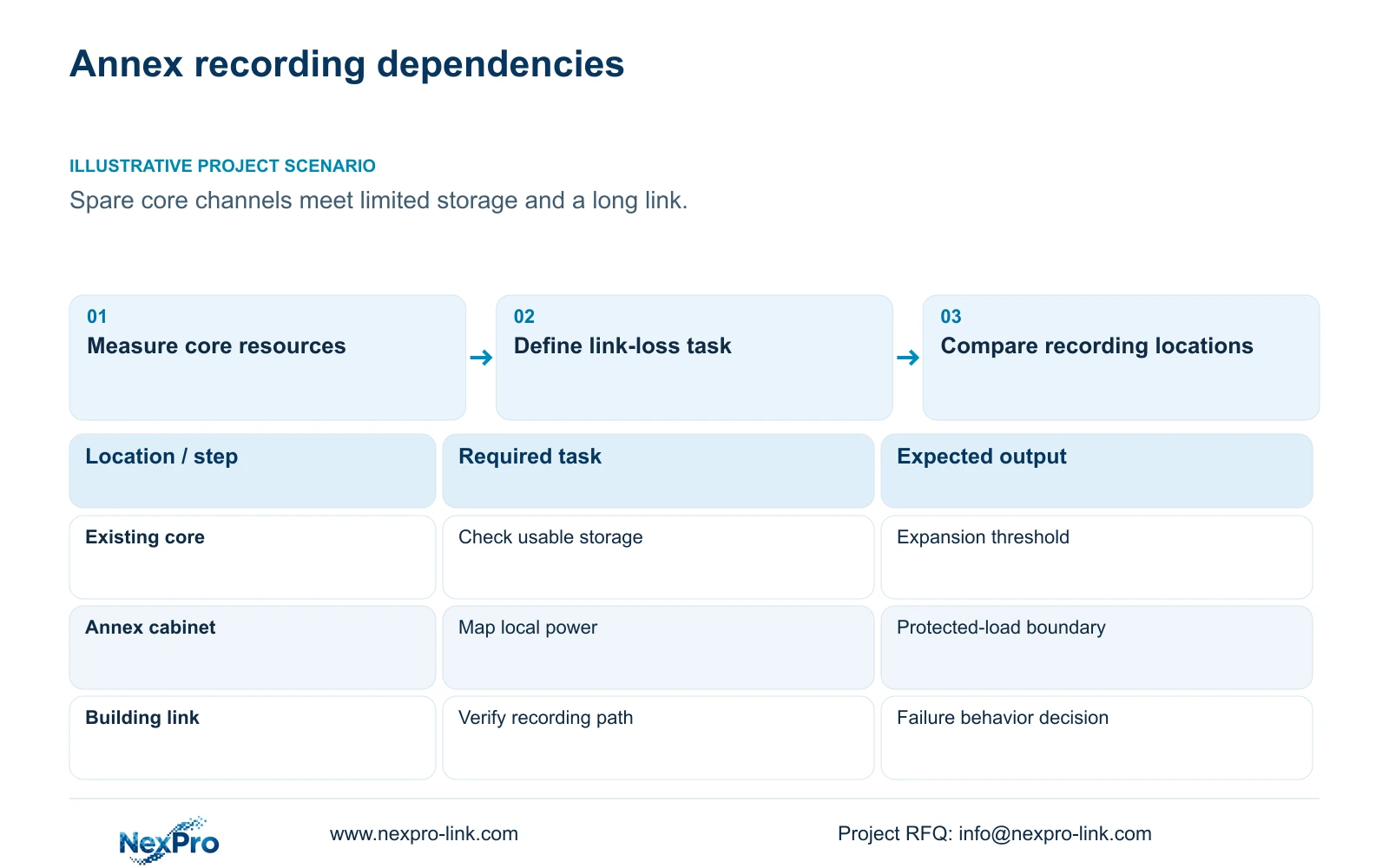
Illustrative project scenario: The old core has spare channels but limited storage and a long link to the annex. Assume six ordinary-area cameras are proposed beyond a 32-camera baseline. CASE09 provides the hypothetical core reference, including four 16 TB drives and a defined recording budget. The existing site's actual recorder and remaining resources are still inputs to obtain.
Capture model and firmware, occupied channels, actual stream settings, current incoming traffic, usable disk capacity and retention achieved. Then identify annex cable routes and power locations. A resource register should state available capacity and the condition under which it was measured, so procurement does not confuse unused channels with verified expansion headroom.
Section 02
Decide what must survive an inter-building link failure
With central recording, annex video must cross the building link to reach the recorder. If that path fails, the proposed central recording workflow loses its annex input unless a separately supported alternative is provided. With a local recorder, annex recording can continue during backbone loss if its cameras, switches, disks and local power remain operational. Central viewing may still become unavailable.
Ask the owner whether the priority is uninterrupted local evidence, continuous guardroom visibility or both. Those tasks require different dependency checks. Local recording contains a backbone failure's effect on storage, but introduces another maintained recorder and an annex equipment environment. It does not create automatic failover, duplicate archives or a redundant network.
Draw data and power separately. A central UPS protects only loads on its actual supplied circuits; it does not establish backup for annex mains. The local contractor should confirm cabinet environment, access and electrical distribution. If the owner chooses local recording, the acceptance test should distinguish continued annex recording from lost central visibility.
Section 03
Price the complete building connection in both options
Both proposals should identify the actual inter-building route, network endpoints, optics where applicable, terminations and testing. Central recording adds continuous annex recording traffic to that path. Local recording may still need the backbone for live supervision, playback and exports. Do not remove the link from the local option merely because video is stored nearby.
Assign each item as supplied, retained or installer-provided. For example, a verified existing fibre route can be retained, compatible endpoint equipment can be supplied, and route repairs or new supports can remain with the local contractor. Name the party responsible for proving the complete link. Unknown route work is an unresolved price input rather than a free existing asset.
Compare installed quotations at the same evidence quality and operating scope. Include central disk changes, annex recorder and disks, cabinet provision, protected power, configuration and maintenance access. A Hikvision, Dahua or other proposal should retain any required platform functions; a lower equipment subtotal is not a valid comparison if it omits annex retrieval or local service.
Section 04
Test whether six additions cross the existing storage budget
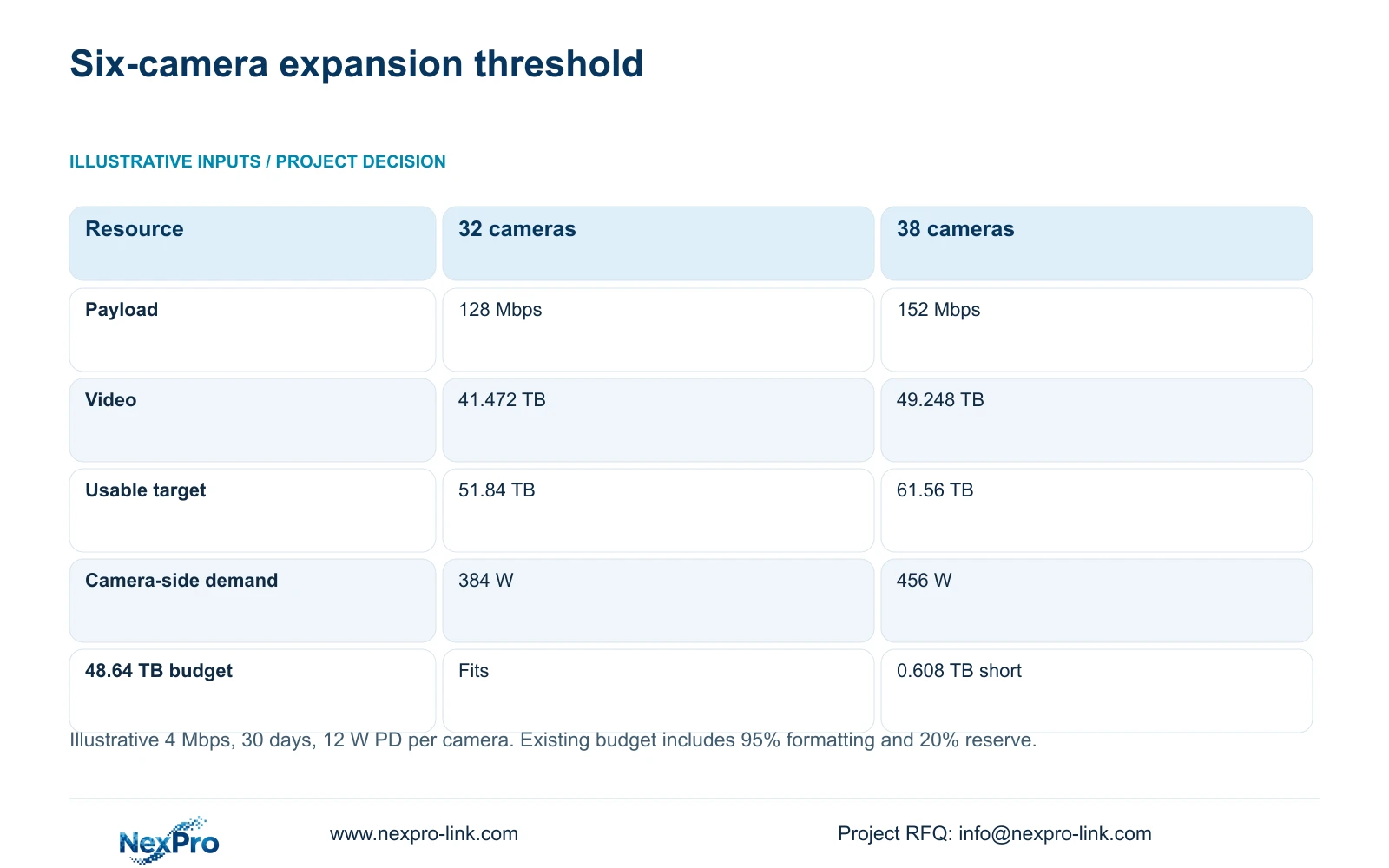
The illustrative inputs are 32 cameras initially and 38 after expansion, each at 4 Mbps for 30-day continuous recording. Camera-side demand is assumed at 12 W per device. Formulas are payload Mbps = n × 4; video TB = 0.0108 × n × 4 × 30; required usable TB = video TB / 0.80; and device-side W = n × 12.
The six additions increase payload from 128 to 152 Mbps and video from 41.472 to 49.248 TB. Required usable capacity rises from 51.84 to 61.56 TB, while assumed camera-side demand rises from 384 to 456 W. The extra 72 W is device-side demand, not complete switch AC input or a UPS sizing result.
CASE09's 64 TB raw disk arrangement provides 64 × 0.95 × 0.80 = 48.64 TB of video budget. The expanded 49.248 TB exceeds it by 0.608 TB. Equivalently, the 61.56 TB usable target exceeds 60.8 TB after the formatting allowance. Reserve is already included in these comparisons. The annex decision therefore needs a storage change even if channels and input bandwidth remain available.
| Resource | 32-camera baseline | 38-camera expansion |
|---|---|---|
| Recording payload | 128 Mbps | 152 Mbps |
| 30-day video | 41.472 TB | 49.248 TB |
| Required usable capacity | 51.84 TB | 61.56 TB |
| Assumed camera-side demand | 384 W | 456 W |
| Against 48.64 TB video budget | Fits | Exceeds by 0.608 TB |
Section 05
Select the architecture at the first limiting resource
For the supplied scenario, carry local recording as the preferred comparison option when annex evidence must survive the long backbone path's loss. Keep central reuse as a valid alternative if the owner accepts that dependency, storage can be expanded appropriately and the full installed quotation supports it. The calculation identifies a central storage threshold; it does not prove that a second recorder is cheaper.
NexPro-NVR4449-4K lists 49 channels, 320 Mbps input and four SATA bays up to 18 TB per drive. Its published modes distinguish 49×5MP and 9×4K. The illustrative 152 Mbps sits below the listed input limit, but actual peaks, stream support and operating load still require checks. Multi-bay recording capacity establishes neither RAID nor the decoding needed at the guardroom.
Size annex PoE and backup independently using exact selected-device demand and the local load list. SP1KR(S), SP2KR(S) and SP3KR(S) are capacity references of 900 W, 1800 W and 2700 W respectively. None establishes annex runtime without its battery configuration. Revising storage alone cannot resolve a deficient link or unprotected local switch.
Section 06
Approve an expansion sequence that preserves the old core
Prepare the annex's equipment and supported streams before changing the operating core. Book a permitted window for any central disk, network or firmware work, and preserve required old footage before storage intervention. Commission annex recording and then central access as separate tasks. An annex addition should not silently shorten retention for existing factory views.
NexPro-Link's factory project and BOQ support scope can help prepare alternative equipment lists and technical deviations. The comparison should show unchanged core items, added annex items and conditional central upgrades separately. Project packing can identify the annex batch without implying that every retained device shares a native software interface.
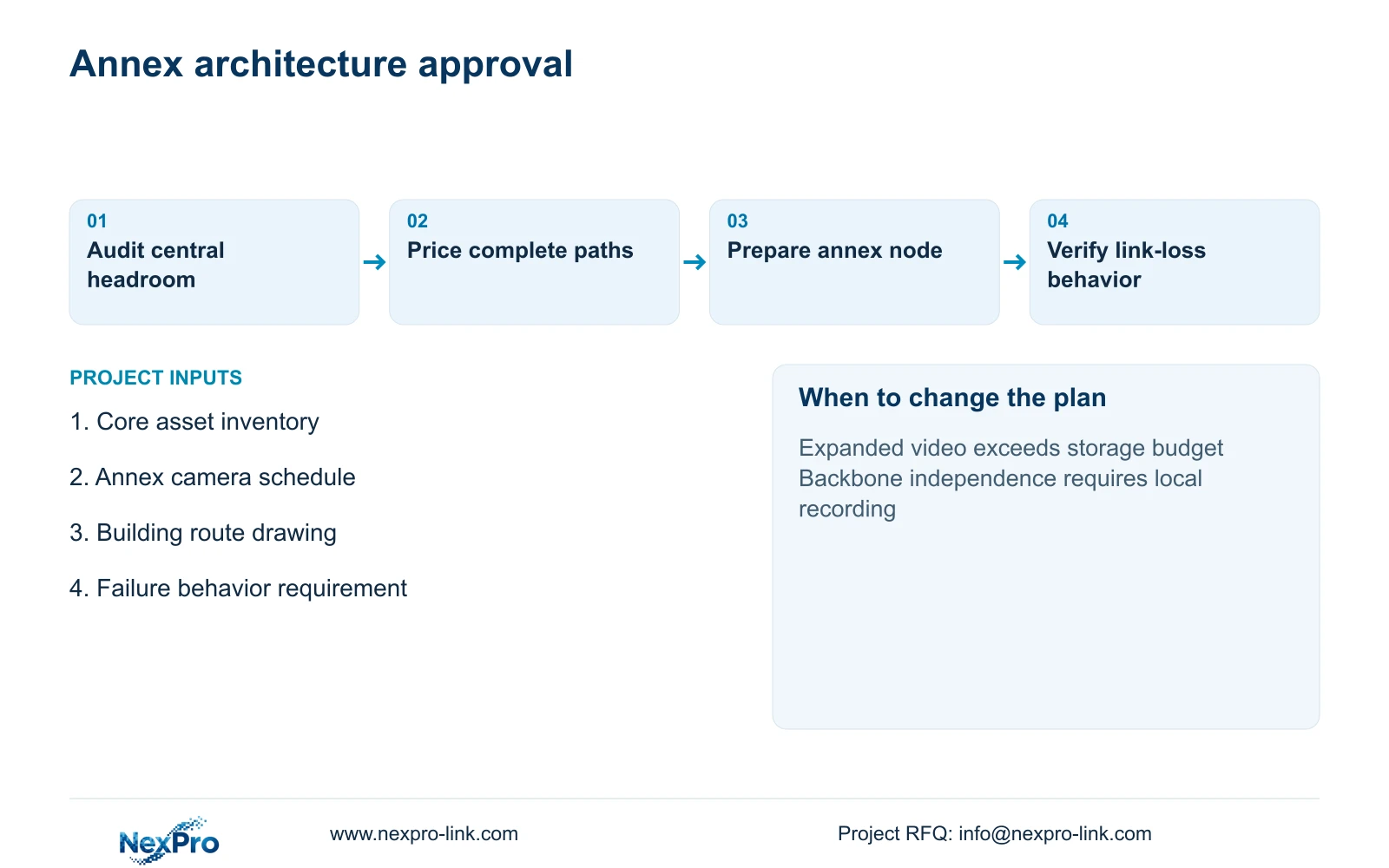
The final approval record should state the accepted failure behavior, retention target, exact recorder configuration and local power boundary. Include the installer responsible for the building link and the owner responsible for access roles. If a trial shows unsupported retrieval or inadequate route capacity, revise the affected option before shipment or cutover.
Section 07
Buyer questions
Does local recording eliminate the need for a backbone? No. It can reduce recording dependence on the backbone, but central supervision, playback and exports may still need it. Specify those tasks and their expected behavior during link loss.
Can reducing annex bitrate avoid adding storage? Only if recorded evidence still meets the accepted task. Trial the changed setting, recalculate retention and obtain approval; do not reduce quality merely to keep the old disk arrangement.
Do dual LAN ports prove network redundancy? No. Confirm the model's supported configuration and the complete network behavior. Two physical ports alone do not establish automatic failover or an independent second path.
Section 08
Compare both annex recording paths
Send your core recorder and disk inventory, six-camera annex schedule, inter-building route drawing and required link-loss behavior to info@nexpro-link.com to discuss central reuse and local-recording scopes.
Engineering references
These sources support the general planning principles. Always use the selected product's current datasheet and applicable project standards for final design.