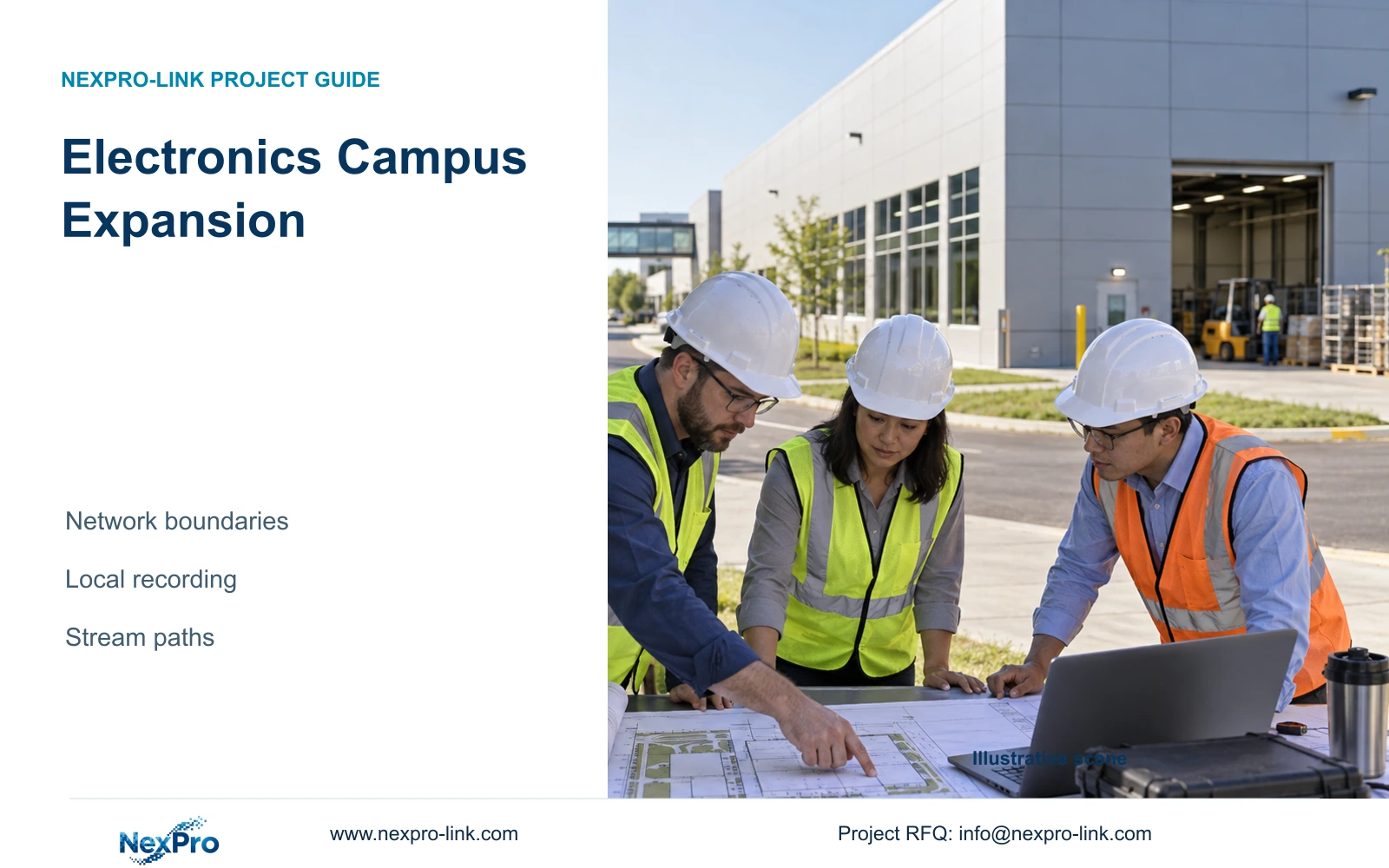
Adding a production building changes CCTV stream paths, access permissions and outage dependencies. Use local recording and a per-interface traffic schedule to preserve campus network boundaries.
Section 01
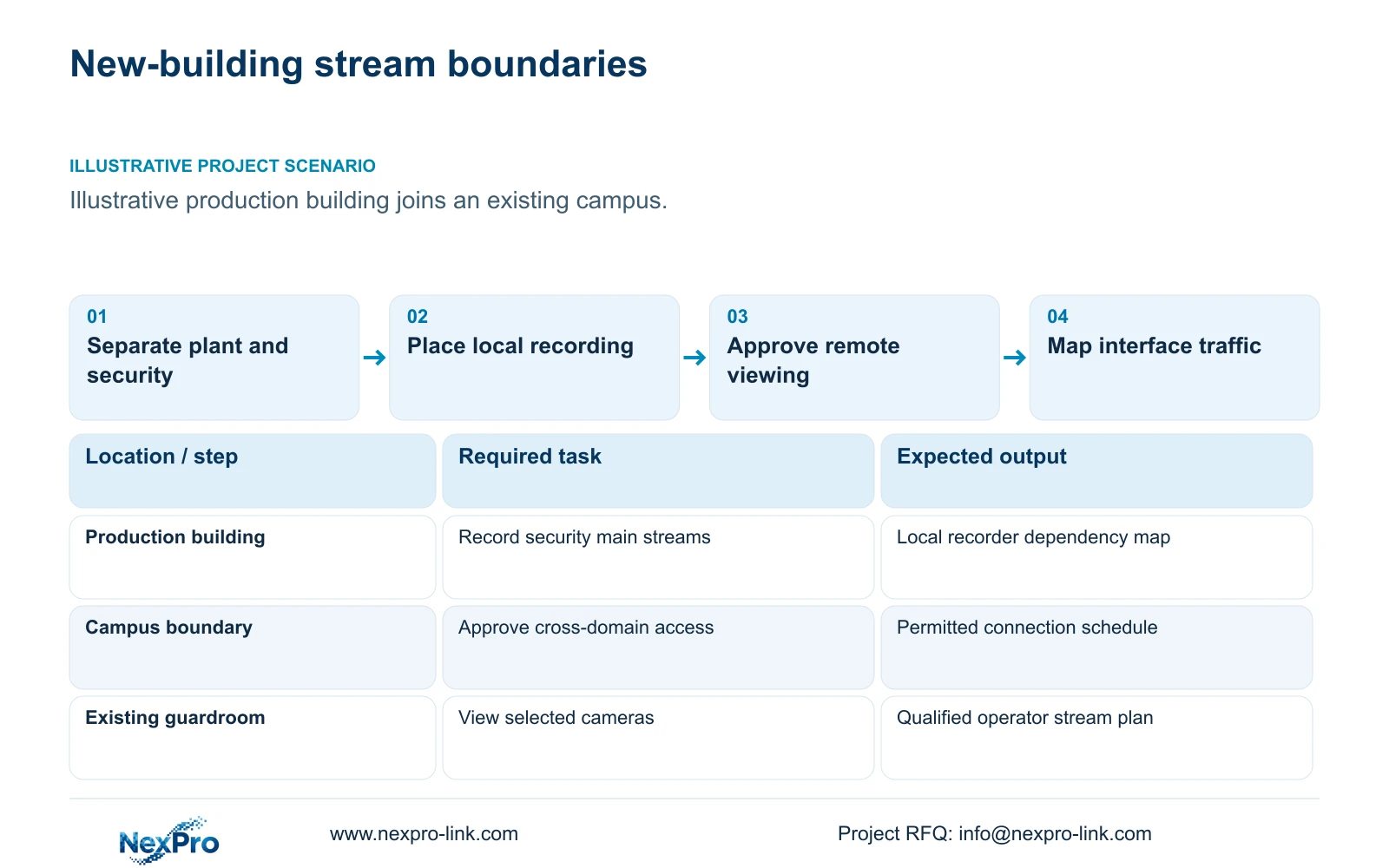
Approve access between domains before connecting the building
For an electronics campus expansion, retain distinct plant, office and security network domains and approve the required communication paths before connecting the new building. A shared fibre route or physical switch connection does not authorize unrestricted connectivity. The project manager should obtain a traffic and access schedule that the security operator, campus IT team and plant network owner can each approve.
Illustrative project scenario: A new production building is added to an existing office and manufacturing campus. Assume its cameras cover receiving, component storage approaches and batch transfer routes, while the existing guardroom needs selected remote views. The new building records locally. These assumptions describe a proposed arrangement, not a client project or an established capability of the existing network.
Define who may view, retrieve footage and administer equipment, and from which endpoints. Keep camera access separate from production-control access unless an explicit interface is required and accepted. NIST SP 800-82 Rev.3 provides an OT-security reference for considering operational constraints and separation. Use that context to structure the review, without assuming that a security VLAN alone resolves every permitted path.
Section 02
Choose recorder placement from the required outage behavior
Choose building-local recording when footage must continue during loss of the campus viewing link. Place the recorder and access equipment in a suitable service room, with a protected supply that reaches their actual circuits. The guardroom then receives an authorized viewing service. This arrangement can preserve local recording through a backbone interruption, provided the local camera, network and power dependencies remain available.
The 32-camera teaching module assumes main streams of 4Mbps, producing 128Mbps recorder input. The NexPro-NVR4449-4K is a candidate reference with 320Mbps input and four SATA bays up to 18TB each. Its stated recording modes, firmware and client functions still need matching to the proposed streams. Spare input bandwidth does not establish storage retention, decoding capacity or compatibility with every retained camera.
CASE02 shows why expansion must also include storage review. Its 64-camera reference creates 256Mbps input and 82.944TB of video for 30 continuous days. The formula is cameras × Mbps × 10^6 × 86,400 × days ÷ 8 ÷ 10^12. Eight 16TB disks yield 128TB raw; raw × 0.95 × 0.80 gives a 97.28TB video budget, already including reserve. Moving to central recording would move those streams onto the backbone and require a different traffic schedule.
Section 03
Assign each stream to the interface it crosses
Build a traffic schedule per connection: source, destination, stream type, simultaneous sessions and intended operating state. Local camera-to-recorder streams stay within the building in this proposed topology. Guardroom live views, playback and exports cross the authorized campus path. Add each payload only where it travels; a site-wide camera total is insufficient for sizing an individual uplink.
The network engineer should identify shared infrastructure, available fibre routes, interface ownership and the controls governing cross-domain access. The project manager can then separate retained backbone work from new optics, switching and configuration. An unused fibre strand may help the physical design, but still needs matching terminations, compatible link equipment and an agreed operating responsibility.
Keep endpoint installation constraints in the same location schedule. A receiving camera outside the process area may be an ordinary security position; an ESD-controlled transition can impose mounting and access procedures. For example, the BL2812M55 5MP-family source lists 2880×1620 output and a 2.8–12mm motorized lens, but neither field establishes cleanroom or ESD suitability. Moving a camera to an approved approach position can change its cable route and access-switch assignment.
Section 04
Keep overview traffic separate from recording quality
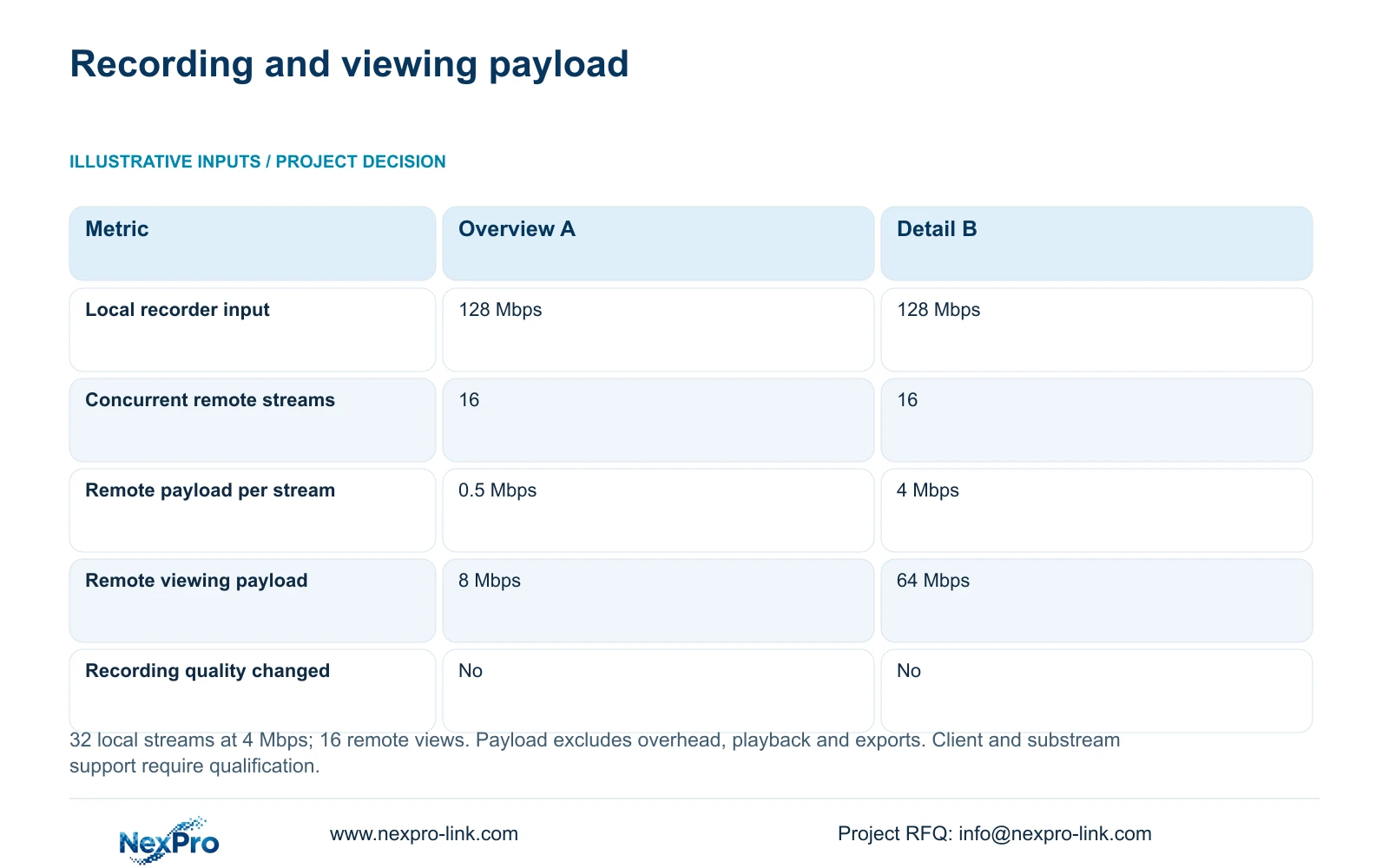
Compare two illustrative guardroom workflows while retaining the same local recording streams. Both options record 32 × 4Mbps = 128Mbps. For 16 simultaneous remote views, Option A assumes 0.5Mbps per overview stream, so viewing payload = 16 × 0.5Mbps = 8Mbps. Option B uses 4Mbps per detail stream, so viewing payload = 16 × 4Mbps = 64Mbps.
The decisive difference is the remote viewing payload, not the recorded image. Option A can support an approved overview task without lowering the local main stream. Select it only after confirming that its visible detail is adequate for the operator's purpose. When the task requires closer inspection, use a qualified detail workflow and count its traffic on the relevant interface.
These figures exclude protocol overhead, variable-bitrate peaks, playback, export and other shared traffic. They do not guarantee WAN performance or universal substream support. Two operator seats may create additional sessions, depending on the actual client and delivery method; inspect that behavior rather than assuming the first workstation's traffic calculation covers both. The acceptance demonstration should exercise the agreed simultaneous workload.
| Metric | Option A: remote overview | Option B: remote detail |
|---|---|---|
| Local recorder input | 128 Mbps | 128 Mbps |
| Concurrent remote views | 16 streams | 16 streams |
| Remote stream payload each | 0.5 Mbps | 4 Mbps |
| Remote viewing payload | 8 Mbps | 64 Mbps |
| Local recording quality changed | No | No |
Section 05
Retain local recording while qualifying shared services
Use local recording with selected remote overview views as the initial basis when the new building can maintain its own recording chain and the guardroom mainly monitors activity. This limits routine inter-building video payload in the teaching example. The trade-off is another recorder location, local storage administration and service access that must be included in the operating plan.
Change the arrangement when the owner requires a mandated central platform, shared search workflow or a different failure-response policy. Qualify those requirements before substituting hardware. ONVIF Profiles provides a basis for checking specific device and client functions, but basic video connectivity does not establish event search, audio or every playback workflow. Obtain exact model and firmware evidence for retained interfaces.
Budget power and cabling alongside the network design. A UPS in the guardroom cannot protect a separately powered building cabinet merely because fibre connects them. CASE02's assumed 1,535.4815W baseline includes two workstations and displays, so it is not a load allowance for this 32-camera module. Count complete PoE-switch AC input without adding camera watts again. Measure each copper route, select suitable backbone media, and test the agreed link type before handover.
Section 06
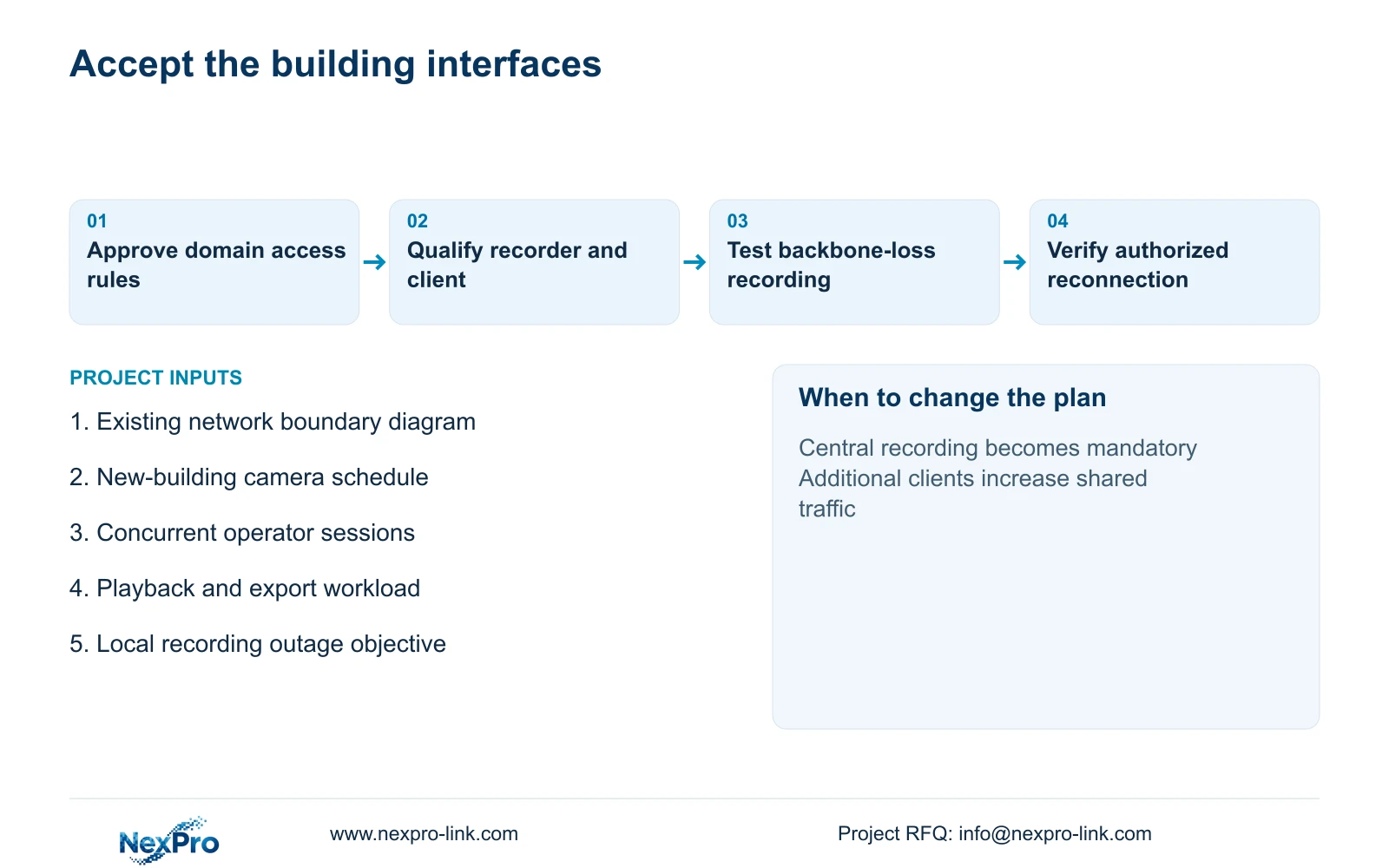
Release the building through interface-based acceptance
Issue the building package with clear supplied, retained and optional items. New cameras, the local recorder and selected access equipment need matched specifications; the retained campus backbone needs owner acceptance; cross-domain rules need approval by the responsible network teams. Specialist mounting conditions stay with the relevant site authority. This division prevents a camera supplier's equipment scope from silently absorbing campus network responsibilities.
Set acceptance tasks around the operating states that matter. Demonstrate local recording with the viewing backbone unavailable, then restore the link and check authorized live viewing, playback and export. Verify that an ordinary viewing account cannot administer the system. Perform outage and access tests under an agreed controlled procedure, keeping production-control equipment outside the CCTV test scope.
NexPro-Link can support equipment matching, technical submittals, BOQ deviations and project packing for the new-building supply. Compare its proposal with other offers using identical viewing sessions, recording objectives, retained interfaces and local services. Keep configuration revisions and location labels aligned with the approved network schedule so the delivered hardware does not arrive with an obsolete address plan.
Section 07
Buyer questions
Does a recorder with two LAN ports automatically separate plant and security networks? No. Port count alone does not establish isolation or an approved routing policy. Confirm the recorder's interface behavior and the surrounding network configuration. The campus network owners must approve how each interface is connected and used.
Can the new building use the existing campus client? Possibly, but qualify the exact recorder, client version and firmware combination against the required tasks. Include user permissions, stream selection, playback and export in the trial. A successful live picture is only one part of acceptance.
Can a shared fibre backbone remain in the proposal? Yes, when its physical capacity, logical access controls, ownership and failure behavior are acceptable. Record the retained infrastructure and any required configuration work explicitly. Sharing the route does not require opening unrestricted access between connected networks.
Section 08
Scope the new building's CCTV interfaces
Send the existing network boundary diagram, new-building camera schedule with restricted-area constraints, concurrent viewing and export requirements, and local recording outage objective to info@nexpro-link.com to discuss a matched building package and its retained-campus interfaces.
Engineering references
These sources support the general planning principles. Always use the selected product's current datasheet and applicable project standards for final design.