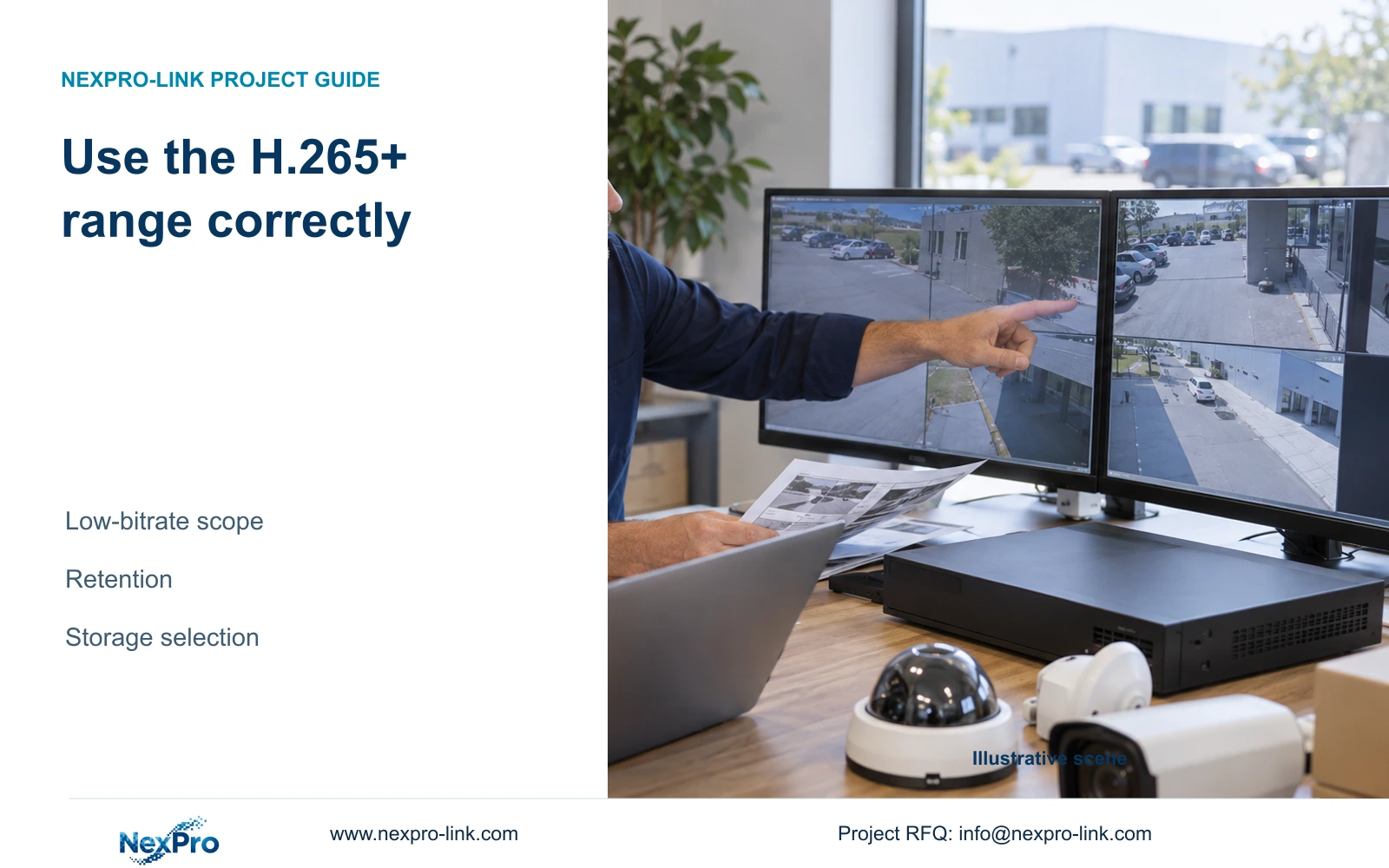
The manual's 6 to 12G daily range describes a low-bitrate equipment example. Use both ends for a clearly labelled sensitivity check, then confirm the proposed camera, codec and stored footage before ordering disks.
Section 01
Qualify the daily range before quoting retention
Use the manual's 5MP range of 6 to 12G/day/channel as a reference for its stated low-bitrate equipment context, not a promise for every 5MP camera. A distributor should retain both ends of the range, identify the proposed recording profile and check representative stored footage before selecting disks. In the supplied teaching example, treating G as decimal GB for 16 channels over 30 days produces 2.88 TB at the lower end and 5.76 TB at the upper end. Those figures describe conditional video volumes. They do not establish the usable capacity of an offered recorder or the retention achieved at a site.
The private supplied NVR4.0 user manual CH_V2.4.doc has V2.4 in its filename and V2.2 in its body. Section 5.1.1 contains the low-bitrate references, including 4 to 8G/day/channel for 2MP equipment. Preserve the original units and equipment scope; use section titles rather than older page numbers.
Section 02
Confirm the camera's accepted encoding profile
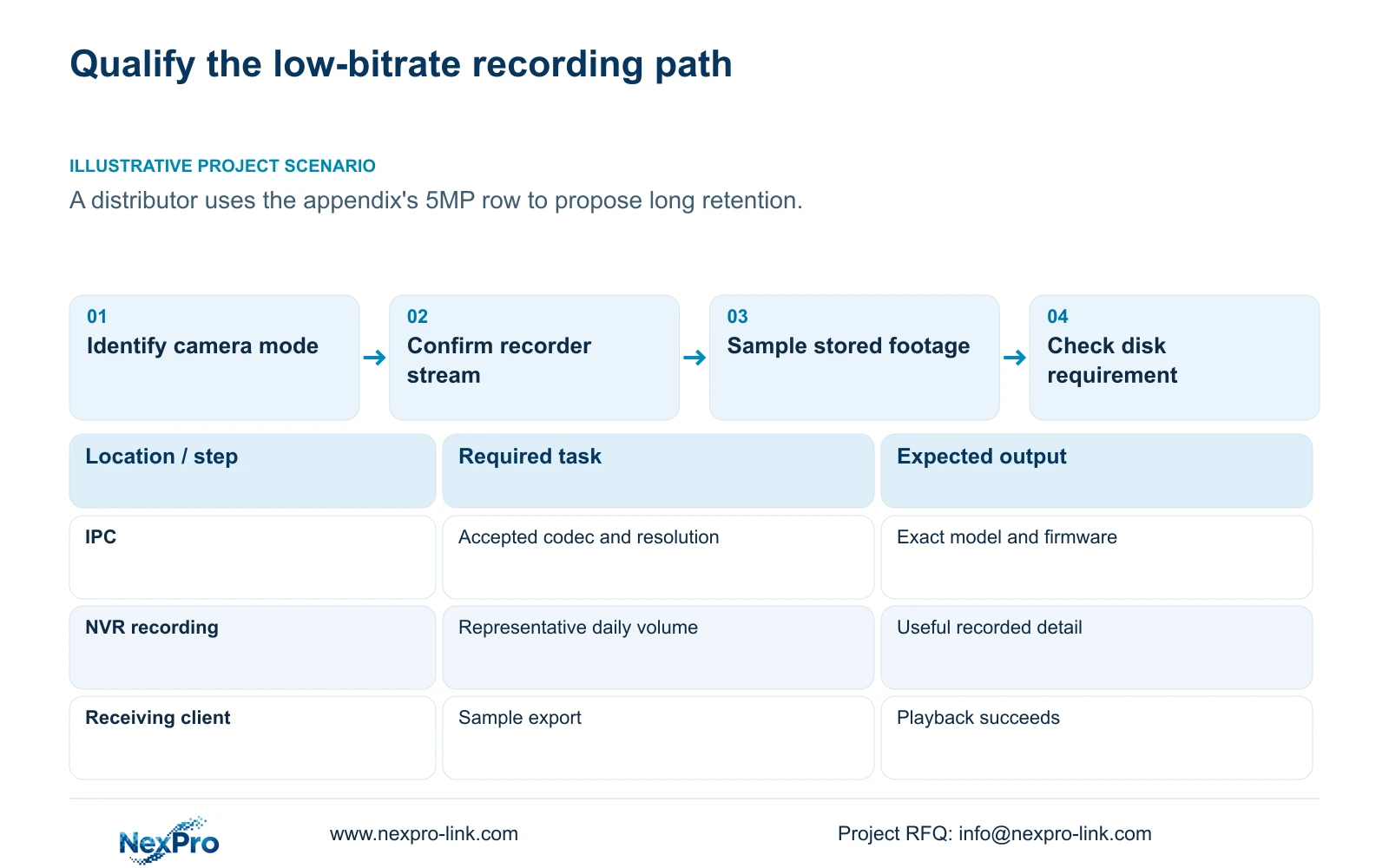
Sections 4.4.5 and 4.12.7 list H.264, H.265 and H.265+ encoding choices, while available resolutions depend on IPC capability. A choice visible in a family manual does not establish that every connected camera can supply it. Record the exact camera model, firmware, connection method and mode accepted by the recorder.
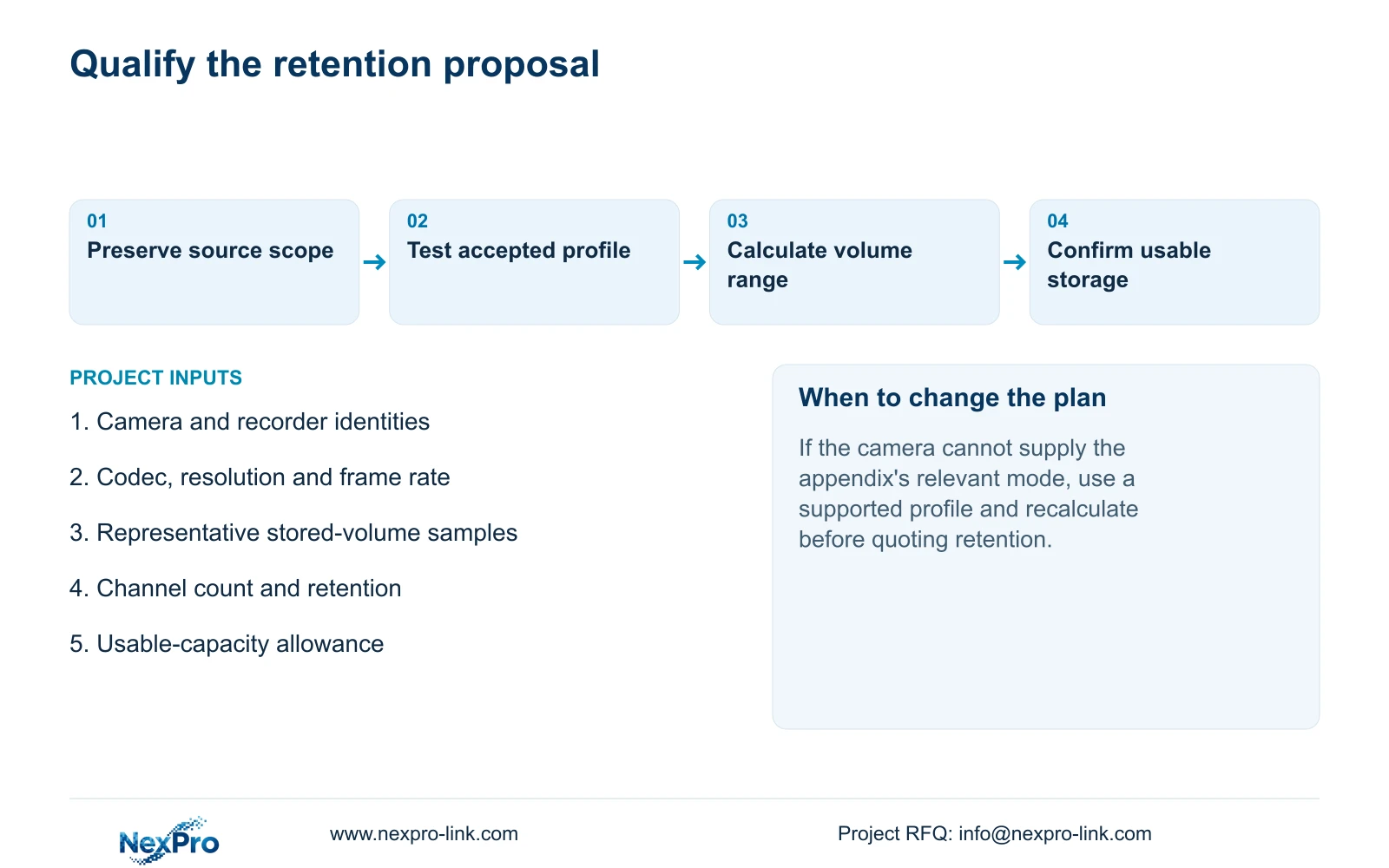
Compare the intended stored stream with the appendix context. If the offered combination cannot use the relevant low-bitrate mode, move to a supported profile and recalculate. Do not keep the original retention claim while substituting a different codec or resolution.
Before changing an encoding profile, preserve a comparable sample. Test the changed recording, export and intended viewing client. If the smaller file loses required detail or cannot be viewed on the receiving path, it is unsuitable as the procurement baseline even when its volume falls within the appendix range.
Section 03
Establish the average from useful recordings
The rate fields in section 4.4.5 and traffic observations in section 4.3.3.3 answer different questions. CBR and VBR describe control modes; the entered rate is a configuration value. Retention planning needs a representative average or a clearly declared assumption.
Sample periods that include the scene's relevant lighting and activity. Attach the codec, resolution and frame-rate settings to the sample so procurement can distinguish a changed scene from a changed profile. The supplied low-light camera article explains why a clean daytime view may not represent night traffic; its acceptance-scene task remains separate from this capacity decision.
If representative stored volume falls outside the appendix range, use the site's evidence for sizing and retain the manual range as a scoped reference. Investigate the profile difference before lowering settings. A low daily total is useful only when the recordings still meet the viewing task.
Section 04
Keep the ONVIF note within the appendix
Section 5.1.1 states that recording days are halved for ONVIF access in its low-bitrate reference context. Keep that note with the table when explaining the source. It does not establish that the protocol label universally doubles storage consumption.
For a third-party combination, identify the actual negotiated stream and compare recorded volume under equivalent conditions. Confirm the required device and client functions separately. The public ONVIF Profiles reference is relevant to matching functional scope; it is not evidence that every camera and recorder pair supports the same codec, controls or retention.
If changing the connection method changes the available stream, document that result and recalculate with the accepted profile. If the stream remains equivalent, the capacity calculation should continue using its bitrate and duration rather than adding an unsupported protocol multiplier.
Section 05
Calculate both ends of the supplied range
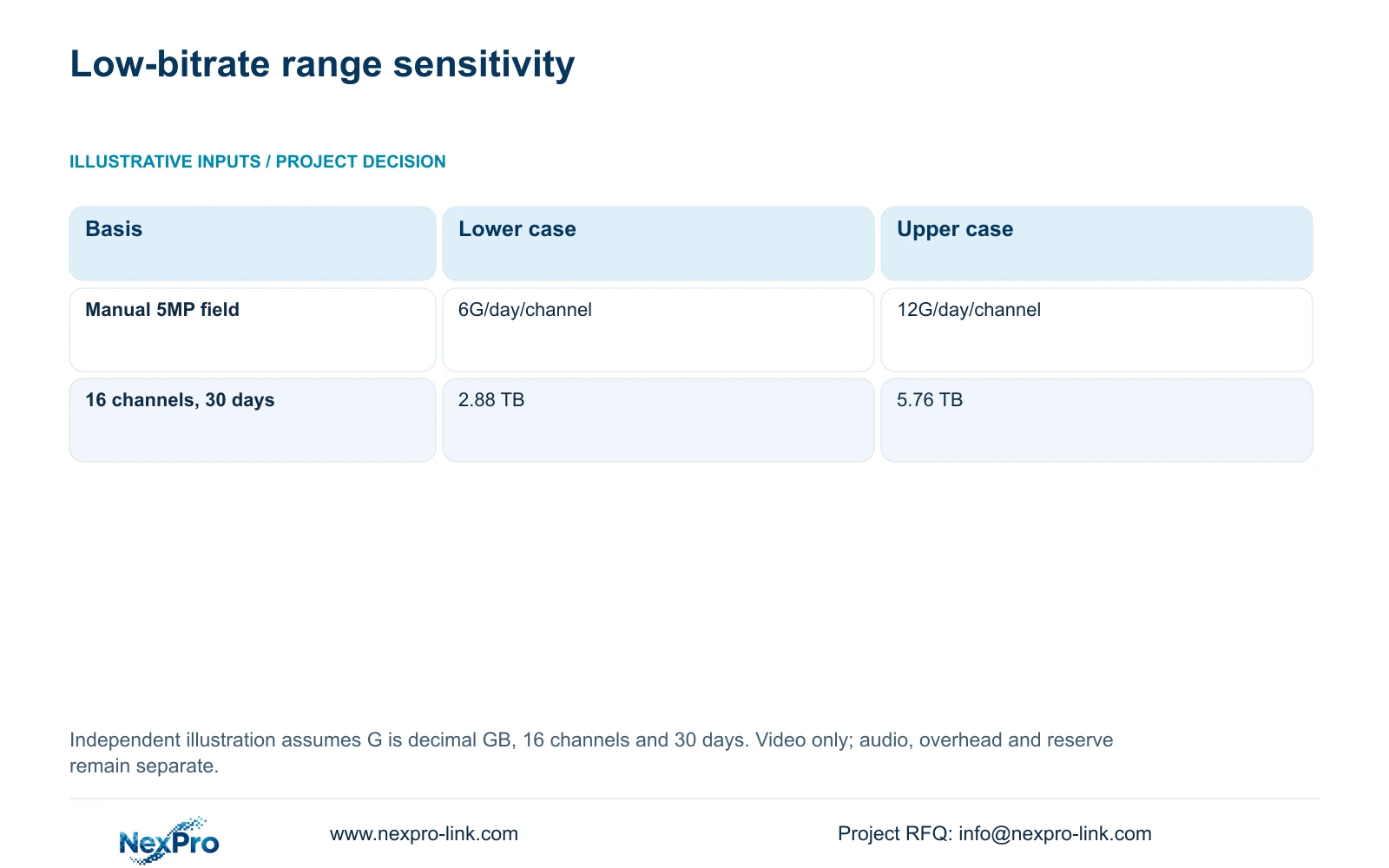
The independent sensitivity example assumes G means decimal GB, 16 recorded channels and 30 days. This assumption does not redefine the original manual field. The formula is video TB = daily GB/channel × channels × days ÷ 1000.
The lower case is 6 × 16 × 30 ÷ 1000 = 2.88 TB. The upper case is 12 × 16 × 30 ÷ 1000 = 5.76 TB. The upper result is twice the lower result, so choosing the lower endpoint alone can materially change the disk requirement.
These volumes exclude separately identified audio, storage overhead and reserve. For bitrate-based planning, use decimal video TB = 0.00045 × Σ(channels × average Mbps × hours/day × days). Apply a reserve fraction r through division by (1 - r) after defining the stored-volume allowances. Keep the range-based and bitrate-based methods labelled instead of combining their inputs.
| Input basis | Lower case | Upper case |
|---|---|---|
| Original manual field | 6G/day/channel | 12G/day/channel |
| Assumed decimal daily volume | 6 GB/day/channel | 12 GB/day/channel |
| 16 channels for 30 days | 2.88 TB video | 5.76 TB video |
Section 06
Select the complete recorder configuration
Compare channel modes, incoming bitrate and the operator's required playback combination alongside usable storage. Confirm the disk bays, individual disk limits, interfaces and remote tasks for the exact candidate. TS model examples in the manual have no established mapping to NexPro-Link commercial SKUs.
A qualified storage configuration must accommodate the accepted planning volume and allowance without exceeding the recorder's supported arrangement. Do not infer a RAID level or redundant storage from a menu. Where capacity or playback support remains unconfirmed, hold that purchasing decision and request the missing model-specific information.
Bench preparation can verify the offered combination, as described in the existing CCTV kit-preparation article. Real lighting and activity still need site checks. Record what the bench proves and what remains to be accepted after installation.
| Finding | Decision | Next action |
|---|---|---|
| Only the 5MP label matches | Appendix applicability is unconfirmed | Identify the accepted stream profile |
| Sample volume exceeds the source range | Use representative site evidence | Revise storage before ordering |
| Capacity fits but export fails | The proposed profile is not yet qualified | Resolve the receiving playback path |
Section 07
Review the distributor's proposed claim
Illustrative project scenario: A distributor wants to quote long retention using only the 5MP example row in the appendix. The engineer identifies the intended camera and stream, shows both sensitivity endpoints and lists the remaining volume allowances. Procurement keeps the retention claim conditional until representative recordings and the offered usable capacity support it. No delivered installation or measured retention result is asserted.
Section 08
Buyer questions
Is 12G/day a universal upper limit for 5MP cameras? No. It is the upper endpoint of the supplied equipment example.
Does H.265+ guarantee a fixed saving? No. Qualify the actual recording profile and its useful image result.
Can the lower endpoint support a firm quotation? Only when the project's evidence and agreed capacity allowances support that basis.
Section 09
Submit the proposed recording profile
Send the proposed camera and recorder identities with the intended stream profile to info@nexpro-link.com for a scoped retention and storage discussion.
Engineering references
These sources support the general planning principles. Always use the selected product's current datasheet and applicable project standards for final design.