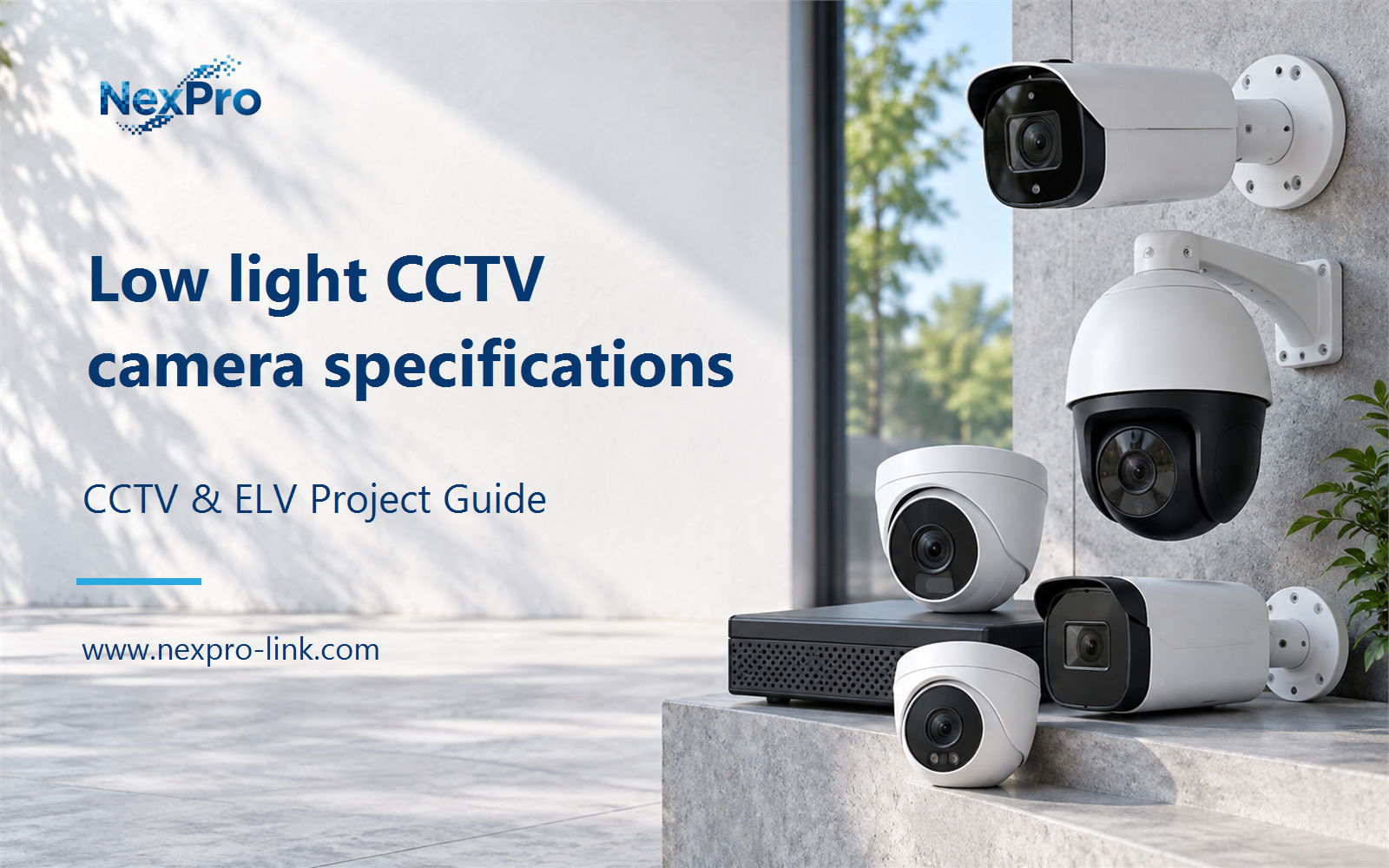
Plan low light CCTV camera specifications with practical guidance on read every condition attached to lux and handle backlight without losing motion. NexPro-Link project guide.
Section 01
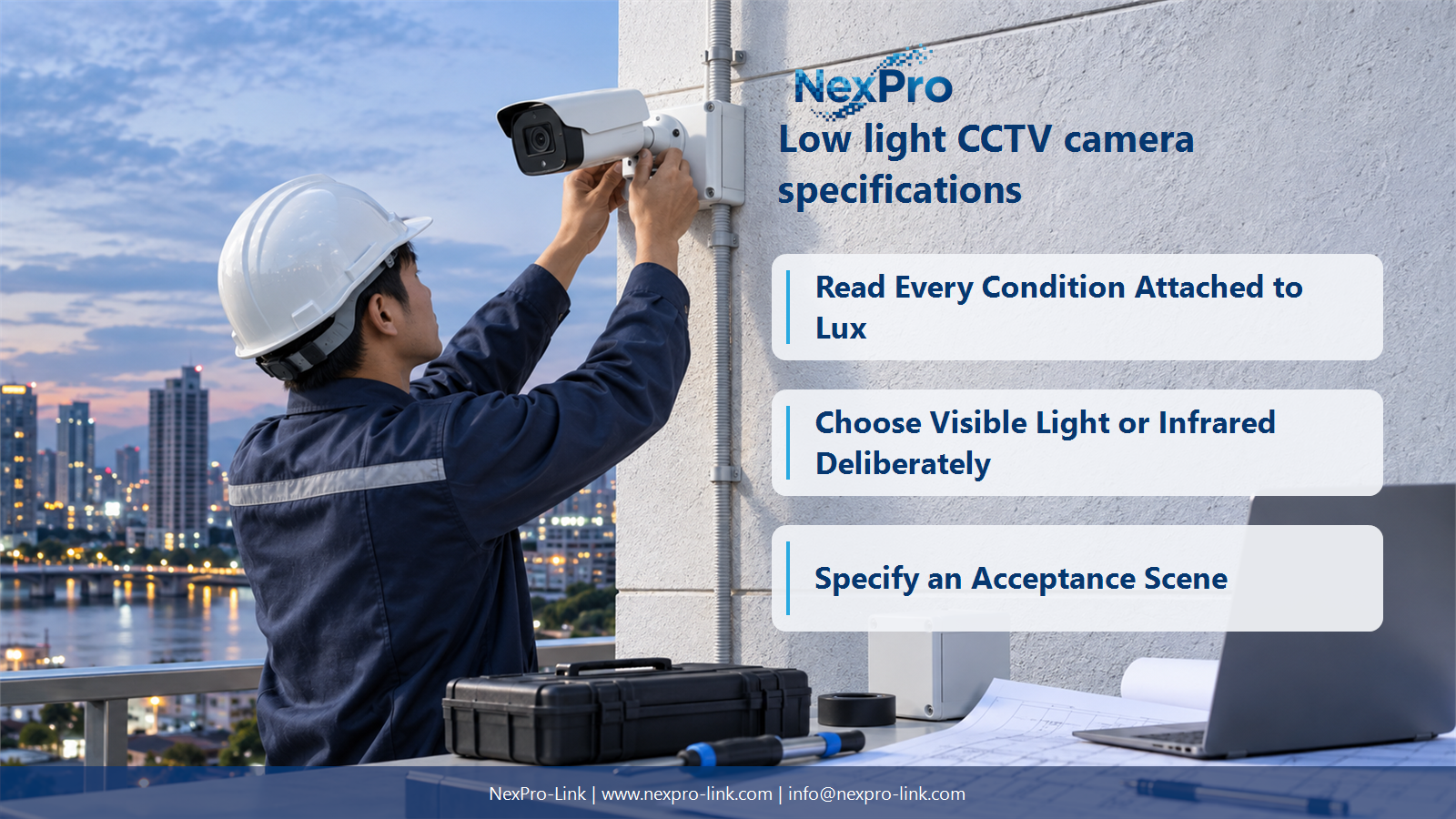
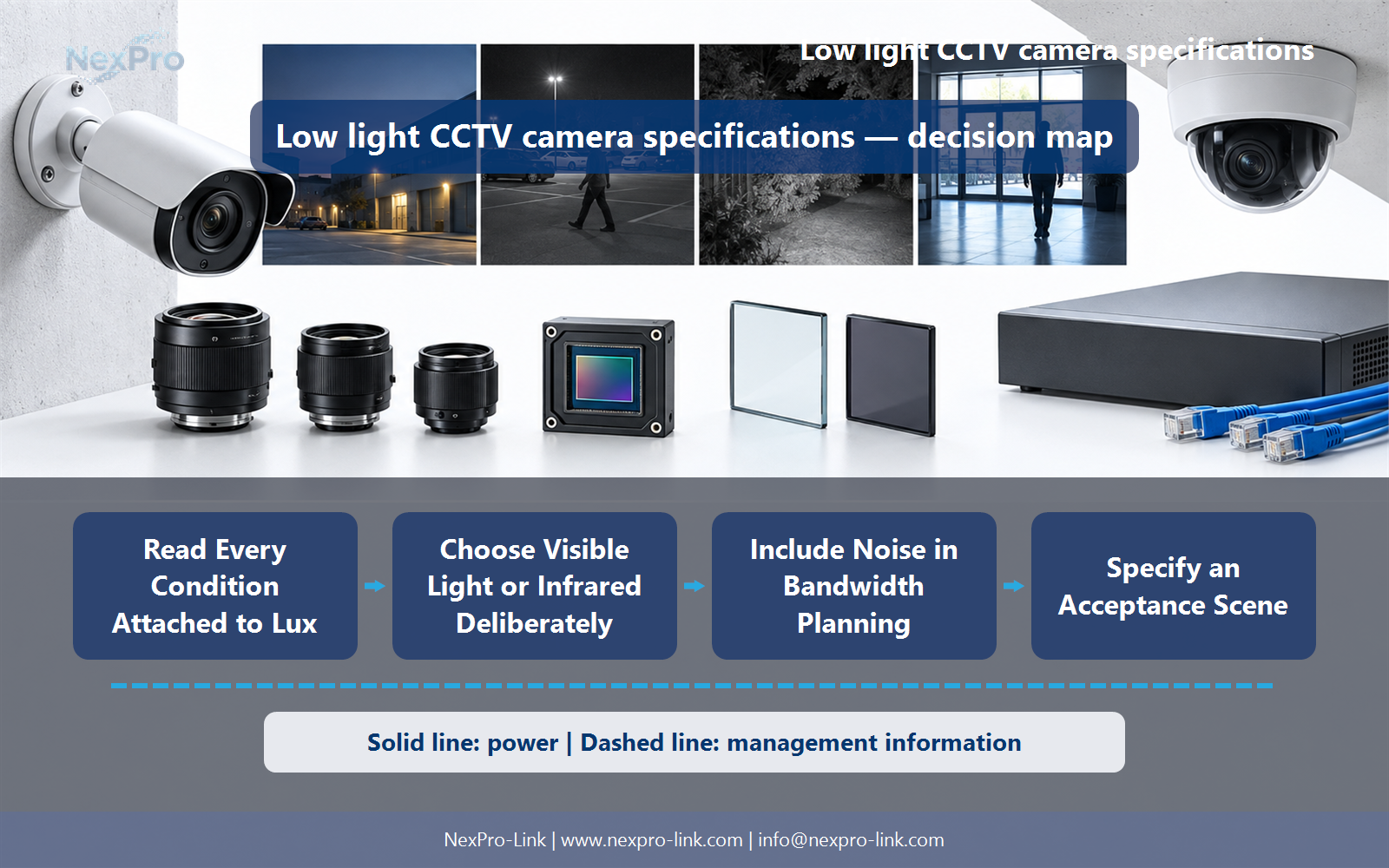
Read Every Condition Attached to Lux
It describes a sensitivity claim under stated conditions, not a complete guarantee of usable night evidence. Aperture, gain, exposure time and the acceptance criterion matter. The supplied NexPro-Link datasheets attach F1.2 and AGC ON to the color value; retain those conditions instead of quoting the lux number in isolation.
Turn the answer into a working record using Claimed lux, Aperture, Gain, Exposure, Image criterion.
| Decision area | Buyer question | Required output |
|---|---|---|
| Read Every Condition Attached to Lux | What does a 0.001 lux camera specification tell the buyer? | It describes a sensitivity claim under stated conditions, not a complete guarantee of usable night evidence. |
| Distinguish Brightness from Moving Detail | Why can a bright night image still be unusable? | Long exposure and aggressive processing can make a scene look bright while moving subjects blur or fine texture disappears. |
| Choose Visible Light or Infrared Deliberately | Does a full-color camera work in complete darkness without light? | Color imaging needs usable illumination. |
Section 02
Distinguish Brightness from Moving Detail
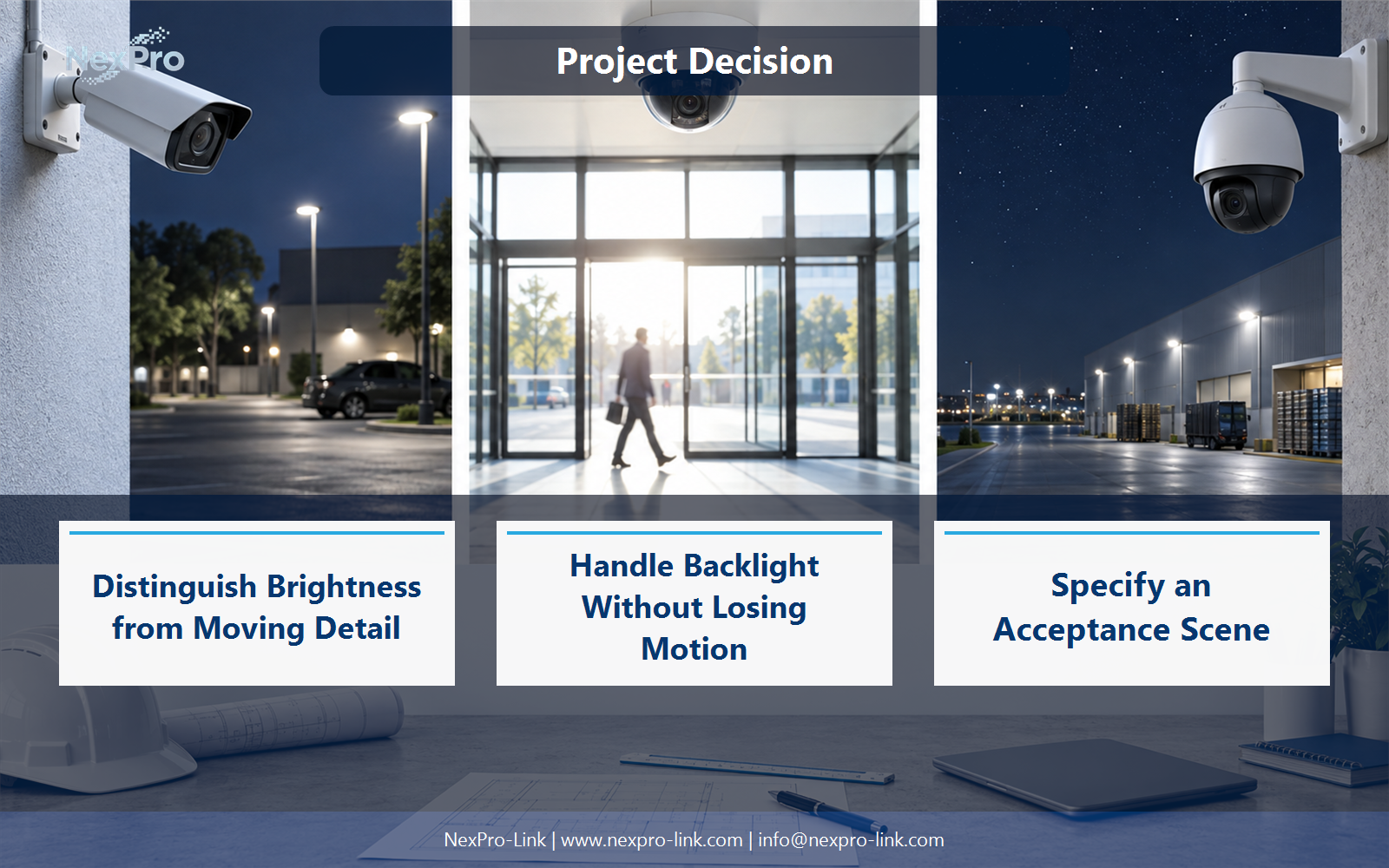
Long exposure and aggressive processing can make a scene look bright while moving subjects blur or fine texture disappears. Judge the task with realistic movement, not only a static screenshot. The better setting is the one that preserves the required event detail with acceptable noise, rather than the one that produces the brightest preview.
Use Setting, Static image, Moving target, Noise, Usable detail to compare options on the same basis. Keep product capability, project assumption and operating responsibility in separate columns.
Section 03
Choose Visible Light or Infrared Deliberately
Color imaging needs usable illumination. Infrared-assisted capture can work in darkness when the camera and scene support it, but the resulting image may not retain normal color information. Choose visible or infrared illumination from the operational task, reflections and site restrictions rather than treating full-color and zero-light claims as interchangeable.
The project output should make Night task, Available light, Illumination mode, Color need traceable from input to acceptance.
- Confirm the answer to: Does a full-color camera work in complete darkness without light?
- Record the project fields: Night task / Available light / Illumination mode / Color need.
- Keep product capability, project assumptions and site responsibility in separate records.
Section 04
Handle Backlight Without Losing Motion
No. Wide dynamic range concerns detail across bright and dark parts of a scene, while sensitivity concerns capture with limited light. Processing methods and exposure trade-offs can affect moving targets. Compare the actual entrance or headlight scene and distinguish digital WDR from other WDR implementations instead of assuming a label proves identical behavior.
Record Scene contrast, WDR mode, Motion effect, Night requirement before selecting a product family. That makes later substitutions possible without silently changing the operational requirement.
Section 05
Include Noise in Bandwidth Planning
They can change encoded traffic under variable-rate operation because noise, motion and processing influence the image stream. Use representative day and night measurements or clearly separated planning assumptions. A storage estimate based only on a clean daytime scene may not represent the camera's full recording cycle.
Review Period, Scene condition, Mean Mbps, Duration, Data with the party that will operate or maintain the system.
Section 06
Specify an Acceptance Scene
Use the same view, target movement, light conditions and intended recording quality, then preserve the configuration used for each result. Compare recognition-relevant detail, glare and motion artifacts rather than different marketing screenshots. NexPro-Link model discussions should include the supplied lens and sensor information without converting those specifications into an untested site result.
Use Candidate, Scene, Settings, Moving detail, Trade-off as the handoff between design and procurement.
Engineering references
These sources support the general planning principles. Always use the selected product's current datasheet and applicable project standards for final design.