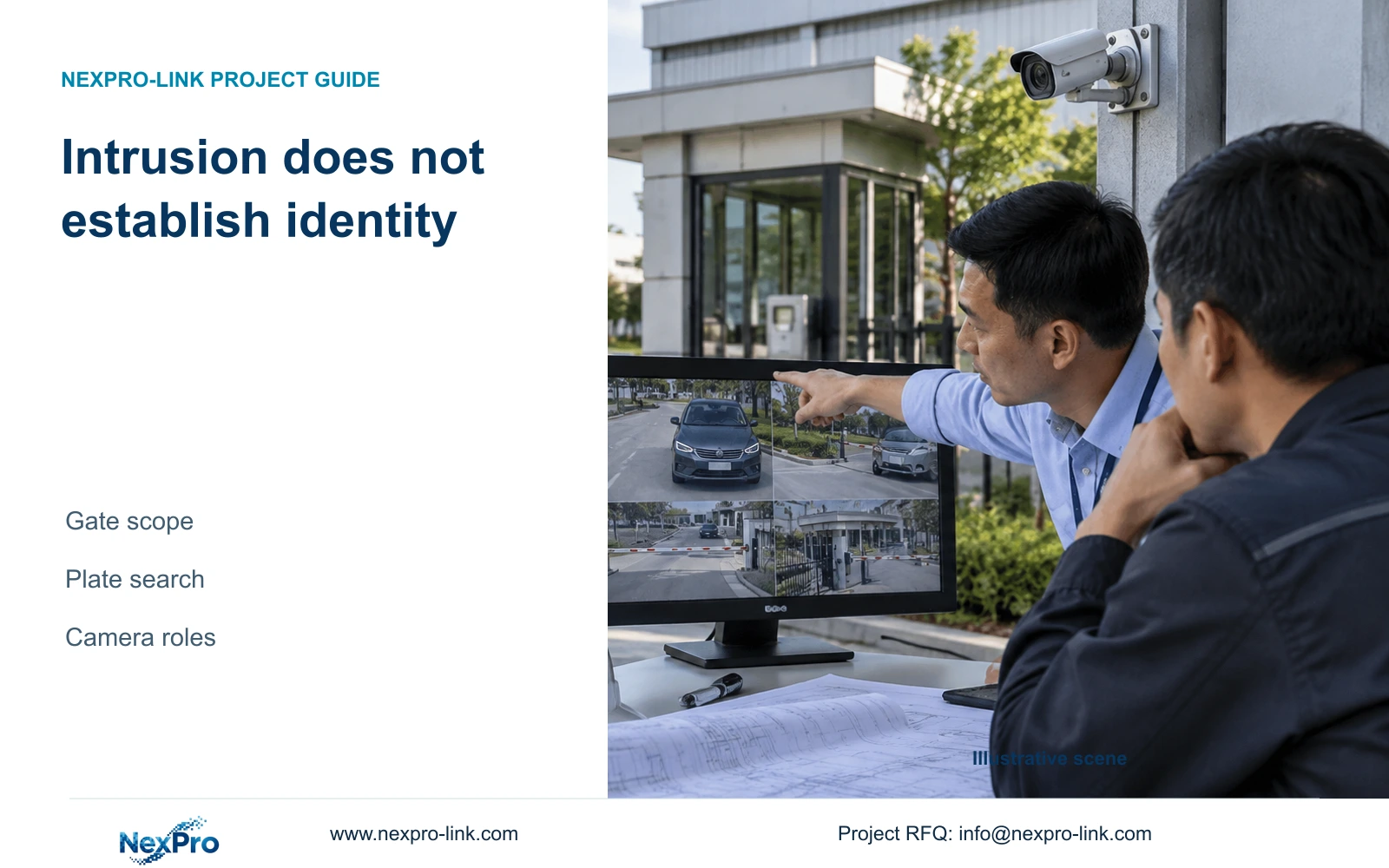
An intrusion menu describes an event rule, not a searchable identity database. Separate overview recording, dedicated recognition and access decisions before specifying equipment.
Section 01
Name the event before specifying identity functions
NVR intrusion detection does not establish face or license-plate recognition. The supplied NVR4.0 manual's light-analytics section describes IPC intrusion and line crossing, with camera-side rules and recorder responses. Those functions do not establish a searchable plate database or a face-identification workflow. For a gate project, decide whether the owner needs footage of a crossing, plate text that can be searched, or an access decision. Specify each required result and the component responsible for producing it. Keep existing overview recording where it remains useful, and request separate evidence for recognition equipment and any interface to the barrier controller.
Write the manual-supported event names into the initial scope: area intrusion and line crossing. Section 4.12.15 describes enabling the NVR function and using Front-end Settings for the IPC region or line, direction and related parameters. This establishes a configuration workflow for supported events, not additional identity capabilities.
Section 02
Match the visible menu to the actual hardware
The manual covers a recorder family, including TS8104A3, TS8108A3, TS8216A3, TS8232C4, TS8108D7, TS8116D7, TS8836M and TS8436M. Its overview and model tables have different purposes. A family-level feature description cannot be copied into every individual equipment line.
Sections 1.2 and 5.2 distinguish capabilities such as preview decoding, local playback, buzzer support and talkback. Apply the same model-specific discipline to a recognition proposal: identify the actual recorder and camera, applicable firmware and requested operation. No mapping from these TS identities to NexPro-Link commercial SKUs is established by this manual. A familiar interface is insufficient evidence that a proposed commercial recorder supports the specialist workflow.
Section 03
Decide whether the operator needs video or structured search
Ask the owner to describe how staff will retrieve an incident. Searching a channel and time to watch a vehicle cross a boundary is a video task. Entering plate text and obtaining associated records requires a separately specified recognition and search workflow. For a face task, state whether staff need a visible face in footage or a particular identity result.
Keep detection, classification and identification on separate lines. A directional event does not establish human/vehicle classification, and classification does not establish a person's identity or plate text. If a supplier demonstrates only an intrusion notification, record that result as event evidence and leave the structured-search requirement open. Confirm the requested interface independently from basic video, including camera capability, protocol and relevant permissions.
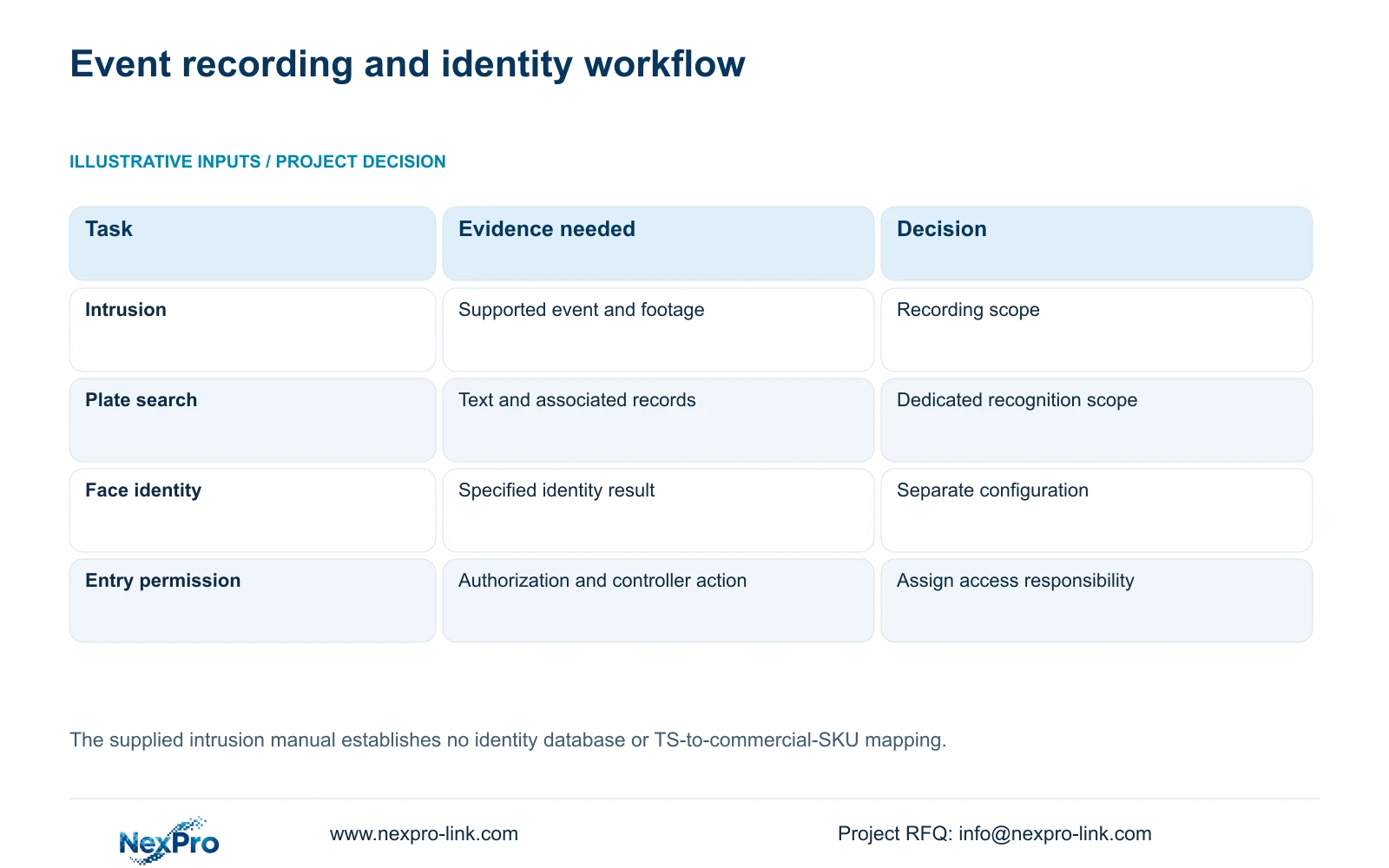
| Owner task | Required result | Scope decision |
|---|---|---|
| Review a boundary crossing | Associated channel footage | Specify supported intrusion and recording |
| Search by license plate | Plate text and associated records | Specify dedicated recognition and search functions |
| Identify a particular person | Defined identity-recognition result | Request a separate face-recognition configuration |
| Permit vehicle entry | Authorized access decision and controller action | Assign recognition, authorization and barrier responsibilities |
Section 04
Assign recognition and barrier responsibilities separately
A gate scope should state where recognition runs, where any searchable records reside and which system owns the authorization decision. Describe the expected event or command interface to the barrier controller as a requirement to verify. The supplied intrusion instructions do not prove that interface exists.
Use observed outcomes to guide the next test. If a plate appears readable in footage but no searchable text is demonstrated, capture is observed and database functionality remains unverified. If recognition is demonstrated but the barrier does not respond, inspect the separately agreed controller interface and responsibility. Do not classify the whole recorder as defective from either observation. Leave unsupported functions out of the committed equipment scope until appropriate documentation or a controlled demonstration resolves them.
Section 05
Retain the overview channel with a reliable identity
Ordinary overview footage can still explain what happened around the gate, even when a dedicated recognition view is required. Keep its role explicit instead of replacing the entire camera schedule with a specialist label. Define whether the overview channel must show the approach, crossing or surrounding incident context.
Maintain separate fields for drawing location, physical camera identity, address, NVR channel and displayed name. Sections 4.3.1, 4.4.4 and 4.12.6 provide connection, channel-name and OSD controls; the project must maintain the mapping. After a replacement or reordering, update the record and confirm which footage belongs to which view. Renaming a channel does not change the camera's analytical capability, and a familiar display position does not establish physical identity.
Section 06
Prepare separate recording and recognition inputs
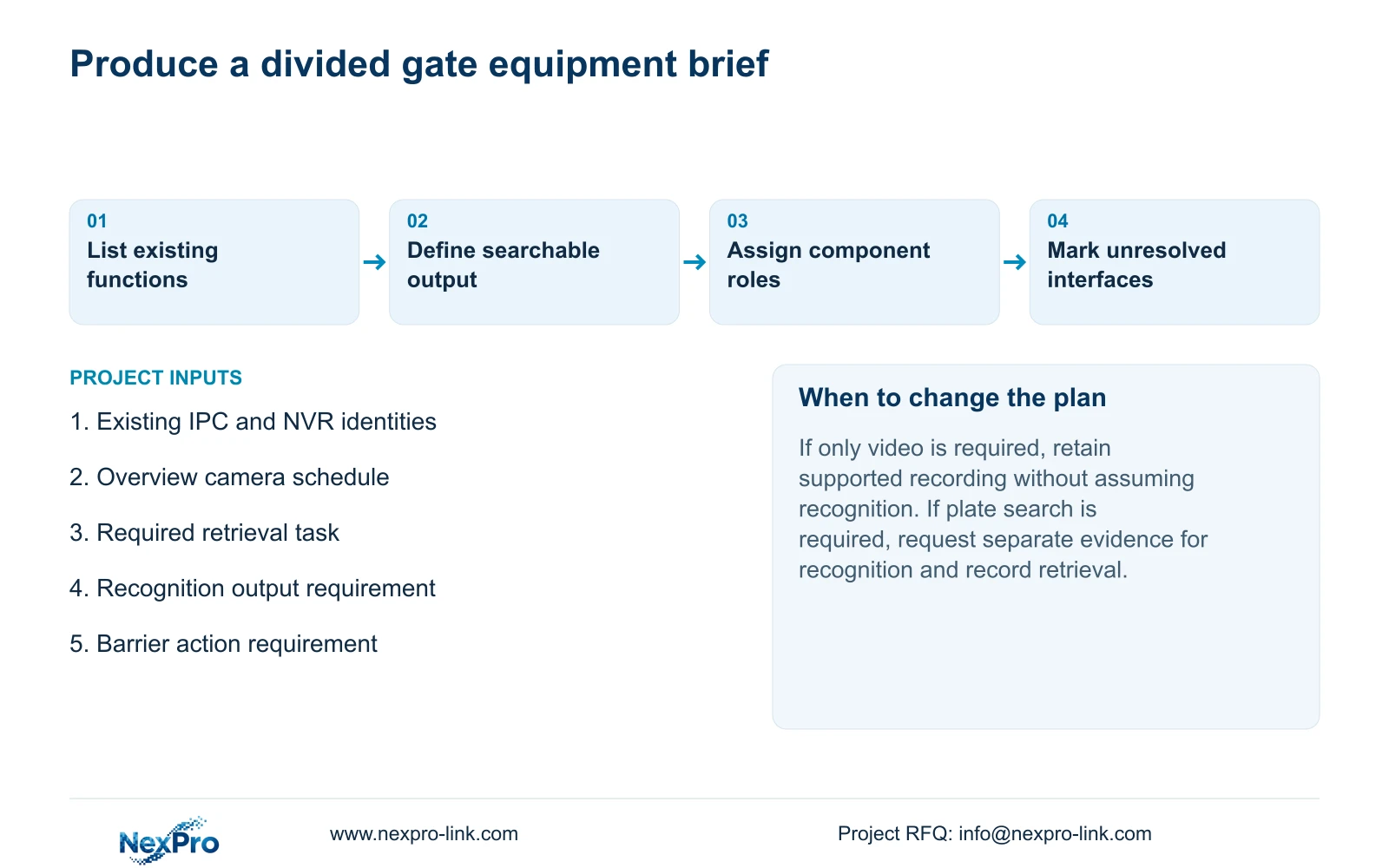
Build the proposal brief around the functions already distinguished. The recording line needs the camera schedule, required viewing and retrieval task, retention objective and relevant network and power arrangement. The recognition line needs the desired searchable output and its association with the recorded view. Add the barrier interface only when the project requires an access action.
Identify existing equipment separately from proposed additions, and mark each specialist requirement as demonstrated, documented or unresolved. Include the delivery destination when the discussion moves to supply. NexPro-Link's BOQ and tender support can use this division to discuss equipment matching and technical scope without treating an ordinary intrusion menu as proof of an identity system.
Section 07
Resolve the gate database assumption
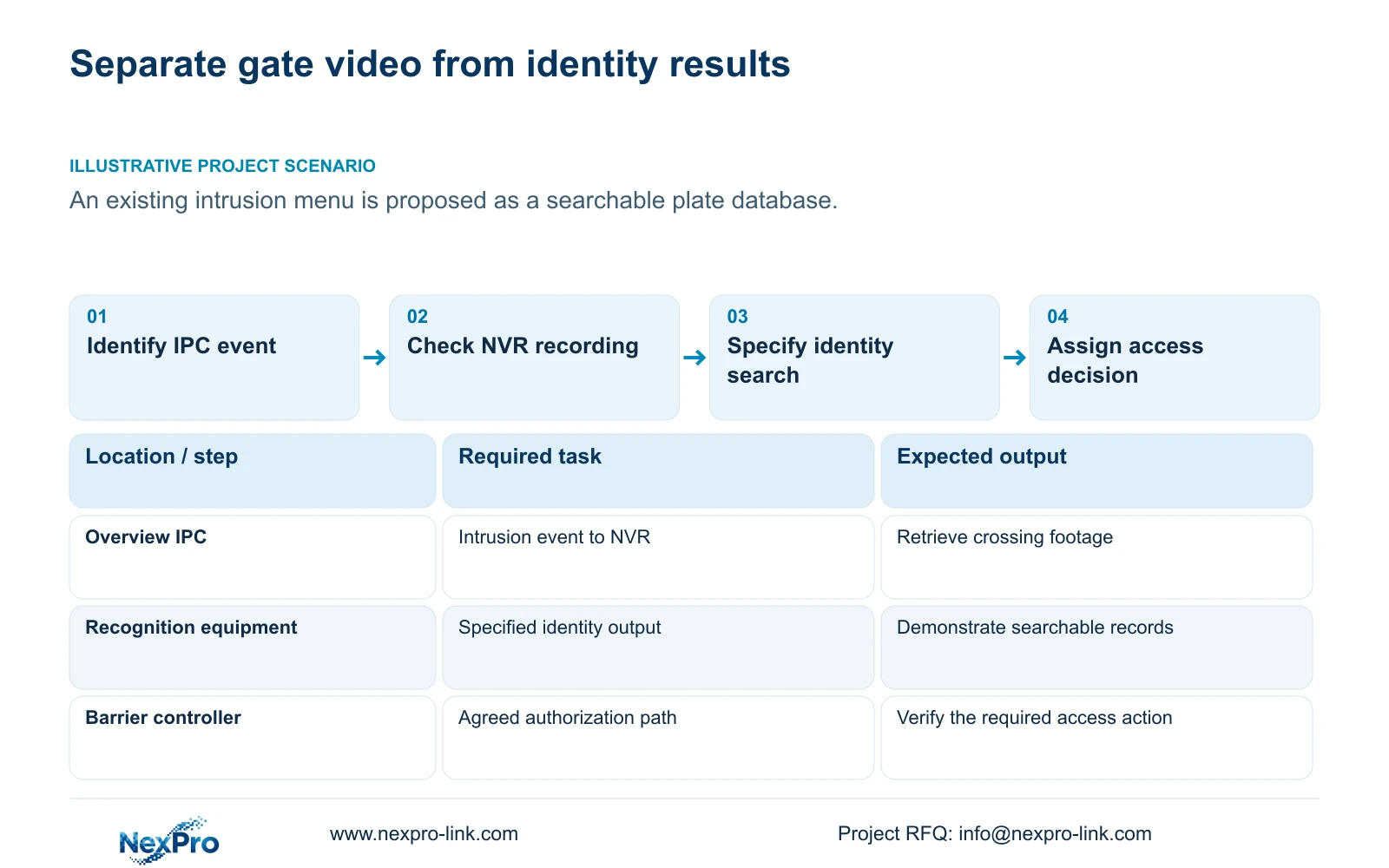
Illustrative project scenario: A gate project asks whether the existing intrusion menu can produce a searchable license-plate database. The engineer keeps the overview recording requirement, records the demonstrated intrusion function and lists plate recognition and searchable records as a separate equipment task. Barrier control remains a further responsibility to specify if entry authorization is required. This produces a scoped enquiry without assuming a delivered result.
The operating basis is the private NVR4.0 user manual CH_V2.4.doc, with V2.2 in its body, sections 4.12.15, 1.2, 5.2, 4.4 and 4.10. Channel mapping follows sections 4.3.1, 4.4.4 and 4.12.6. These sections do not establish a commercial SKU mapping or universal third-party analytics interoperability.
Section 08
Must the existing overview camera be replaced?
Only if it fails its assigned viewing or recording task. A separate recognition requirement can justify additional specialist equipment while the overview camera retains its original role.
Section 09
Define the required gate output
Send NexPro-Link the existing equipment identities and a brief stating whether the gate needs incident video, searchable plate records or an access action at info@nexpro-link.com.
Engineering references
These sources support the general planning principles. Always use the selected product's current datasheet and applicable project standards for final design.