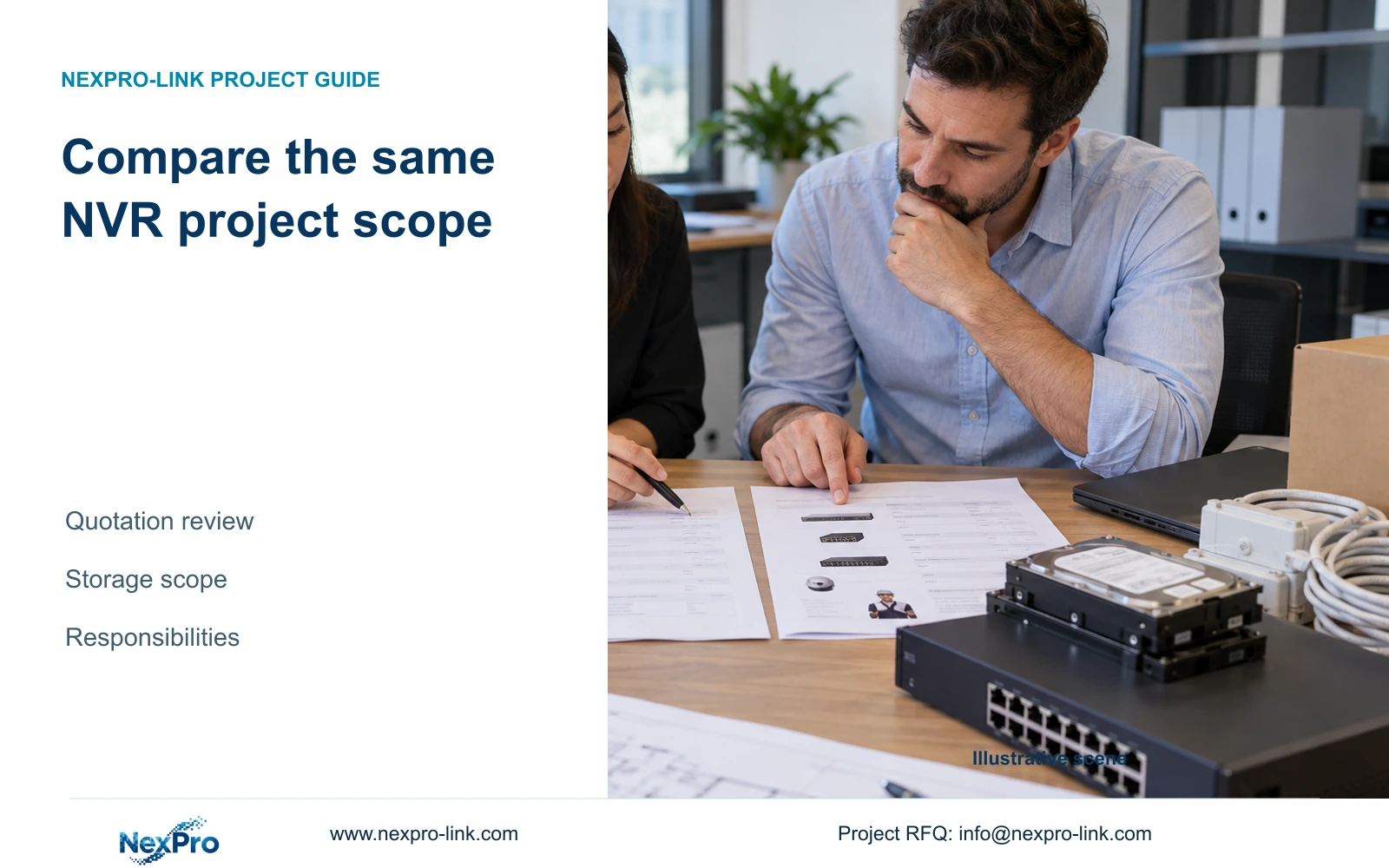
A recorder-only quotation and a project package need a common scope before their totals are comparable. Check storage, operator tasks and responsibility line by line.
Section 01
Qualify both offers against one recording task
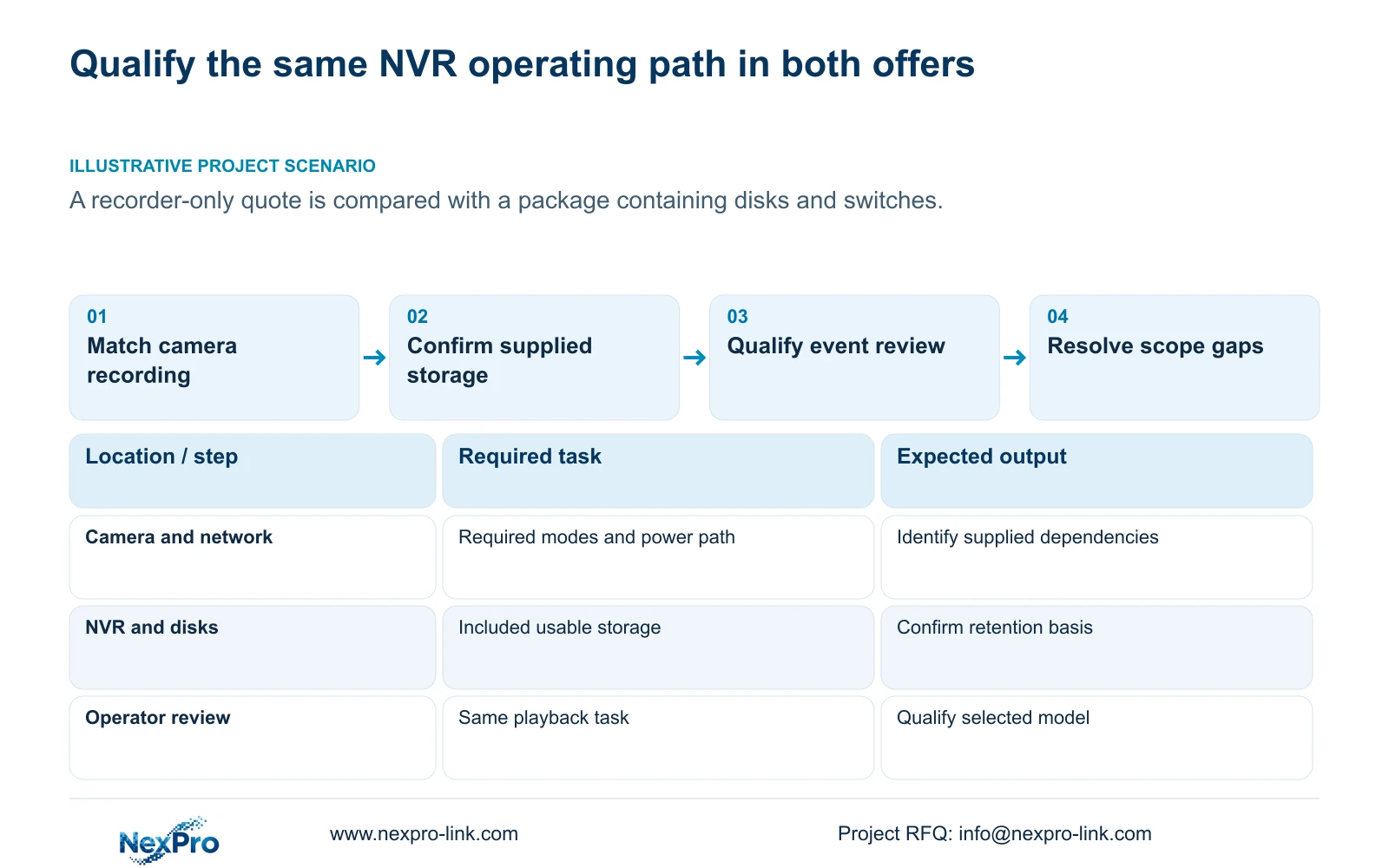
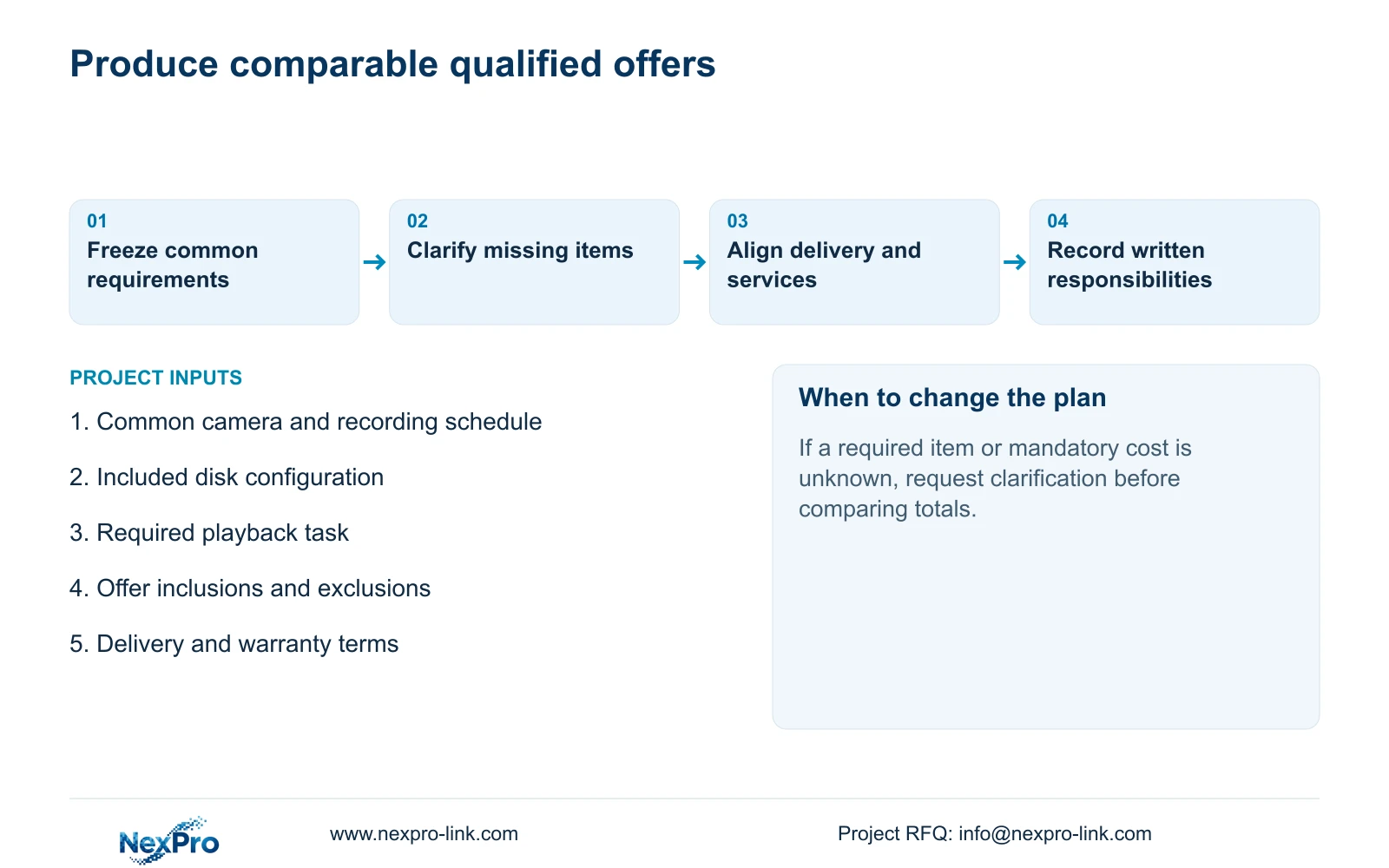
Compare two NVR quotations by bringing both offers to the same required recording, storage, playback and delivery scope before comparing totals. A recorder-only price excludes work or equipment that a project package may include, so the difference cannot establish savings by itself. Start with the camera modes and retention target, confirm the supplied disk configuration, and preserve the same operator review requirement. Then reconcile switches, power, displays, accessories and service responsibilities. Keep unknown costs marked as missing inputs. The scope matrix below is qualitative because actual quotations have not been supplied; it supports clarification without inventing prices, performance rankings or a percentage saving.
Give both suppliers the same camera schedule and operating requirement. Include stream modes, aggregate incoming bitrate, recording hours, retention target, interfaces, remote tasks and the installation environment. Each proposed configuration should state what meets the requirement and where it differs.
A channel count or 4K label cannot answer all those questions. If either offer omits a material capability, request the exact model information before treating it as qualified. Preserve the original requirement when considering an alternative so the buyer can approve a disclosed change.
Section 02
Confirm the disks supplied and their usable capacity
Check whether the quoted recorder arrives empty or with disks installed. Identify disk quantity and exact model, then distinguish supported maximum capacity from the usable capacity provided by the proposed configuration. A supported disk ceiling does not establish included storage or the required retention.
Both suppliers should use the same channel groups, average bitrate basis, hours recorded per day and retention period. They should identify additional audio, overhead and reserved space separately. An assumed bitrate must remain visible as a planning input rather than a measured camera result.
Where one proposal has no disks, obtain a priced storage addition that meets the common requirement. Where another lists disks without a retention basis, request that basis before marking the storage row complete. Multiple disk positions do not establish redundancy or an unspecified RAID arrangement.
If a client is part of the proposal, identify whether its storage supports PC local recording or whether the task retrieves NVR recordings. Seetong PC storage and recorder disk storage are different objects and should not be combined into one unexplained retention claim.
Section 03
Keep the same event-review requirement
State the local playback task independently from recording channels and incoming bandwidth. Identify the stream mode, simultaneous review requirement and intended display arrangement. Ask both suppliers to qualify that task on the selected hardware and firmware.
The manual's TS8232C4 example lists 1 × 4K OR 4 × 2MP OR 2 × 5MP local playback. Those alternatives cannot be added together or transferred to a commercial SKU. The TS model codes have no established mapping to NexPro-Link sales models.
If one offer needs extra decoding or a workstation to perform the required review, place that dependency in its scope. If the buyer accepts a different review mode, record the change explicitly. A lower price achieved by reducing the operating task is a changed proposal, not a like-for-like result.
Section 04
Reconcile the camera-to-recorder equipment path
Trace camera power, network transport, recorder storage and the required display. The manual's non-PoE diagram uses a switch and separate camera power; it does not show the recorder LAN socket supplying PoE. An offer relying on external PoE must identify suitable sourcing equipment.
Assign every required switch, adapter, display and accessory to supplier provision, owner provision or a separately priced item. Owner-provided equipment still needs a confirmed interface and available capacity. An empty connector or a broad equipment description does not establish that the dependency is ready.
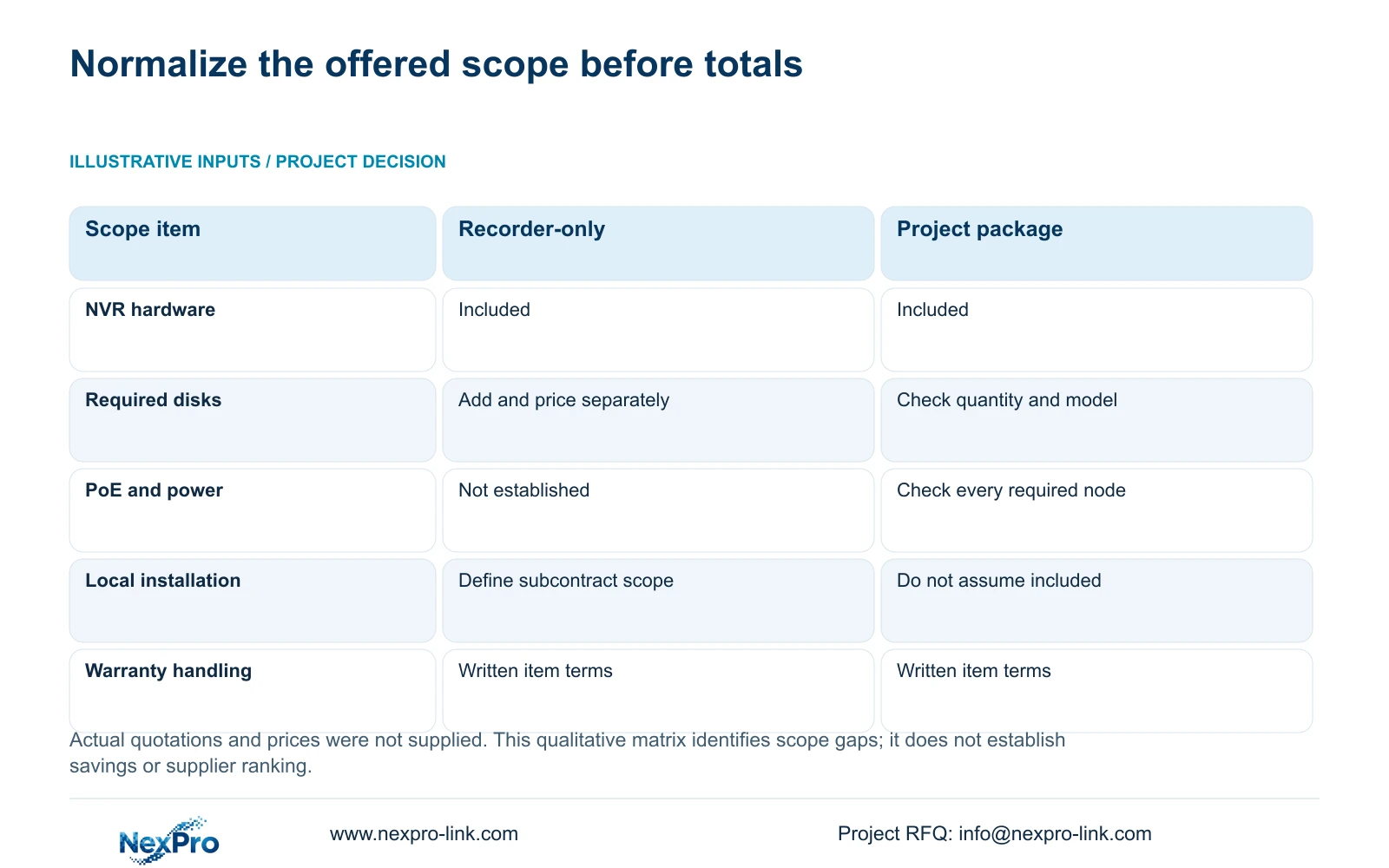
Check the scope node by node. If a required camera group has no established power source, clarify that gap before comparing totals. Keep equipment supply, configuration work and local installation separate even when they appear in one proposal heading.
| Scope item | Recorder-only offer | Complete-project offer |
|---|---|---|
| NVR hardware | Included | Included |
| Required disks | Add and price separately | Check exact quantity and model |
| PoE and power path | Not established | Check every required node |
| Local installation | Define subcontract scope | Do not assume included |
| Warranty handling | Written item terms | Written item terms |
Section 05
Compare services and delivery on a common basis
Use the same commercial boundary when assembling comparable totals. The scope relationship is: comparable total = required equipment + disks + accessories + agreed services + costs on a common delivery basis. Every amount must come from the actual quotation or an identified additional offer.
Separate commissioning support from local installation. Describe the tasks included, who performs them and where responsibility ends. Remote guidance does not establish included local labor, and supplied hardware does not establish completed site acceptance.
Align currency, quotation date, quantities, delivery destination and the treatment of transport, taxes and other charges. Leave an unknown mandatory cost unresolved rather than inserting a favorable estimate for one supplier. The buyer can compare technical qualification first while the suppliers clarify the commercial gaps.
If an optional item changes one total, retain it as an option alongside the common baseline. This lets the buyer evaluate the extra service or equipment without losing the original comparison.
Section 06
Read the remedy and responsible party
Compare the written handling terms for recorder hardware, disks, adapters, site wiring and third-party services. Identify the support contact and cost allocation for the relevant fault. Warranty duration alone does not establish local attendance, data recovery or unrestricted replacement.
The supplied operating manual does not set NexPro-Link's warranty period. Use the applicable written order and return and warranty policy for the selected equipment. Storage media and other categories need their own confirmed coverage rather than an assumed extension of the recorder terms.
A proposal with commissioning support should explain whether that support continues into fault handling and what it includes. If the route for an on-site wiring fault or a storage problem remains unclear, obtain a written allocation before treating the service package as complete.
Section 07
Resolve the differences before choosing an offer
Illustrative project scenario: A buyer receives one recorder-only quote and another proposal containing disks, switches and commissioning support. The buyer first adds the missing storage and power requirements to the recorder-only scope, then checks the exact contents and service boundary of the project proposal.
The outcome is a clarified comparison with disclosed exclusions and remaining questions. It may support either offer once both are qualified. Without actual matched prices, it cannot establish which is cheaper. NexPro-Link's BOQ support provides an entry point for discussing those equipment and documentation requirements.
Section 08
Should an incomplete offer be rejected immediately?
An omitted item can be clarified and priced separately when the proposed configuration can meet the task. Keep the offer unqualified until the material gap is resolved; do not treat an omission as a confirmed saving.
Section 09
Provide the scope differences for review
Technical scope references are NVR4.0 user manual CH_V2.4.doc, §§3.3.1, 5.1 and 5.2. Its body says V2.2. The quotation matrix and responsibility review are procurement methods, not manual price data.
Send NexPro-Link a redacted comparison of the two offers' included and excluded items, with the common recording requirement, at info@nexpro-link.com.
Engineering references
These sources support the general planning principles. Always use the selected product's current datasheet and applicable project standards for final design.