Reconcile the cut list with installed camera identities, remaining continuous pieces and approved route deviations. Mark a reel-count correction separately from a tested-link result.
Section 01
Order cable against executable continuous cuts
Reconcile the cut list with installed camera identities, remaining continuous pieces and approved route deviations. Mark a reel-count correction separately from a tested-link result. If a planned cut cannot complete its revised route, allocate another continuous piece or redesign; aggregate leftovers do not establish a usable link or restore a missing recorder channel.
Calculate the individual continuous camera runs before ordering CAT6 for an NVR project. Dividing the aggregate length by reel length gives a lower bound that may not produce enough usable cuts. For ten 85 m runs and 305 m reels, the total is 850 m and the rounded aggregate estimate is three reels. Each reel can supply only three complete 85 m runs, however, so three reels produce nine runs and a fourth is required. The example already includes its permitted termination allowance and does not allow remnants to be joined into permanent runs. It demonstrates cutting arithmetic, not an approved cable-distance or installation specification.
Measure the intended pathway for every link, including the cabinet approach and endpoint termination allowance. Retain the basis of the allowance instead of adding an unexplained percentage after the total. If a route remains uncertain, identify that route for confirmation before allocating its cut.
The supplied manual's general long-cable wording does not define a universal CAT6 distance, cable grade or power budget. Confirm permitted link conditions separately. A feasible reel allocation establishes that stock can supply the cuts; it does not establish that the designed links meet their electrical or installation requirements.
Section 02
Keep every route attached to a camera identity
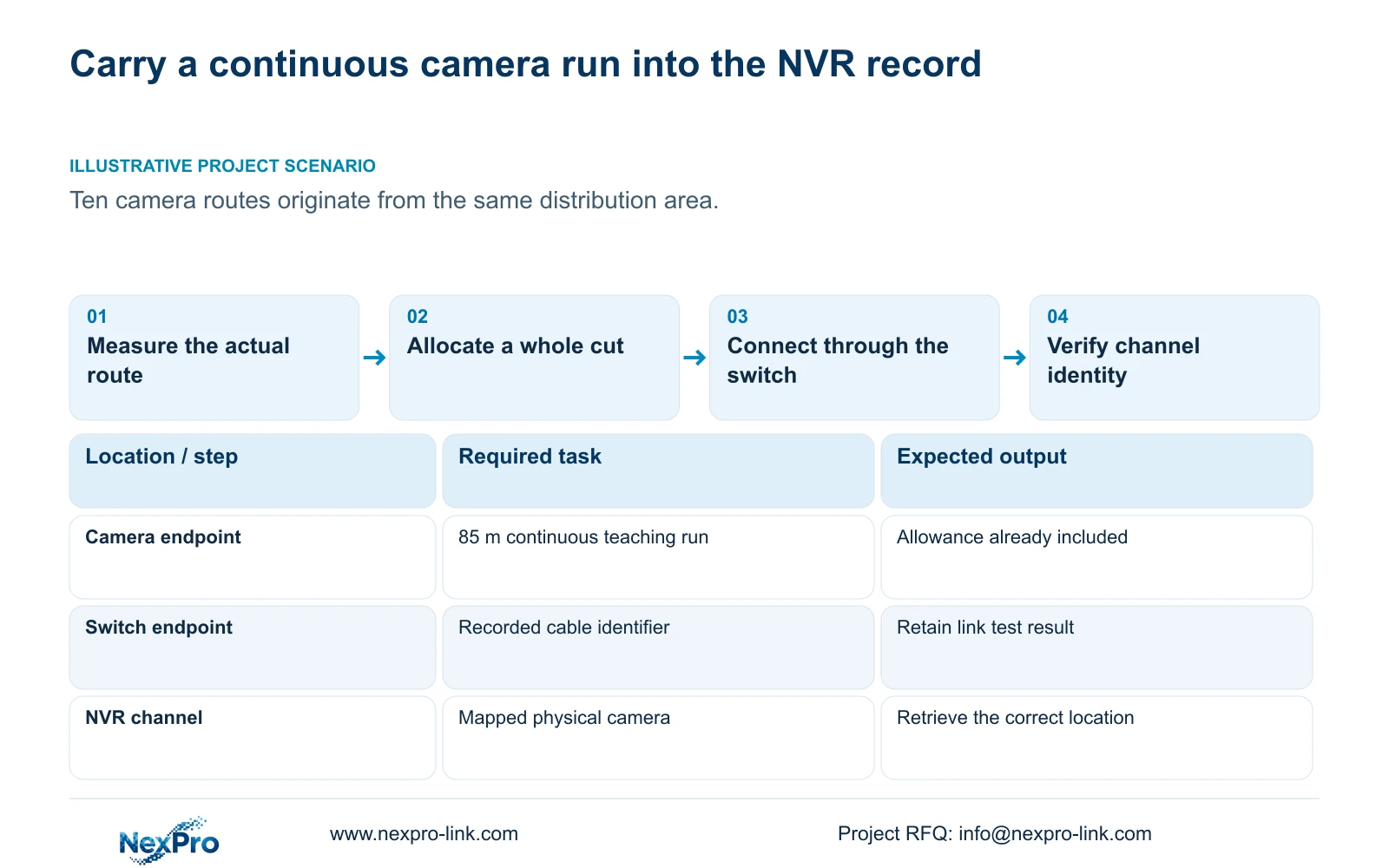
Give each continuous run a stable project identifier and record its endpoints and required cut length. Keep drawing location, physical camera identity, IP address, recorder channel and displayed name in separate fields. Channel-name and OSD controls help presentation, but they cannot replace the installed-link record.
This distinction matters when a camera is replaced or a recorder view is reordered. The same display name can remain while the physical equipment changes. Update the affected mapping so a cable test result and a retrieved recording still refer to the intended location.
Trace the actual data path before grouping cuts. The manual's non-PoE arrangement connects cameras and the recorder through a switch and supplies cameras separately. An external PoE design requires an explicitly selected sourcing device. Do not draw the recorder's ordinary LAN socket as a camera power output or assume every camera run terminates at the NVR.
Section 03
Test the aggregate estimate against each reel
The supplied inputs are ten continuous runs at 85 m each and 305 m per reel. Total required cut length = 10 × 85 m = 850 m. Aggregate lower bound = ceil(10 × 85 ÷ 305) = 3 reels. Here ceil means round upward to the next whole reel.
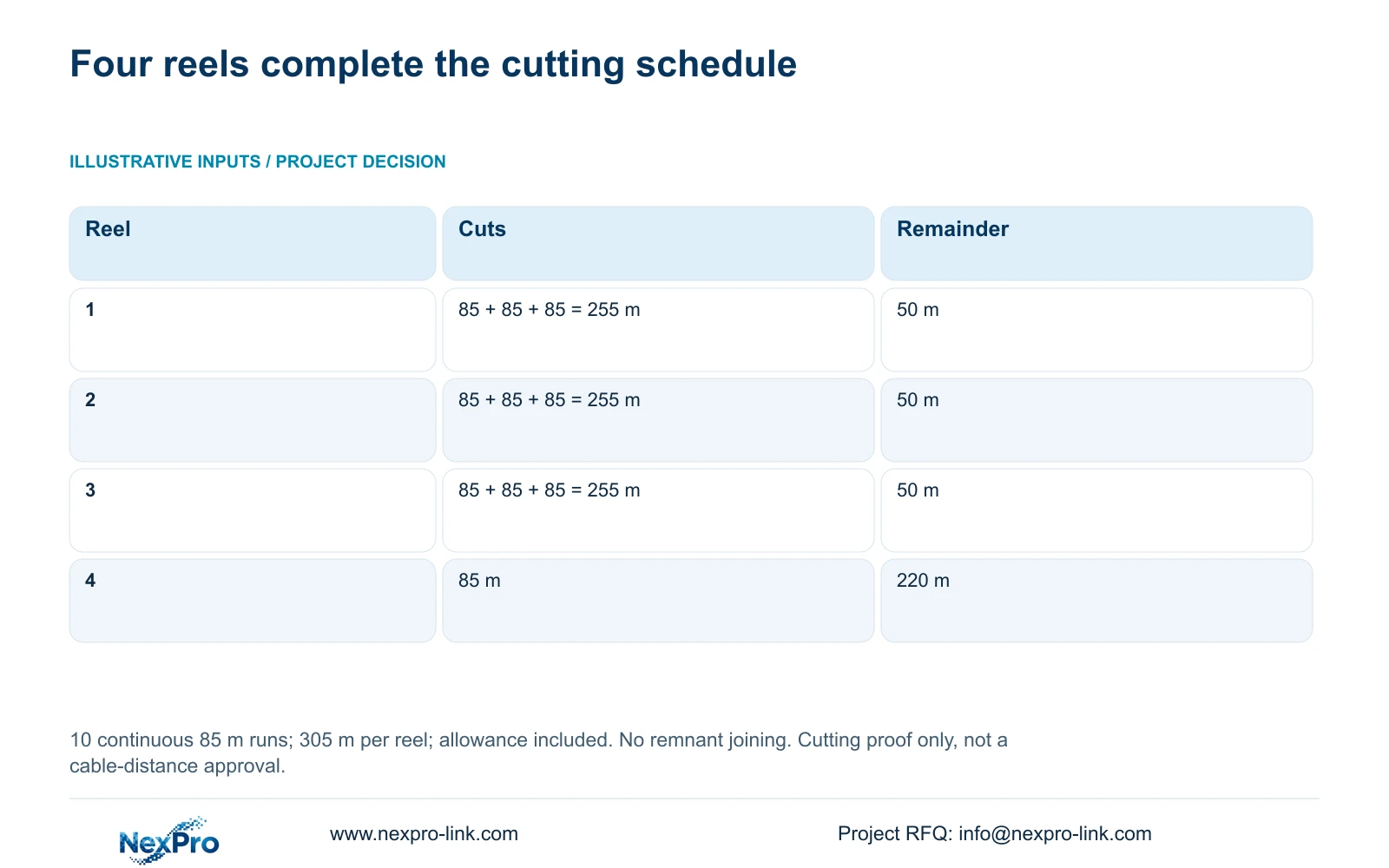
Maximum complete runs per reel = floor(305 ÷ 85) = 3 runs, where floor means round downward to a whole cut. Executable reel requirement = ceil(10 ÷ 3) = 4 reels. Three reels provide only 3 × 3 = 9 complete runs, so they cannot finish the schedule.
Allocate three cuts to each of the first three reels: 85 + 85 + 85 = 255 m, leaving 305 - 255 = 50 m on each. The fourth reel supplies the final 85 m run and leaves 305 - 85 = 220 m. These residual lengths should remain visible in the stock record.
For a schedule with unequal lengths, preserve the individual entries and check the actual allocation before approving quantity. The equal-length formula used here answers this example; it is not a universal optimization method for every mixed cutting schedule.
| Reel | Continuous cuts | Remainder |
|---|---|---|
| 1 | 85 + 85 + 85 = 255 m | 50 m |
| 2 | 85 + 85 + 85 = 255 m | 50 m |
| 3 | 85 + 85 + 85 = 255 m | 50 m |
| 4 | 85 m | 220 m |
Section 04
Resolve short stock without changing the link design
The example excludes joining remnants midway through a permanent run. Do not introduce an unplanned joint merely to make the aggregate stock appear sufficient. If the allocated stock cannot supply a continuous cut, revise the stock allocation or procurement quantity. Any change to the link architecture needs its own design decision.
A live image after installation does not by itself resolve every link question. Retain the agreed cable test results and reconcile them with the route identifiers. If a channel later disconnects, investigate the identified path without immediately attributing the symptom to its length.
For the manual's local-network diagnostic workflow, §4.3.3.1 requires an attached hard disk before enabling the feature. It describes connection-history export, statistics reset, real-time diagnostics and a week's disconnection details. A diskless demonstration that cannot enable this workflow does not establish a defective cable. This prerequisite is specific to the documented diagnostic feature, not every basic network operation.
Section 05
Separate purchase quantity from remaining stock
Keep reel procurement, installed cuts and retained remnants in separate records. The 50 m and 220 m residual lengths may serve suitable other work, but they cannot be deducted from the four reels needed for the stated continuous-run task. A usable remnant is stock with a recorded length, not an assumed substitute for an unfinished longer run.
Compare supplier offers using the same cable requirement and responsibility boundary. Material reels, installed metres, termination work and completed tested links describe different deliverables. State which party supplies cable and which party cuts, installs and tests it.
If a route changes, update its required cut and the affected reel allocation before treating an extra order as installation loss. Keep the reason for the revision with the schedule. Without matched quotations, this comparison supports a scope decision rather than a claimed saving percentage.
Section 06
Reconcile cable records with usable recorder operation
Illustrative project scenario: A cost manager budgets cable for ten long camera runs from the same distribution area. The aggregate estimate suggests three reels, but the continuous-cut check requires four. The installer receives a run allocation, and the remaining stock is recorded separately for suitable later use.
Handover should connect line labels and test results to the camera schedule and NVR channels. The owner should be able to identify the intended location, retrieve a required period and export a playable file. Keep applicable equipment versions, configuration-backup location and maintenance responsibility with the record, while transferring credentials through a controlled route.
Accept the documents and the operator task separately. A complete folder does not show that the owner can retrieve the correct camera's footage. Record the practical check against the installed mapping without presenting this teaching scenario as a delivered project.
| Situation | Required record | Decision boundary |
|---|---|---|
| Cut matches installed channel | Route, camera identity and continuous piece | Reconcile material with actual handover |
| Route changes beyond the cut | Revised length and available piece | Allocate a feasible cut or redesign |
| Reel count corrected | Quantity record, not test evidence | Keep installed-link acceptance separate |
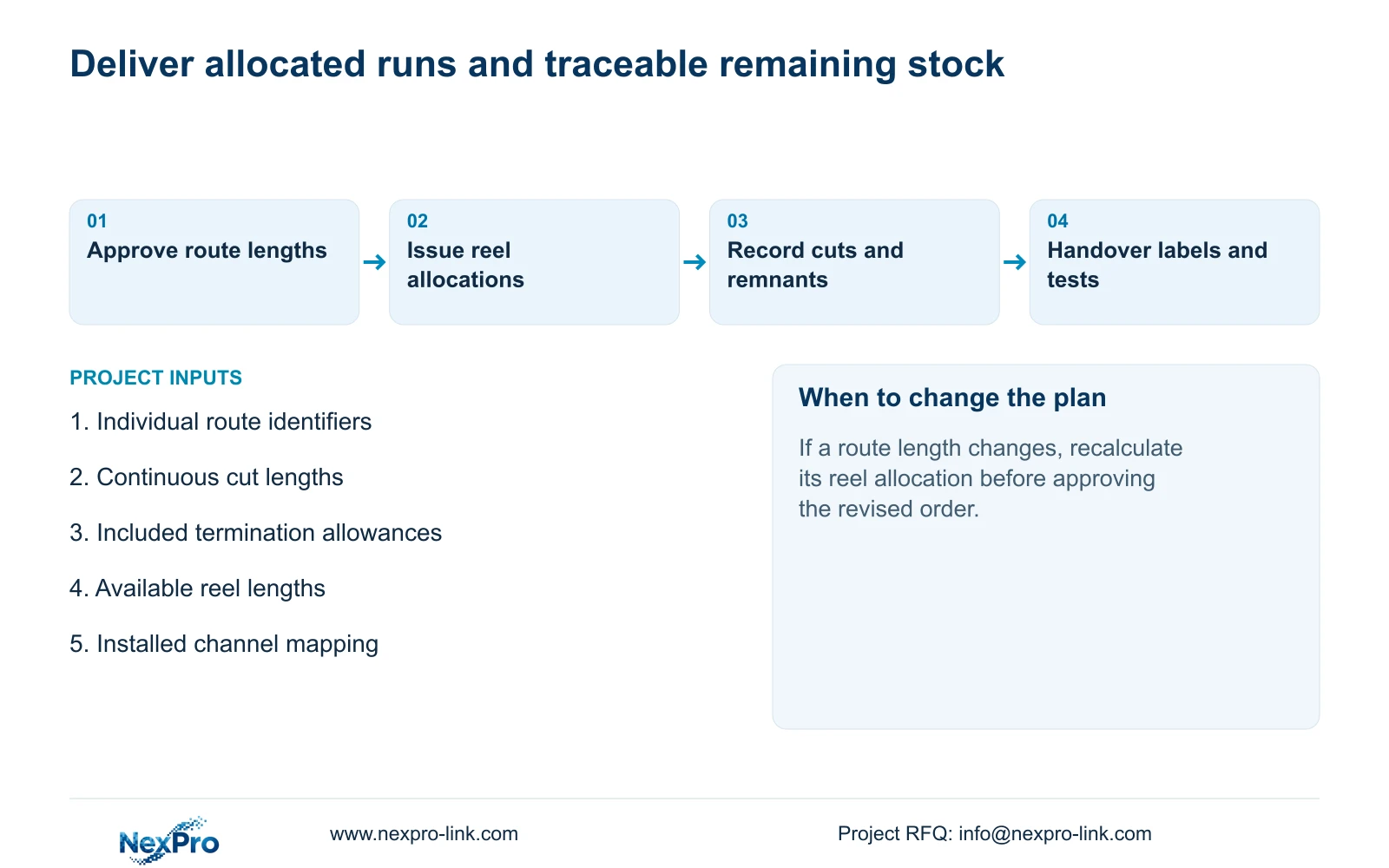
Section 07
Can the fourth reel's remainder offset this order?
It can support another suitable cut, but it does not reduce the reel count required to finish these ten runs. Reuse must be based on an actual remaining length and a separate continuous-run requirement.
Section 08
Prepare the route and cutting schedule
This guide uses NVR4.0 user manual CH_V2.4.doc, §§1.1, 3.3.1, 4.3.1, 4.3.3.1, 4.4.4, 4.12.6 and the handover functions in §§4.11, 4.12.3 and 4.12.17 to 4.12.19. Its body says V2.2. Cutting arithmetic is an independent engineering example.
Send NexPro-Link the individual route lengths with included termination allowances and available reel lengths at info@nexpro-link.com to discuss the cable supply scope.
Engineering references
These sources support the general planning principles. Always use the selected product's current datasheet and applicable project standards for final design.