Plan CCTV cable length estimation with practical guidance on trace the installed route and distinguish waste from expansion stock. NexPro-Link project guide.
Section 01
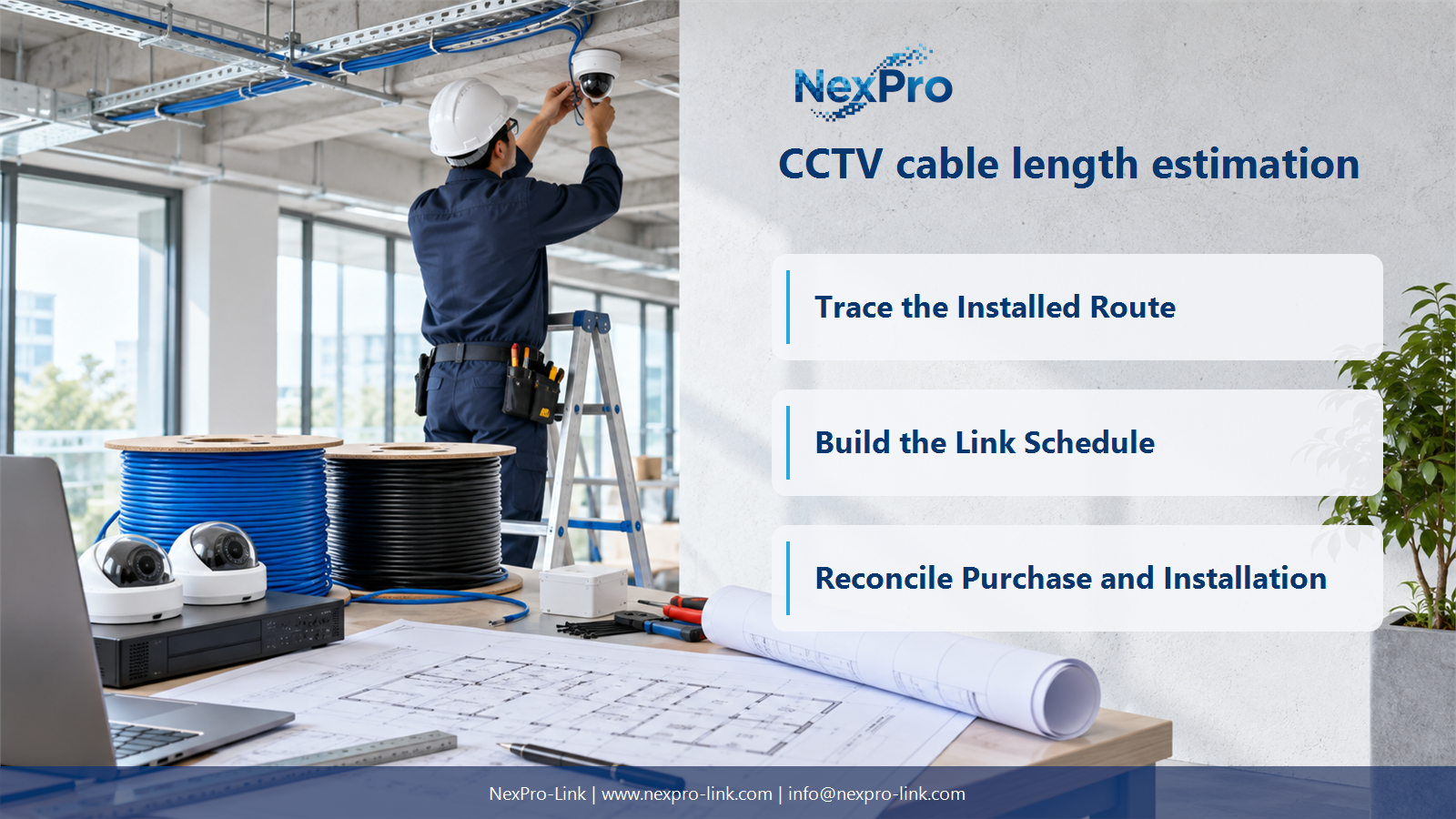
Trace the Installed Route
Cables follow trays, risers, cabinet entries and installation routes rather than the shortest line between camera and switch. Trace each segment and add vertical changes. A floor-plan measurement becomes useful for procurement when it reflects the intended pathway and endpoint location.
Turn the answer into a working record using Camera, Horizontal route, Vertical route, Cabinet entry.
| Decision area | Buyer question | Required output |
|---|---|---|
| Trace the Installed Route | Why is straight-line distance insufficient for cable quantities? | Cables follow trays, risers, cabinet entries and installation routes rather than the shortest line between camera and switch. |
| Make Service Allowances Explicit | Is six metres of allowance required at every CCTV point? | No universal allowance applies to all locations. |
| Build the Link Schedule | How should a cable estimate be organized? | List continuous runs by identifier, route and required cut length before summing the project total. |
Section 02
Make Service Allowances Explicit
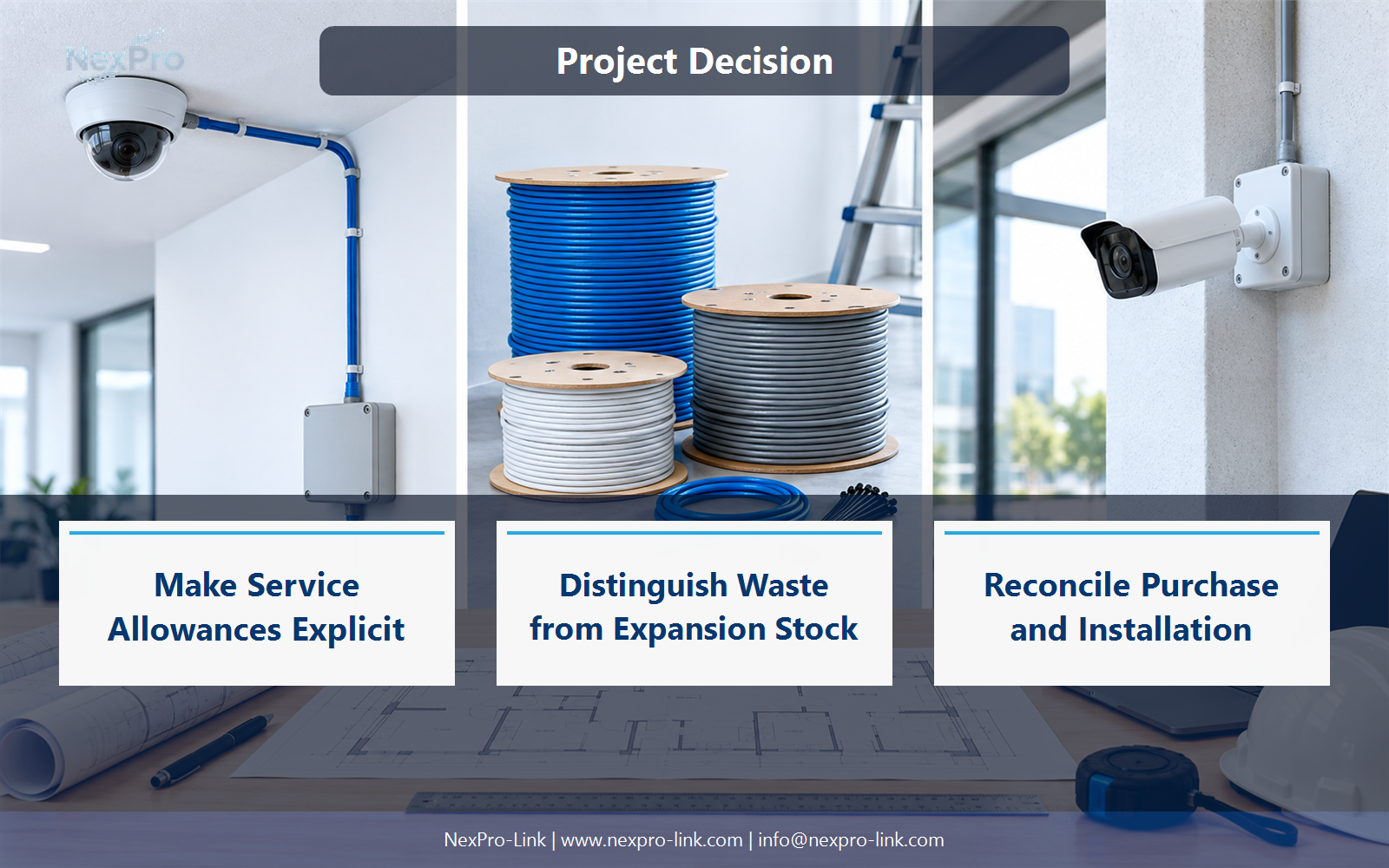
No universal allowance applies to all locations. State the service loops, termination needs and cabinet management allowed by the project. An example may use a chosen length, but it should not be presented as a mandatory rule for every camera and rack.
Use Camera allowance, Cabinet allowance, Purpose, Total to compare options on the same basis. Keep product capability, project assumption and operating responsibility in separate columns.
Section 03
Build the Link Schedule
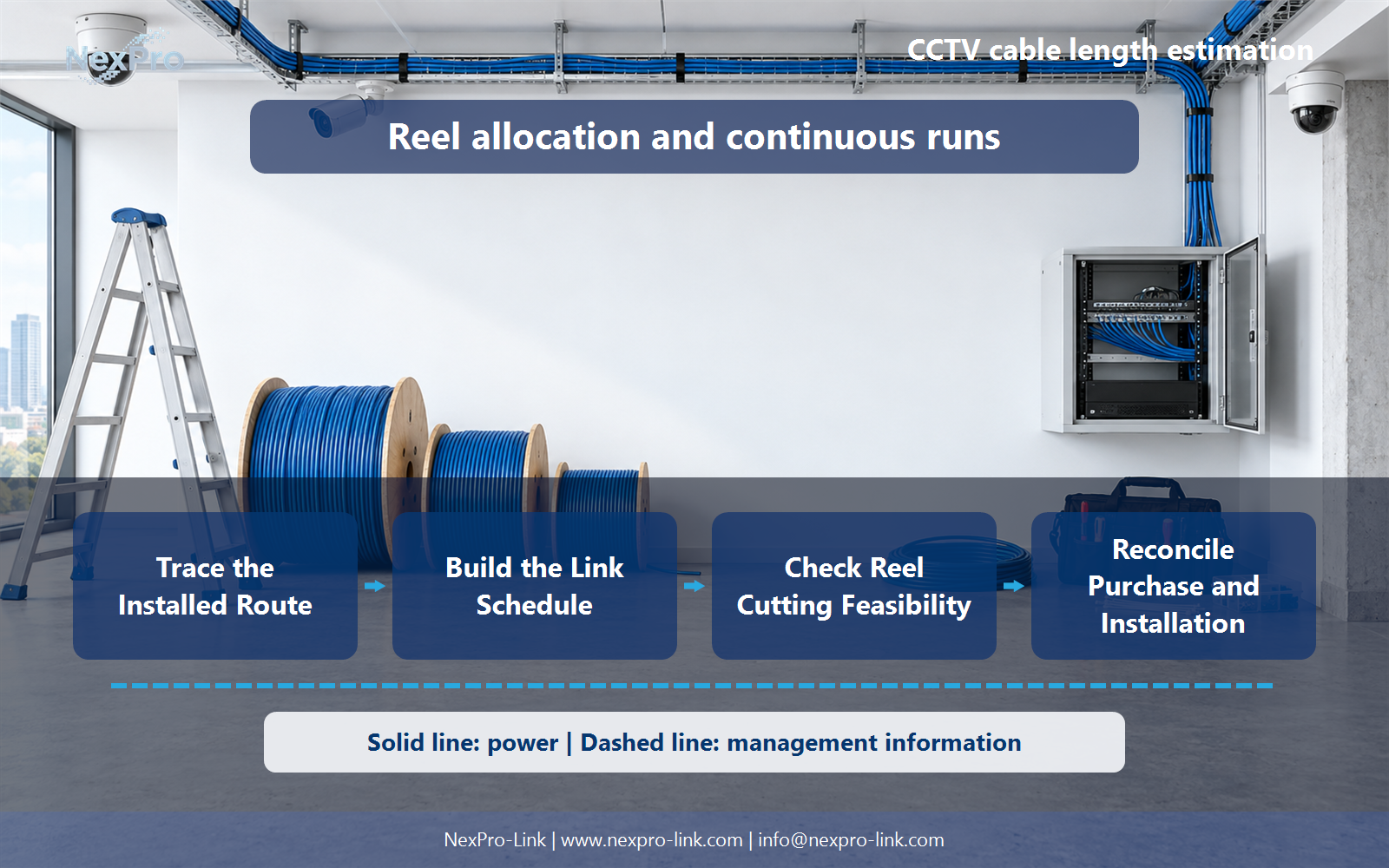
List continuous runs by identifier, route and required cut length before summing the project total. Group similar zones for planning but retain the individual long runs. This makes changes traceable and helps installers avoid splicing simply because the aggregate stock appears sufficient.
The project output should make Link ID, Zone, Route, Cut length, Delivery phase traceable from input to acceptance.
- Confirm the answer to: How should a cable estimate be organized?
- Record the project fields: Link ID / Zone / Route / Cut length / Delivery phase.
- Keep product capability, project assumptions and site responsibility in separate records.
Section 04
Distinguish Waste from Expansion Stock
No. Waste accounts for expected cutting or installation losses, while spare stock supports future or contingency needs. State them separately when possible. A single unexplained percentage can hide whether the project has allowed for reel remnants, route uncertainty or later additions.
Record Base length, Cutting loss, Contingency, Expansion stock before selecting a product family. That makes later substitutions possible without silently changing the operational requirement.
Section 05
Check Reel Cutting Feasibility
Not for every cutting pattern. Individual runs must fit the available lengths, and remainders may be too short for the remaining links. Use a cutting plan or practical allocation check after calculating the aggregate lower bound. Do not call the rounded total an optimized purchase quantity.
Review Reel, Assigned runs, Used metres, Remaining metres with the party that will operate or maintain the system.
Section 06
Reconcile Purchase and Installation
Update the affected link lengths, reel allocations and remaining stock, then explain the procurement effect. Distinguish approved route changes from installation loss. Keeping the installed schedule aligned with the estimate supports the as-built record and prevents unexplained extra cable orders.
Use Change, Affected links, Added metres, Stock effect as the handoff between design and procurement.
Engineering references
These sources support the general planning principles. Always use the selected product's current datasheet and applicable project standards for final design.