Replace a vague recorder BOQ line with explicit recording, playback, disk, interface and supply-scope fields before comparing supplier prices.
Section 01
Specify the recording task behind the recorder line
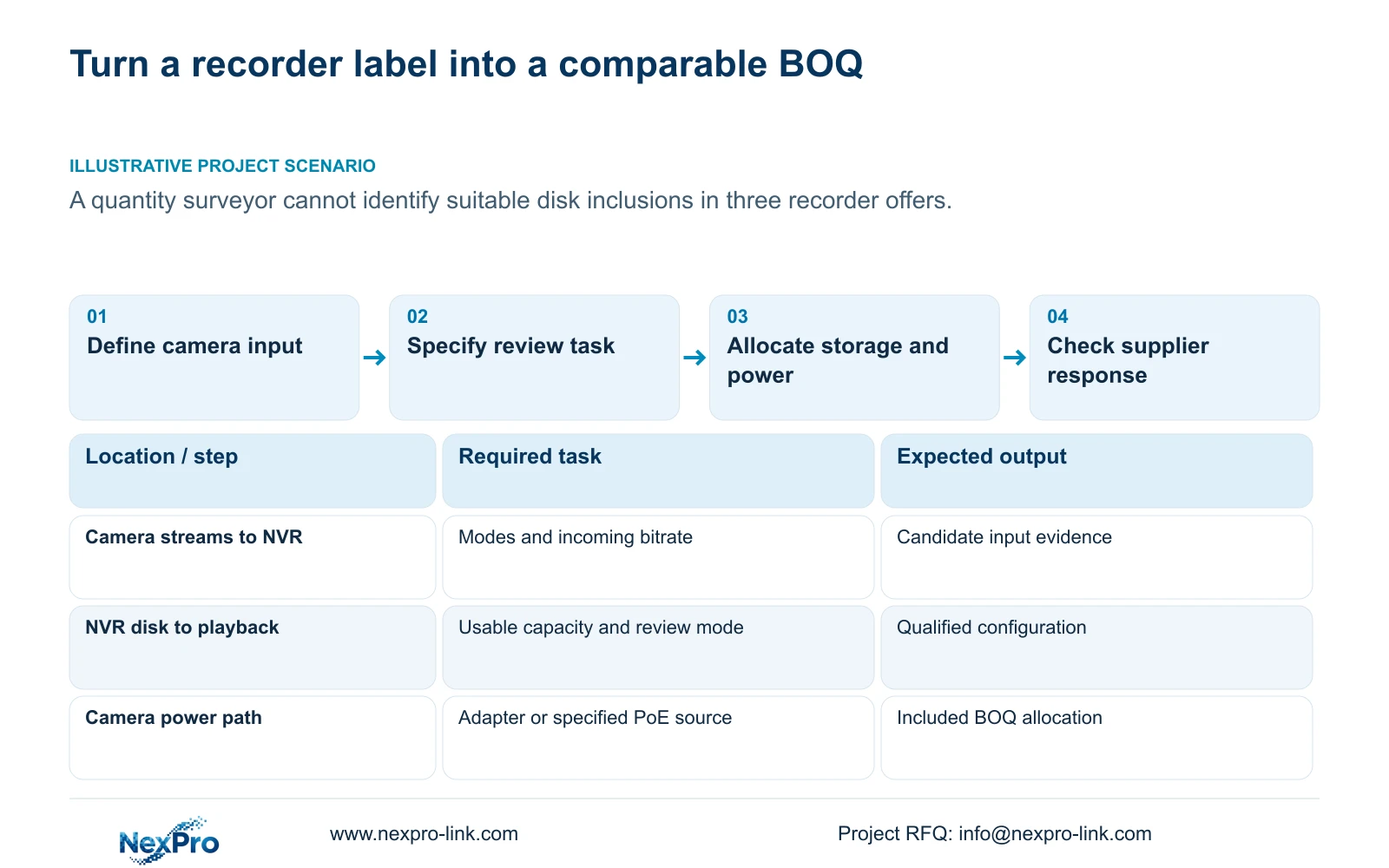
An NVR BOQ needs enough detail to establish what each supplier is pricing. A line reading only '32-channel 4K NVR' leaves camera modes, incoming bitrate, simultaneous playback, usable disk capacity and supporting equipment unresolved. State those requirements separately, then ask each supplier to identify its proposed configuration and exclusions. Compare prices only after the offers address the same recording and viewing tasks. If retention inputs or disk inclusions are missing, mark them for clarification rather than filling them with an assumed specification. This gives the quantity surveyor an auditable comparison and prevents a recorder-only offer from being treated as a complete working system.
Start with the camera or point schedule. Group cameras by intended stream mode and identify the required recording hours, retention target and operator review task. Include interfaces, remote tasks and relevant installation conditions. Each field should connect a project requirement to a candidate value and any unresolved difference.
Technical distinctions here follow the private supplied NVR4.0 user manual CH_V2.4.doc, with V2.2 in its body. Sections 5.1 and 5.2 support storage and model comparisons; section 3.3.1 supplies the non-PoE topology. Sections take priority over page numbers. TS examples do not establish equivalence to NexPro-Link commercial SKUs.
Section 02
Write the simultaneous playback requirement explicitly
Separate recording-channel count, total incoming bandwidth, preview decoding, simultaneous local playback and HDMI output. These fields describe different limits. A channel count does not establish that the operator can display or review every recorded stream simultaneously at its full recorded resolution.
Define the actual review task, including stream count and resolution together. Section 5.2 lists TS8232C4 local-playback alternatives as 1×4K OR 4×2MP OR 2×5MP. TS8116D7 is listed at 1×5MP OR 2×2MP, while TS8108D7 is listed at 1×3MP. Select the relevant alternative; do not add modes.
For TS8836M/TS8436M, the supplied alternatives are 1×4K 30fps OR 2×5MP OR 4×4MP@20fps OR 4×2MP@25fps. Preserve those frame-rate qualifications. Ask suppliers to show the corresponding evidence for their proposed commercial configuration instead of copying a TS row into its specification.
Section 03
Distinguish installed disk capacity from usable storage
Request disk quantity, capacity per disk, supported disk arrangement and the resulting usable recording capacity. A recorder with empty bays and a recorder supplied with suitable disks are different offers. Maximum supported disk capacity is also different from installed capacity.
Retention requires channel groups, average video bitrate in Mbps, recording hours per day and retention days. Record whether each bitrate is measured or assumed. Account separately for audio, storage overhead and reserve. If those inputs are absent, keep the capacity decision open instead of accepting a channel-based retention claim.
The decimal engineering formula is video TB = 0.00045 × Σ(channels × Mbps × hours per day × days). The coefficient follows 1,000,000 bits/s × 3,600 s/hour ÷ 8 bits/byte ÷ 1,000,000,000,000 bytes/TB = 0.00045 TB per Mbps-hour. If reserve fraction r is part of the capacity requirement, divide the relevant stored-data requirement by (1 − r); adding r does not produce the same reserve.
This topic has no supplied project-specific retention inputs, so no completed capacity total is assigned to its BOQ. Require the supplier to return the calculation basis with the proposed usable capacity. Multiple disks or a 'RAID-ready' description do not establish a RAID level or redundancy arrangement.
Section 04
Separate switching and camera power from the NVR
The non-PoE connection diagram in section 3.3.1 shows camera data passing through a switch to the recorder, with a separate camera power adapter. It does not show the recorder LAN socket supplying PoE. The BOQ must therefore identify who supplies the switch and how each camera receives power.
If the design requires PoE, specify a suitable external power-sourcing device or a recorder whose exact specification explicitly includes PoE. Keep the data path separate from the power path in the supporting drawing. List the monitor, mouse, network connections and power provision where they affect the quoted package.
When a supplier proposes a different topology, compare it with the same camera and operation requirements. Record any equipment moved into another BOQ line. An omitted switch may be supplied elsewhere, but that allocation needs an explicit reference before its cost can be excluded from comparison.
Section 05
Normalize inclusions before reviewing totals
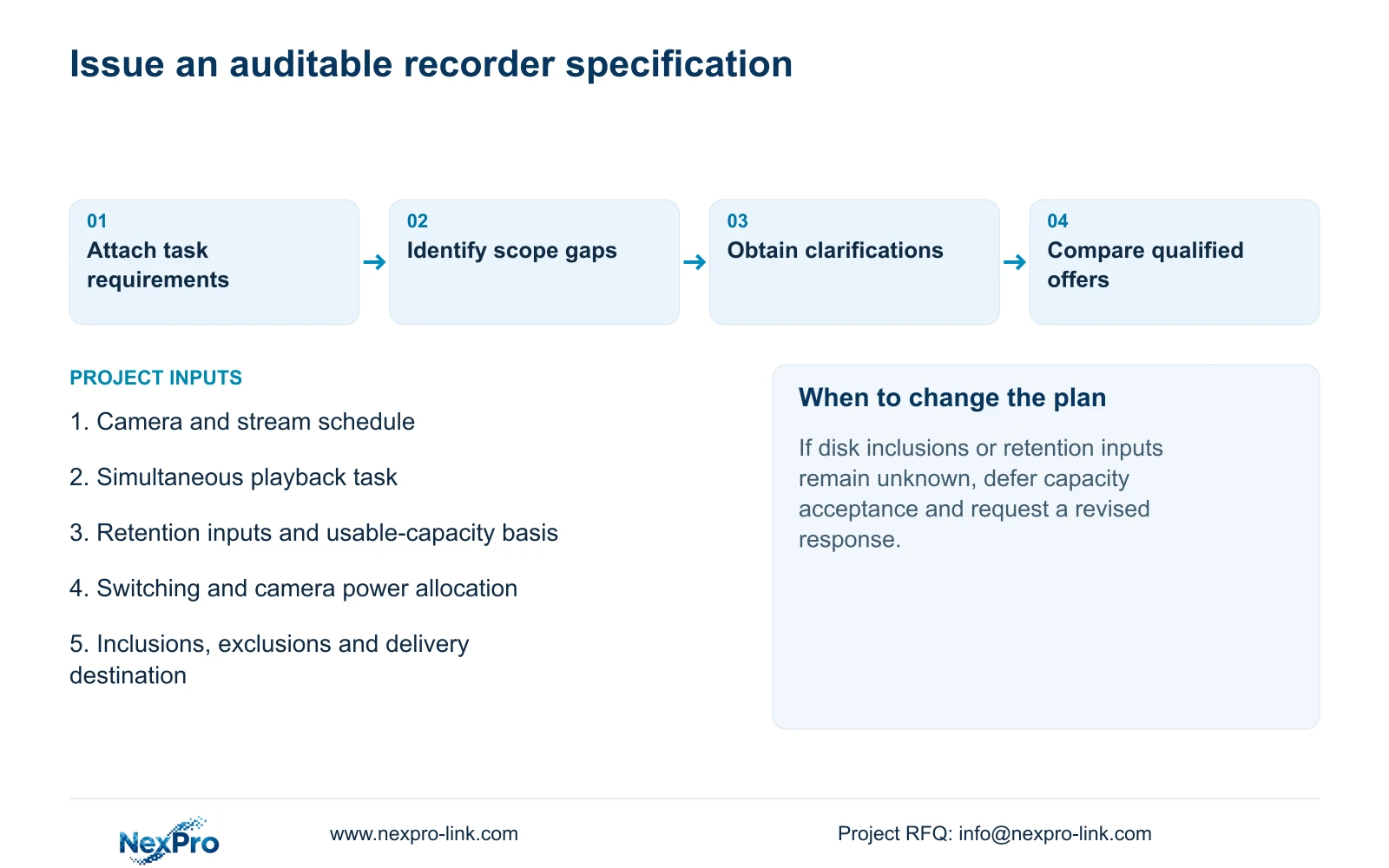
Ask each supplier to classify required items as included, excluded or requiring confirmation. Apply the same classification to disks, accessories, software and services. A blank field is unresolved; it should not be interpreted as included or priced at zero.
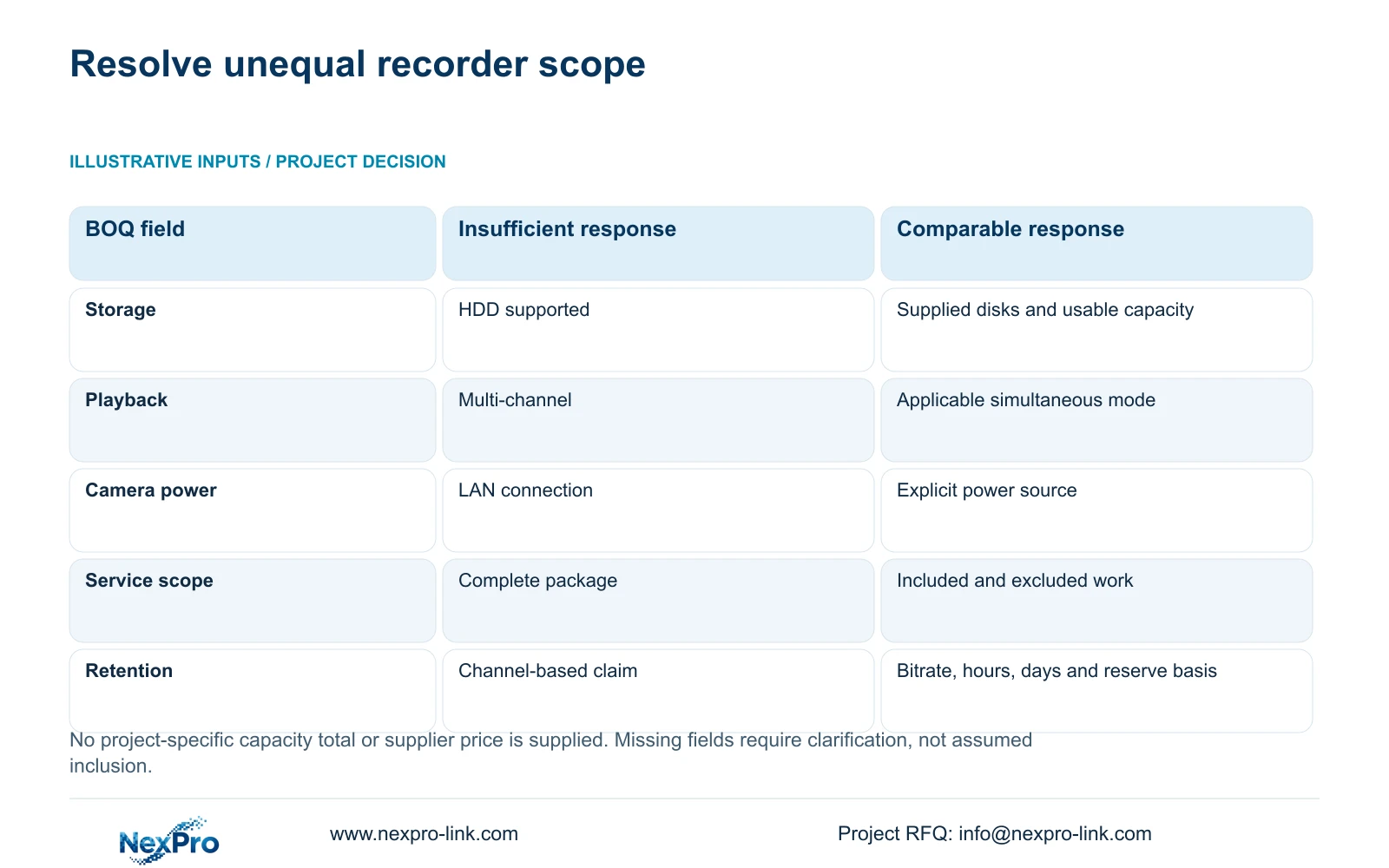
The table below turns common ambiguous recorder descriptions into specific clarification requests. It is a scope decision tool, with no invented supplier prices or performance scores.
| Offer wording | Unresolved requirement | Required supplier response |
|---|---|---|
| 32-channel 4K NVR | Camera modes and total incoming bitrate | Identify supported input configuration against the camera schedule. |
| Multi-channel playback | Simultaneous resolution and frame-rate combination | State the applicable playback mode and its evidence. |
| HDD supported | Installed disks and usable capacity | List supplied disks, capacity basis and exclusions. |
| Network recorder package | Switching and camera power allocation | Identify included equipment and referenced external BOQ lines. |
| Complete supply | Software, accessories and service boundaries | Separate included scope, optional items and excluded work. |
Section 06
Keep the commercial comparison on equal terms
Once technical gaps are resolved, compare actual quotations within the same commercial boundary. Normalize camera modes, retention and playback first, then review the disk and accessory scope. Identify the delivery destination and any site-service responsibilities that affect the offer.
Separate equipment supply from installation, configuration assistance and acceptance work. Coordinated project supply does not establish that every product shares native interoperability or that local installation is included. Required camera-to-recorder functions should remain explicit even when a package uses a common client.
If offers remain unequal, publish the differences alongside the totals instead of declaring a percentage saving or an overall brand winner. The decision may require a revised offer for a missing mandatory task before price ranking is meaningful.
Section 07
Close the missing inputs with a focused clarification
Send suppliers only the missing information that changes selection: the relevant camera schedule, required recording and playback task, retention target, network/power arrangement or delivery destination. Where a buyer input is undecided, label it as undecided and ask which candidate decision depends on it.
Keep the clarification tied to the affected BOQ field. For disks, request the supplied disk list and usable-capacity basis. For playback, request the simultaneous mode. This avoids reopening unrelated specification questions and creates a clear record for the revised offer.
Illustrative project scenario: A quantity surveyor has three prices for a recorder line but cannot see whether any include suitable disks. The surveyor requests disk inclusions and usable capacity from each supplier, while the engineer confirms the recording inputs. Offers remain provisionally unequal until those responses establish a common scope.
Section 08
Can empty disk bays satisfy a retention requirement?
Empty bays establish an expansion provision, not supplied recording capacity. Confirm installed disks and usable capacity against the retention calculation before accepting the offer.
Section 09
Does 4K HDMI output prove 4K multi-stream playback?
No. Monitor output and simultaneous playback are separate limits. Require the applicable stream-count, resolution and frame-rate combination for the proposed recorder.
Section 10
Clarify the recorder line
Send NexPro-Link the recorder BOQ line and its unresolved disk, playback or power field at info@nexpro-link.com.
Engineering references
These sources support the general planning principles. Always use the selected product's current datasheet and applicable project standards for final design.