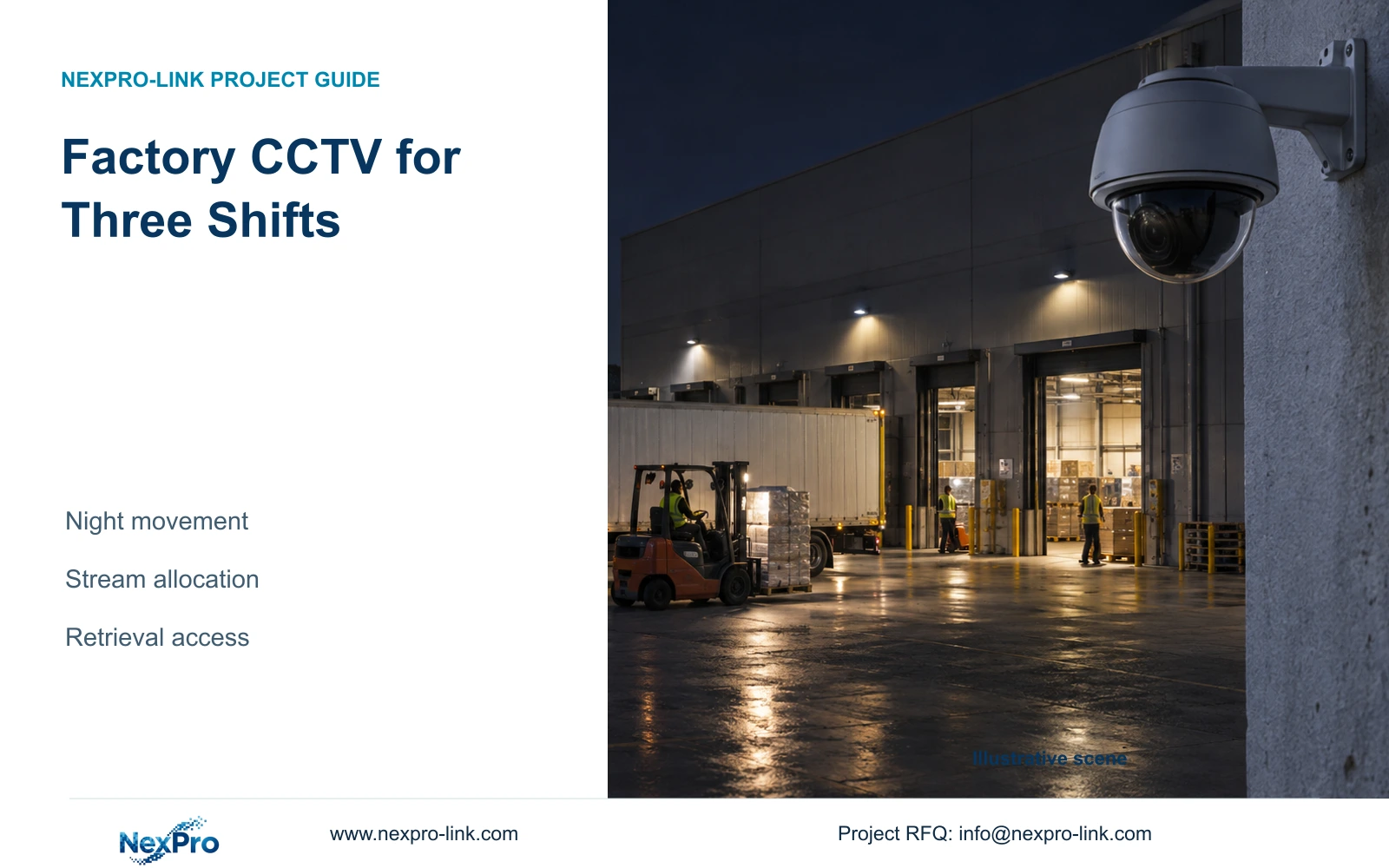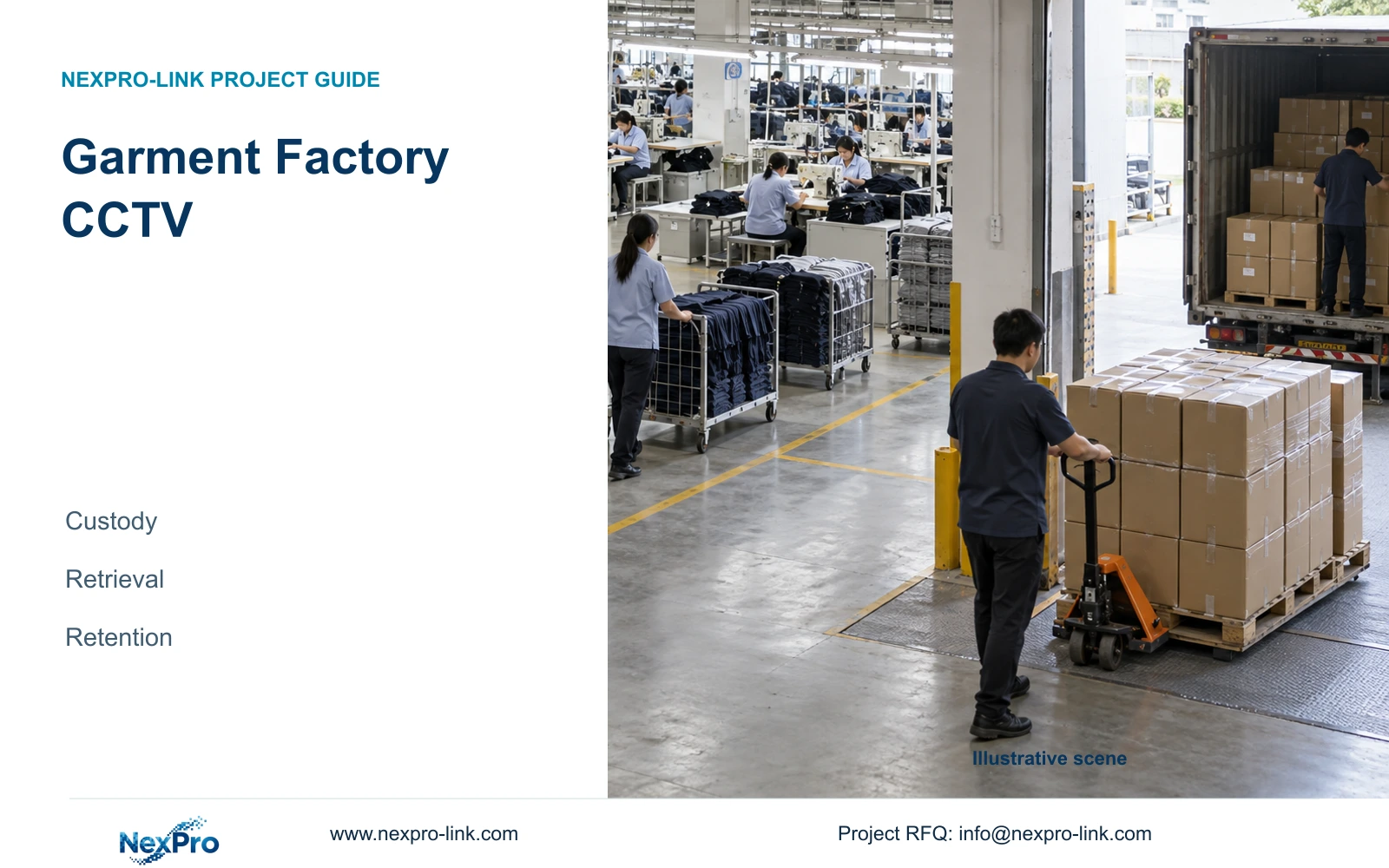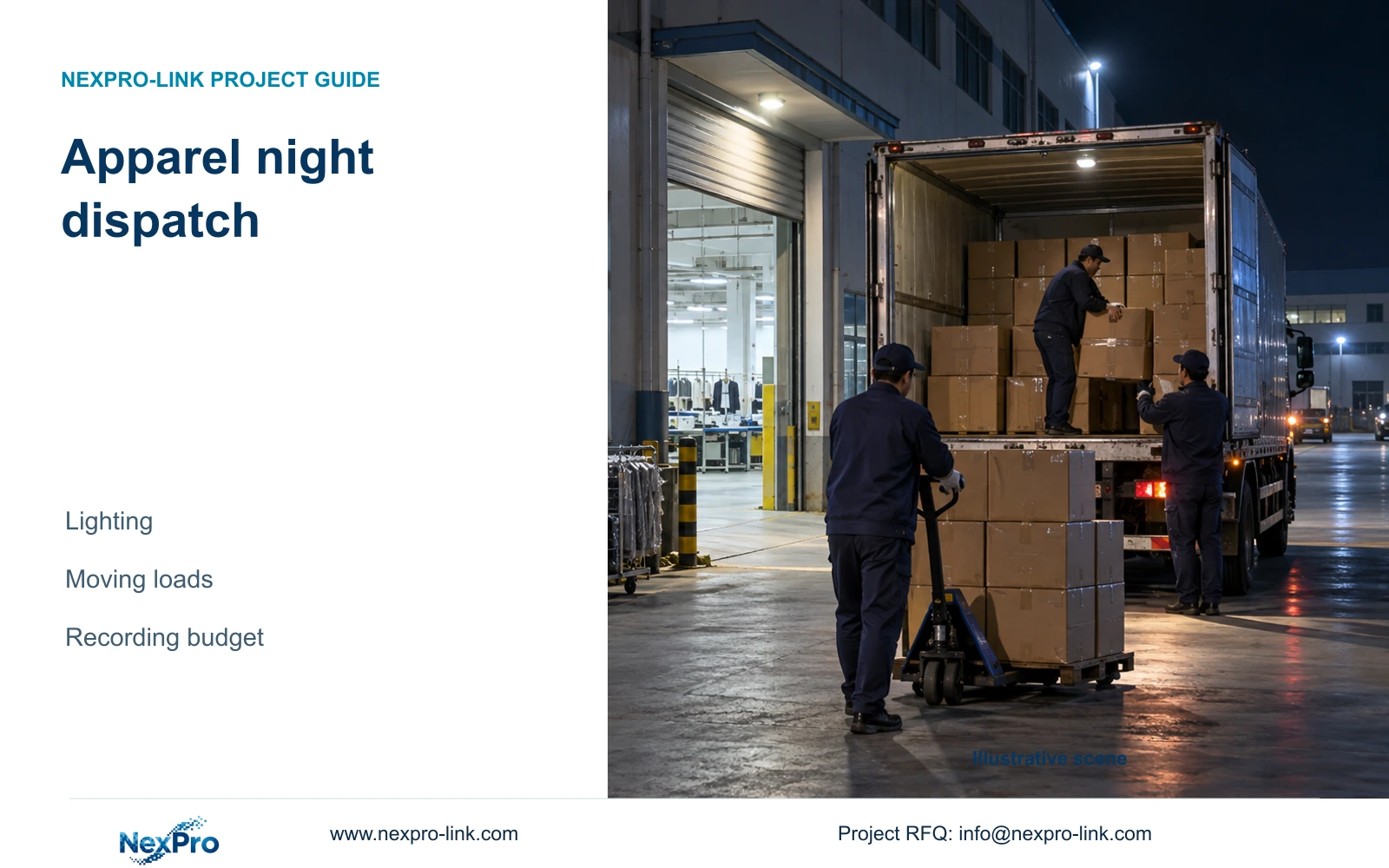
Night dispatch needs usable footage of moving cartons and their transfer into vehicles. Separate these views from quieter indoor areas before choosing recording rates, storage and protected power.
Section 01
Set the evidence task for moving cartons
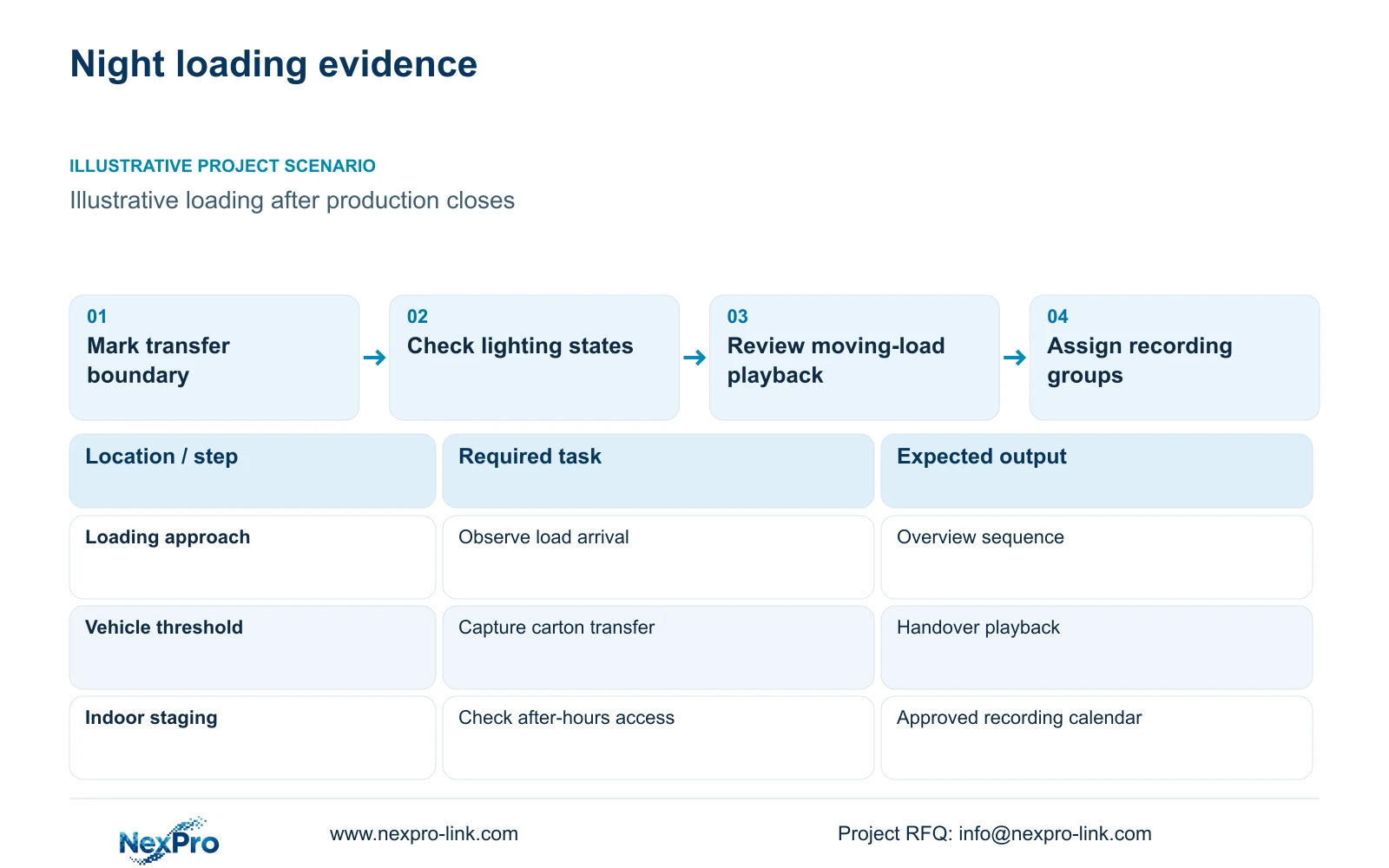
For night dispatch at an apparel factory, preserve the loading transfer view first, then assign recording settings to quieter indoor areas according to their separate security tasks. Choose lighting and camera position together: the required evidence is whether a load crossed the agreed handover point and entered the intended vehicle. A broad yard image alone may leave that transfer hidden behind stacked cartons.
Illustrative project scenario: Finished garments are loaded after the daytime production floor is closed. Assume the engineer can allocate an overview of the loading approach and a closer view of the carton transfer point. These are planning roles, not surveyed positions. The owner should identify the handover boundary, expected load movement and information that must remain visible during a dispute.
Inspect the proposed view with the actual night lighting states, including vehicle headlights and lights switching off inside the building. Ask the local installer to record representative moving loads for review. Judge the recorded sequence rather than a stationary live image, and keep the purpose limited to permitted material and security observation.
Section 02
Keep the transfer point visible through lighting changes
Place the detail view where the transfer remains visible before cartons disappear inside the vehicle. Check the sightline with doors open, the vehicle in its loading position and a plausible stack at the staging area. If the load blocks the camera, changing the lens setting cannot recover the hidden event; the mounting position or observation boundary needs to move.
The NexPro-BL2812M55-5MP-DIC-AI is an ordinary-area candidate with a 2.8–12mm motorized lens, dual light and PoE. Its specification lists the 5MP family, 25fps@5MP and a main output including 2880×1620. These fields support a selection discussion but do not establish readable carton labels at a particular distance. Adjust the view and verify the chosen recorded output against the agreed task.
Record lint accumulation, humidity and cleaning access alongside the mounting decision. A view requiring frequent lens cleaning needs reachable service access that does not obstruct dispatch. Where site lighting produces a usable transfer image, compare that arrangement with camera-assisted illumination using the same movement and playback test. Do not assume illumination mode alone determines the necessary bitrate.
Section 03
Approve recording hours before counting storage savings
Keep the loading approach and critical transfer view continuously recording across the agreed dispatch operating period. Before restricting indoor recording to a shift schedule, establish whether those cameras also cover after-hours store access, goods staging or routes used by cleaners and maintenance staff. A closed production floor does not automatically remove every security task.
Create a role-based camera map with a separate recording calendar for each approved group. The owner approves operating coverage; the engineer assigns stream settings and retention; the installer verifies clocks, schedules and playback. Include late departures and unscheduled collections in the operating discussion so the schedule does not create an unexplained gap around the event being investigated.
The bitrate comparison below deliberately keeps both options continuous for 30 days. It isolates the effect of different stream allocations and does not include shift-only savings. If the owner later approves shorter recording hours for selected indoor views, calculate that group separately and preserve the dispatch schedule. Keep a retrieval display available where needed without making a display wall part of the recording path.
Section 04
Compare stream allocations on the same retention basis
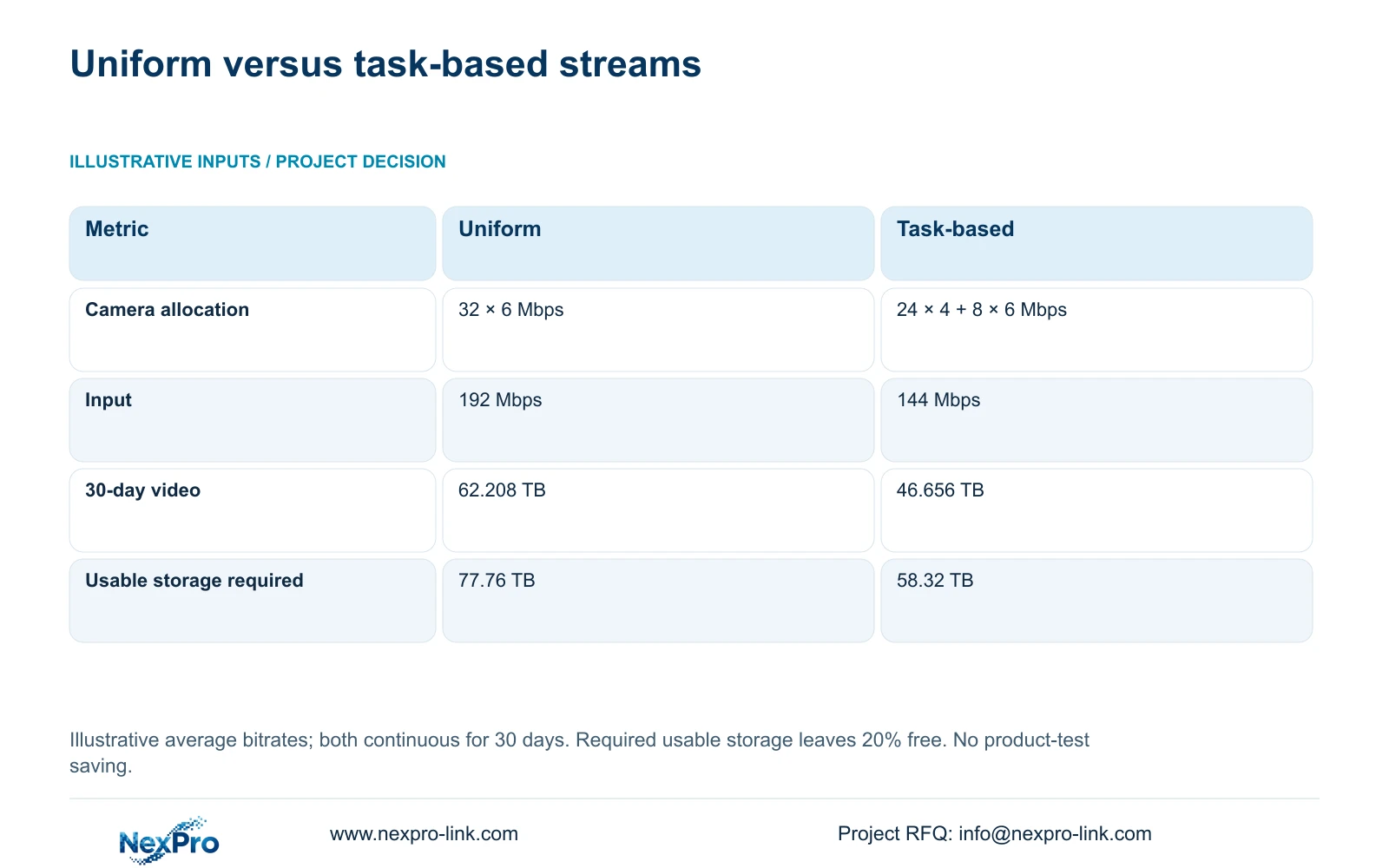
Use the illustrative 32-camera module to compare a uniform allocation with a task-based allocation. Option A assumes 32 cameras at 6 Mbps each. Option B assumes 24 cameras at 4 Mbps and eight at 6 Mbps, retaining the higher allowance for views requiring it. Both record continuously for 30 days; these are teaching inputs, not fixed rates attached to a resolution.
Calculate input_Mbps = sum(n × b), where n is camera quantity and b is average Mbps. Video_TB = 0.0108 × input_Mbps × days uses decimal TB. Option A gives 192 Mbps and 62.208 TB; Option B gives 144 Mbps and 46.656 TB. Dividing video volume by 0.80 gives the required usable storage while leaving 20% free.
The decisive difference is the allocation to the 24 lower-rate views while the eight higher-rate views retain their allowance. Approve Option B only after their recorded evidence remains acceptable. With variable bitrate, measure average demand for retention and peak demand for network planning separately. This calculation establishes neither a guaranteed compression saving nor a brand-level cost advantage.
| Metric | Option A: uniform | Option B: task-based |
|---|---|---|
| Stream allocation | 32 × 6 Mbps | 24 × 4 + 8 × 6 Mbps |
| Total input | 192 Mbps | 144 Mbps |
| 30-day video | 62.208 TB | 46.656 TB |
| Usable storage at 80% occupancy | 77.76 TB | 58.32 TB |
Section 05
Apply the night-view decision at its recording node
CASE04 provides a separate campus reference: four buildings with 20 cameras each, all assumed at 4 Mbps continuously for 30 days. Each local recorder receives 80 Mbps and generates 25.92 TB of video. Four 12 TB drives give 48 TB raw; the illustrative recording budget is 48 × 0.95 × 0.80 = 36.48 TB. Compare 25.92 TB directly with that budget, which already includes formatting allowance and reserve.
Do not add the 32-camera module to this 80-camera reference or distribute its savings across buildings without a revised camera schedule. If dispatch settings change in the stores/dispatch building, recalculate that node first. NexPro-NVR4449-4K is a four-bay, 320 Mbps input reference whose published summary distinguishes 49×5MP from 9×4K. Recording capacity does not establish simultaneous playback or RAID capability.
Keep the dispatch cameras, their access switches and recorder inside the intended protected-power boundary. CASE04 uses separate local UPS nodes, so a central protected recorder would not protect an unpowered remote switch. The SP1KR(S) rating is 1kVA/900W; battery configuration and load-specific runtime remain separate selection inputs. Lighting supplied outside that boundary also needs its own outage decision.
Section 06
Price the lighting and recording responsibilities separately
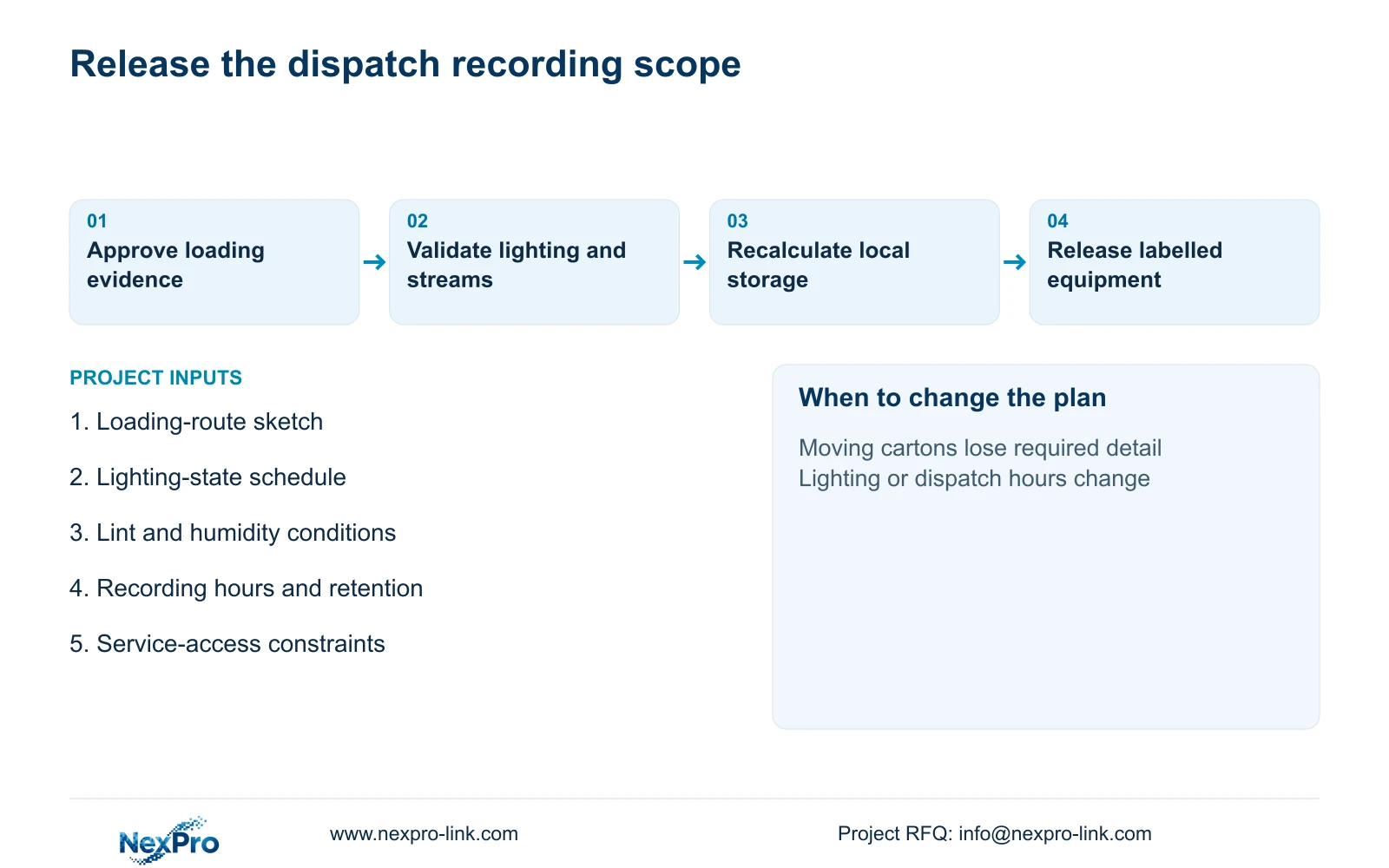
Recommend a tested task-based stream schedule with the dispatch transfer view preserved, while retaining continuous coverage wherever after-hours access remains relevant. Change that recommendation if lower-rate playback loses required detail, lighting becomes unreliable or the owner needs additional concurrent investigation views. Show the affected camera settings, storage and interfaces together rather than substituting a camera and leaving the old budget unchanged.
For comparable quotations, separate cameras and mounting accessories from site lighting work, recorder disks, local protected power and commissioning. Identify existing equipment proposed for retention and who verifies it. Compare another supplier against the same loading sequence, retention period and installation scope; an equipment-only price cannot settle the cost of lighting alterations or local service access.
NexPro-Link can discuss model matching, BOQ preparation and relevant technical documents through its factory project and tender-support scope. Building-labelled packing can associate each camera with its view and recording group. The local team should retain responsibility for lighting installation, cable routes and site acceptance, with any special environmental requirements resolved before the ordinary-area equipment is released.
Section 07
Buyer questions
Should readable carton labels be part of the loading-view requirement? Only if the owner needs that information from video. Define label position, orientation and movement for a sample trial; otherwise use dispatch records to identify the load and CCTV to review its transfer. A megapixel label does not prove text readability.
Can we reduce storage without changing the installed drives? An accepted lower average bitrate may extend retention or increase free space on the existing drives. Confirm the actual recording volume first. The illustrative capacity reduction does not automatically justify removing a drive or changing an approved disk arrangement.
What should be checked after night lighting is replaced? Repeat the moving-load recording review with the new lighting states. Check the transfer view, exposure behavior and actual bitrate, then update storage and peak-traffic assumptions if the stream demand changes.
Section 08
Define the night-dispatch package
Send your loading-route sketch, night-lighting states, lint/humidity and service-access conditions, and required recording hours with retention to info@nexpro-link.com for a discussion of the camera roles and equipment scope.
Engineering references
These sources support the general planning principles. Always use the selected product's current datasheet and applicable project standards for final design.