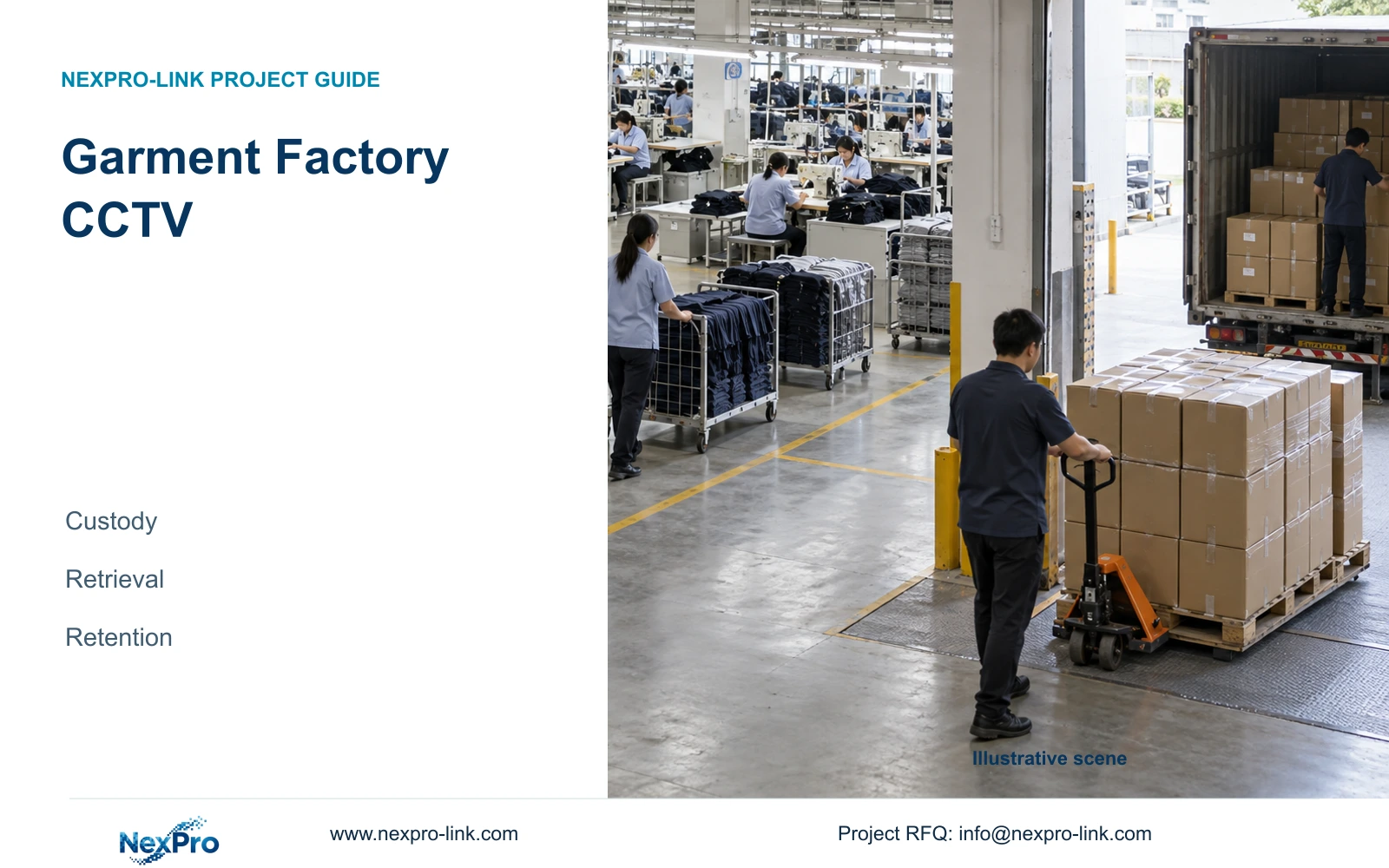
Reconstruct a garment material route from separate receiving, bundle-transfer and dispatch references. Record gaps between those business records instead of expecting CCTV to identify stock automatically.
Section 01
Locate the transfers that need evidence
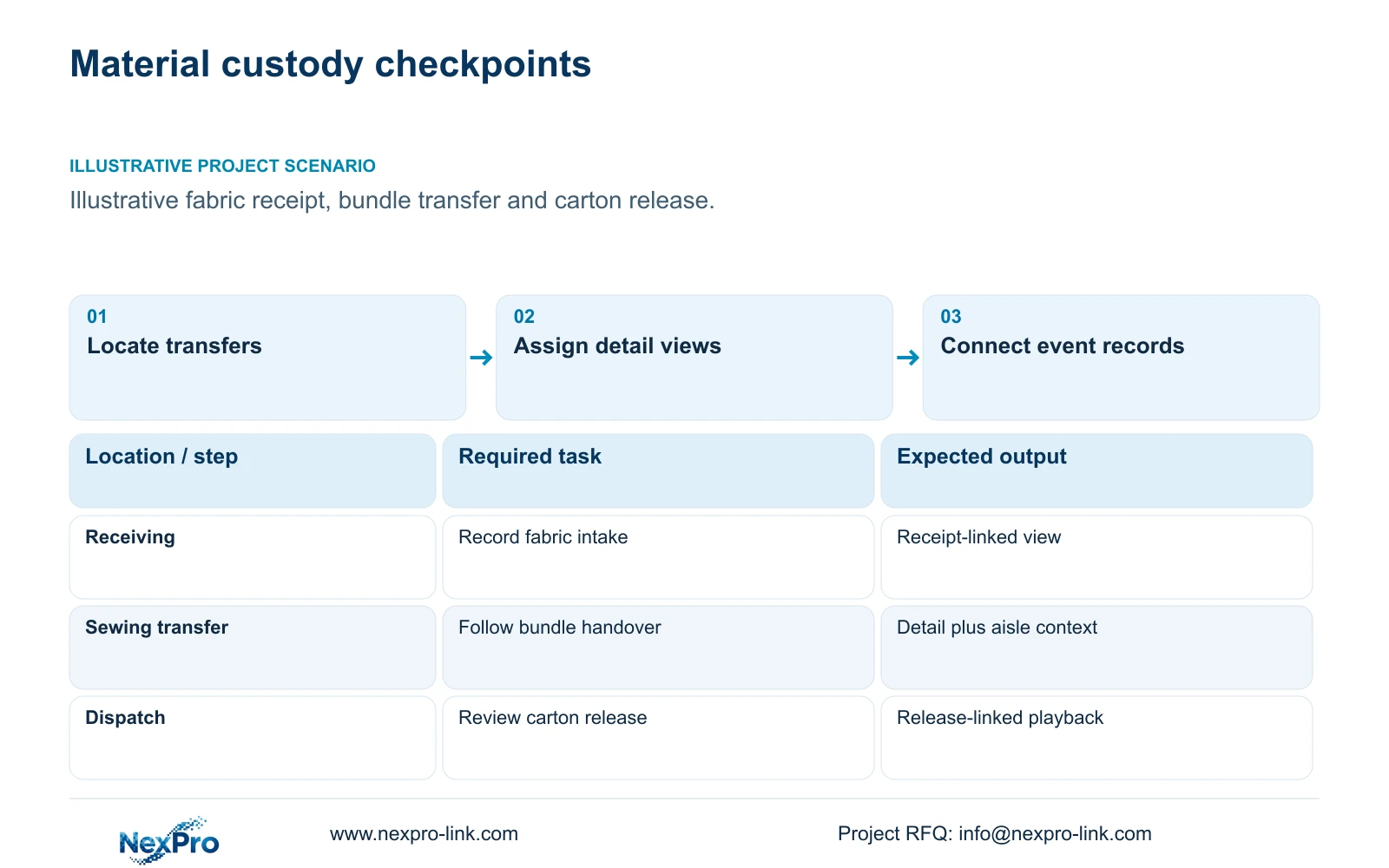
For a garment dispute that spans several teams, build a reference chain from fabric receipt through the relevant bundle transfer to carton release. Use each team's recorded location and time to retrieve the corresponding view. Do not assume that a fabric-roll reference automatically identifies a later carton or that one dispatch clip proves every upstream handover. Where the records do not establish that relationship, report the gap and review the relevant movement context. The deliverable is a traceable cross-team retrieval sequence, not a count of cameras over sewing benches.
Illustrative project scenario: An apparel factory needs evidence of fabric intake, work-in-progress transfers and carton release. Assume, for planning, that receiving, cutting, sewing and dispatch teams maintain separate handover records. The proposed camera map connects those records through named transfer locations. These are hypothetical operating arrangements, not a completed client project. Ask the owner to approve the material events being recorded before the designer allocates camera positions.
Walk each route with representative rolls, bundles and cartons in place. Stacks can hide a handover that appears visible on an empty drawing. Note lint exposure, humidity and night-shift lighting alongside the target position. A detail view across the transfer surface and an overview of the approach can answer different questions; neither should be accepted solely because the live picture looks sharp.
Section 02
Separate sewing movement from handover detail
Use sewing-area overview cameras to follow bundles entering and leaving the agreed work zone. Position detail cameras where a bundle is presented or released, rather than aiming continuously at individual operators. Record the required target width, mounting height, likely obstruction and direction of movement for each role. If transfer tables move with production styles, identify which viewpoints require adjustment and which common-route views can remain fixed.
The NexPro-BL2812M55-5MP-DIC-AI provides a relevant ordinary-area reference: its source lists a 5MP family, 2880x1620 main output and a 2.8 to 12mm motorized lens. The NexPro-DM2812M55-5MP-DIC-AI is listed as a Dome-family candidate with the same stated output dimensions and lens range. These fields help define candidate framing; they do not establish readable bundle labels at an unspecified distance.
Compare sample recordings with the transfer surface occupied and the night lighting operating. When labels remain hidden, change the viewing angle or presentation arrangement before increasing resolution across the whole room. Include a reachable cleaning position because accumulated lint can undermine an otherwise suitable image. Any humidity or cleaning exposure outside documented suitability requires a separate selection decision.
Section 03
Reconstruct the cross-team material-reference chain
Define a retrieval key that dispatch staff already understand: release reference, bay, date and approximate time. Give the associated camera a stable task name such as Dispatch release table, then map that name to its recorder channel and physical label. The stock or dispatch system remains the source of carton identity. Video supports review of the event without an assumed barcode-reading or transaction-integration feature.
Assign ownership explicitly. Dispatch supplies release references and timestamps; the designer specifies the corresponding view; the installer verifies channel names and recording; the owner authorizes playback and export access. Include supplied, retained and optional items in the camera schedule. This prevents an optional close view from becoming an unexplained dependency when someone later expects every carton code to be readable.
Demonstrate retrieval using a representative release record, then export the relevant interval and reopen it on the agreed review device. Check time alignment between records and video. For the quantity surveyor, this test identifies separately priced work such as channel naming, operator training or a qualified software interface. A camera quotation alone does not describe that workflow.
Start with the disputed release record and work backward only through relationships the receiving, cutting or dispatch records actually retain. For each handover, preserve the business reference, camera location and observed time context. A missing relationship belongs in the investigation note; similar-looking bundles in adjacent clips are not proof of continuity. Ask the owner to demonstrate this search with a redacted representative record before accepting the retrieval workflow. This is a proposed method and does not imply automatic production-system integration.
| Condition / stage | Required input | Decision and evidence |
|---|---|---|
| Finished-carton release | Release reference, bay and time | Retrieve departure and retain its actual dispatch identity |
| Relevant bundle handover | Available upstream reference and transfer location | Follow the recorded relationship; report an absent link |
| Fabric receipt under review | Receiving reference and route context | Separate confirmed movement from unproved material-to-carton continuity |
Section 04
Choose retention before fixing the disk allowance
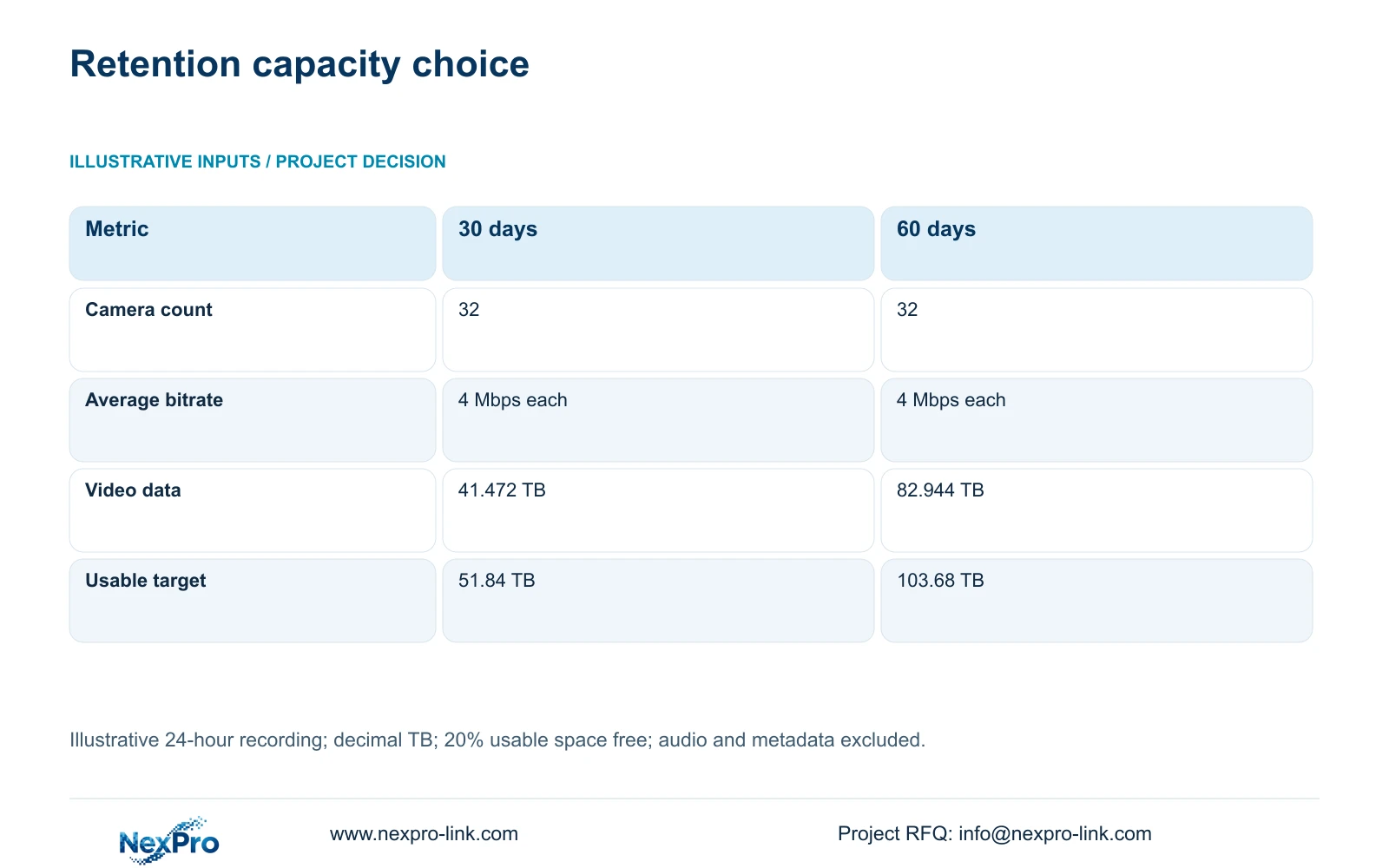
The illustrative comparison below uses 32 cameras, an average 4 Mbps per camera and continuous recording for 24 hours per day. Calculate decimal video capacity as video_TB = cameras × Mbps × 10^6 × 86400 × days / 8 / 10^12. Keeping 20% of usable storage free gives required_usable_TB = video_TB / 0.8. Audio and extra metadata are excluded, and the assumed bitrate must be replaced with representative recordings for procurement.
Thirty days requires 41.472 TB of video and 51.84 TB of usable capacity. Sixty days requires 82.944 TB and 103.68 TB respectively. The decisive difference is the review window: doubling retention doubles the video allowance under these unchanged assumptions. Select the period from the owner's investigation workflow rather than suggesting one brand will achieve the longer period through unverified compression savings.
Keep the separate CASE04 campus boundary visible. That illustrative design has four buildings with 20 cameras each, not this 32-camera comparison. Each node generates 25.92 TB over 30 days and installs four 12 TB drives: 48 TB raw × 0.95 × 0.80 = 36.48 TB video budget. Compare 25.92 TB directly with 36.48 TB; the reserve is already included.
| Metric | 30-day option | 60-day option |
|---|---|---|
| Cameras | 32 | 32 |
| Average bitrate per camera | 4 Mbps | 4 Mbps |
| Recording schedule | 24 hours/day | 24 hours/day |
| Video data | 41.472 TB | 82.944 TB |
| Required usable capacity | 51.84 TB | 103.68 TB |
Section 05
Price the custody workflow as a complete package
Recommend targeted handover detail, retained movement context and the owner-approved retention period as the base scope. Add further detail positions when occupied-layout tests reveal an unanswered transfer question. Compare supplier proposals against the same accepted views, export task and service access. Preserve required owner platforms or integrations, and show deviations explicitly rather than declaring a cheaper camera an equivalent complete system.
For recording, the NexPro-NVR4449-4K lists 320 Mbps input, four SATA bays and up to 18 TB per drive. Its published summary distinguishes 49×5MP from 9×4K modes. Channel count alone does not establish simultaneous decoding or RAID. The 32-camera example's 128 Mbps payload is only one selection input; the disk allowance and actual stream modes still have to fit.
Protect the local camera-power and recording chain where continued operation is required. Include switches, recorder, drives and necessary link equipment in the power schedule, without adding camera watts again when complete switch AC demand already includes PoE. Keep an ordinary retrieval screen unless simultaneous viewing justifies a separate display package. Remote buildings need protection on their actual electrical circuits.
Section 06
Release a location-labelled procurement schedule
Issue a role-based camera map and service-access arrangement with a revision date. Each position should carry its material event, target width, environmental inputs, recorder node and acceptance task. Distinguish equipment supply from mounts, containment, electrical work and local commissioning. Measure individual cable routes so a global metre allowance does not conceal an impractical connection or an unpriced inter-building backbone.
NexPro-Link's Factory & Warehouse project supply and BOQ & Tender Support scopes provide relevant routes for model matching, coordinated equipment lists and technical submittals. Request location-labelled preparation and packing where they help the installer separate receiving, sewing and dispatch equipment. Keep final viewpoint approval and local installation with the appointed project team, and price any proposed substitution against the approved task rather than the original camera count alone.
Section 07
Buyer questions
Should the longest retention period apply to every view? Only if the owner needs that review window across every task. Different groups may justify different periods, but the selected recorder must support the proposed schedules and storage allocation. Document the groups before recalculating capacity.
Can a dispatch camera replace the carton scanning system? No such capability is established here. Keep stock identity in the dispatch records and use video to review presentation, movement and release. Any automatic reading or record integration needs a separately specified and verified solution.
How should an alternative brand offer be evaluated? Require the same handover evidence, retention, export workflow and installation boundary. Compare exact models and itemized services, retaining any mandatory platform requirement. No matched prices or comparative image tests are supplied.
Section 08
Define your garment custody package
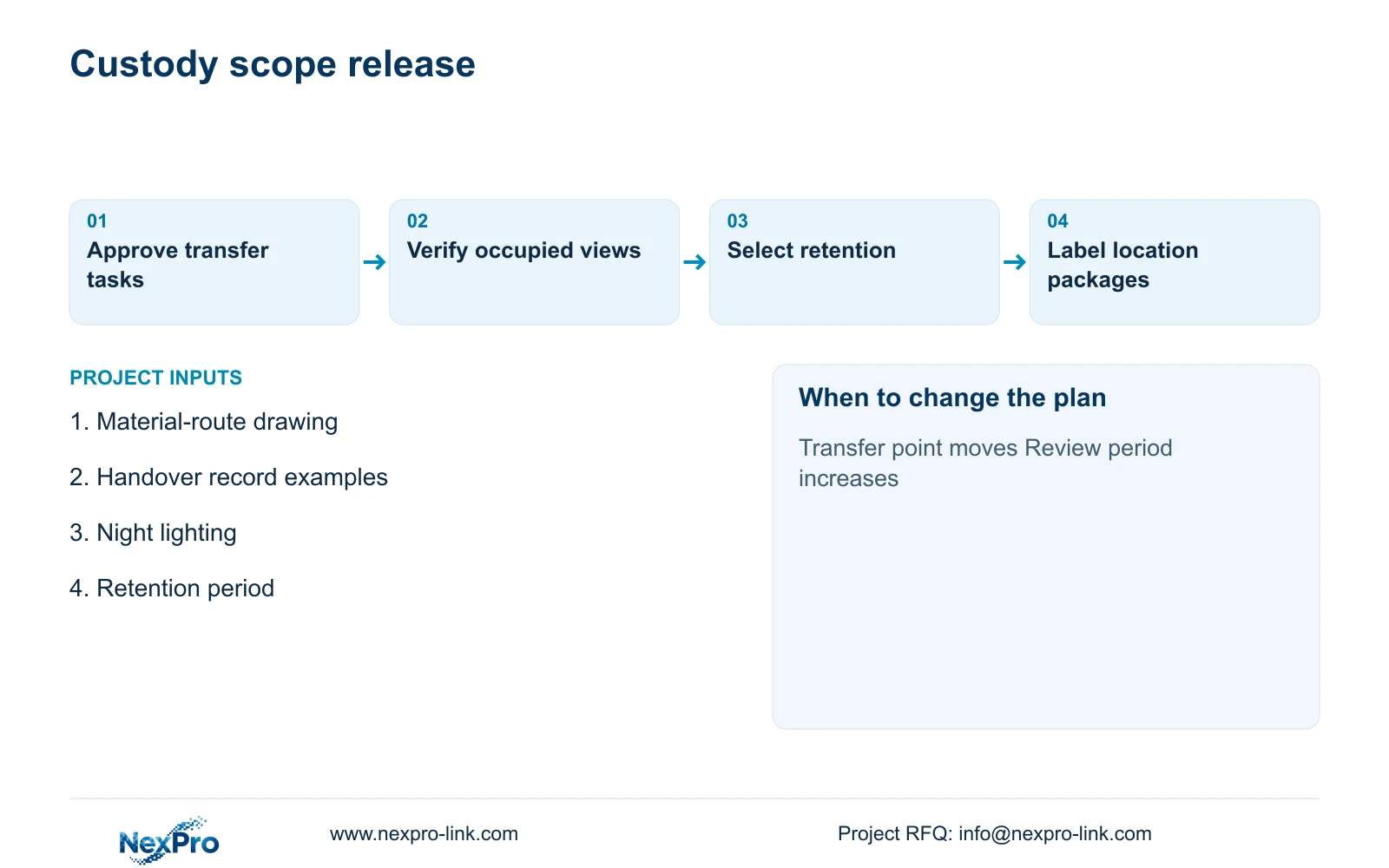
Send your material-route drawing, handover and release-record examples, lint/humidity and night-lighting conditions, and required review period to info@nexpro-link.com for a task-based equipment and BOQ discussion.
Engineering references
These sources support the general planning principles. Always use the selected product's current datasheet and applicable project standards for final design.