A garment factory moves rolls from receiving through cutting, sewing-floor aisles and finished-goods dispatch. Identify the handovers that matter to the operation: receiving, issue to cutting and dispatch.
Section 01
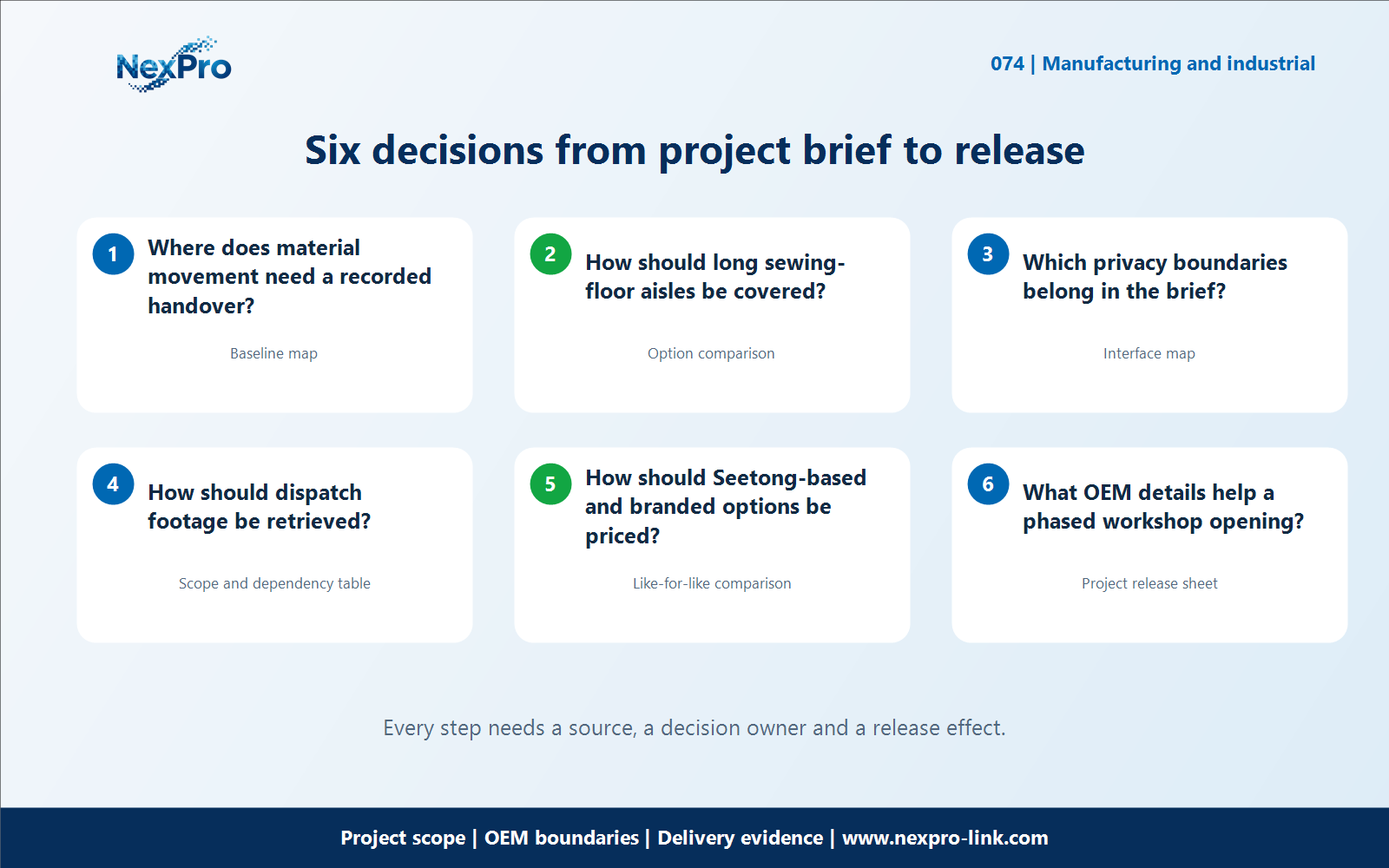
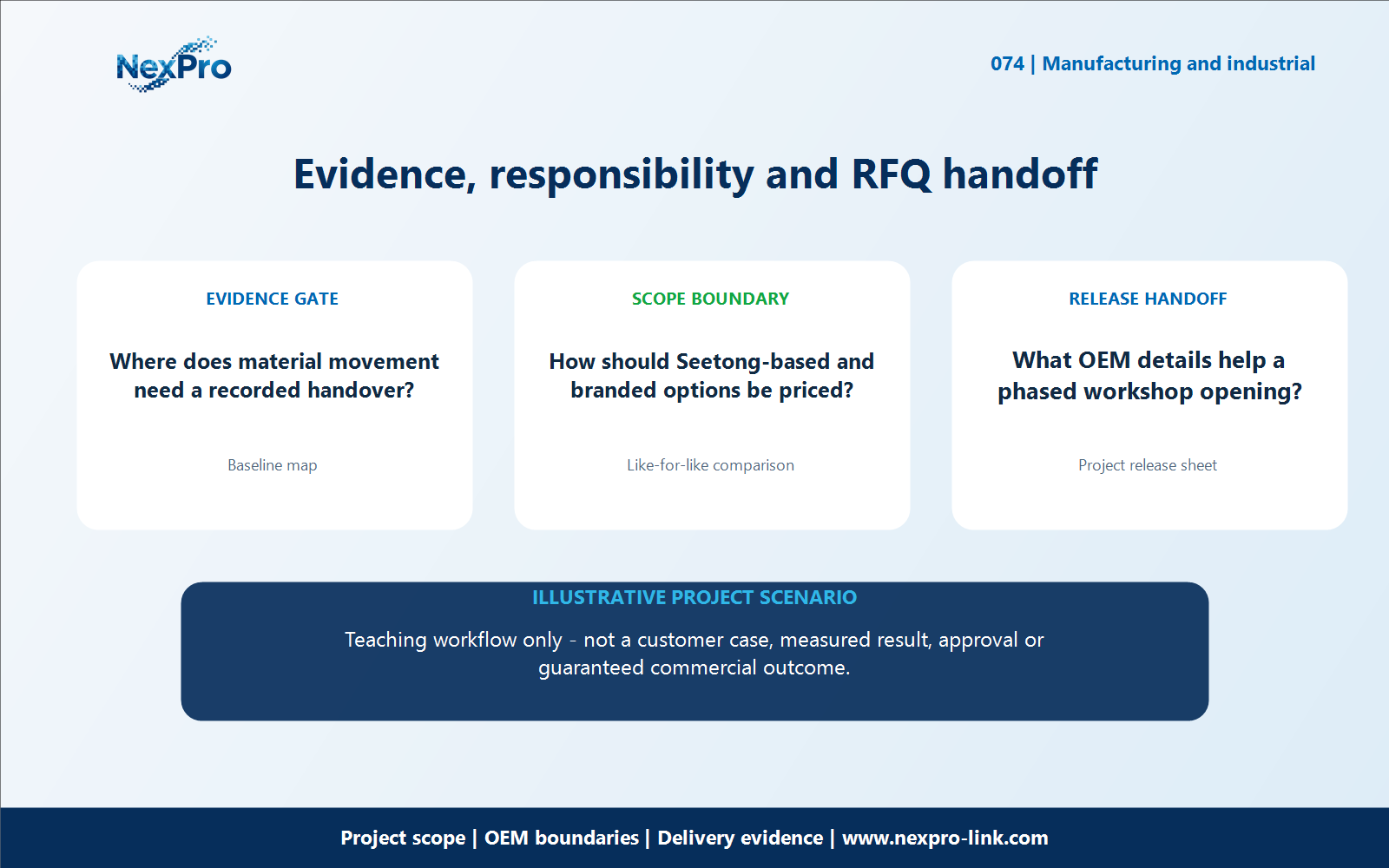
Where does material movement need a recorded handover?
A garment factory moves rolls from receiving through cutting, sewing-floor aisles and finished-goods dispatch. Identify the handovers that matter to the operation: receiving, issue to cutting and dispatch. A useful plan does not require a camera above every workstation. Focus on approved transfer points and the context needed to review them.
For the "Where does material movement need a recorded handover" decision, use the baseline map fields Area or item, Required task, Current assumption, Decision owner. Apply it to garment factory CCTV flow so the buyer, supplier and local integrator can see which input is confirmed, who owns it and which evidence remains open.
Evaluate where does material movement need a recorded handover against the stated site task and the surrounding equipment, documentation, packing and handover dependencies for garment factory CCTV flow. For where does material movement need a recorded handover in garment factory CCTV flow, record the confirmed condition, chosen option and remaining evidence separately; an open value is not a price, test, approval or customer-result claim.
Carry the where does material movement need a recorded handover decision into the RFQ, BOQ, configuration or release record for garment factory CCTV flow. For where does material movement need a recorded handover in garment factory CCTV flow, name the equipment, artwork, network, installation and acceptance owner; site-specific work remains with the buyer or integrator unless the signed scope says otherwise.
Section 02
How should long sewing-floor aisles be covered?
How should long sewing-floor aisles be covered? Plan views around columns, lighting and stored material rather than assuming an unobstructed floor. Match lens choice to the required aisle segment. Wide coverage and useful handover detail may need different positions instead of one universal camera model. For Garment Factory CCTV: Material Handover, Cutting Rooms and Finished-Goods Routes, keep this decision tied to the same project brief rather than opening a separate generic specification exercise.
For the "How should long sewing-floor aisles be covered" decision, use the option comparison fields Position or option, Suitable condition, Trade-off, Next choice. Apply it to garment factory CCTV flow so the buyer, supplier and local integrator can see which input is confirmed, who owns it and which evidence remains open.
Evaluate how should long sewing-floor aisles be covered against the stated site task and the surrounding equipment, documentation, packing and handover dependencies for garment factory CCTV flow. For how should long sewing-floor aisles be covered in garment factory CCTV flow, record the confirmed condition, chosen option and remaining evidence separately; an open value is not a price, test, approval or customer-result claim.
Carry the how should long sewing-floor aisles be covered decision into the RFQ, BOQ, configuration or release record for garment factory CCTV flow. For how should long sewing-floor aisles be covered in garment factory CCTV flow, name the equipment, artwork, network, installation and acceptance owner; site-specific work remains with the buyer or integrator unless the signed scope says otherwise.
Section 03
Which privacy boundaries belong in the brief?
Which privacy boundaries belong in the brief? Define excluded areas and the purpose of the approved views before installation. Keep the project focused on access and material incidents. Applicable workplace and privacy requirements should be handled by the responsible buyer and local project team. For Garment Factory CCTV: Material Handover, Cutting Rooms and Finished-Goods Routes, keep this decision tied to the same project brief rather than opening a separate generic specification exercise.
For the "Which privacy boundaries belong in the brief" decision, use the interface map fields Device or record, Input, Output, Responsible party. Apply it to garment factory CCTV flow so the buyer, supplier and local integrator can see which input is confirmed, who owns it and which evidence remains open.
Evaluate which privacy boundaries belong in the brief against the stated site task and the surrounding equipment, documentation, packing and handover dependencies for garment factory CCTV flow. For which privacy boundaries belong in the brief in garment factory CCTV flow, record the confirmed condition, chosen option and remaining evidence separately; an open value is not a price, test, approval or customer-result claim.
Carry the which privacy boundaries belong in the brief decision into the RFQ, BOQ, configuration or release record for garment factory CCTV flow. For which privacy boundaries belong in the brief in garment factory CCTV flow, name the equipment, artwork, network, installation and acceptance owner; site-specific work remains with the buyer or integrator unless the signed scope says otherwise.
| Project question | Project-oriented treatment | Keep equal when comparing offers |
|---|---|---|
| Where does material movement need a recorded handover? | Identify the handovers that matter to the operation: receiving, issue to cutting and dispatch. | Factory zone and environmental requirement |
| How should long sewing-floor aisles be covered? | Plan views around columns, lighting and stored material rather than assuming an unobstructed floor. | Required event-review task |
| Which privacy boundaries belong in the brief? | Define excluded areas and the purpose of the approved views before installation. | Network and operational boundary |
| How should dispatch footage be retrieved? | Give transfer points consistent names and time references so an operator can follow the sequence. | Complete supply and local-work scope |
Section 04
How should dispatch footage be retrieved?
How should dispatch footage be retrieved? Give transfer points consistent names and time references so an operator can follow the sequence. Automatic order linkage is a separate integration task. A clear manual retrieval workflow may meet the brief without adding unused platform complexity. For Garment Factory CCTV: Material Handover, Cutting Rooms and Finished-Goods Routes, keep this decision tied to the same project brief rather than opening a separate generic specification exercise.
For the "How should dispatch footage be retrieved" decision, use the scope and dependency table fields Item, Included, Dependency, Separate option. Apply it to garment factory CCTV flow so the buyer, supplier and local integrator can see which input is confirmed, who owns it and which evidence remains open.
Evaluate how should dispatch footage be retrieved against the stated site task and the surrounding equipment, documentation, packing and handover dependencies for garment factory CCTV flow. For how should dispatch footage be retrieved in garment factory CCTV flow, record the confirmed condition, chosen option and remaining evidence separately; an open value is not a price, test, approval or customer-result claim.
Carry the how should dispatch footage be retrieved decision into the RFQ, BOQ, configuration or release record for garment factory CCTV flow. For how should dispatch footage be retrieved in garment factory CCTV flow, name the equipment, artwork, network, installation and acceptance owner; site-specific work remains with the buyer or integrator unless the signed scope says otherwise.
Section 05
How should Seetong-based and branded options be priced?
How should Seetong-based and branded options be priced? Compare equivalent coverage, retention and operator tasks. Repeating a suitable model in ordinary areas can simplify supply, while difficult entrances may need a different choice. Keep those distinctions visible in both the NexPro-Link and competing schedules. For Garment Factory CCTV: Material Handover, Cutting Rooms and Finished-Goods Routes, keep this decision tied to the same project brief rather than opening a separate generic specification exercise.
For the "How should Seetong-based and branded options be priced" decision, use the like-for-like comparison fields Requirement, Baseline, Proposed treatment, Remaining difference. Apply it to garment factory CCTV flow so the buyer, supplier and local integrator can see which input is confirmed, who owns it and which evidence remains open.
Evaluate how should seetong-based and branded options be priced against the stated site task and the surrounding equipment, documentation, packing and handover dependencies for garment factory CCTV flow. For how should seetong-based and branded options be priced in garment factory CCTV flow, record the confirmed condition, chosen option and remaining evidence separately; an open value is not a price, test, approval or customer-result claim.
Carry the how should seetong-based and branded options be priced decision into the RFQ, BOQ, configuration or release record for garment factory CCTV flow. For how should seetong-based and branded options be priced in garment factory CCTV flow, name the equipment, artwork, network, installation and acceptance owner; site-specific work remains with the buyer or integrator unless the signed scope says otherwise.
Section 06
What OEM details help a phased workshop opening?
What OEM details help a phased workshop opening? Use workshop and phase codes on cartons, with the agreed buyer-brand material and technical references inside. Keep software branding separate from physical marking. The goal is an orderly release that crews can install without mixing floor allocations. For Garment Factory CCTV: Material Handover, Cutting Rooms and Finished-Goods Routes, keep this decision tied to the same project brief rather than opening a separate generic specification exercise.
For the "What OEM details help a phased workshop opening" decision, use the project release sheet fields Configuration, Artwork, Quantity, Location, Release stage. Apply it to garment factory CCTV flow so the buyer, supplier and local integrator can see which input is confirmed, who owns it and which evidence remains open.
Evaluate what oem details help a phased workshop opening against the stated site task and the surrounding equipment, documentation, packing and handover dependencies for garment factory CCTV flow. For what oem details help a phased workshop opening in garment factory CCTV flow, record the confirmed condition, chosen option and remaining evidence separately; an open value is not a price, test, approval or customer-result claim.
Carry the what oem details help a phased workshop opening decision into the RFQ, BOQ, configuration or release record for garment factory CCTV flow. For what oem details help a phased workshop opening in garment factory CCTV flow, name the equipment, artwork, network, installation and acceptance owner; site-specific work remains with the buyer or integrator unless the signed scope says otherwise.
Engineering references
These sources support the general planning principles. Always use the selected product's current datasheet and applicable project standards for final design.