Three-shift CCTV needs recorded moving-target evidence under actual night lighting, supported by a stream, storage and power plan that retains retrieval access.
Section 01
Design around the actual night operating state
Factory CCTV for three shifts should preserve the required evidence when lighting, movement and staffing change overnight. Describe the night operating state in the design brief and verify recorded moving targets under that state. A clear daytime scene or an illumination-distance specification does not establish whether a night handover will remain useful in playback.
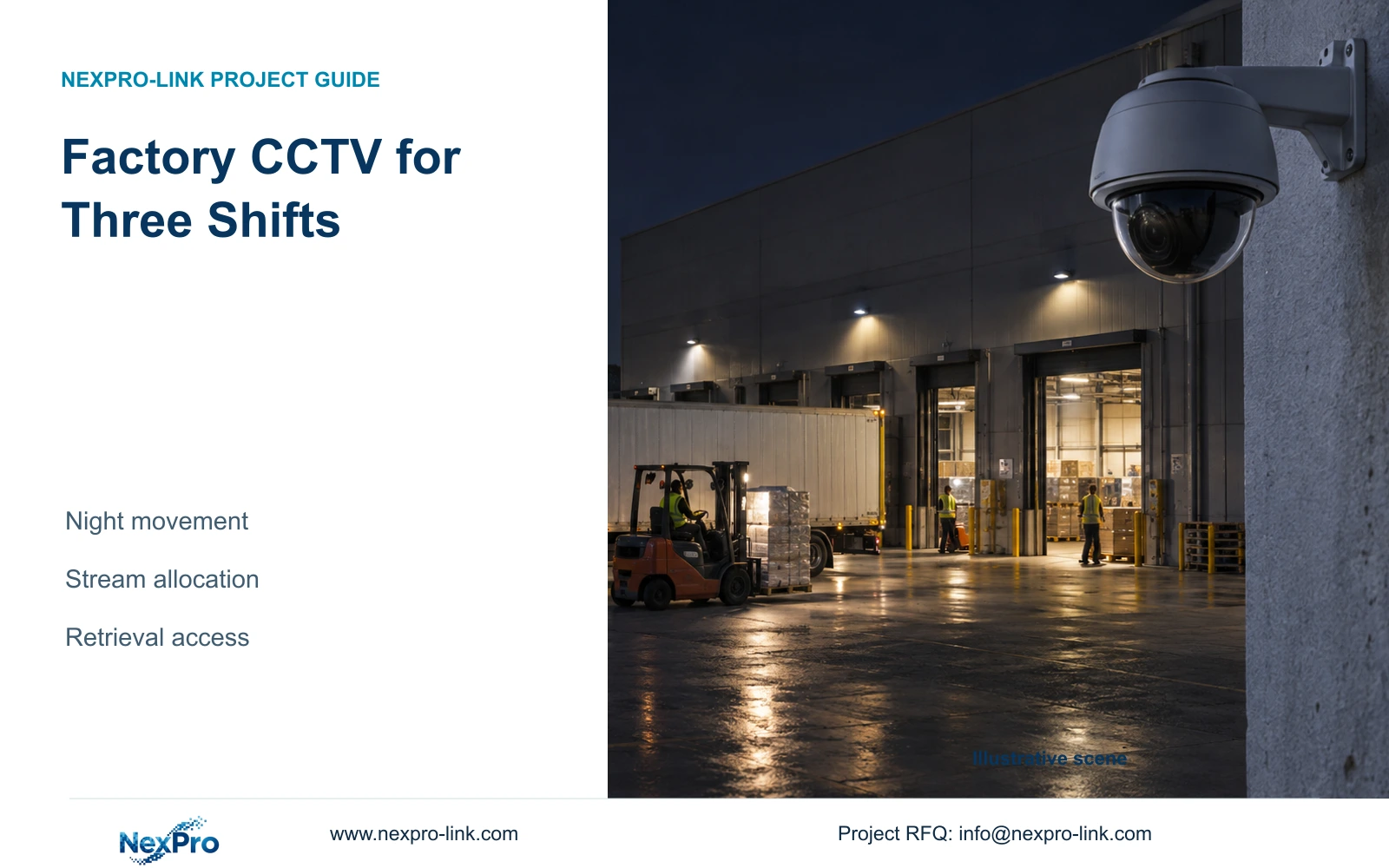
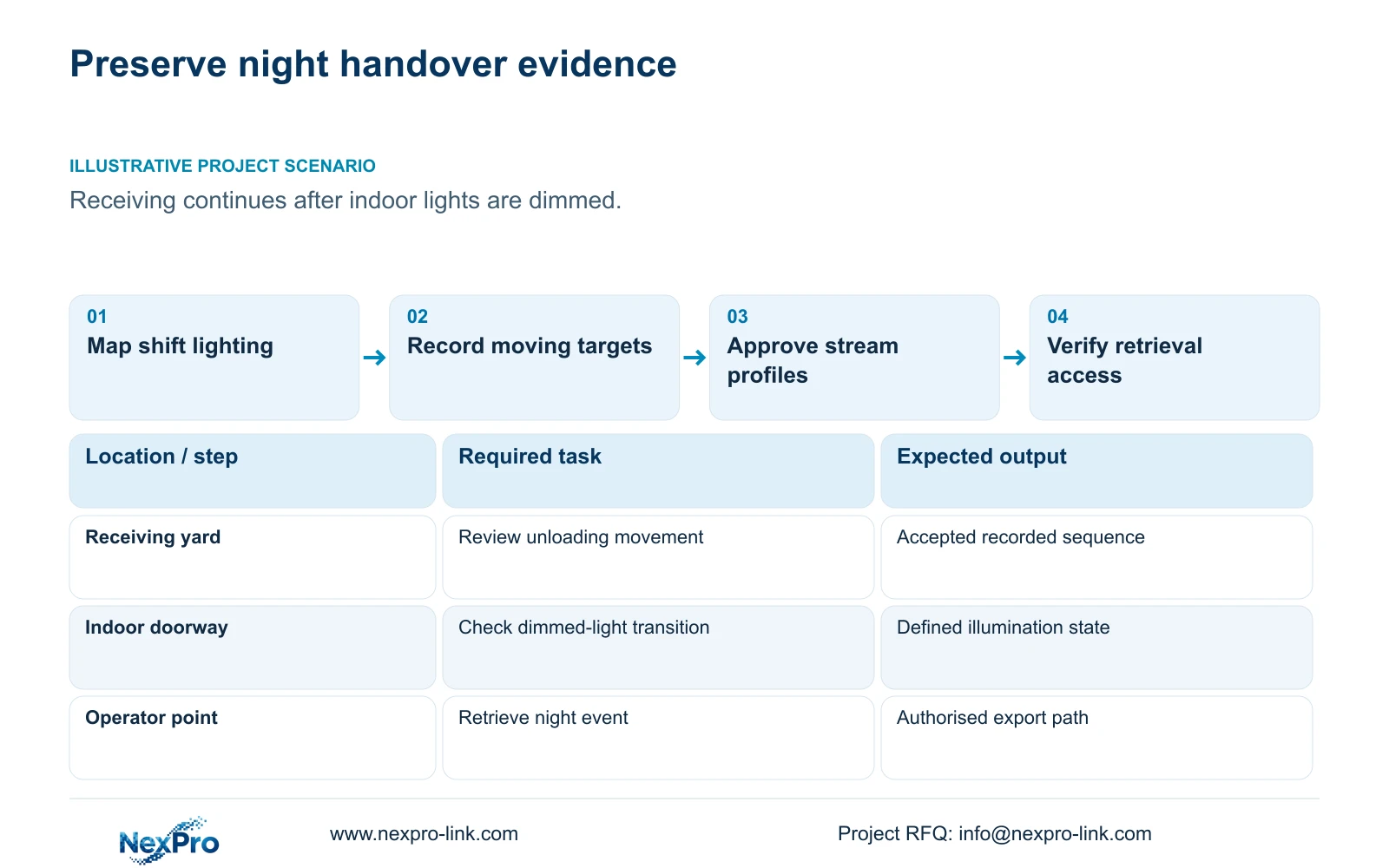
Illustrative project scenario: The receiving yard operates after indoor lights have been dimmed for the night shift. Assume workers continue unloading while vehicles pass the yard entrance and the interior doorway provides less background light. The owner needs to review authorised material transfers during every shift, including periods when the daytime lighting arrangement is unavailable.
Map lighting by task and shift: permanently available yard lights, dimmed indoor areas and intermittent vehicle headlights. Record who controls each source and whether it remains available during an outage. Mark proposed lighting changes as assumptions. A night camera selection based on lamps that operations later switches off leaves a dependency the equipment quotation cannot resolve.
Section 02
Judge moving footage at the handover plane
Define a short representative sequence for each critical night view. Include a worker crossing the target plane, a loaded vehicle occupying the usual position and the actual handover movement. Review the recorded main stream and exported clip, because a pleasing live preview does not establish the quality of the retained evidence.
Longer exposure can brighten a still scene while blurring a moving target, as Axis explains in its image-quality troubleshooting guide. This principle supports the trial, not a claim about NexPro camera performance or menus. Added light may introduce glare or reflections. Record target distance, width and movement direction, then compare recorded settings against the same sequence instead of accepting a static screenshot.
The NexPro-BL2812M55-5MP-DIC-AI lists 25fps@5MP, a main output including 2880×1620, a 2.8–12mm motorized lens and dual light. These are candidate specifications, not proof of useful footage at the yard. Confirm permitted illumination behaviour and the final operating settings. Ordinary security footage also remains separate from machine inspection and safeguarding.
Section 03
Keep recording power and night retrieval connected
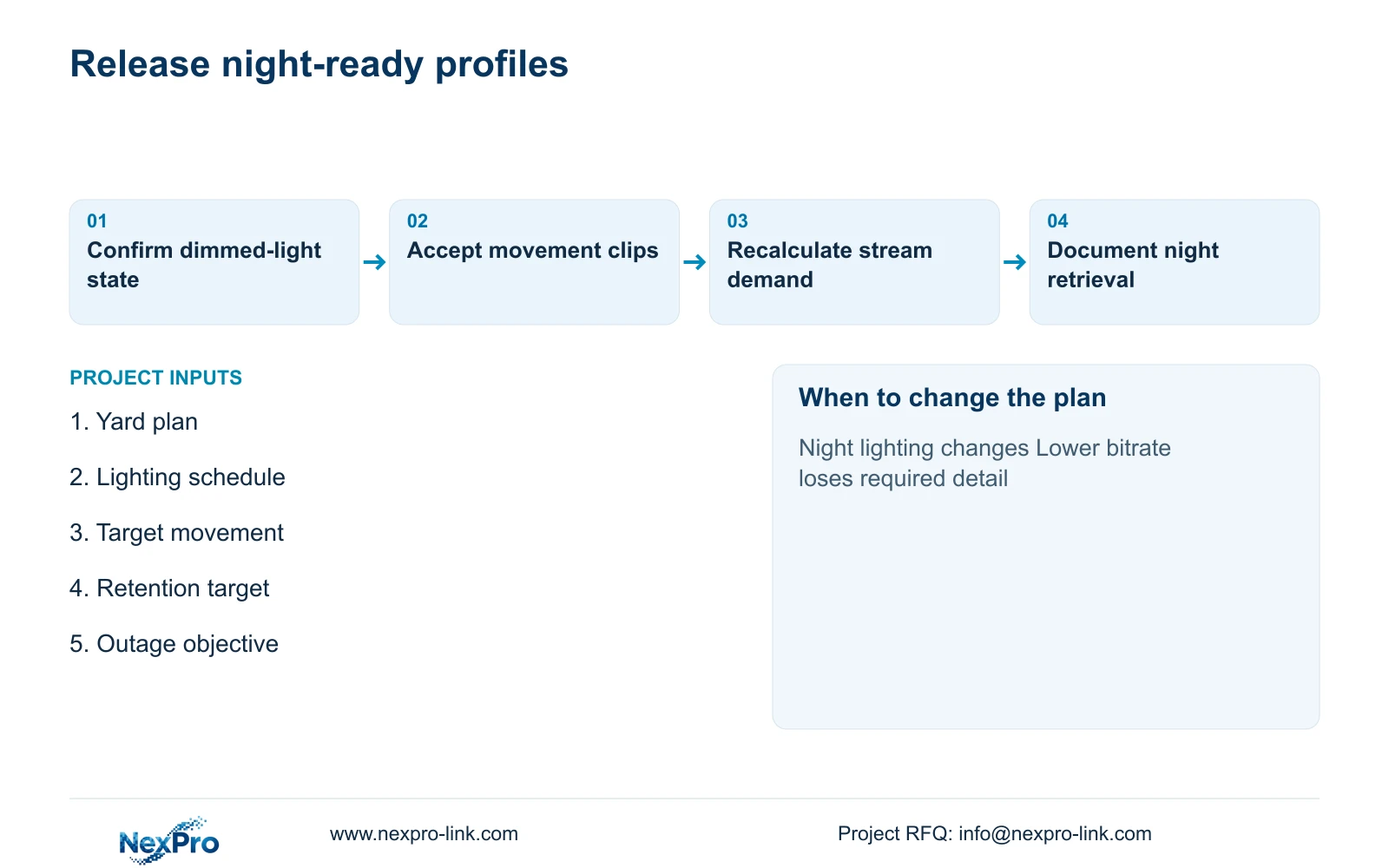
Trace the night operator's retrieval path as carefully as camera power. The recorder, access switches and any link equipment needed to reach them must remain available for the specified outage task. If the owner requires immediate review, include the relevant local display or client connection. Internet availability should not be the assumed prerequisite for local playback.
The illustrative CNC reference uses four groups of eight cameras. Its teaching inputs are 12 W per camera, 90% cable delivery, 15 W switch self-load and 90% AC conversion. For each group, PSE output is 8 × 12 / 0.90 = 106.6667 W, and complete switch AC demand is (106.6667 + 15) / 0.90 = 135.1852 W. These assumptions must be replaced by selected equipment demand.
Night illumination may alter that demand, so obtain the relevant enabled-feature power input rather than treating 12 W as a camera rating. The SP1KR(S) reference is rated 1kVA/900W; that capacity alone establishes no operating duration. Include the exact battery configuration and load condition when specifying backup, and do not add camera power again after counting complete switch AC demand.
Section 04
Compare uniform and task-based recording schedules
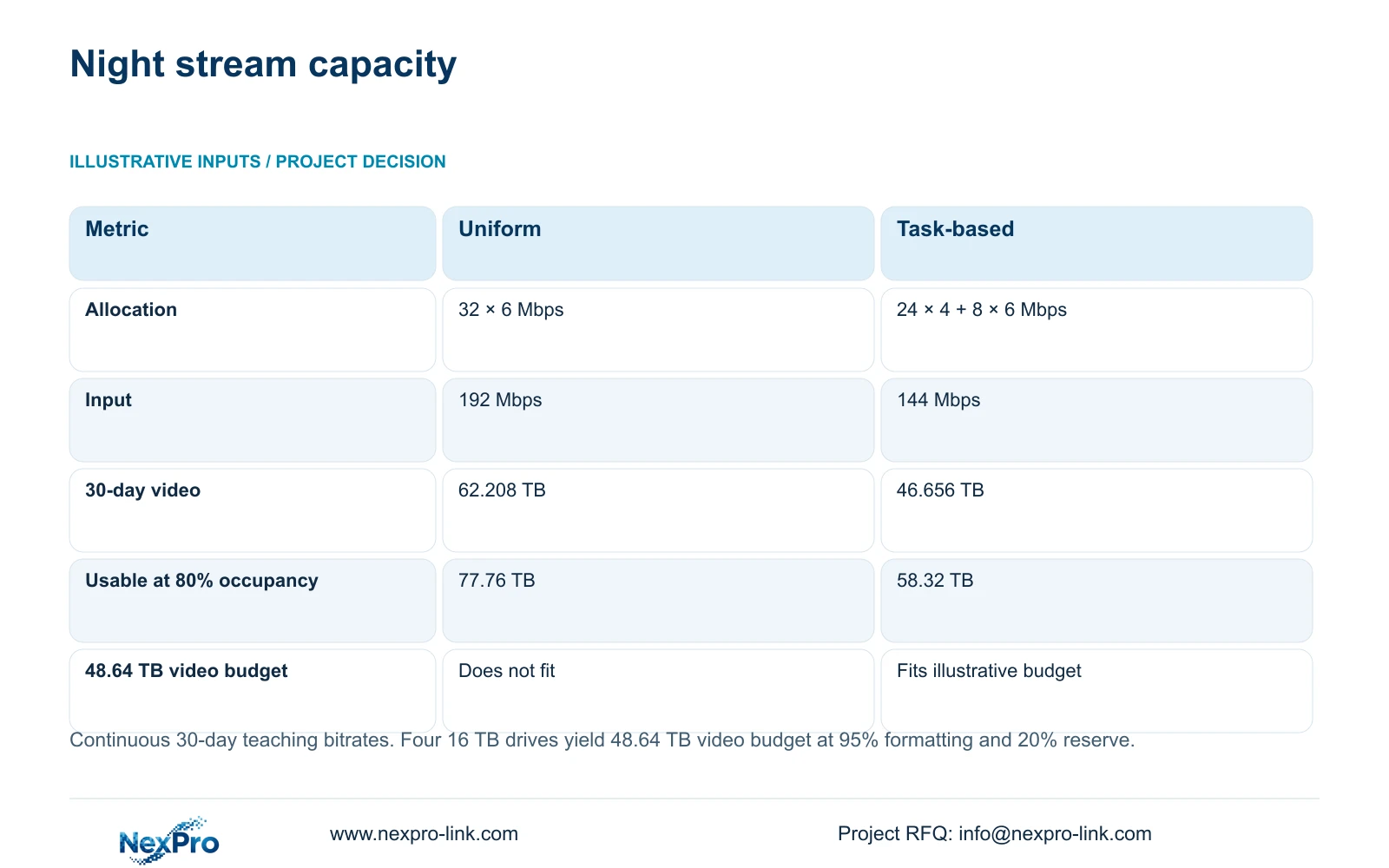
For an illustrative 32-camera system, Option A assigns 6 Mbps to every camera. Option B assigns 4 Mbps to 24 cameras and 6 Mbps to eight cameras. Both record continuously for 30 days. Calculate input_Mbps = sum(n × b): Option A is 32 × 6 = 192 Mbps; Option B is 24 × 4 + 8 × 6 = 144 Mbps.
Using decimal units, video_TB = 0.0108 × input_Mbps × days. The resulting video quantities are 62.208 TB and 46.656 TB. Dividing each by 0.80 gives required usable capacities of 77.76 TB and 58.32 TB at 80% occupancy. These are assumed stream budgets, not fixed values dictated by resolution or guaranteed compression savings.
The decisive difference is the allocation of bitrate to accepted tasks. Option B is appropriate only if its 24 lower-budget streams preserve their required night evidence. With the reference case's four 16 TB drives, recording budget = 64 × 0.95 × 0.80 = 48.64 TB. Option B's 46.656 TB fits that illustrative video budget; Option A's 62.208 TB does not. Do not apply the reserve again, and assess variable-bitrate peaks separately from retention averages.
| Metric | Option A: uniform | Option B: task-based |
|---|---|---|
| Stream allocation | 32 × 6 Mbps | 24 × 4 + 8 × 6 Mbps |
| Total input | 192 Mbps | 144 Mbps |
| 30-day video | 62.208 TB | 46.656 TB |
| Usable capacity at 80% occupancy | 77.76 TB | 58.32 TB |
Section 05
Choose the stream plan after night evidence is accepted
Prefer the task-based schedule when recorded trials support its allocation. Keep the higher budget at views whose movement and required detail justify it, then verify the remaining views individually. If an important clip loses useful detail at 4 Mbps, revise that stream and recalculate capacity rather than preserving the mixed total as a budget target.
The NexPro-NVR4449-4K reference provides 320 Mbps input and four SATA bays supporting up to 18 TB per drive. Its summary distinguishes 49×5MP from 9×4K. The example's aggregate bitrate must therefore be checked alongside supported modes, actual peaks and required playback workloads; throughput below a catalogue limit is not complete acceptance.
Change the recommendation when lighting schedules, vehicle routes or night duties change. Where additional lighting is needed, specify its supply, controls and outage behaviour separately. Compare candidate packages using equivalent night movement, framing and recorded quality. Without matched trials and complete quotations, neither the bitrate calculation nor a brand name establishes an overall winner.
Section 06
Hand over shift-specific settings and retrieval tasks
Build the equipment schedule around accepted night views, with a stream profile for each task group. Record the approved firmware, codec, frame rate, exposure-related settings and illumination behaviour used for the acceptance sequence. The local team should be able to reproduce the tested state after replacement or configuration changes.
Include an operator exercise that locates and exports a night event using the intended permissions. Identify the responsible person for lighting schedules and the person who can change recording profiles. NexPro-Link's BOQ support can help coordinate model matching and technical documents, while the site team confirms real lighting, installation and operating behaviour.
Keep the opening package complete for all active shifts. If a yard starts night receiving later, its lighting and recording readiness become a separate release condition. Preserve the accepted sample clips and stream inputs as project records so a later change can be evaluated against the required event, not merely against a remembered image appearance.
Section 07
Buyer questions
Can daytime settings be copied to every night view? Use them only as a starting point. Night views may have different illumination, glare and movement conditions. Confirm the recorded task at the installed target plane before approving a common profile.
Does 30-day recording mean every event remains equally useful? No. Retention describes availability over time; it does not establish usable motion detail. Acceptance should address both the stored duration and the evidence visible in representative night clips.
Must all cameras use the same codec for a fair trial? Keep codec and other relevant settings consistent when isolating a model difference. If comparing complete operating packages, record each configuration and judge equivalent required footage, with its resulting storage demand.
Section 08
Specify your night-shift recording package
Email info@nexpro-link.com with a marked receiving-yard plan, shift lighting schedule, required moving-target examples and retention plus outage objectives. NexPro-Link can discuss camera candidates and a task-based recording scope.
Engineering references
These sources support the general planning principles. Always use the selected product's current datasheet and applicable project standards for final design.