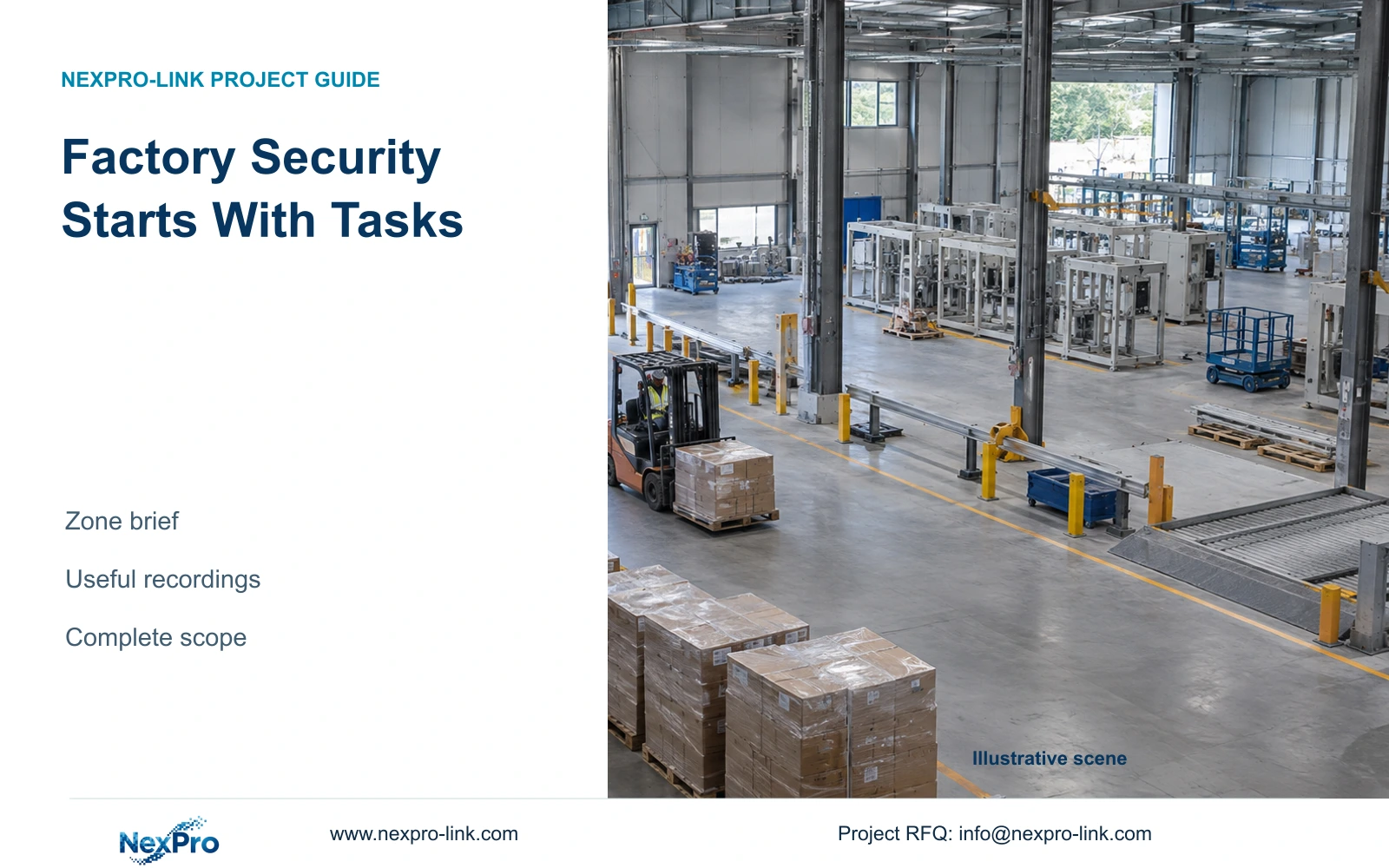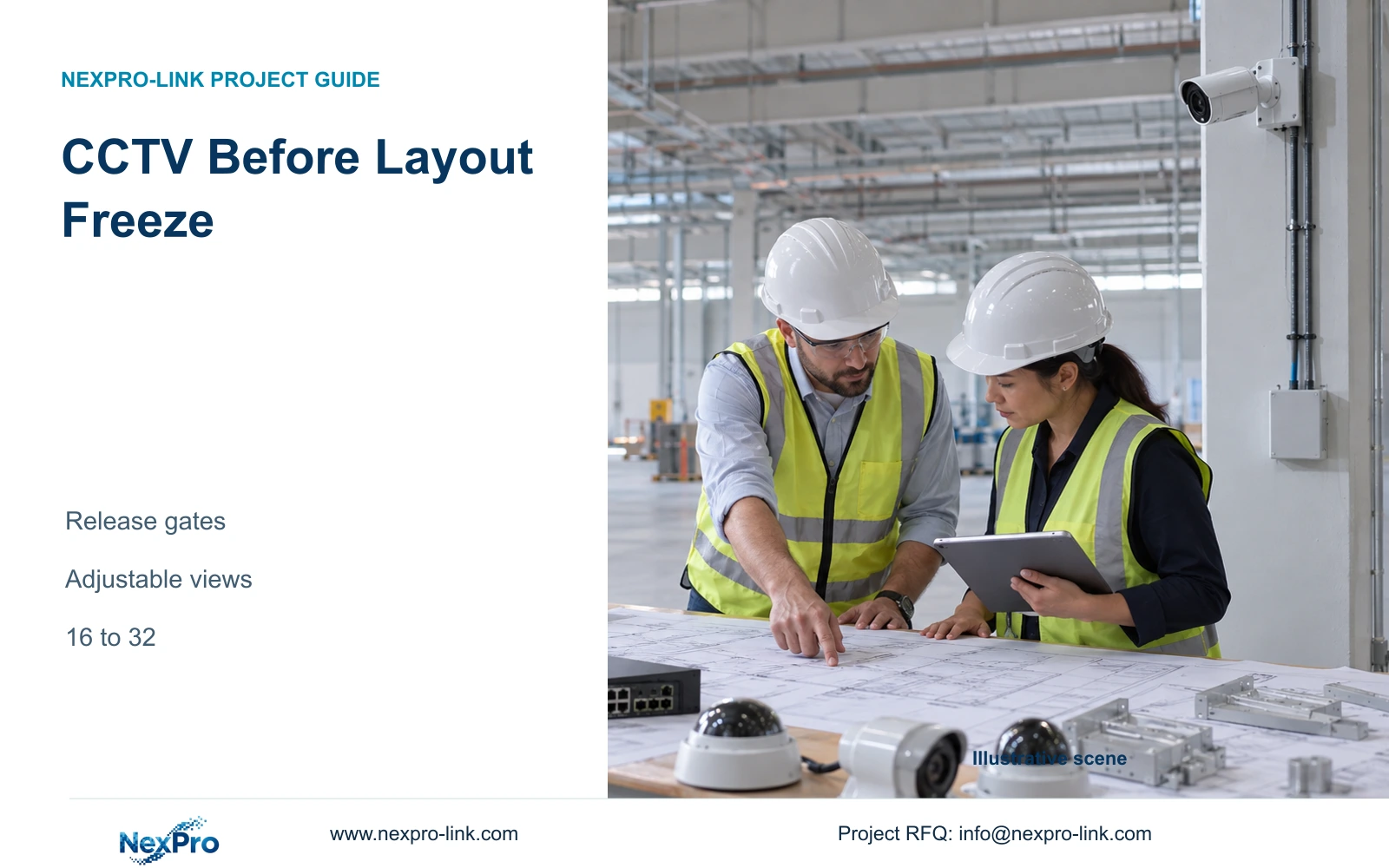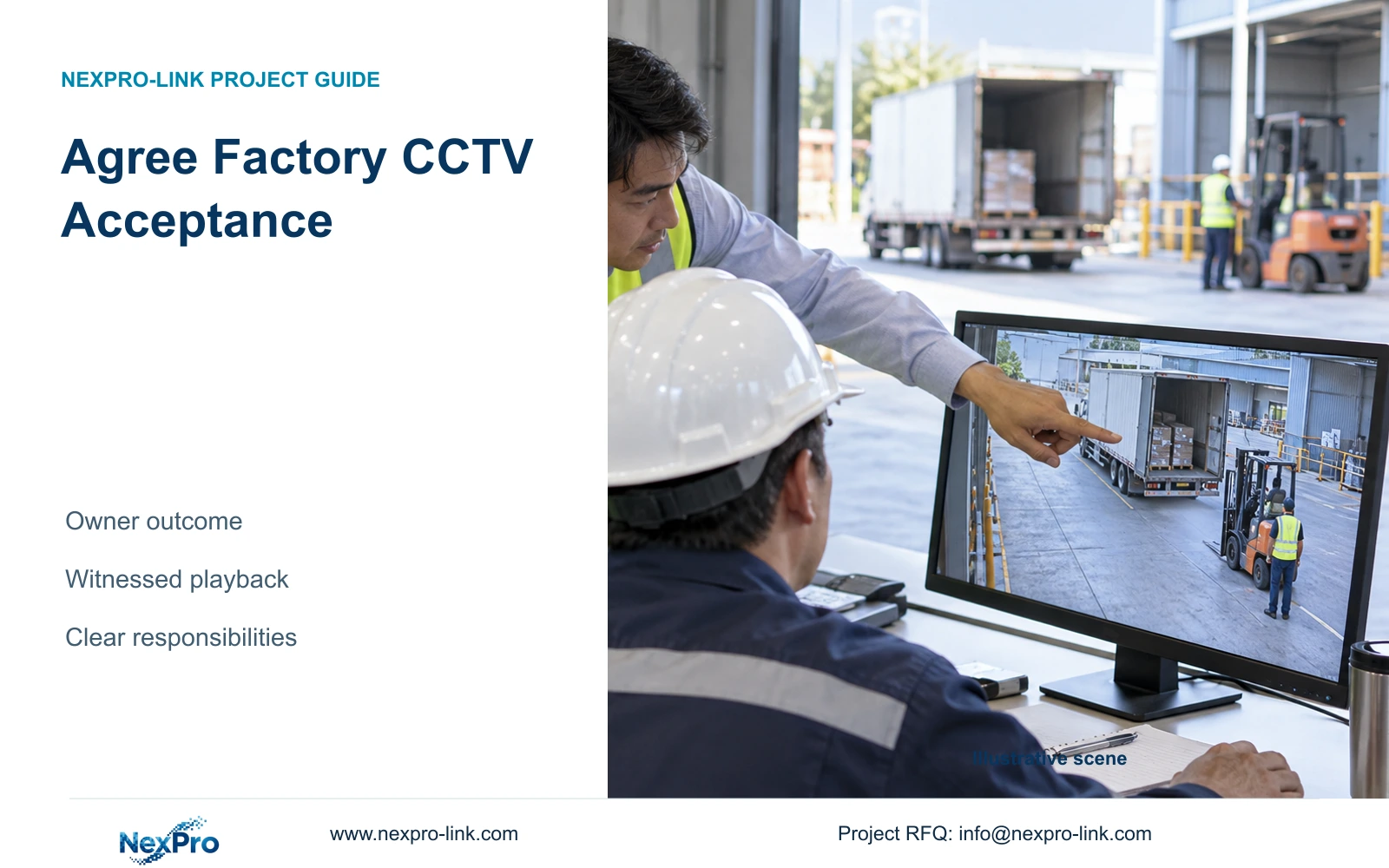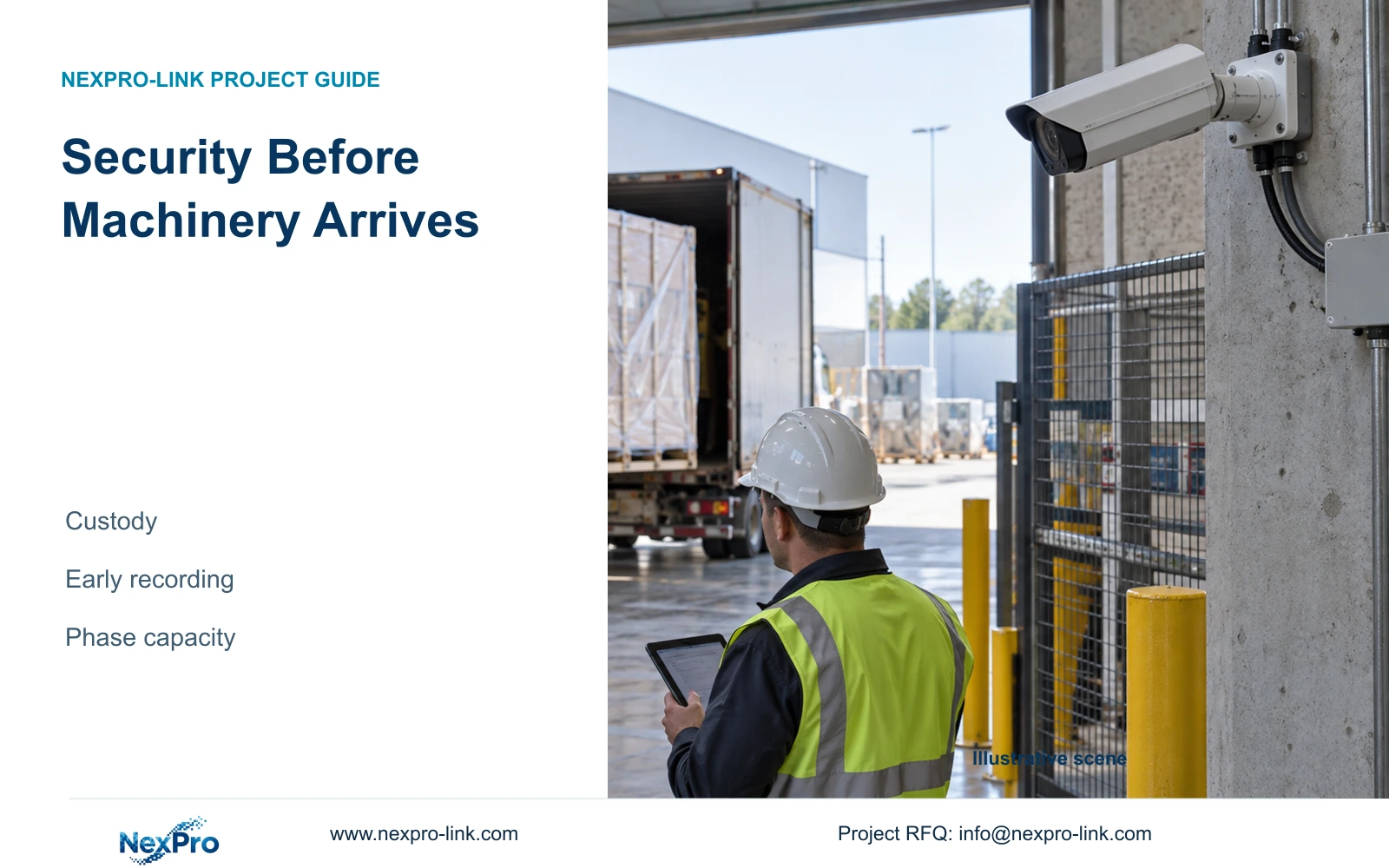
The first machinery delivery creates a security deadline of its own. A usable early CCTV phase needs the receiving views, recording, network, power and authorized retrieval path working together.
Section 01
Protect the first equipment handover before opening production
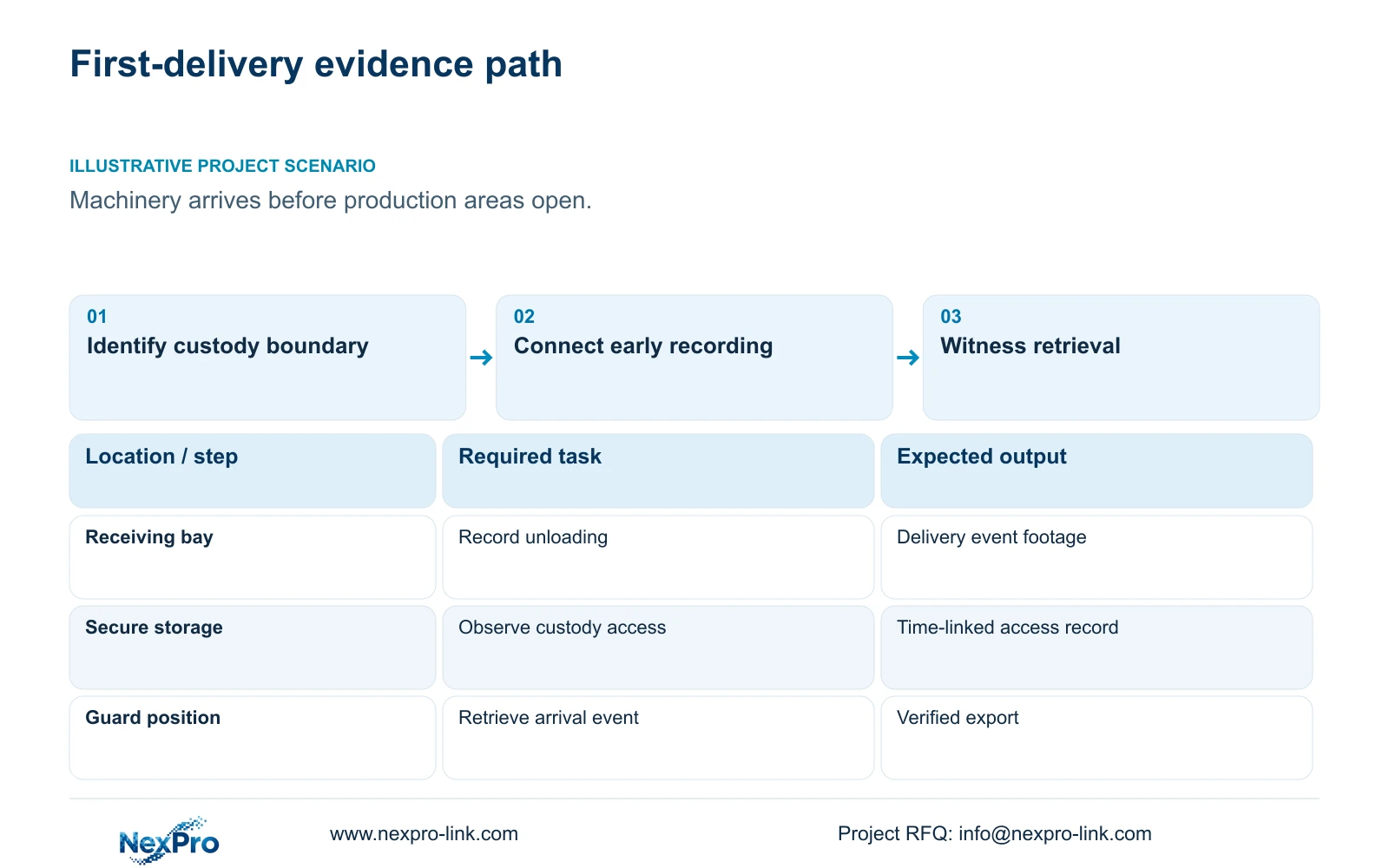
For new factory commissioning, bring the receiving and secure-storage CCTV path into operation before valuable machinery arrives. Define the handover events that need evidence, then commission the associated cameras, links, recorder, storage and power together. Purchasing scattered cameras without their shared dependencies leaves the project unable to retrieve the first delivery event.
Illustrative project scenario: High-value machinery will arrive before all production areas are commissioned. Assume unloading occurs at an approved receiving area and equipment waits in a restricted storage zone before installation. The teaching opening phase contains 16 cameras, expanding to 32 later. These are planning quantities, not a camera-count recommendation for every new factory.
The project manager should obtain delivery dates, unloading routes, temporary storage locations and the named custody owner. Ask where responsibility changes between carrier, receiving team and installation contractor. Assign views to those boundaries rather than distributing early cameras evenly across unfinished production halls. Changes to the delivery route should trigger a coverage review before the next machinery arrival.
Section 02
Commission a subset that can operate without unfinished areas
Draw the opening-phase path from each required view to its local switch, recorder and authorized review position. Identify any shared cabinet, uplink or electrical service that is still part of unfinished construction. An early package is operationally independent only when those dependencies are available or an approved temporary arrangement replaces them. Remote viewing should remain a separate task from local recording.
The engineer should select the intended stream modes and verify recorder support before approving the subset. NexPro-NVR4449-4K is a reference with 49 catalogue channels, 320 Mbps input and four SATA bays supporting up to 18 TB per drive. Its published summary distinguishes 49×5MP from 9×4K; the opening design must therefore preserve the actual channel and resolution combination.
Use a normal retrieval monitor where that supports the guard's task. A display wall should enter the opening package only if simultaneous supervision requires it. The electrician must identify the loads on the protected circuit, while the network contractor verifies the data path. A powered recorder alone cannot retain footage from cameras whose switches lose supply.
Section 03
Give temporary equipment a defined permanent destination
Classify every opening item as permanent in place, reusable after relocation or temporary for removal. A recorder installed in the final equipment room may remain unchanged throughout commissioning. A camera on a temporary support needs a future location, suitable accessories and a planned transfer window. Record these destinations before treating early purchases as part of the final bill of materials.
For suitable ordinary areas, NexPro-BL2812M55-5MP-DIC-AI provides a listed 2880×1620 output, 25fps@5MP and a 2.8–12mm motorized lens. These fields support a view-selection discussion, but do not establish the detail achievable from a temporary mounting point. Demonstrate the receiving task using recorded footage under the lighting and obstructions expected during deliveries.
CASE09 offers a useful reuse discipline: its 20 retained cameras and 12 additions depend on condition and compatibility checks. A greenfield 16-camera opening phase is a different boundary and must not inherit that retained quantity. Apply the method instead: tag assets individually, approve their future role and keep relocation labor and replacement accessories visible.
Section 04
Reserve growth capacity without buying every later camera
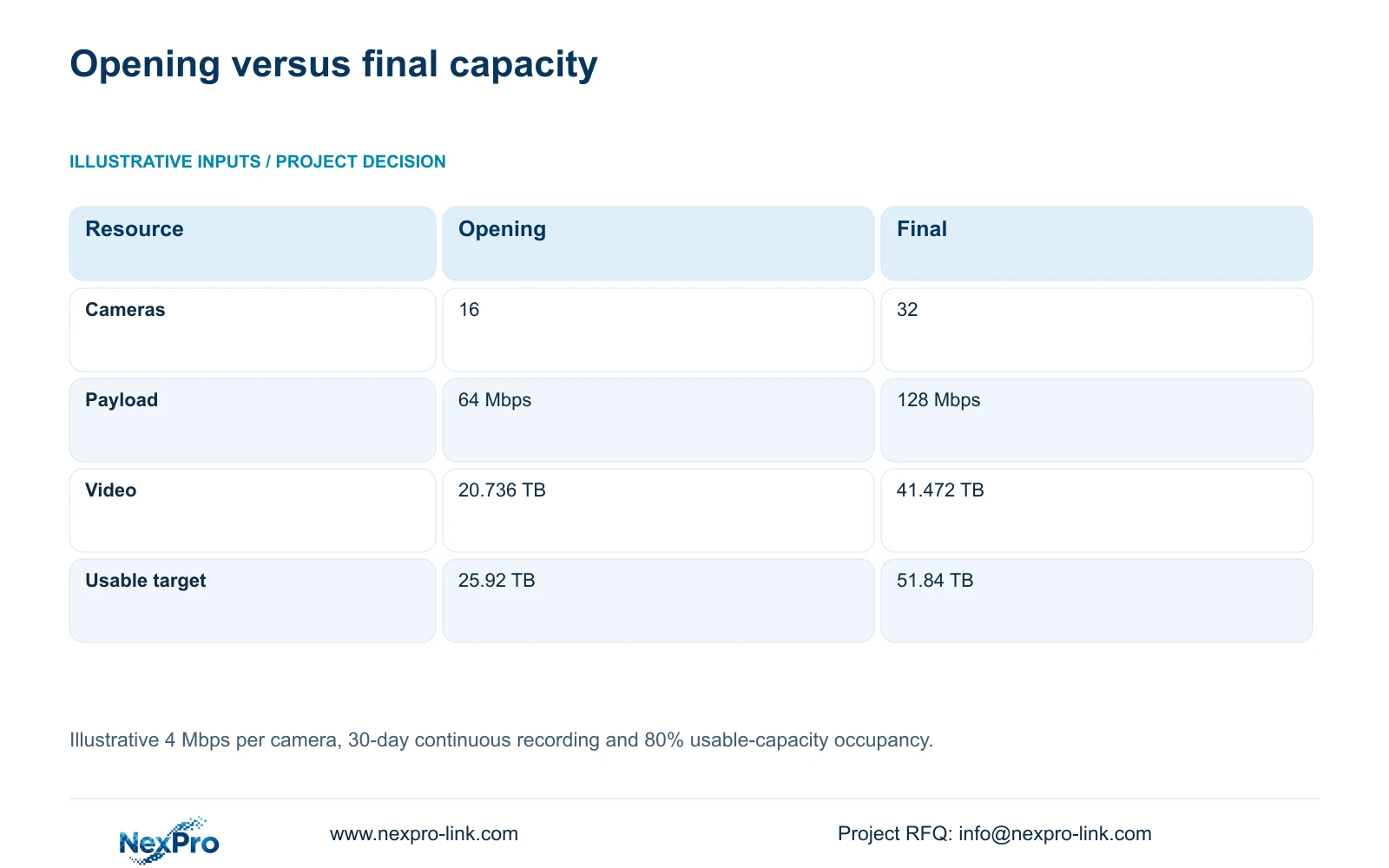
The illustrative calculation assumes 4 Mbps per camera, 24-hour continuous recording and a 30-day retention target in both phases. Recording payload is n × 4 Mbps. Decimal video capacity is 0.0108 × n × 4 × 30 TB, where 0.0108 converts one Mbps recorded for one day into decimal TB. Required usable capacity is video TB / 0.80, retaining 20% free space.
At 16 cameras, the results are 64 Mbps, 20.736 TB of video and 25.92 TB of usable-capacity target. At 32 cameras, they become 128 Mbps, 41.472 TB and 51.84 TB. The decisive difference is doubled recording and retention demand, even though the evidence policy stays unchanged. Reserve the final recorder and cabinet interfaces now if that avoids replacing an opening-phase core.
CASE09's final-capacity example installs four 16 TB drives: 64 TB raw × 0.95 × 0.80 = 48.64 TB of video budget. Its 41.472 TB requirement fits that budget. The 0.95 factor is an illustrative formatting and overhead allowance, and reserve is already included. Disk compatibility, actual bitrate and additional recording data still require confirmation.
| Resource | Opening phase | Final phase |
|---|---|---|
| Cameras | 16 | 32 |
| Recorder payload | 64 Mbps | 128 Mbps |
| 30-day video | 20.736 TB | 41.472 TB |
| Required usable capacity | 25.92 TB | 51.84 TB |
Section 05
Make machinery arrival conditional on a verified security path
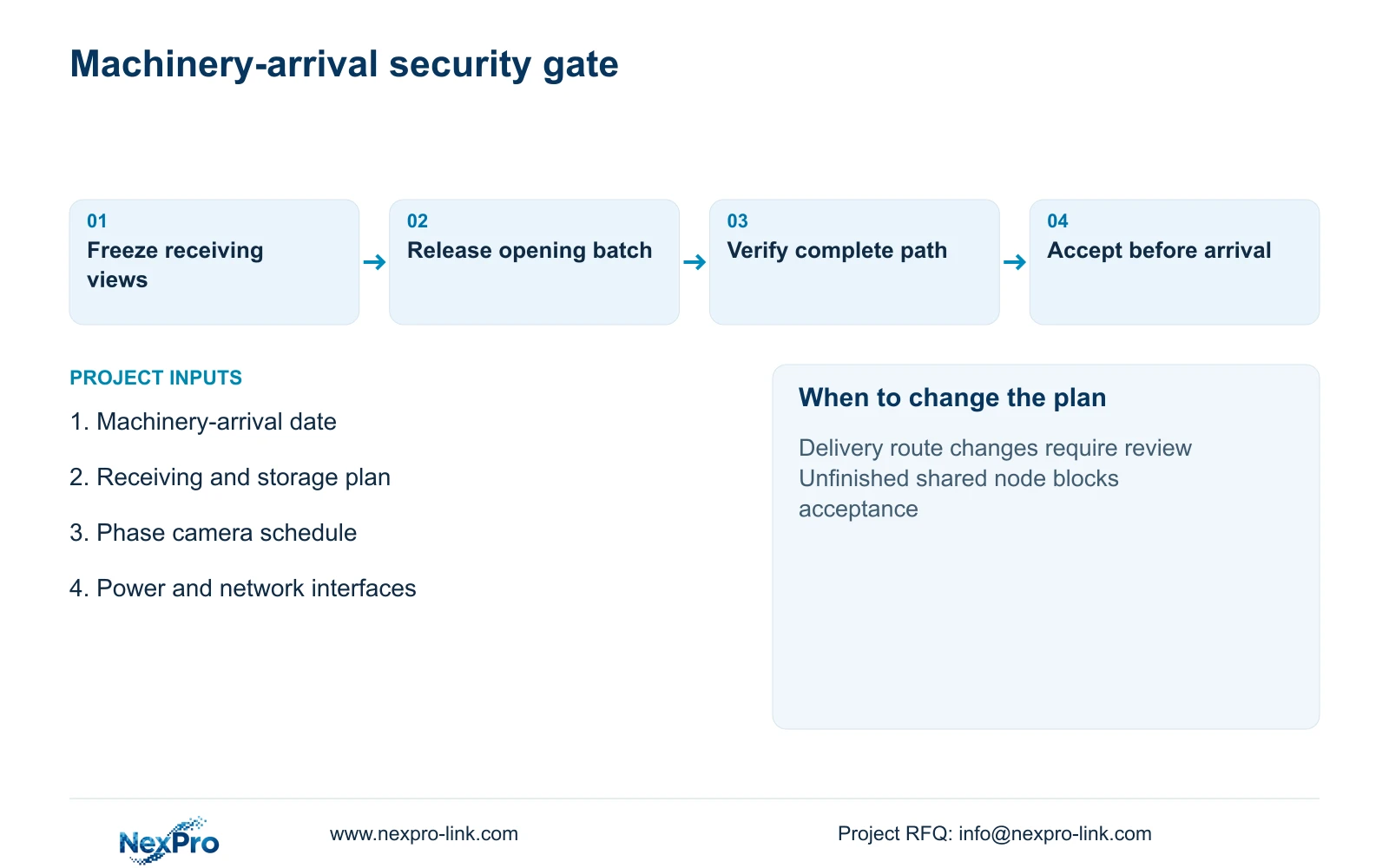
Prefer a complete early package focused on receiving and custody boundaries, with later cameras released as production zones become ready. Before the first delivery, the owner should witness an unloading-route recording, locate it by camera and time, and verify an export using the assigned operator account. Document any blind interval or unavailable area rather than calling the whole factory commissioned.
Power acceptance should use the actual opening-phase load list. CASE09's full 32-camera recording-priority design assumes 682.7407 W and 341.3704 Wh of load-side energy for 30 minutes. Those values cannot be halved to select the 16-camera phase because fixed recorder and network loads remain. SP1KR(S) is a published 1kVA/900W capacity reference; battery configuration and runtime need separate evidence.
Change the recommendation if receiving moves beyond the commissioned network, machinery storage becomes dispersed or the owner needs additional specialist coverage. An approved alternative may require another local node or a different platform. Compare quotations against the same first-delivery task, recording period and power boundary, including installation and temporary works where required.
Section 06
Package the opening phase around its acceptance date
The supply schedule should show the machinery-arrival milestone, equipment delivery, local installation and witnessed acceptance as separate dates. Allow time to resolve failed checks before custody starts. Name the owner representative who can accept the opening subset and the installer responsible for correcting view or link problems. An equipment dispatch date alone is insufficient for this milestone.
NexPro-Link can discuss a phase-specific equipment list, model matching and technical submittals through its factory project and BOQ support scope. Packing by receiving zone can keep the first installation package separate from later production-area stock. Labels should identify the approved camera task and phase without exposing credentials in public or carton-facing records.
Require the handover file to contain accepted views, stream settings, storage configuration, protected-load boundaries and access roles. The later phase should reference that baseline so expansion does not silently alter opening retention or operator permissions. Local supports, electrical installation and final site approval remain assigned project responsibilities.
Section 07
Buyer questions
Can security start before the factory has internet access? It can if the selected package supports the agreed local recording and retrieval workflow. Verify those tasks with internet unavailable; off-site access needs its own working connection and authorization.
Should the opening phase use the final recorder? Often that is practical when its location, stream support and final capacity are settled. A temporary core may be preferable if the final equipment room is unavailable, but its transfer and footage-preservation work must be priced.
Does a successful live view prove the delivery is recorded? No. Check the recorded timeline, playback quality and export after the event. Also verify that the assigned account can perform the required retrieval task.
Section 08
Scope security for the first machinery arrival
Send the machinery-arrival date, receiving and storage plan, opening/final camera schedule and available power/network interfaces to info@nexpro-link.com to discuss a complete early commissioning package.
Engineering references
These sources support the general planning principles. Always use the selected product's current datasheet and applicable project standards for final design.