Oil-mist camera selection starts with the contamination path and a reachable service position. An explicit maintenance model exposes costs that camera unit prices omit.
Section 01
Move the lens out of the contamination path
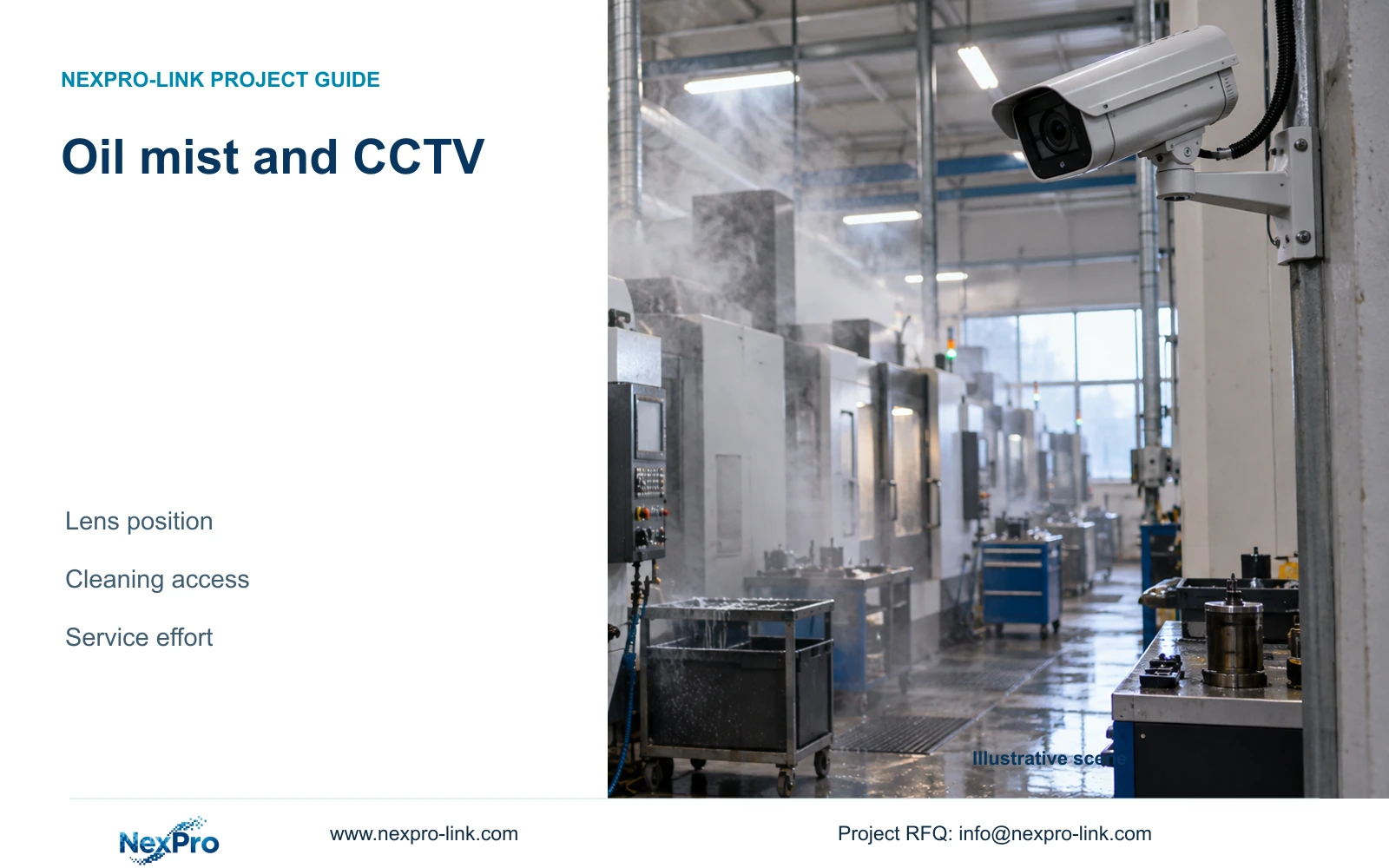
For metalworking CCTV with oil mist, first seek a suitable position outside the direct contamination plume that still captures the required event. Compare cleaning access before purchasing higher resolution. A deposit across the viewing surface can defeat an otherwise adequate image, while a difficult mounting position adds service work every time the camera needs inspection.
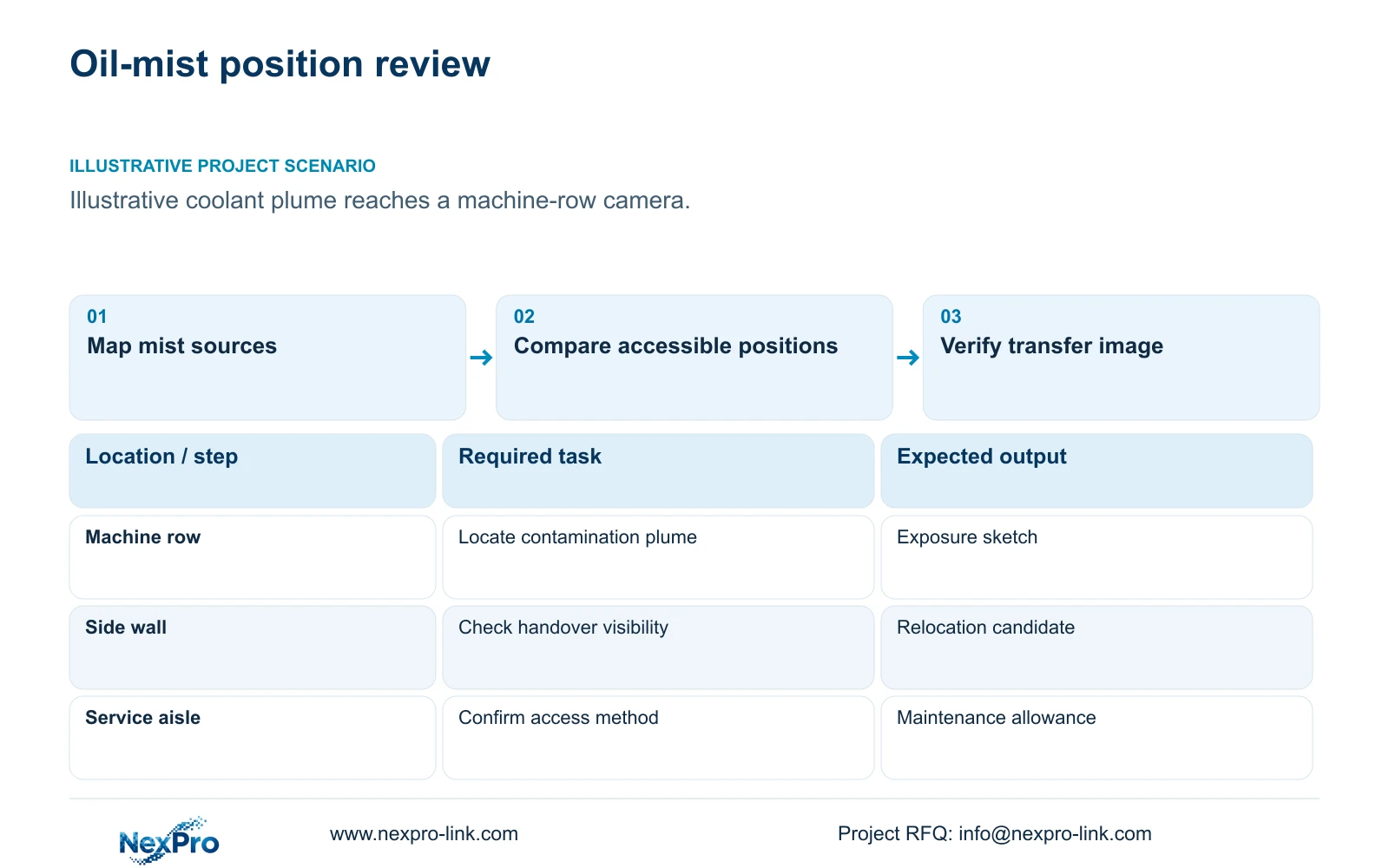
Illustrative project scenario: Coolant mist reaches the proposed camera near a row of machining centres. Assume the owner wants recorded evidence of material handovers along the adjacent aisle. An accessible side wall and a high position above the machine row are provisional alternatives. Their image quality, contamination exposure and service effort have not been measured.
Mark the suspected mist source, proposed camera and target area on the same layout. Ask site personnel how conditions change during normal production, door opening and cleaning. Inspect representative operating conditions rather than relying on an empty workshop. The resulting location record should distinguish a clear sightline from an environmentally suitable place to install equipment.
Section 02
Check how each position will actually be reached
A reachable position needs an approved access method, space for that method and a working window. Have the local team identify whether inspection requires equipment movement, restricted access or production isolation. Do not lower the camera into a traffic path merely to simplify cleaning. Compare the observation task and service arrangement together, including the bracket and cable termination.
The side position is preferable when it preserves the handover and can be serviced without entering an unsuitable machine area. A higher overview remains useful if stacks or personnel block the side angle, but its access requirements should appear in the quotation. Record who provides access equipment, who authorizes the work and how the image is checked after cleaning.
The BL2812M and DM2812M 5MP-family sources list IP66 and an operating temperature field of -20 to +60°C. Those ratings do not establish resistance to the site's coolant chemistry or compatibility with a proposed cleaning agent. Obtain the relevant material and cleaning information before approving the ordinary camera for the selected position.
Section 03
Separate access effort from the cleaning operation
Build the maintenance allowance from defined tasks. Record travel and setup, access preparation, inspection, cleaning where required, image verification and return to service. State which tasks the estimated minutes include. Otherwise, one supplier may quote only a wipe of the viewing surface while another includes the complete controlled visit, producing a misleading price comparison.
Use camera IDs to group work by access method and production window. Several accessible cameras may be inspected in one visit, while a remote high position could require separate preparation. Confirm whether estimates are elapsed time or person-minutes, especially where more than one person is required. Convert the agreed labour basis into hours before applying actual commercial rates.
CASE01 provides a hypothetical 32-camera CNC system, but this topic's service calculation covers 24 cameras. Treat those 24 as a separately declared comparison scope; do not apply its result automatically to every camera in the reference case. The cost team should identify which actual positions belong in each maintenance group and which remain outside the allowance.
Section 04
Calculate the service burden under equal assumptions
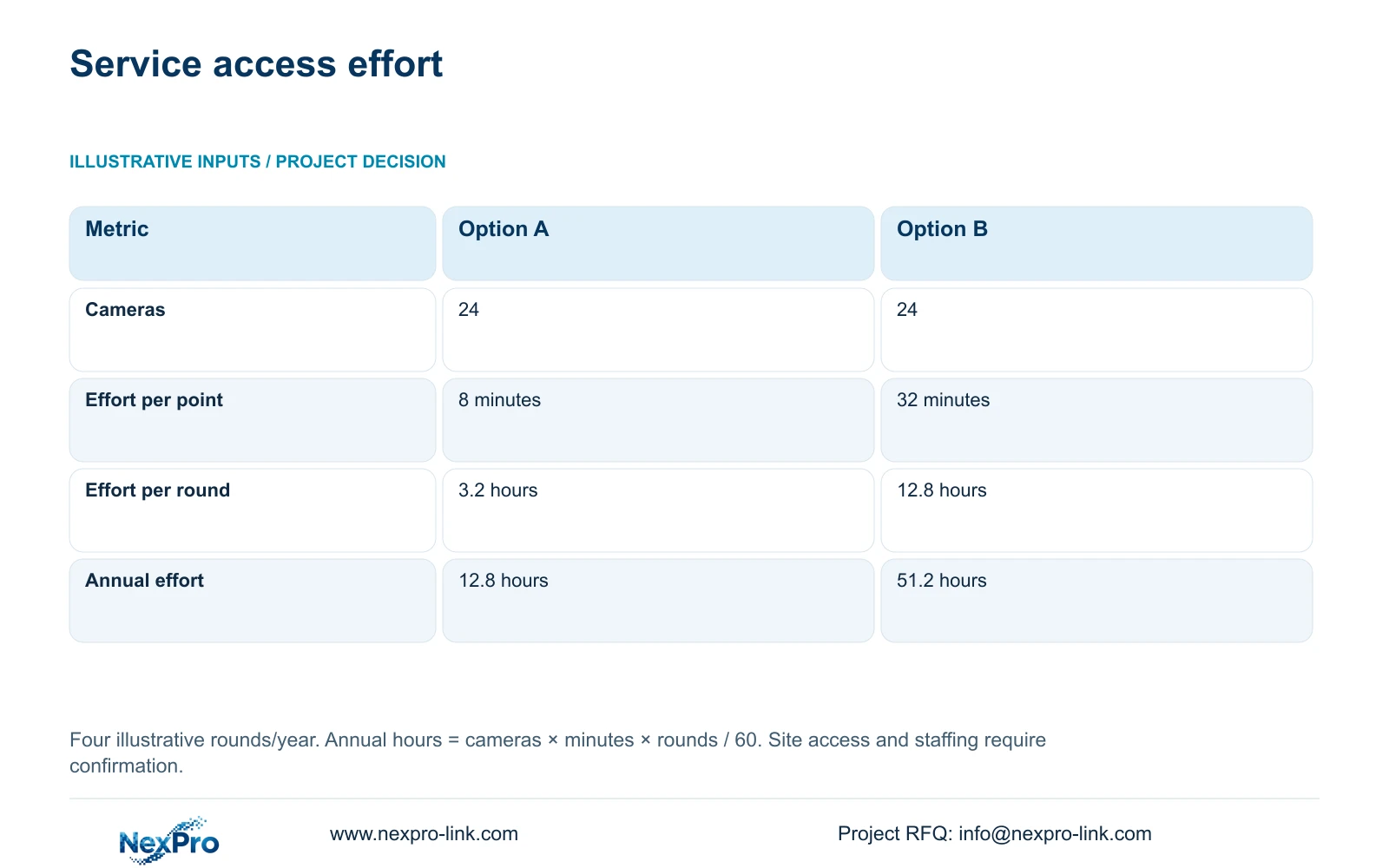
For the illustrative model, both options contain 24 cameras and four service rounds per year. Option A assumes eight minutes of access/inspection effort per point; Option B assumes 32 minutes. Four rounds are an example planning frequency, not a prescribed cleaning interval. The estimates make no claim about labour productivity or prevention of equipment failure.
Use annual_hours = cameras × minutes_per_point × rounds / 60. Option A requires 24 × 8 / 60 = 3.2 hours per round and 3.2 × 4 = 12.8 hours annually. Option B requires 24 × 32 / 60 = 12.8 hours per round and 12.8 × 4 = 51.2 hours annually. The annual difference is 38.4 hours on this stated effort basis.
The decisive input is access effort, with camera count and frequency unchanged. To make a commercial comparison, replace the minutes with the site's approved method and apply the corresponding labour rate. Quote access hire, consumables and any agreed production-window costs separately. Identical camera prices do not make the installed and maintained options economically equivalent.
| Input or result | Option A: accessible | Option B: difficult access |
|---|---|---|
| Cameras | 24 | 24 |
| Effort per point | 8 minutes | 32 minutes |
| Effort per round | 3.2 hours | 12.8 hours |
| Rounds annually | 4 | 4 |
| Annual effort | 12.8 hours | 51.2 hours |
Section 05
Approve relocation only if the event remains visible
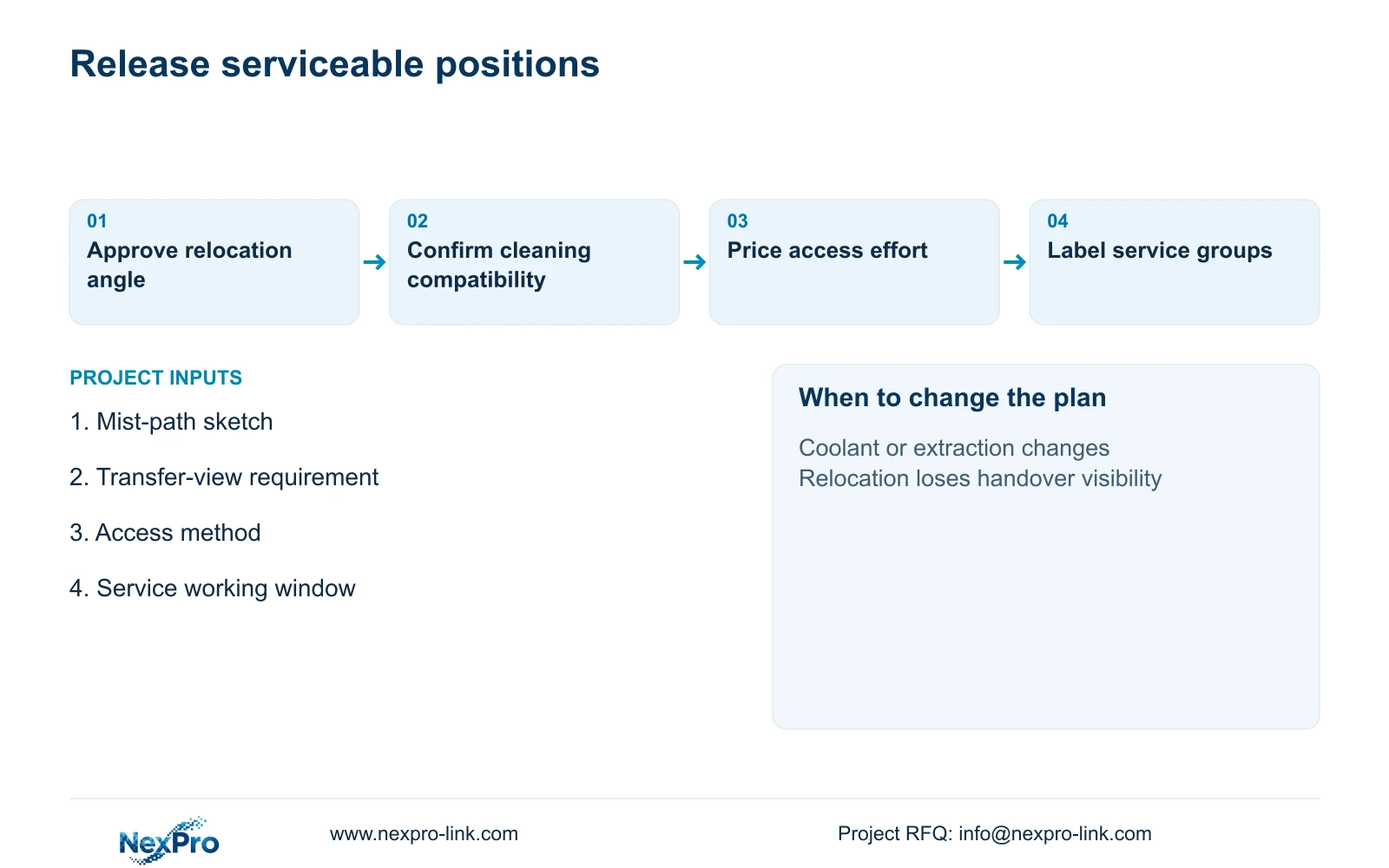
Recommend the accessible position outside the plume when recorded footage still captures the agreed handover. Retain a wider overview if relocation removes essential movement context. If the side view is repeatedly blocked, compare another permissible angle or a dedicated detail view before treating a higher-megapixel replacement as the solution. Approve the view during working conditions.
Set the eventual cleaning interval from observed image condition and the approved service plan. Keep inspection findings against the camera ID so a worsening deposit pattern can trigger a location or interval review. A different coolant, extraction arrangement or machine layout may invalidate the original assumptions even when the camera model has not changed.
For a NexPro-Link, Hikvision, Dahua or other proposal, preserve the same event, mounting constraints and maintenance responsibilities. Separate camera supply, brackets, relocation work and recurring access charges. Specialist environmental protection must remain where required. There are no matched quotations or coolant-exposure tests in this example, so it establishes a comparison method rather than a brand winner.
Section 06
Carry the new position into supply and maintenance records
The camera role schedule should include contamination source, proposed position, observation task, service method, working window and responsibility. Identify supplied cameras, retained devices and optional additional views. Keep cleaning instructions model-specific and subject to material compatibility; an installer should not infer an approved chemical from an ingress rating.
Relocation also changes the supporting system. CASE01 assumes continuous camera links of 41 to 76 m and suitable recording infrastructure at one node. Re-measure changed routes, confirm termination access and inspect whether the switch cabinet itself is exposed to mist. Keep recorders, switches and UPS batteries in suitable service locations. A clean camera position does not qualify an unsuitable cabinet.
NexPro-Link's BOQ support can help align the approved locations with equipment, accessories and technical documents. Project labels and packing can distinguish the accessible standard positions from any separately qualified specialist scope. The local team retains responsibility for access methods, installation and operating approval. Specify the maintenance boundary before ordering so unresolved access work does not become an unpriced handover item.
Section 07
Buyer questions
Does IP66 remove the need to clean the viewing surface? No. The supplied IP66 field does not establish that deposited coolant leaves the image usable. Base inspection and cleaning on actual image condition and model-specific material compatibility.
Can the annual-hour comparison be used as a maintenance quotation? Only after confirming included tasks, staffing, access methods and frequency. Add actual rates and separately priced access equipment; the illustrative hours alone are not a quoted service cost.
Should every camera in a machining shop use the same cleaning interval? Group cameras by exposure and access conditions. A store entrance and a mist-facing machine-row position may need different inspection plans even when they use the same model.
Section 08
Compare oil-mist camera positions
Email the machine-row layout, suspected mist paths, required transfer view and approved service-access method to info@nexpro-link.com to discuss position-specific equipment and maintenance assumptions.
Engineering references
These sources support the general planning principles. Always use the selected product's current datasheet and applicable project standards for final design.