Metal-finishing CCTV procurement needs separate decisions for corrosion, cleaning and area classification. Preserve material-transfer evidence without assigning security equipment process-control duties.
Section 01
Map chemical exposure and classification separately
Metal finishing plant CCTV should use the site's environmental and area-classification information to divide ordinary and specialist equipment. IP66 does not establish chemical resistance or explosion protection. Identify the conditions at each proposed camera, connector and network cabinet before choosing products, while retaining the material-transfer task the owner needs to review.
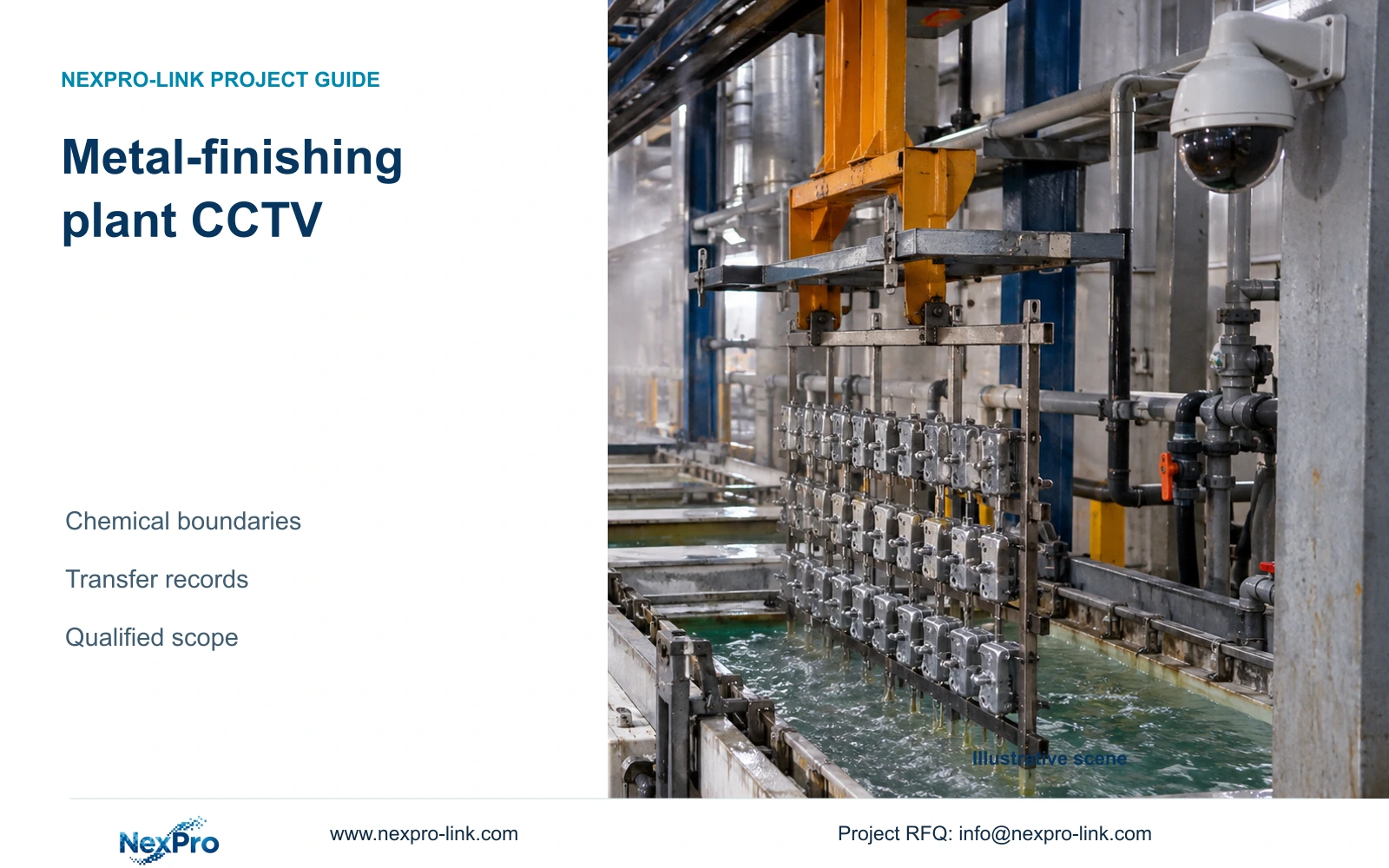
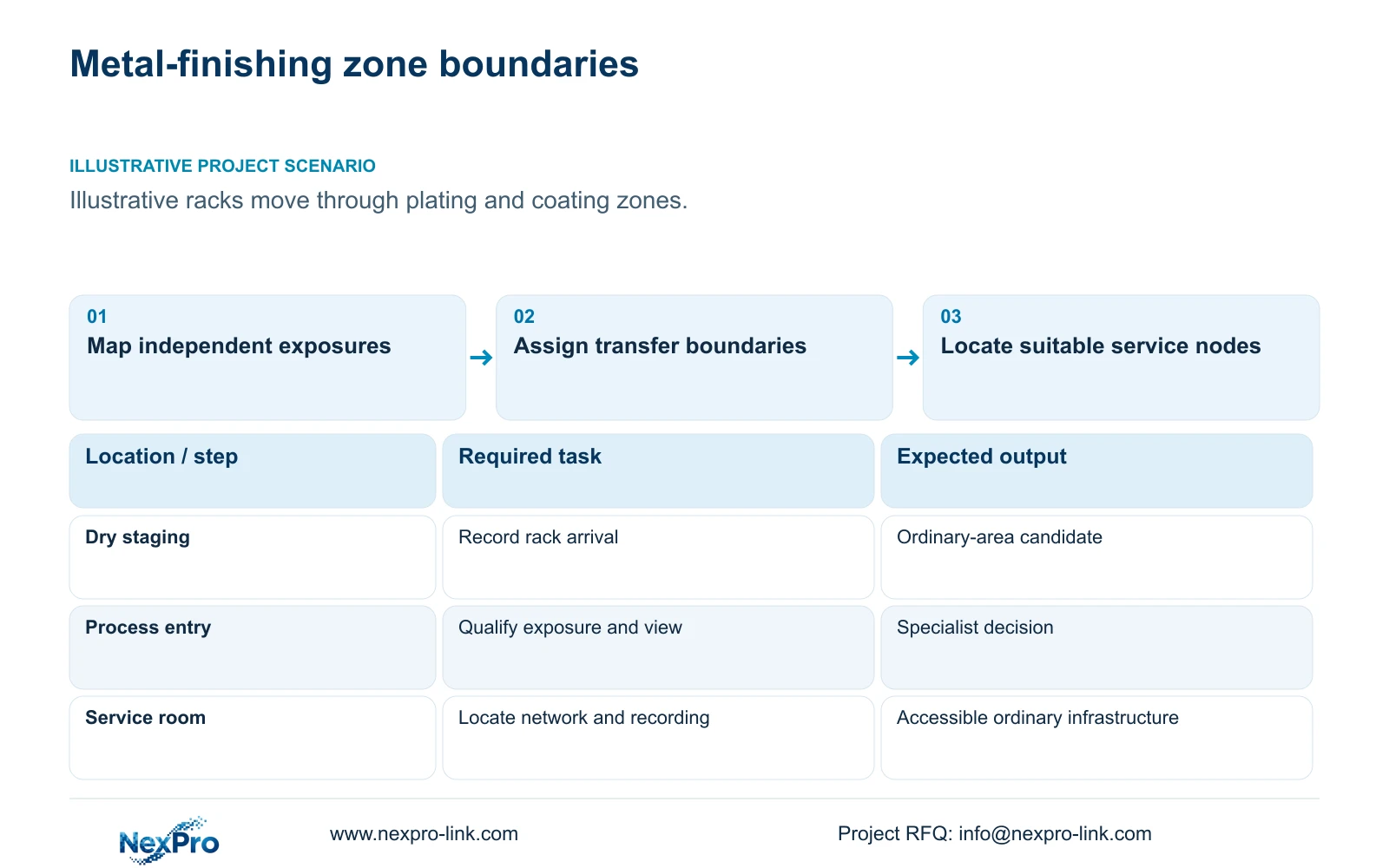
Illustrative project scenario: An electroplating and coating plant needs material movement evidence across dissimilar environmental zones. Assume the owner wants to follow racks from a dry staging area through an approved process-entry boundary to finished-goods dispatch. The environmental status of those proposed positions remains unresolved. These roles are planning assumptions, not a surveyed or completed project.
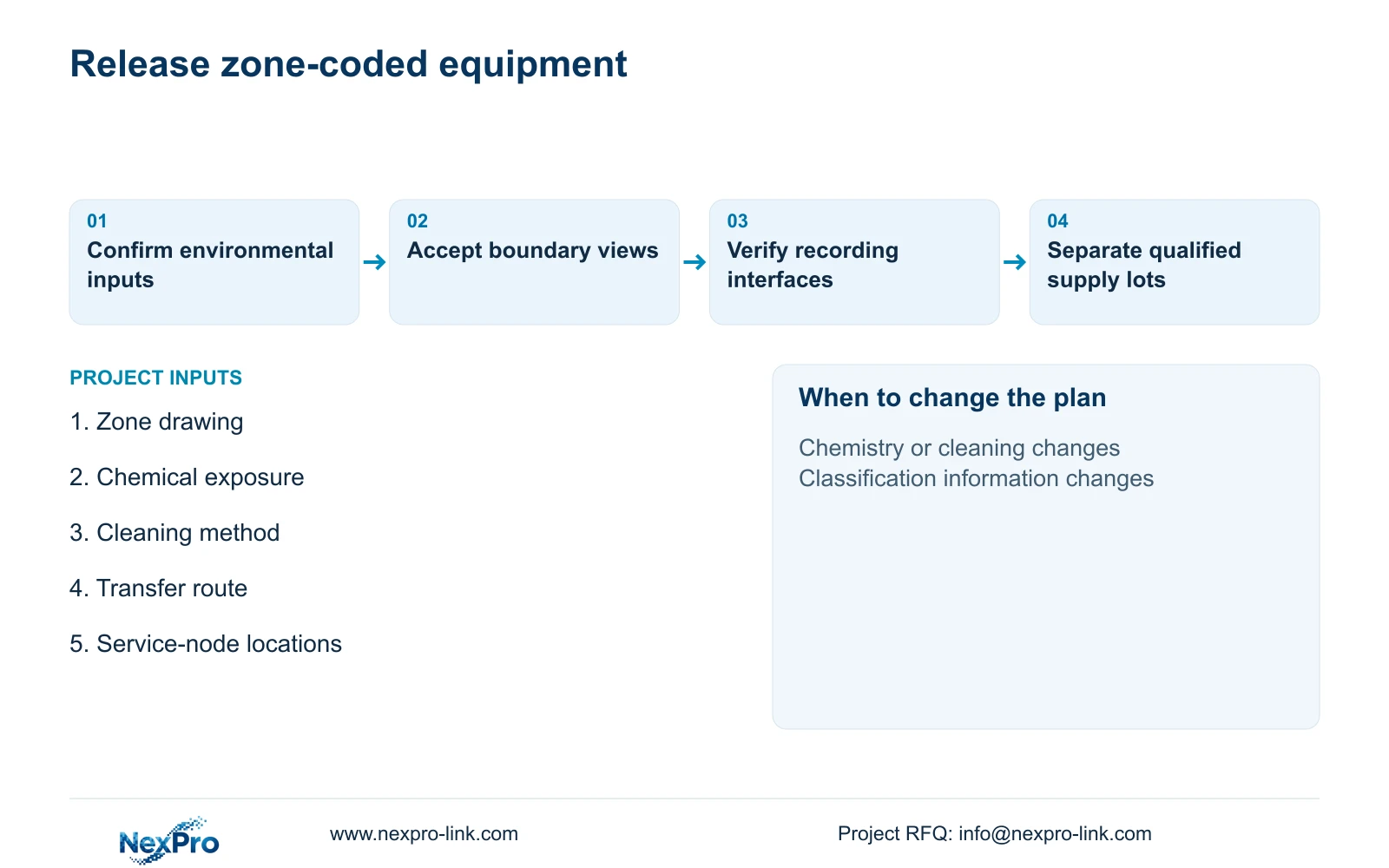
Obtain the responsible team's location drawing, chemical exposure description, cleaning method and classification information where applicable. Keep corrosion and hazardous-area status as independent fields: one does not establish the other. Record normal operation and cleaning conditions. A dry-looking position during a site walk should not be treated as evidence that vapour, deposits or washdown are absent.
Section 02
Define transfer evidence without taking over process control
Write the recording task around visible movement: a rack reaches staging, crosses the agreed entry boundary and later arrives at dispatch. State the container or load detail that must be distinguishable and the external time reference used for retrieval. Keep bath chemistry, coating quality and automatic process decisions in their separately engineered systems.
Consider an ordinary camera observing the entry from a qualified dry-side position before proposing equipment closer to the process. Check whether racks, doors or screens hide the transfer. If the remote view preserves the event, it may simplify service access and product qualification. If an essential action remains hidden, retain the specialist requirement rather than quietly reducing the evidence task.
The camera role schedule should identify which view records each boundary and who accepts it. The owner approves the evidence, the engineer documents geometry and the environmental team qualifies the location. Use representative recordings for image acceptance. A suitable environmental configuration still needs to demonstrate the required view; product protection alone does not guarantee useful footage.
Section 03
Keep network nodes serviceable and outside unsuitable exposure
Locate recorders, switches and batteries in suitable accessible service rooms wherever possible. Assess the room's exposure, ventilation, electrical supply and maintenance route independently of the cameras. A cabinet enclosure description is not enough to qualify the equipment inside for chemical conditions. Include cable-entry and connection arrangements in the selected scope.
Draw the camera-to-switch-to-recorder path and mark environmental crossings. CASE01's ordinary CNC reference uses local PoE access groups feeding a recorder and authorized clients; it has no specialist positions. Use that arrangement only as a data-path example. Its assumed links and camera power inputs do not qualify plating-area cabling or connections.
Verify each remote node's actual power dependency and approved maintenance window. An office UPS protects only equipment reached by its electrical arrangement. When the full switch AC input includes PoE demand, do not count that camera power again. Confirm exact device/client support if specialist cameras join an ordinary recording system; video connection does not establish every event, audio or export workflow.
Section 04
Use complete qualification rather than a single rating
The ordinary BL2812M55 and source Dome DM2812M55 references list IP66 and -20 to +60°C. Their 2880×1620 listed output can inform image planning in suitable locations. Neither source establishes chemical resistance, compatibility with the plant's cleaning method or explosion protection. Keep those unresolved inputs visible rather than replacing them with a general 'industrial camera' description.
Apply the supplied rule conjunctively: location conditions AND complete product scope AND approved installation requirements must fit. In this plant, assess the dry-side entry camera against its actual environment and the process-facing candidate against the separate chemical and classification conditions. A temperature match does not resolve corrosion; a protective rating does not resolve image occlusion.
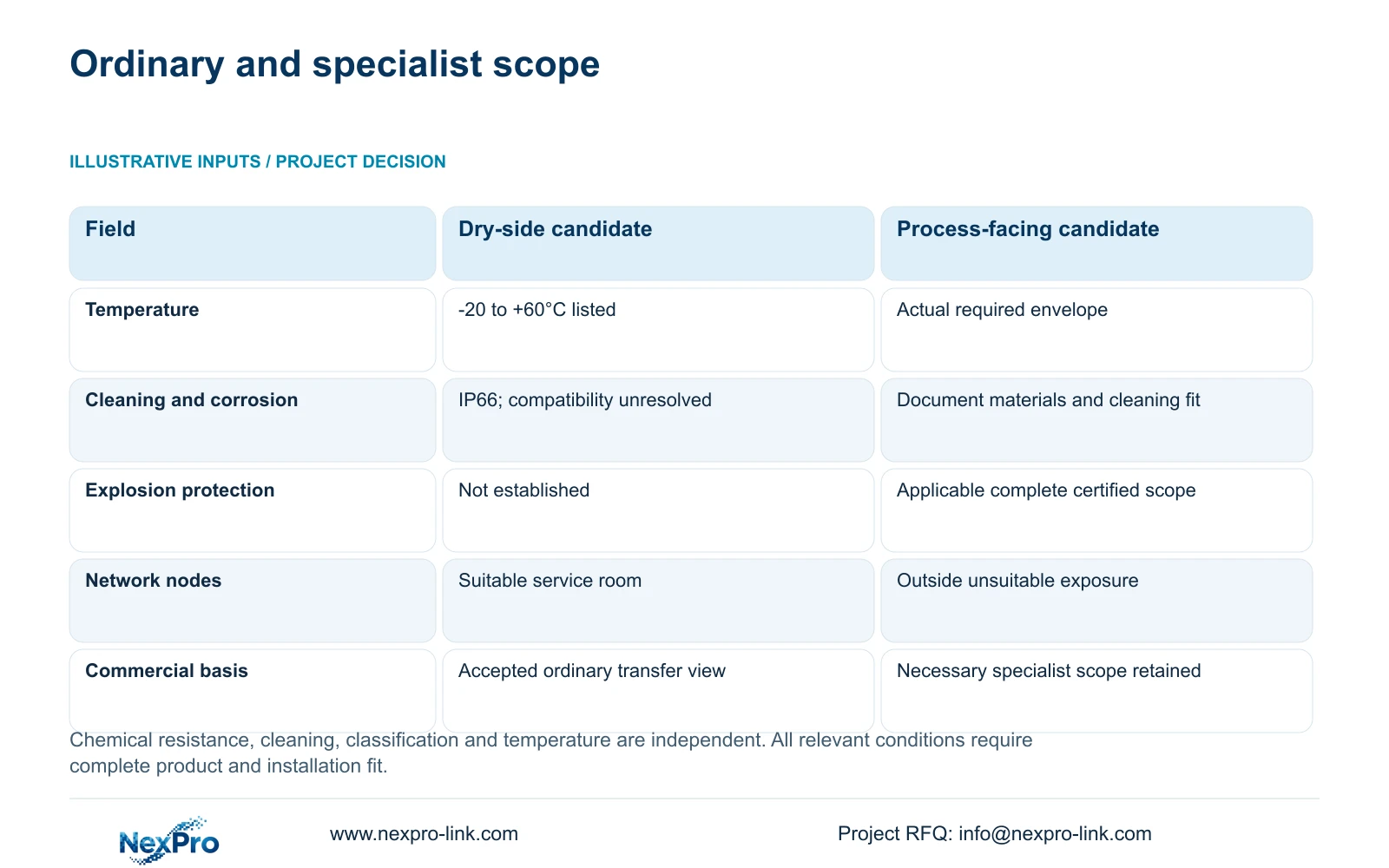
The table defines procurement choices without scores or invented prices. Where specialist protection is necessary, review the complete product, accessories and installation scope. Responsible designers must verify current local requirements for the actual site. Do not treat this boundary method as an instruction to assemble a certified system from individually described components.
| Decision field | Ordinary dry-side candidate | Specialist process-facing candidate |
|---|---|---|
| Temperature | -20 to +60°C listed; site fit required | Specify actual operating envelope |
| Ingress and cleaning | IP66 listed; chemistry compatibility unresolved | Match cleaning method and materials |
| Explosion protection | Not established by ordinary source | Review applicable complete certified scope |
| Recording location | Suitable accessible service room | Keep ordinary nodes outside unsuitable exposure |
| Price comparison | Accepted dry-side transfer task | Required protection and services retained |
Section 05
Retain specialist scope where relocation cannot solve the task
Recommend qualified ordinary views for dry staging, suitable access routes and dispatch where they preserve the agreed evidence. Use specialist scope for positions whose actual conditions or required observation cannot be met by those remote views. Do not make all plant cameras specialist by default, and do not substitute ordinary models at process-facing points merely to simplify purchasing.
Compare offers location by location. Preserve environmental qualification, accepted view, recording workflow and service arrangement when evaluating a NexPro-Link alternative to another supplier. A lower ordinary-camera line price cannot establish equivalence to a package containing necessary protection and local engineering. Request current matching quotations after the technical boundary is agreed.
Reopen the decision when chemistry, cleaning, extraction arrangements or classification information changes. The affected scope may include brackets, connectors, cable construction and node locations as well as the camera. Keep an approved ordinary-area list distinct from unresolved specialist positions so purchasing can progress without treating a provisional substitution as final acceptance.
Section 06
Release a zone-coded supply and responsibility schedule
For every position, record zone identifier, transfer task, environmental inputs, qualification evidence, maintenance method and recorder assignment. Identify supplied, retained, optional and separately procured specialist items. Require the offered model and configuration to match the submittal. Give the environmental approval and installation decision to the appointed parties rather than leaving responsibility implied in the equipment list.
Keep the network and export acceptance test in the handover package. Use exact device and firmware identities where interoperability matters; ONVIF profiles apply to defined device/client functions, not universal full-feature compatibility. Confirm that operators can locate and export the accepted transfer sequence without requiring changes to the plant's process-control network.
NexPro-Link can discuss ordinary-area camera matching, BOQ deviations, related equipment and technical documentation through its published support scope. Project labels and packing can carry zone-coded location IDs into delivery. Keep specialist evidence, local works and final approval distinct, so the coordinated shipment preserves the environmental boundaries instead of obscuring them.
Section 07
Buyer questions
Is corrosion resistance the same requirement as explosion protection? No. Keep them as independent qualification fields tied to the actual position. Documentation addressing one condition does not establish suitability for the other.
Can specialist and ordinary cameras share a recorder? Potentially, subject to exact model, firmware, stream and workflow verification. Confirm required recording and export functions; a generic connectivity claim is insufficient.
Can the dry-side package be ordered before specialist positions are settled? Yes, where its locations, tasks and interfaces are approved independently. Identify unresolved positions and their dependencies explicitly so early purchasing does not imply approval of the complete plant scope.
Section 08
Prepare a zone-qualified CCTV scope
Send the environmental/classification drawing, chemical and cleaning exposure information, material-transfer route and proposed service-node locations to info@nexpro-link.com for an ordinary-area equipment discussion with specialist requirements kept separate.
Engineering references
These sources support the general planning principles. Always use the selected product's current datasheet and applicable project standards for final design.