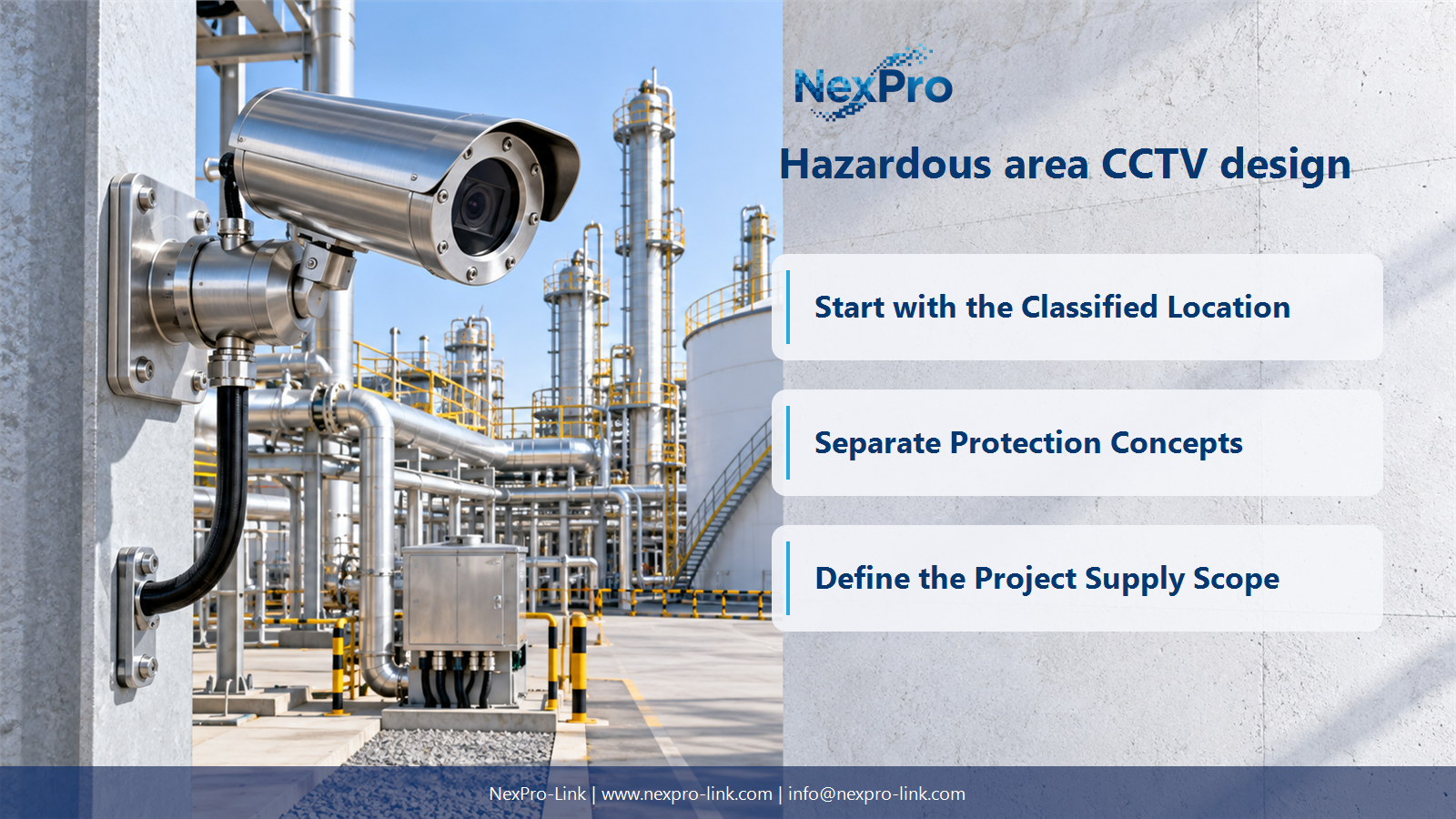
Plan hazardous area CCTV design with practical guidance on start with the classified location and keep ordinary infrastructure outside where appropriate. NexPro-Link project guide.
Section 01
Start with the Classified Location
Obtain the location classification and relevant gas or dust, temperature and installation requirements from the responsible specialist. These define the equipment application. A general industrial camera description or IP rating cannot substitute for the site's hazardous-area design information.
Turn the answer into a working record using Area, Classification, Hazard, Temperature, Specialist input.
| Decision area | Buyer question | Required output |
|---|---|---|
| Start with the Classified Location | What information is needed before hazardous-area CCTV selection? | Obtain the location classification and relevant gas or dust, temperature and installation requirements from the responsible specialist. |
| Treat Certification Scope Precisely | Does a certified enclosure certify any camera installed inside it? | No. |
| Separate Protection Concepts | Must every hazardous-area camera use a safety barrier? | No universal component recipe applies. |
Section 02
Treat Certification Scope Precisely
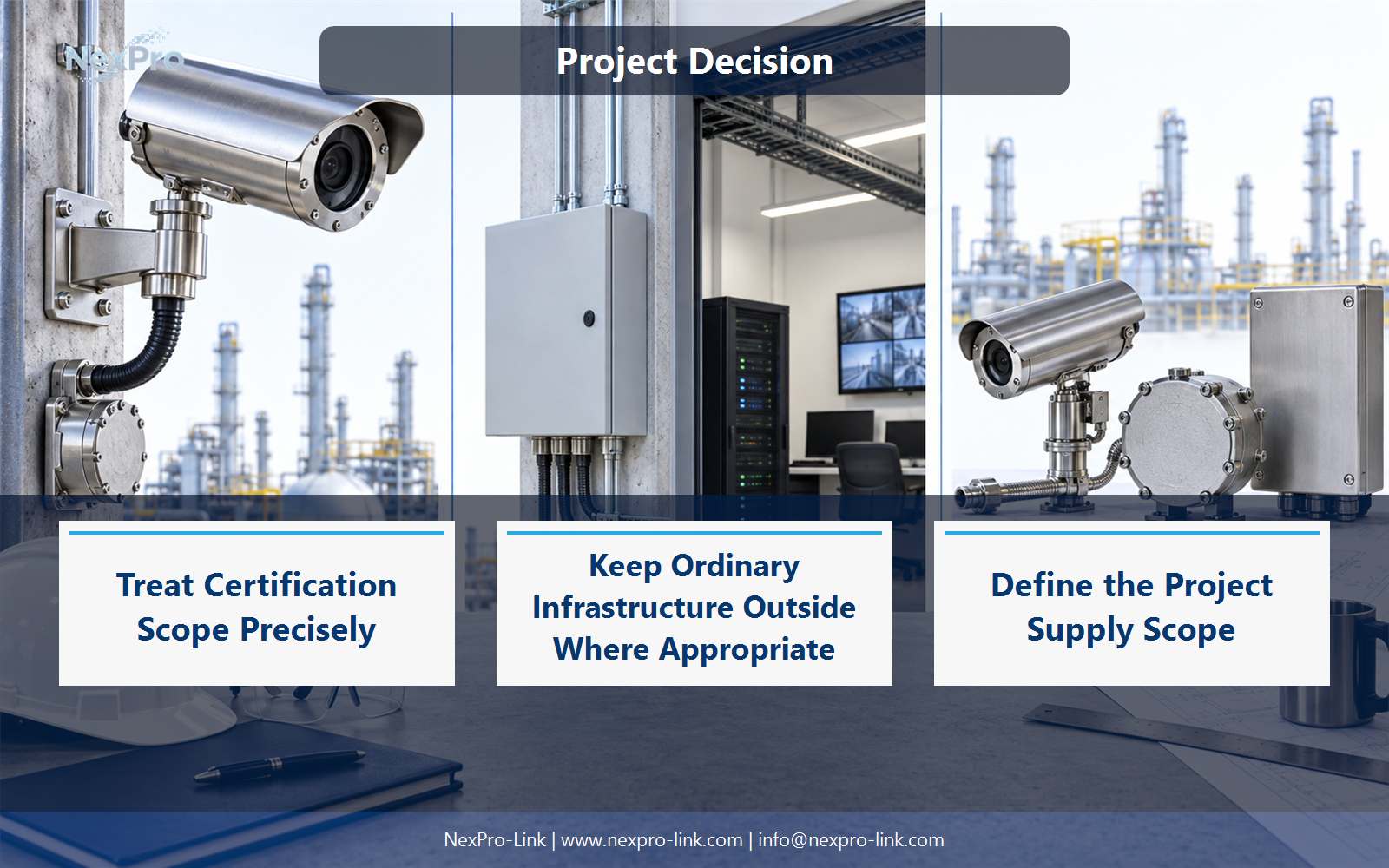
No. Suitability depends on the complete equipment arrangement and the certificate's scope and conditions. Components may require incorporation into an assessed assembly. Do not present a third-party enclosure as automatically transferring certification to any standard camera, lens, power supply or cable entry.
Use Equipment assembly, Certificate scope, Conditions, Integration to compare options on the same basis. Keep product capability, project assumption and operating responsibility in separate columns.
Section 03
Separate Protection Concepts
No universal component recipe applies. The required protection concept and complete circuit arrangement determine the appropriate components. Intrinsic safety and flameproof protection are not interchangeable labels. The specialist design should identify the required protection arrangement before selecting barriers, switches or cable interfaces.
The project output should make Protection concept, Complete arrangement, Specialist design, Boundary traceable from input to acceptance.
- Confirm the answer to: Must every hazardous-area camera use a safety barrier?
- Record the project fields: Protection concept / Complete arrangement / Specialist design / Boundary.
- Keep product capability, project assumptions and site responsibility in separate records.
Section 04
Keep Ordinary Infrastructure Outside Where Appropriate
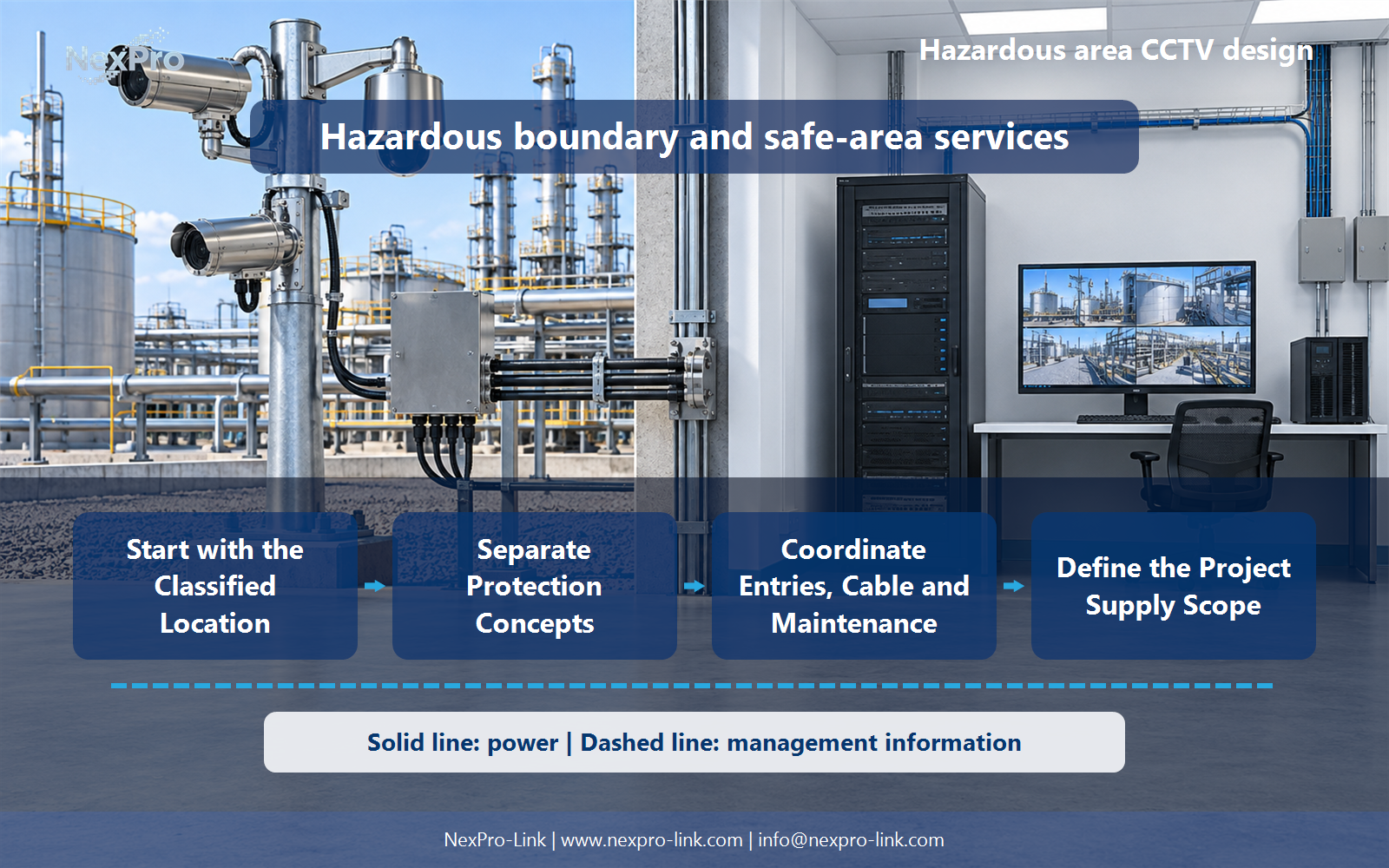
Where practical, place ordinary recording, storage, displays and power equipment in a suitable non-hazardous location and design the field interface accordingly. That does not remove requirements at the hazardous boundary. Equipment within the classified area still needs the appropriate complete design.
Record Hazardous field, Boundary, Safe-area network, Recorder, UPS before selecting a product family. That makes later substitutions possible without silently changing the operational requirement.
Section 05
Coordinate Entries, Cable and Maintenance
Entries, seals, glands and cable arrangements form part of the installation's protection concept and conditions. They cannot be treated as generic accessories selected only by thread size. Maintenance and replacement must preserve the approved arrangement through the responsible specialist process.
Review Entry, Cable, Protection arrangement, Replacement condition with the party that will operate or maintain the system.
Section 06
Define the Project Supply Scope
Separate ordinary CCTV infrastructure from the specialist equipment serving the classified area. A request to NexPro-Link should identify the required equipment schedule, environmental classification and interfaces. Any specialist third-party supply must follow the agreed arrangement and complete equipment specification; a standard camera rating does not establish hazardous-area suitability.
Use Scope, Equipment role, Specialist supplier, Interface, Owner as the handoff between design and procurement.
Engineering references
These sources support the general planning principles. Always use the selected product's current datasheet and applicable project standards for final design.