Put temporary added views on a separate variation line with their active period, dependencies and recovery destination. Compare the peak concurrent load, not only the final permanent count.
Section 01
Identify which observation tasks actually change
Put temporary added views on a separate variation line with their active period, dependencies and recovery destination. Compare the peak concurrent load, not only the final permanent count. Identify reusable material versus paid installation and removal work. An eventual camera removal does not eliminate its interim storage or power requirement.
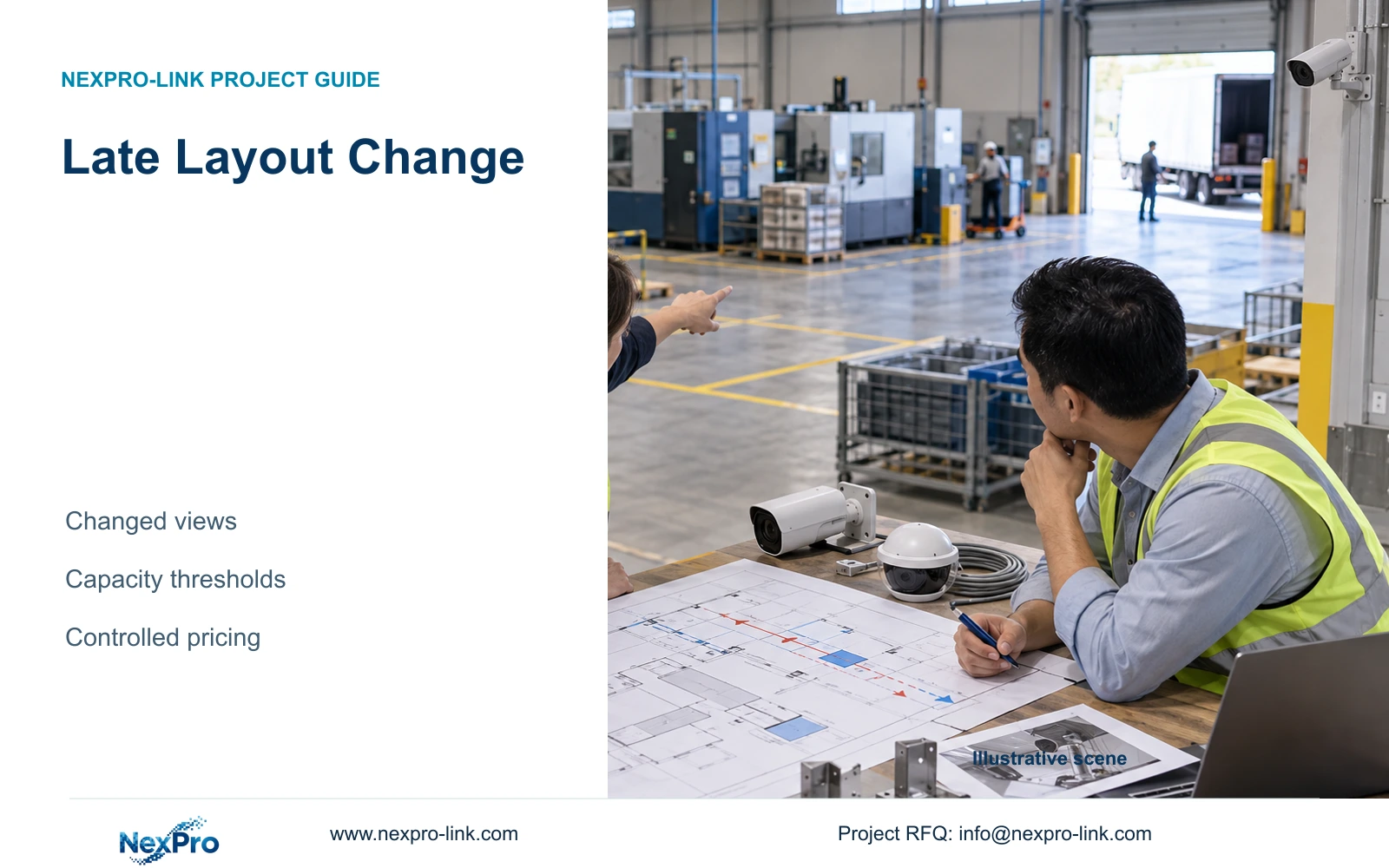
Handle a late production layout change by issuing a change-by-change CCTV matrix. Record the affected observation task, camera position, mounting arrangement, cable route and shared infrastructure. Keep unaffected BOQ lines at their agreed scope, and require a stated technical trigger for each replacement or addition. This gives the project manager a basis for approving variations without reopening the entire equipment package.
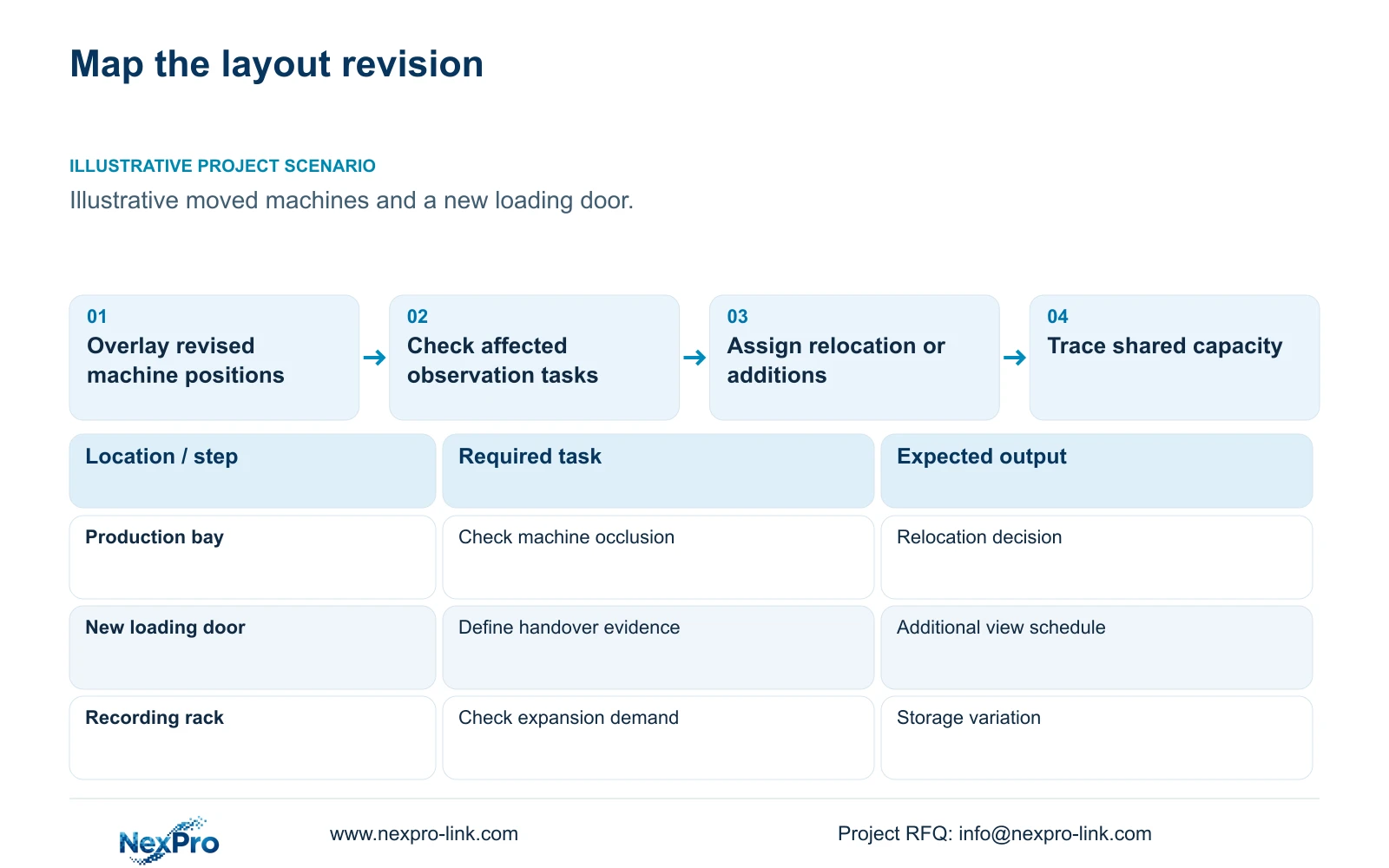
Illustrative project scenario: Machines move and a new loading door is introduced after the first BOQ is priced. Use CASE09 as the planning baseline: 20 retained cameras and 12 new cameras, including four receiving, four dispatch and four common-route views. A further six cameras are considered after the layout revision. These quantities describe a hypothetical design, with retained-device compatibility still unconfirmed.
Overlay the revised layout on the priced drawing using existing camera identifiers. For each changed position, ask whether the original task remains achievable through refocusing, relocation or a different mounting point. Mark temporary construction obstructions separately from permanent machine occlusion. The owner should approve the required evidence at the new loading door before the engineer converts that task into equipment quantities.
Section 03
Separate retained assets from installation variations
Build the commercial variation around identifiable changes. A retained camera may still need removal, a replacement bracket, a new cable and recommissioning. Conversely, an additional camera does not automatically require another recorder. Give each variation line an original reference, changed quantity, reason, supply status and responsible party so the cost team can identify additions, omissions and reused equipment.
CASE09 illustrates the importance of distinguishing the full inventory from the purchase scope. Its complete 32-link baseline totals 1,872m and has a feasible seven-reel cutting plan using 305m reels. If the 20 old links pass the appropriate tests and are approved for retention, the original new purchase covers only 12 links, totaling 742m, with a feasible three-reel plan. Neither quantity includes routes for the further six cameras.
Assign route measurement and installation access to the local contractor, view approval to the owner, and equipment matching to the supplier and engineer. Keep the old zone operating while suitable preparation proceeds elsewhere. The migration schedule should name the point at which an old view can be disconnected and the conditions for restoring it if the revised position fails acceptance.
Section 04
Price the capacity threshold crossed by six additions
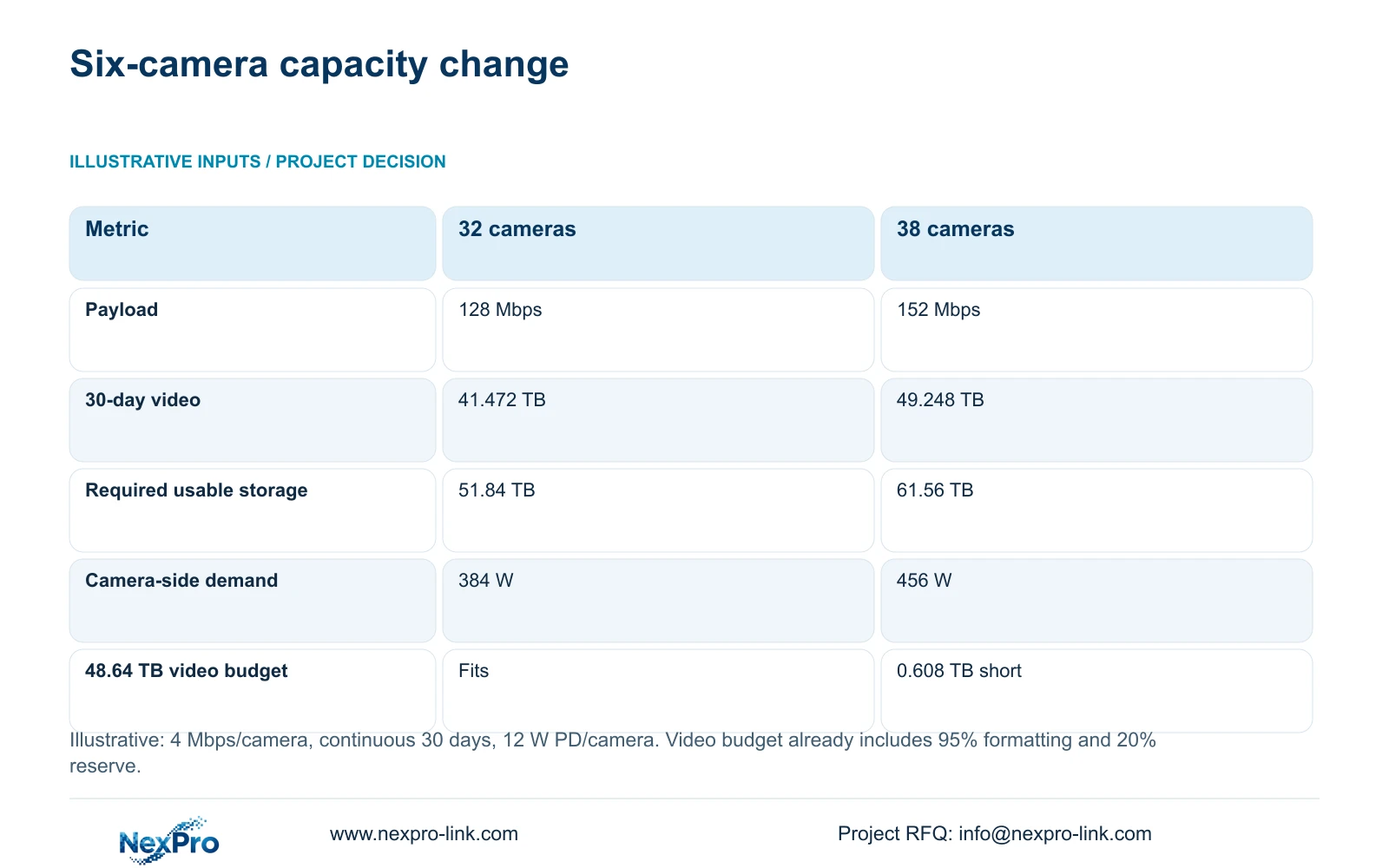
The illustrative comparison assumes 4 Mbps average bitrate per camera, continuous recording for 30 days and 12 W device-side demand per camera. Recording payload is n×4 Mbps. Decimal video storage is 0.0108×n×4×30 TB, and required usable capacity is video_TB/0.80. Camera-side demand is n×12 W. The power input is a planning assumption, not a published camera maximum.
Six additions increase payload by 24 Mbps, video storage by 7.776 TB and assumed camera-side demand by 72 W. The decisive storage check uses CASE09's four 16 TB disks: 64×0.95×0.80 = 48.64 TB video budget. The 32-camera requirement of 41.472 TB fits, while 49.248 TB for 38 cameras exceeds that budget by 0.608 TB. The formatting allowance and reserve are already included.
A capacity-only alternative of four 18 TB disks would provide 72×0.95×0.80 = 54.72 TB under the same assumptions, subject to exact drive compatibility. Compare that replacement scope with an approved alternative recording architecture. Separately check where the six cameras connect: CASE09's four eight-device groups do not establish six spare powered ports, and camera-side watts cannot simply be added to its UPS AC load.
| Metric | Option A: 32 cameras | Option B: 38 cameras |
|---|---|---|
| Recording payload | 128 Mbps | 152 Mbps |
| 30-day video | 41.472 TB | 49.248 TB |
| Required usable capacity at 80% occupancy | 51.84 TB | 61.56 TB |
| Assumed camera-side demand | 384 W | 456 W |
| Fit within 48.64 TB video budget | Fits | Exceeds by 0.608 TB |
Section 05
Approve a targeted revision with explicit change conditions
Prefer a targeted revision when the existing equipment can still meet the approved task. Keep satisfactory views and links, relocate only affected positions, and add cameras where the revised layout creates a genuine evidence gap. For the 38-camera example, storage needs a specific resolution even though the assumed input payload remains below the recorder's listed 320 Mbps input figure.
Keep display changes independent of recording changes. CASE09's recording-priority option assumes 682.7407 W complete AC demand; its alternative adds four LCD panels and decoder equipment, reaching 1,262.7407 W. Those are separate planning configurations, not revised totals for 38 cameras. A new loading door does not justify a display wall unless the operator needs additional simultaneous views.
Reconsider the targeted approach if the revised zone requires specialist equipment, a mandatory platform feature or an unsupported retained-device workflow. Compare supplier proposals against the same accepted views, retention and migration responsibilities. Ask for the actual price of disk replacement, additional switching, cable work and preparation rather than inferring savings from camera unit prices or declaring a brand-wide winner.
Section 06
Release a revision package the supplier can quote
Issue the approved layout revision together with the original BOQ and a variation schedule. Separate unchanged lines, relocated equipment, new purchases and conditional replacements. Include the old and new location identifiers, mounting details, cable-route status and the required commissioning sequence. This prevents a supplier from interpreting every revised drawing symbol as a new camera order.
NexPro-Link's BOQ and tender-support scope can help match models, prepare technical submittals and record deviations. Factory project supply can coordinate the relevant CCTV and associated equipment, with location-based packing for the changed zones. Ask for preparation and packing to follow the approved revision identifier so an earlier equipment schedule does not enter the shipment unnoticed.
Keep local installation, electrical work and final acceptance assigned to the appointed project parties. Request separate commercial treatment for retained hardware handling, new equipment, storage changes and migration support. Before release, reconcile the priced revision with the engineer's capacity checks and the owner's observation tasks; otherwise a commercially complete quotation can still leave the new door inadequately covered.
Section 07
Buyer questions
Can we shorten retention instead of replacing disks? Only if the owner approves a changed retention requirement. Recalculate storage using the revised days and accepted bitrate, and record the operational consequence. A supplier should not silently reduce the agreed 30-day target to make the existing disks fit.
Should retained cable be valued as free infrastructure? Separate the avoided cable purchase from inspection, testing, relocation and recommissioning work. A retained link may reduce material demand while still requiring paid site work. Its condition and route must be accepted before the variation relies on reuse.
What if the six additional views are only temporary? Define their removal date, recording period and reusable equipment destination. Temporary views still need suitable ports, storage and power while active. Quote temporary installation and later recovery separately from permanent additions.
Section 08
Request a traceable CCTV variation
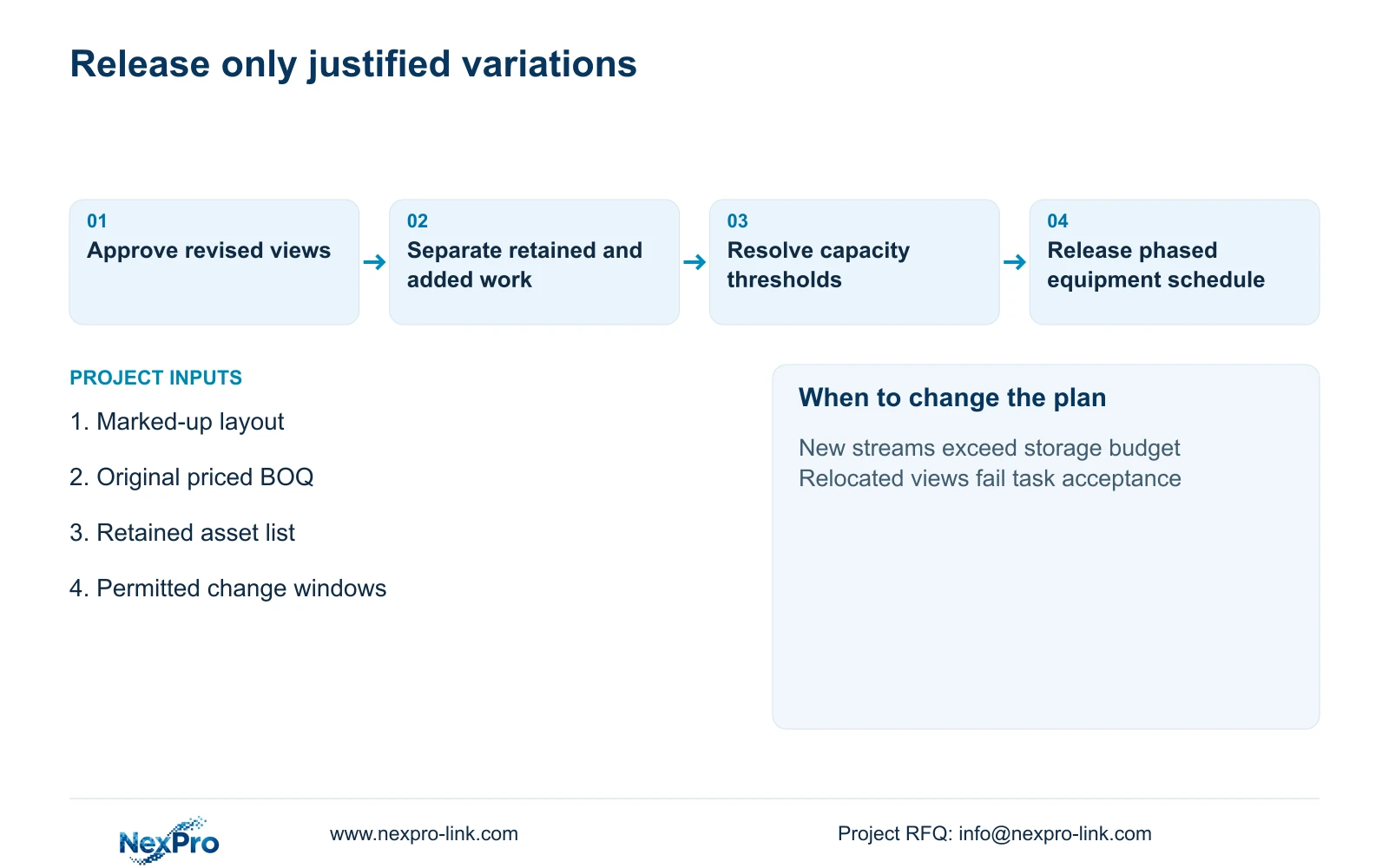
Send the marked-up layout, original priced BOQ, retained asset list and permitted change windows to info@nexpro-link.com. NexPro-Link can discuss the affected equipment and preparation scope without treating unchanged lines as a new package.
Engineering references
These sources support the general planning principles. Always use the selected product's current datasheet and applicable project standards for final design.