
Six additional cameras can leave a selected recorder within its channel limit while pushing storage beyond the agreed retention budget. Coordinate the whole change before releasing equipment.
Section 01
Freeze the operating requirement and its equipment baseline
A factory CCTV design freeze should tie the approved camera schedule to recording, network ports, protected power, cable routes and installation scope. When cameras are added, release those dependencies together. The project manager should hold the affected purchasing lines until the engineer identifies what can remain and what must change; unrelated approved equipment can continue through procurement.
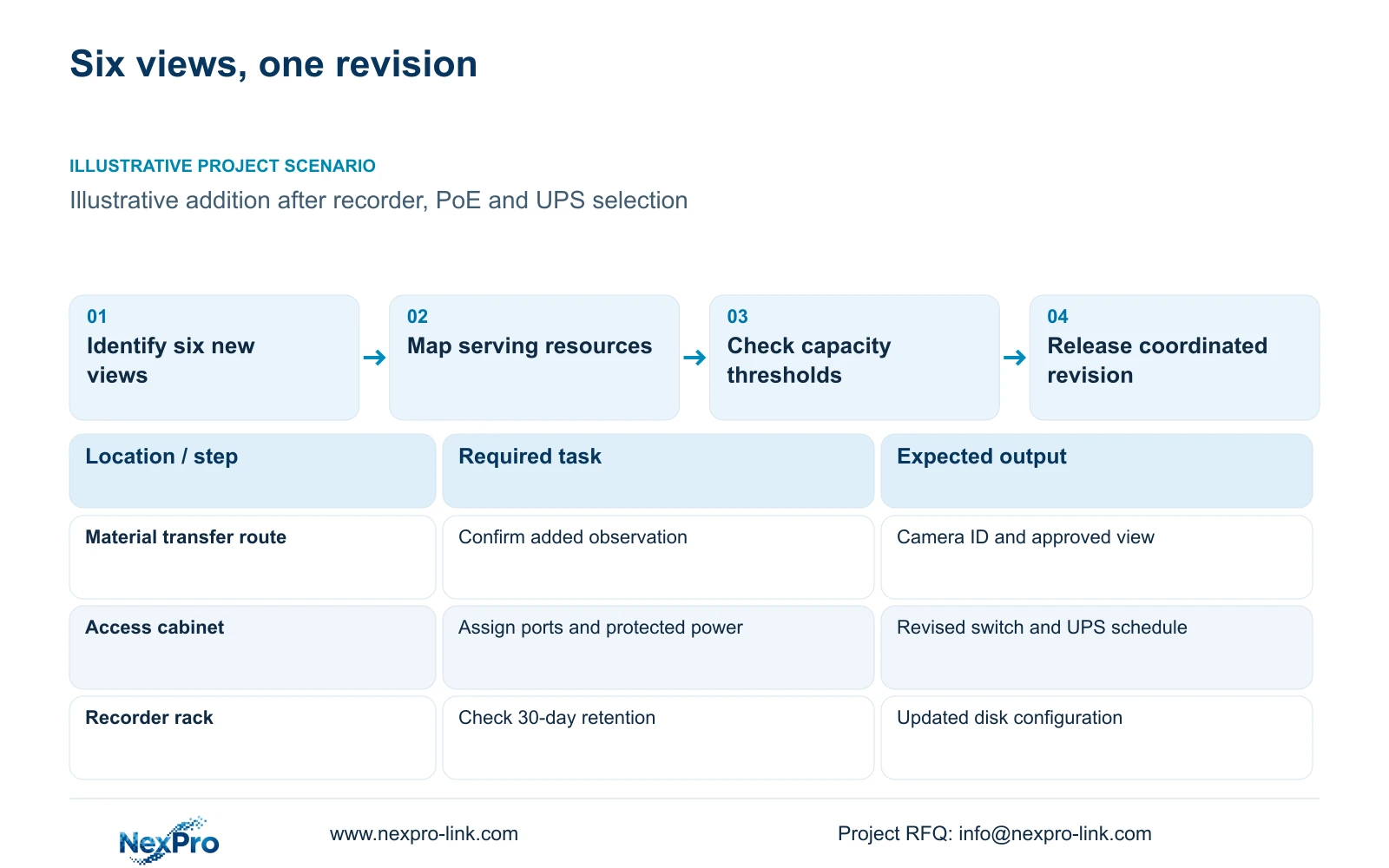
Illustrative project scenario: Six cameras are added after the NVR, PoE and UPS package has been selected for a new CNC factory. CASE01 provides the hypothetical baseline: 32 ordinary security views covering gates, material and tool stores, permitted machine-hall transfers, common routes, dispatch and equipment-room approaches. Assume the additional views concern authorised transfers and access review, with their final locations awaiting drawing approval. They do not introduce machine inspection or safeguarding duties.
Give the baseline a revision identifier and record each view's purpose, camera ID, serving switch, recorder and electrical node. Attach the accepted 30-day continuous-recording target and outage objective. Mark provisional routes separately from fixed cabinet locations. This lets the owner approve the added observation tasks without accidentally approving unresolved hardware or construction assumptions.
Section 02
Trace each added view to the resources it consumes
Start with the six locations rather than distributing their demand evenly across the system. A camera beside an existing cabinet may need an available port and a new link. A distant location may require another access group, an uplink or a separately protected electrical node. Record these differences before using a site-wide power total to justify the selected switches.
For recording, preserve the accepted stream mode, average bitrate, recording hours and retention period. For PoE, obtain the selected camera's maximum device-side demand and required port standard or class. The example's 12 W per camera is an assumed design input, not a published NexPro-Link peak rating. Replacement models, enabled lighting and other operating features can change the power assessment.
Cable and labour need their own revision. CASE01's original 32 continuous links total 1,872 m and have a feasible seven-reel cut plan using 305 m reels. Those quantities cannot price six unspecified routes. Add measured route lengths, termination method, mounting access and testing work to the change schedule. Recheck reel allocation instead of assuming leftover cable will accommodate every new continuous run.
Section 03
Assign approval to one coordinated change package
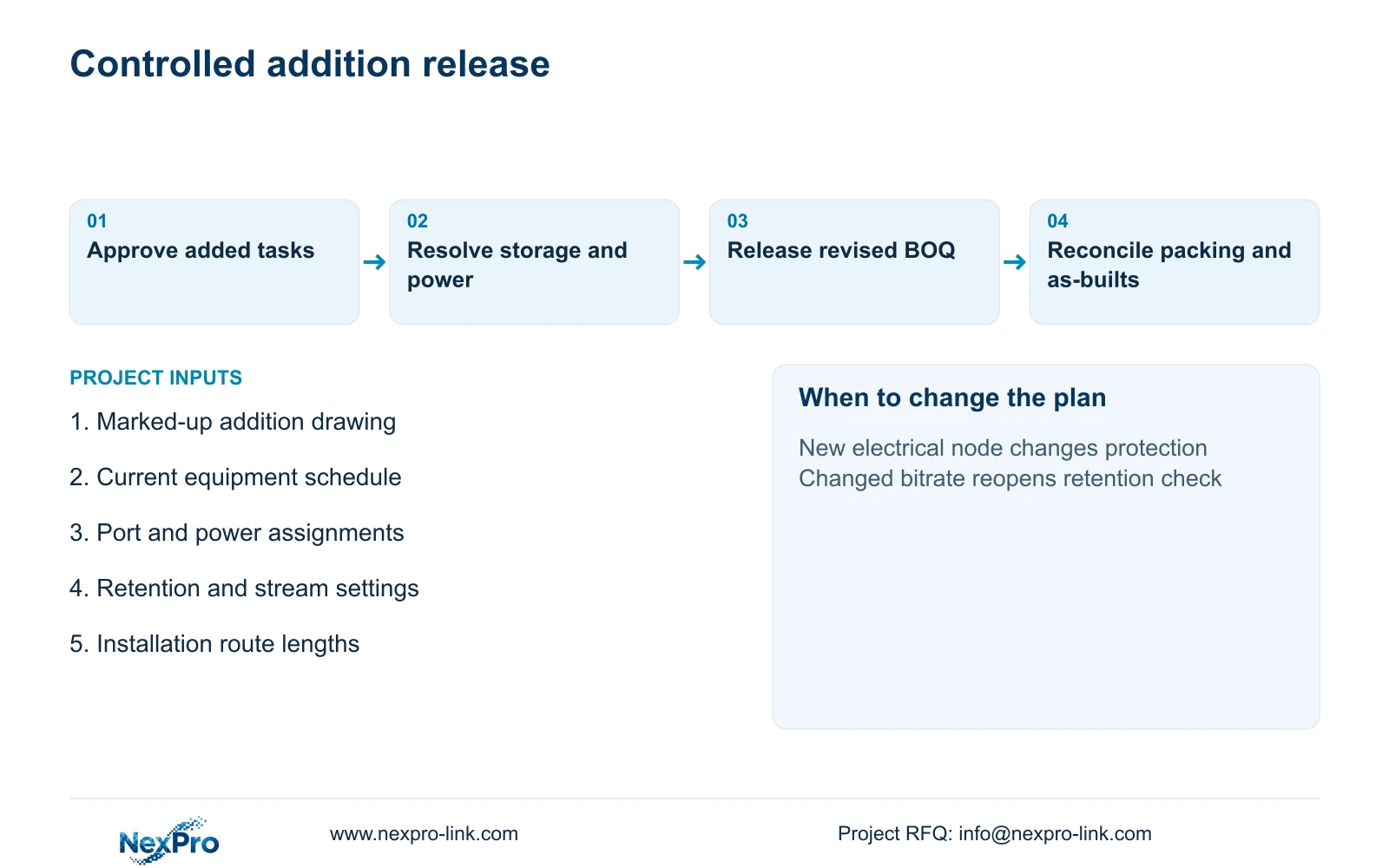
Prepare a change package containing the marked-up location drawing, revised camera schedule, capacity checks and BOQ delta. The owner confirms the six observation tasks and the unchanged retention objective. The engineer confirms equipment and interface suitability. The cost manager identifies supplied, retained, replaced and additional items, while the local installer confirms routes, access and construction work.
Use an explicit release decision for every affected line. For example, retain the recorder subject to stream-mode checks, hold the disk configuration pending the storage calculation, and request a switch option for the six new locations. A supplier's revised camera quotation alone does not close these decisions. Record the drawing and calculation revisions against the quotation so purchasing cannot combine an old UPS schedule with a new camera count.
NexPro-Link's BOQ and Tender Support scope includes model matching, technical submittals, deviations and quotation coordination. These services can support the revised package; project approval remains with the buyer. If an added position changes from ordinary access observation to a specialist process or safety task, separate that requirement before issuing the equipment release.
Section 04
Check the capacity threshold hidden by spare channels
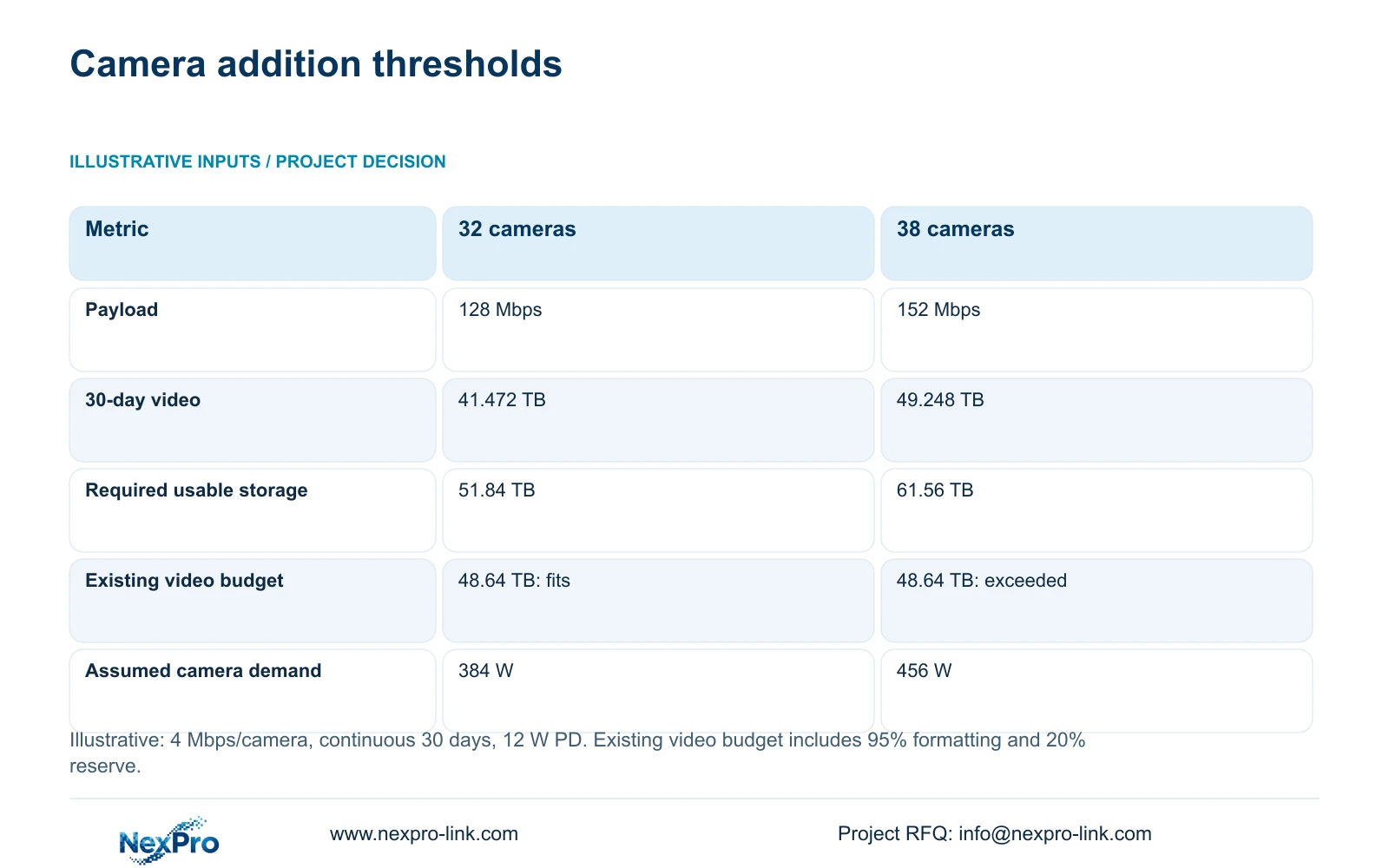
The illustrative comparison keeps both options at 4 Mbps per camera, 24-hour continuous recording and 30 days. Use payload_Mbps = n × 4, video_TB = 0.0108 × n × 4 × 30, and camera_PD_W = n × 12. Decimal TB are used. Required usable capacity at 80% occupancy equals video_TB / 0.80.
The decisive difference is storage. CASE01 installs four 16 TB disks: 64 TB raw, 60.8 TB after the assumed 95% formatting allowance, and a 48.64 TB video budget after reserving 20% of usable capacity. The original 41.472 TB fits. The revised 49.248 TB exceeds that budget by 0.608 TB. Equivalently, 61.56 TB required usable capacity exceeds 60.8 TB. The reserve is already included and must not be applied again.
The NexPro-NVR4449-4K catalogue lists 49 channels, 320 Mbps input and four SATA bays supporting up to 18 TB per drive. Its summary distinguishes 49×5MP from 9×4K. The revised 152 Mbps payload is below the listed input rating, but supported stream modes and playback demands still require confirmation. Spare channels therefore support a retention review, not an automatic approval of the complete revision.
| Metric | Option A: baseline | Option B: revised |
|---|---|---|
| Cameras | 32 | 38 |
| Recording payload | 128 Mbps | 152 Mbps |
| 30-day video | 41.472 TB | 49.248 TB |
| Required usable capacity | 51.84 TB | 61.56 TB |
| Assumed camera-side demand | 384 W | 456 W |
Section 05
Retain suitable equipment and revise the constrained resources
Prefer a coordinated 38-camera revision if the owner accepts all six additional tasks. Retain the recorder where the exact stream configuration remains supported, and investigate a compatible disk combination within its four-bay limit. A larger recorder becomes relevant if supported modes, storage architecture or future expansion exceed that boundary. Do not shorten retention or lower accepted image quality simply to keep the original order unchanged.
Recalculate switch and UPS demand from the resulting topology. CASE01 uses four eight-camera groups, each with an illustrative 133.3333 W PSE budget target and 135.1852 W complete switch AC demand. Six added cameras may consume spare ports or require another switch with its own overhead. Camera-side watts are already represented in switch AC demand; adding them again to the UPS schedule would double-count them.
The original recording-priority load is 682.7407 W. With 80% rated-capacity utilisation and assumed power factor 0.9, its targets are 853.4259 W and 948.2510 VA. SP1KR(S) is a quoted 900 W/1 kVA capacity reference, leaving limited room against those design targets. Recheck the revised load before retaining it. Battery configuration and runtime evidence must separately support the 30-minute objective; calculated load Wh does not prove duration.
Section 06
Carry the approved revision into preparation and delivery
Issue the supplier a revision-controlled delta alongside the complete current schedule. Identify retained recorder hardware, the approved disk change, switch assignments and any revised UPS configuration. Keep optional monitoring-wall equipment separate: adding recording views does not establish a need for more displays. Show configuration, accessories and local installation work as distinct quotation lines.
Before shipment, reconcile camera IDs, port allocations, recorder settings and packing labels against the same release. Project-labelled cartons should identify where the six additions belong without obscuring model and serial information. NexPro-Link's project-supply scope can support equipment selection, preparation, packing and export coordination, with local construction responsibilities retained by the appointed project team.
Close the change after the installer confirms the as-built routes and the operator demonstrates recording, retrieval and export from the added views. Replace assumed bitrate and power inputs with accepted configuration evidence. If a late location change creates a longer route, another electrical node or a different camera requirement, reopen the affected checks before treating the revision as complete.
Section 07
Buyer questions
Can the original 32-camera package be shipped while the addition is reviewed? Yes, if the project manager separates unaffected equipment from held items. Identify any disks, switches, UPS components or packing assignments that the revised design could replace, and obtain written agreement on the staged release.
Must every camera relocation trigger a full storage calculation? A relocation with unchanged stream settings and recording hours may leave storage demand unchanged. It still requires checks of sightline, cable route, serving port and power node. Recalculate storage when the move changes the camera, bitrate or recording policy.
How should competing change quotations be compared? Give each supplier the same revised locations, accepted stream settings, retention period and outage objective. Compare retained equipment, replacements, configuration and local work separately. A lower camera subtotal cannot resolve missing storage or power scope.
Section 08
Request a coordinated CCTV change review
Send the marked-up six-camera addition drawing, current equipment and port schedule, recording requirements, and protected-load list to info@nexpro-link.com for a coordinated equipment and quotation review.
Engineering references
These sources support the general planning principles. Always use the selected product's current datasheet and applicable project standards for final design.