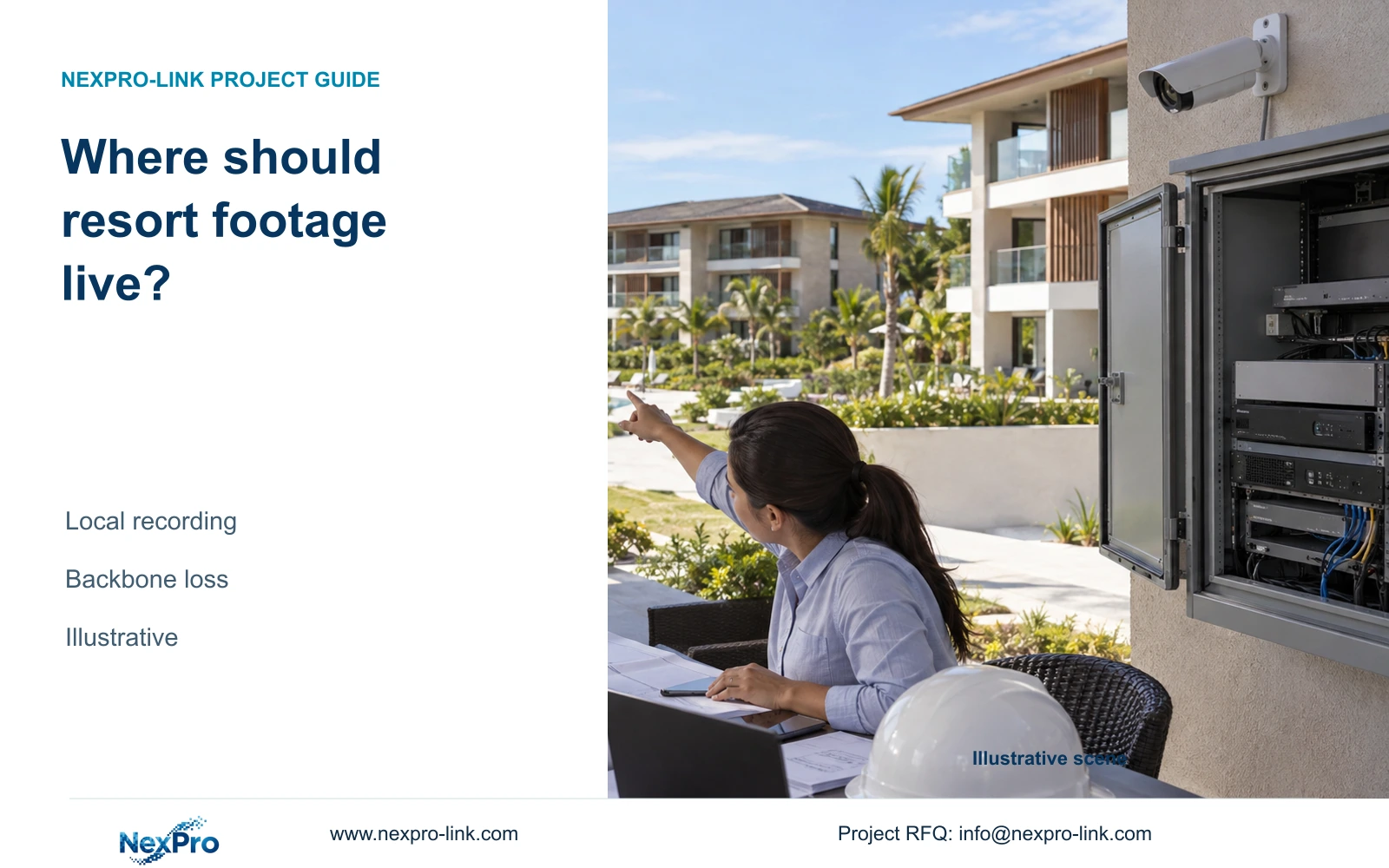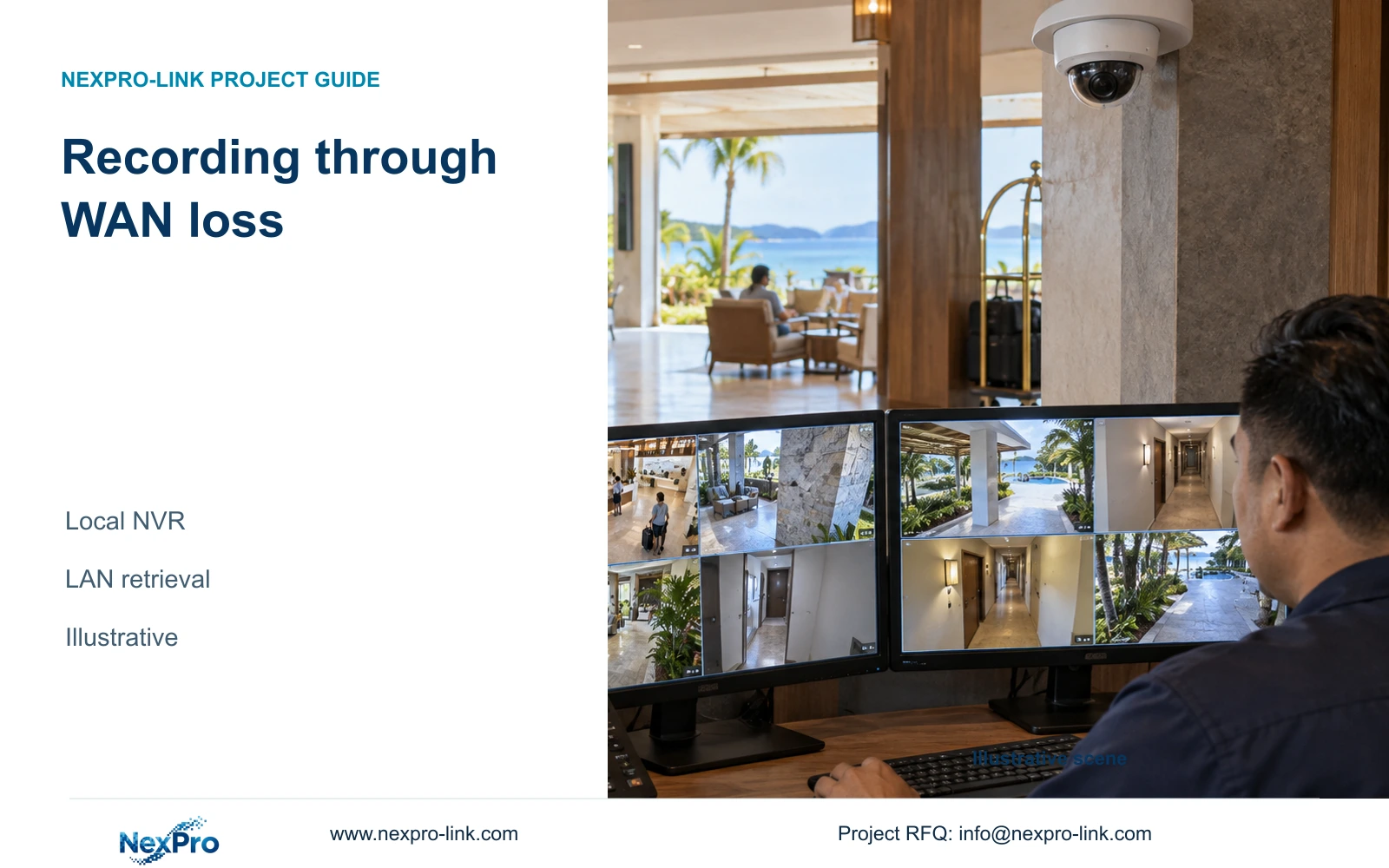
Keep essential recording and authorized local retrieval inside the hotel network. Treat remote viewing as a separate service with its own bandwidth, access and recovery requirements.
Section 01
Keep essential operation inside the LAN
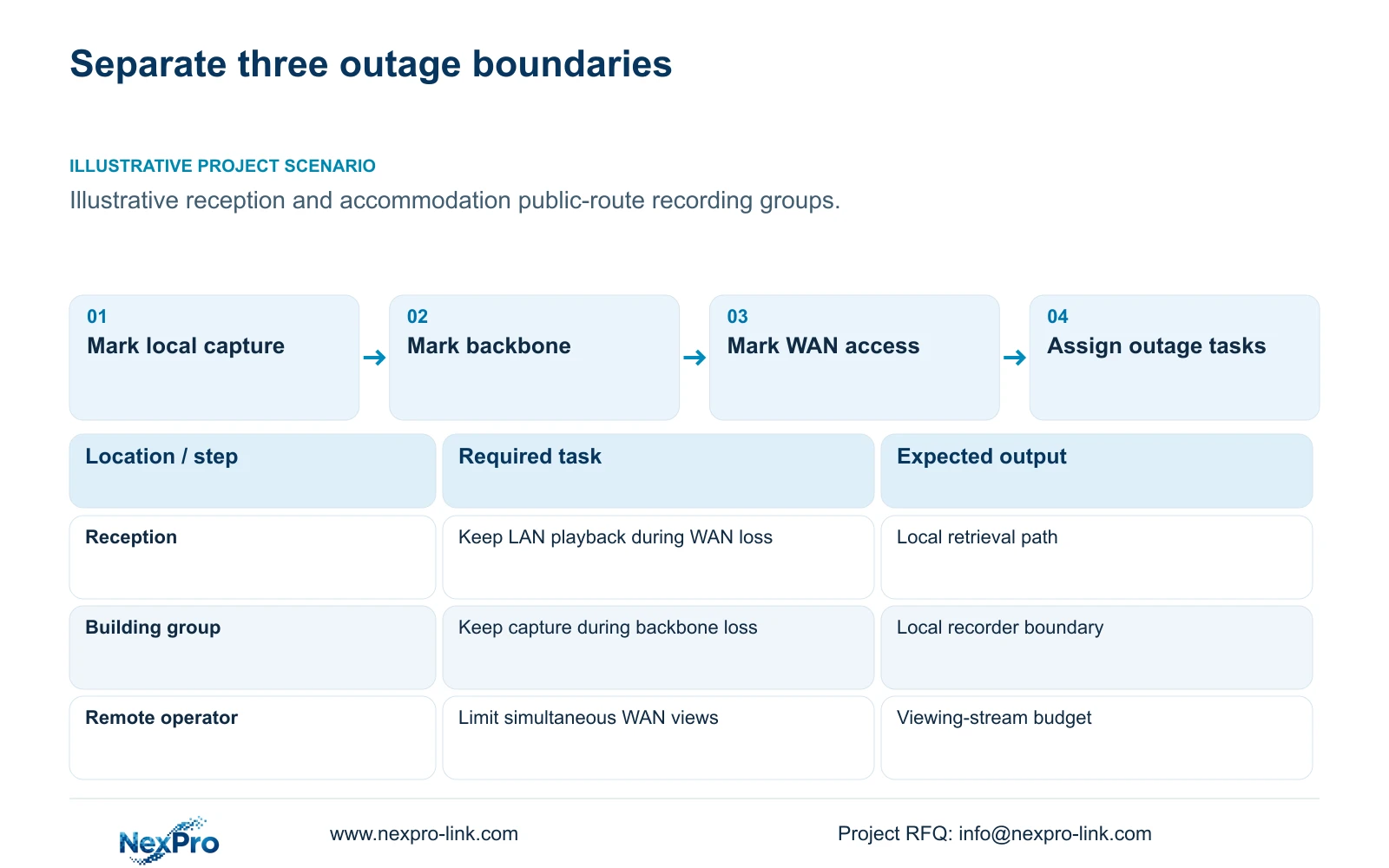
Choose local recording with an authorized LAN viewing path when internet outages must not interrupt capture or incident retrieval. Add remote access separately. Building-level recorders are appropriate when recording must also survive a resort backbone interruption, provided each building retains its camera network and protected power.
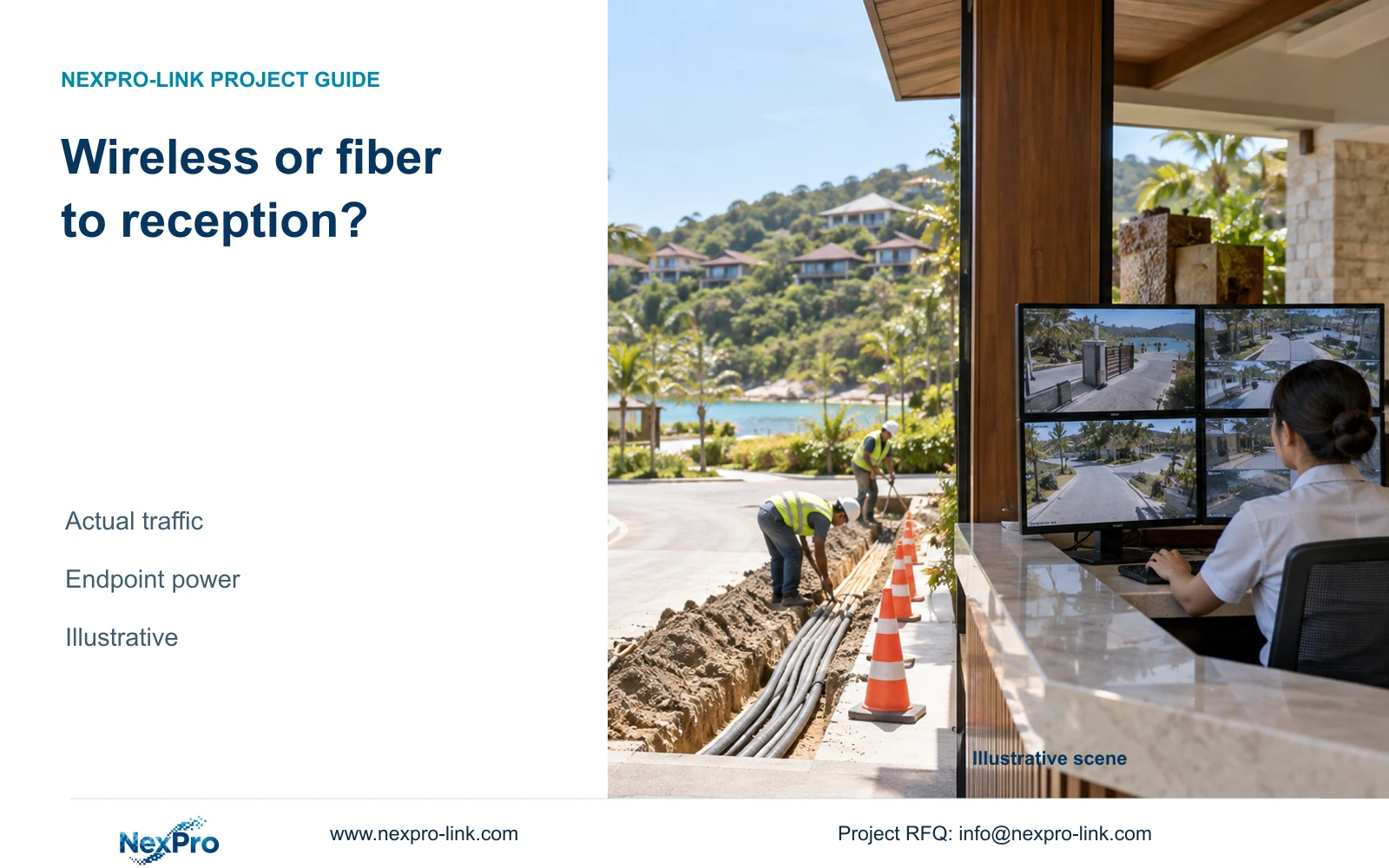
Define the outage precisely. Loss of the internet connection, failure of a router that also supports local networking, and failure of an interbuilding link create different operating states. A proposal that promises offline recording should identify which state it covers and which equipment must remain available.
Connect public-area camera tags to their access switches, recorder and local operator endpoint. Mark the internet boundary on the data diagram. On a separate power diagram, identify the supply to each required node. This exposes a remote switch whose network connection survives while its electrical supply does not.
| Required task | Given information | Decision still needed |
|---|---|---|
| Continue capture | Internet is intermittent | Which local nodes remain independent? |
| Retrieve an incident | Hotel staff need local footage | Supported LAN client and authorized account |
| View remotely | Occasional off-site access | Concurrent streams and available upload |
Section 02
Assign an authoritative recording location
Give every camera a named recording destination. The camera schedule should identify the responsible recorder, stream profile and retention policy, together with the method used to retrieve an authorized event. A remote preview does not establish where the retained footage resides.
The illustrative CASE04 resort assigns 96 cameras to three locally recorded groups of 32. Each recorder receives an assumed 128 Mbps. NexPro-NVR4449-4K is a candidate because its public record lists 49 channels, 320 Mbps input and four SATA bays supporting up to 18 TB per drive. Its stated image modes still need checking; channel count alone does not establish arbitrary 8MP concurrency.
CASE04 uses four 16 TB disks per recorder, with no RAID capacity deduction and a hypothetical 95% formatted usable ratio. Those are case assumptions, not a guaranteed disk configuration. Record the actual approved disk layout and retrieval workflow. An independent incident export has a separate purpose from the recorder's routine overwrite cycle.
Section 03
Calculate recording and remote viewing separately
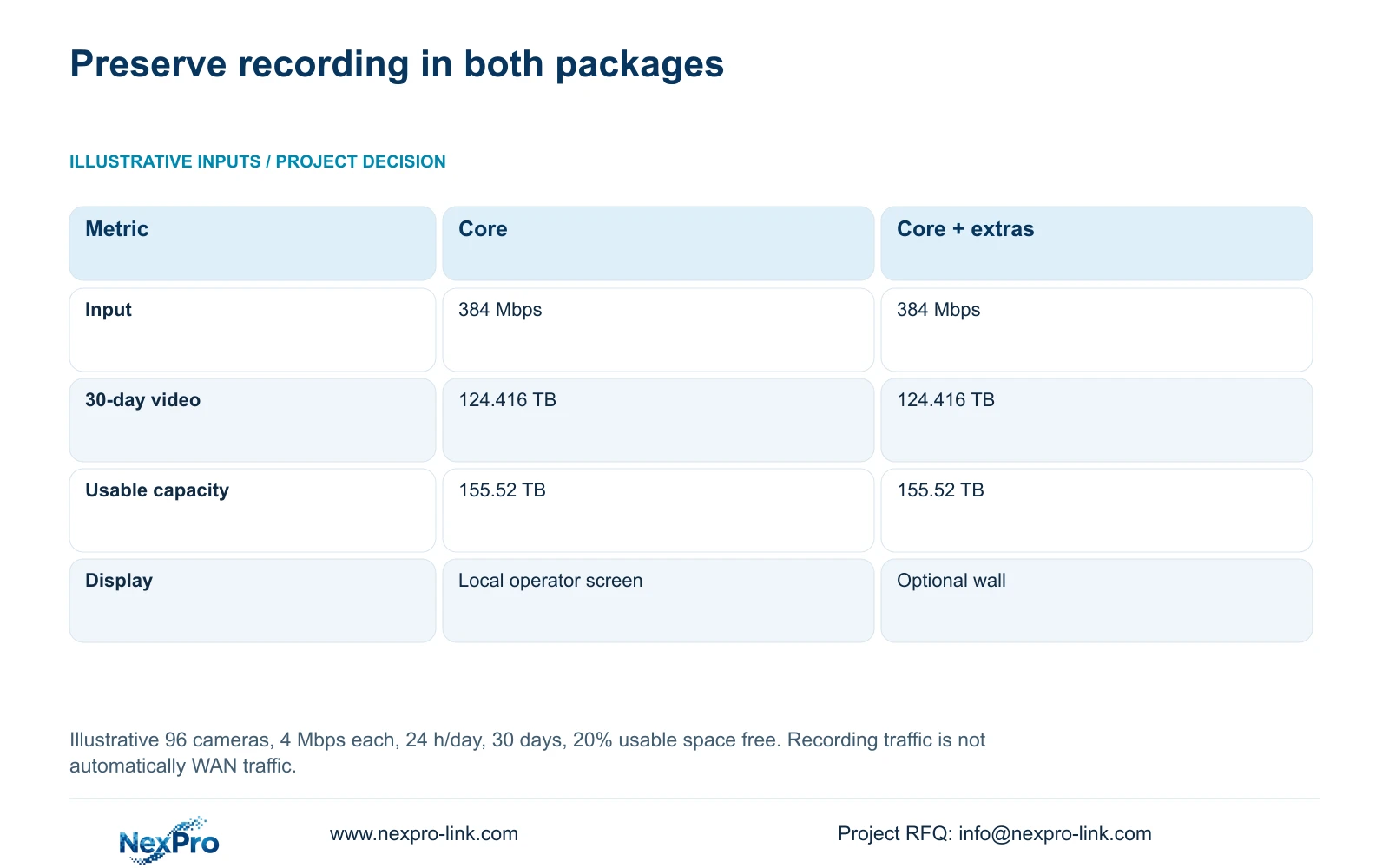
For the article's illustrative 96 cameras at an average 4 Mbps, continuous recording produces 96 × 4 = 384 Mbps across the defined recording system. Video volume in decimal TB is 0.0108 × cameras × Mbps × days. At 30 days this gives 124.416 TB; retaining 20% of usable space free requires 124.416 / 0.80 = 155.52 TB.
These figures describe local recording demand. They become internet upload demand only if that recording traffic actually crosses the internet boundary. For occasional remote viewing, sum the selected viewing-stream rates multiplied by simultaneous stream counts on the WAN path. Add any concurrent export traffic and state the chosen traffic allowance separately.
Request the hotel's effective upload conditions and the supported substream profiles before setting remote concurrency. Restrict remote mosaics or schedule exports when they exceed the available path. Keep the recording profile unchanged unless the hotel separately approves a recording-quality revision.
| Metric / condition | Essential recording-first package | Same core plus optional display/recovery |
|---|---|---|
| Recording input | 384 Mbps | 384 Mbps |
| 30-day video data | 124.416 TB | 124.416 TB |
| Required usable capacity | 155.52 TB | 155.52 TB |
| Protected path | Cameras + network + recording | Same plus explicitly selected extras |
| Operator display | Task-sized monitor/workstation | Optional wall; independent recording |
| Cost comparison | Complete scope quotation required | Documented incremental scope only |
Section 04
Compare local and internet-dependent tasks
Specify local capture, LAN playback and approved export as individual requirements. Then list remote live view, off-site retrieval and any cloud storage as separate services. Each service needs a supported device, client and account workflow. An app name cannot establish that all of these functions remain available without external connectivity.
NexPro-Link's Seetong system record provides an App and PC client workflow reference. It does not establish full interoperability across all hardware or guarantee every offline account behavior. ONVIF Profiles likewise provide a function-matching framework, not proof of cloud binding, advanced events or complete playback compatibility.
Both packages in the calculation preserve the same storage target. An optional display can improve an approved monitoring task without becoming a recording dependency. NX-VP-5535 is a 55-inch Full HD LCD candidate, not direct-view LED. Add a wall only when operator positions and concurrent viewing justify its separate decoding, installation and power scope.
Section 05
Protect the router and the recording path
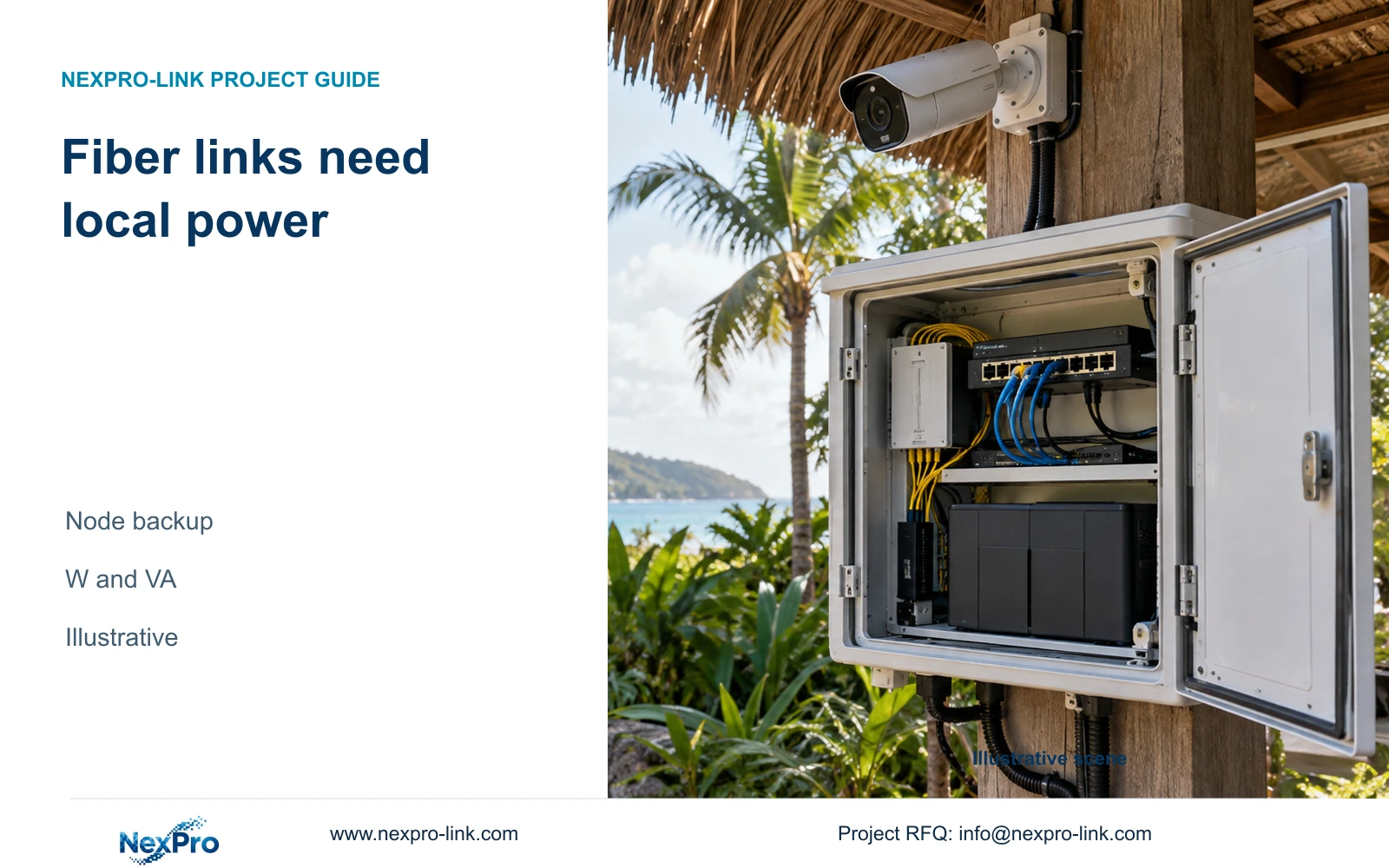
Determine whether the router performs a local-network function required during WAN loss. If it does, include that function's equipment in the essential power boundary. Protect building access switches and recorders wherever they are installed. Fibre carries data between buildings; it does not supply the remote equipment with electricity.
Calculate each protection zone using actual AC watts and VA. When a complete PoE switch AC load includes its cameras, adding the same camera watts again would double-count the load. Per-port PoE capability and total output budget also require separate confirmation. NexPro SW-POE1618G remains an inquiry candidate because its total PoE watts are unspecified and its access-port speed descriptions conflict.
SP2KR(S) has a published 2 kVA / 1800 W rating, but that rating does not establish runtime or suitability for every remote cabinet. Use the supported battery configuration and load curve for the required outage duration. A larger central UPS cannot substitute for an undesigned electrical supply to dispersed buildings.
Section 06
Test internet loss and restoration
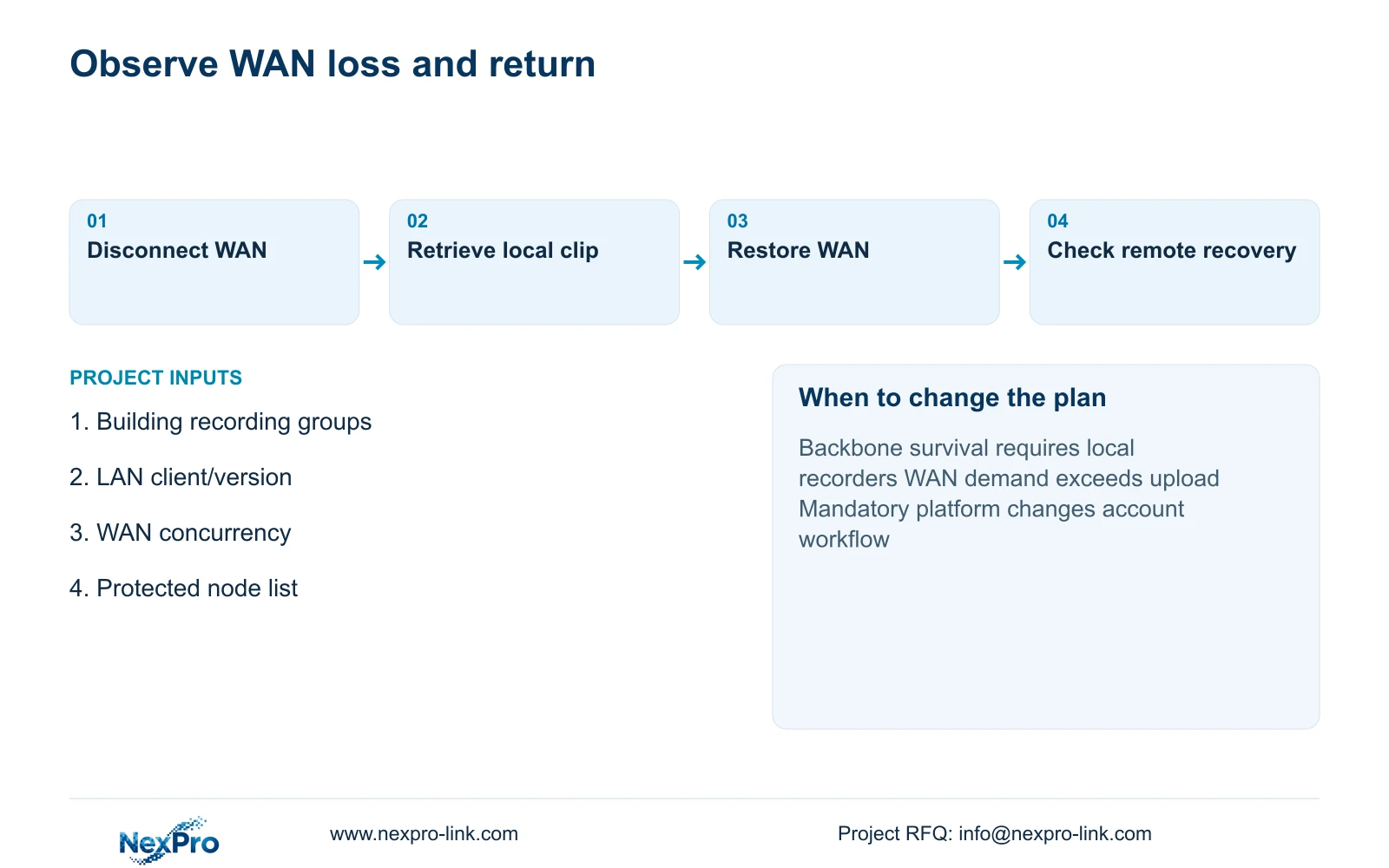
During an authorized acceptance exercise, remove the WAN connection while preserving the intended LAN and power state. Check that new footage continues recording, an authorized local user can locate the affected interval, and an export plays correctly. Record actual observations against the selected model, firmware and client version.
Restore internet access and check remote access recovery without changing local recording settings. Test backbone loss separately if building independence is required. Do not prefill results as passes or infer cold-start, power-failure or cloud-upload behavior from a WAN-only exercise.
Recommend the recording-first package where local operation satisfies the hotel's outage requirement. Add recovery or platform scope when mandatory off-site services or backbone failure objectives require it. Send the building-group layout, recording policy, WAN viewing concurrency and remote power conditions to info@nexpro-link.com through hotel project support. NexPro-Link can coordinate model matching and supply boundaries; local installation and third-party interfaces need their own agreed responsibilities.
Section 07
Buyer questions
Does remote access include cloud storage? No cloud storage scope follows automatically from remote viewing. Request the recording destination, storage service, retention and applicable license terms as separate quotation lines.
Can one recorder serve all resort buildings? It can be considered if the required recording paths remain available through the approved failure states. Choose building-level recording when footage must continue during backbone loss, and verify central retrieval separately.
What should an initial RFQ exclude? Exclude guest footage, passwords and personal access credentials. A building diagram, camera grouping and description of required outage behavior are enough to begin a scoped technical discussion.
Engineering references
These sources support the general planning principles. Always use the selected product's current datasheet and applicable project standards for final design.