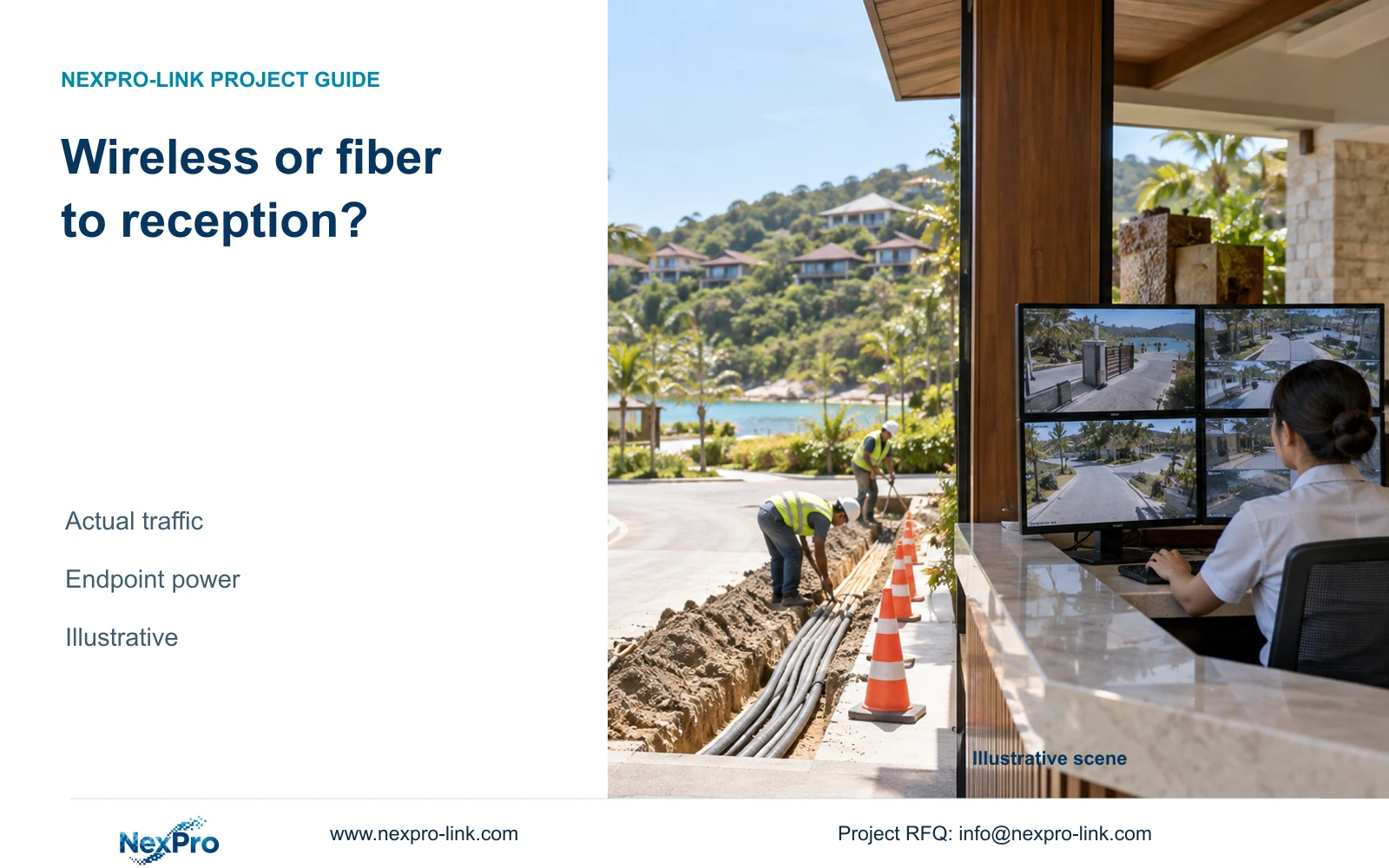
A wireless bridge can replace a difficult fiber route only when the surveyed path, usable throughput, outage behavior and endpoint power meet the same required CCTV service.
Section 01
Check the route before selecting the link medium
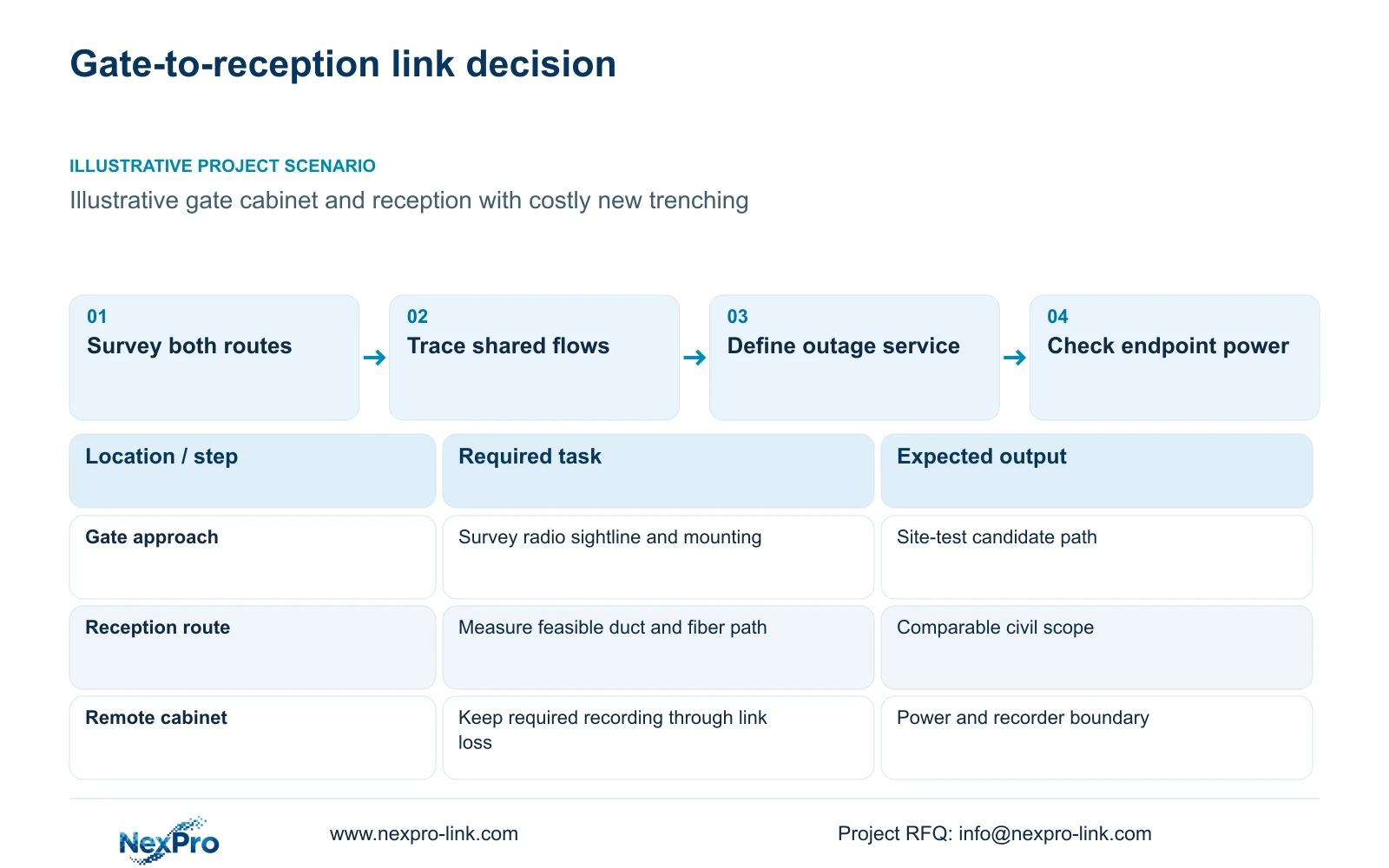
Choose a wireless bridge only when the surveyed path and a site-specific test support the required traffic and operating conditions, with power resolved at both endpoints. Prefer a feasible fiber route when those wireless conditions remain unproven or cannot meet the approved service. High trenching cost is a reason to compare alternatives, not evidence that a radio link is equivalent.
Survey the gate-to-reception route from the actual proposed mounting positions. Record distance, line of sight, intervening structures and foreseeable planting changes. Identify access for alignment and replacement. A clear line drawn between buildings does not establish that the selected radios will provide the required usable connection.
For fiber, measure the installable route through ducts, risers and detours, including termination locations. Compare existing route availability with new civil work. Draw data and power separately for both options so neither proposal hides an unpowered remote switch or active interface.
Keep the route survey attached to the required gate task. If staff must retrieve footage during link loss, recorder location also enters the decision. Changing medium alone does not remove the dependence of central recording on that route.
| Required task | Given information | Decision still needed |
|---|---|---|
| Transport gate video to reception | Trenching is costly | Survey wireless path and feasible fiber route |
| Continue recording during link loss | Remote equipment location identified | Approve local recording or accept link dependency |
Section 02
Define the streams that actually share the link
Trace recording, live viewing and export flows through the topology. Add traffic only where it traverses the selected link, with direction and concurrency identified. A gate branch serving a few cameras should not inherit the whole resort's recording total simply because the resort has 96 cameras.
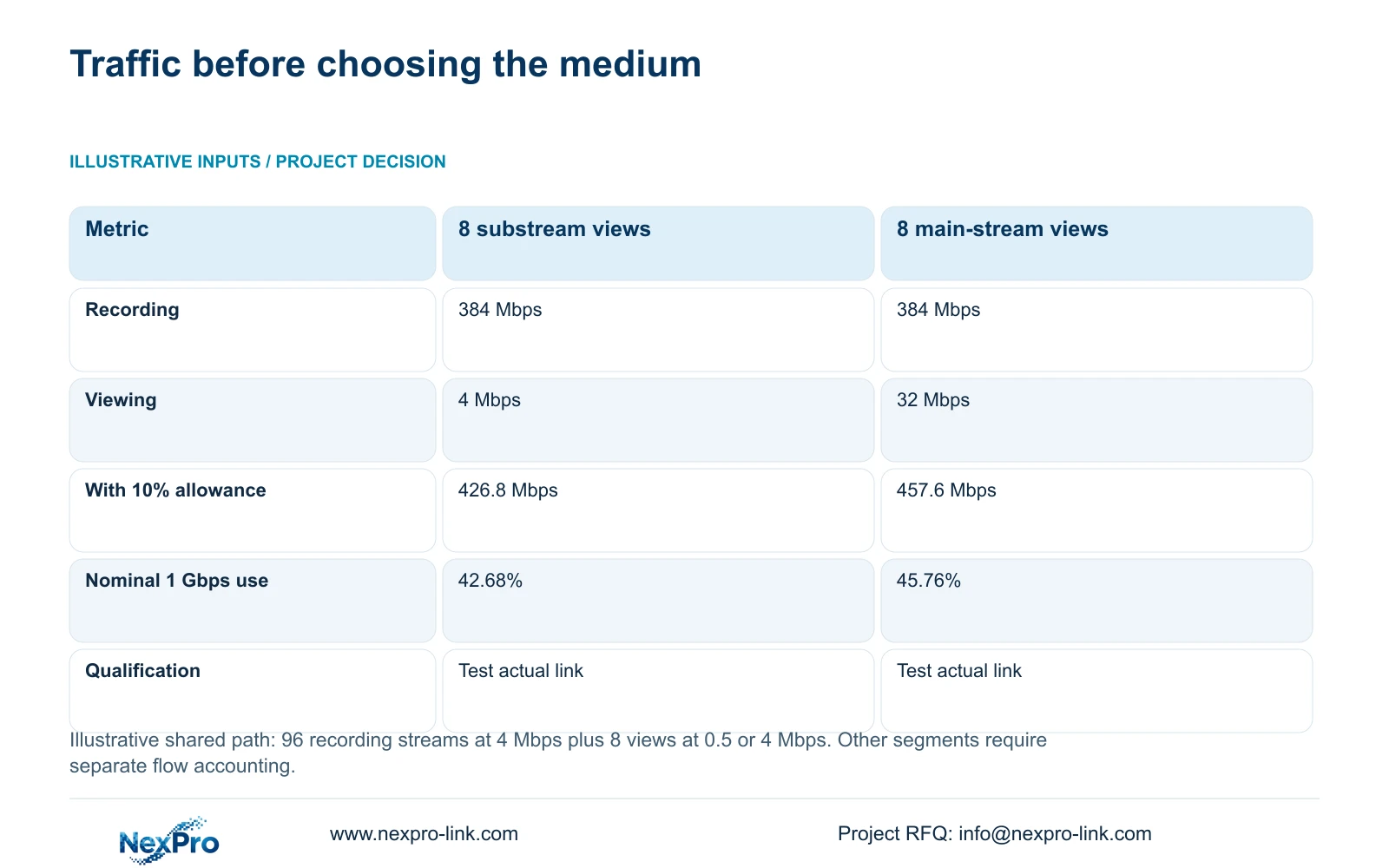
The supplied topic example deliberately places 96 recording streams at 4 Mbps and eight viewing streams on one shared path. Viewing is either 0.5 Mbps per substream or 4 Mbps per main stream. A stated 10% allowance is applied to the sum. These are hypothetical traffic inputs, not measured radio throughput or fixed rates derived from camera resolution.
Recording contributes 96 × 4 = 384 Mbps. Viewing adds either 8 × 0.5 = 4 Mbps or 8 × 4 = 32 Mbps. Planned demand equals the combined rate multiplied by 1.10. Both options retain the same main-stream recording profile; the operator's viewing choice changes this link's demand.
| Metric | Main recording + 8 substream views | Main recording + 8 main-stream views |
|---|---|---|
| Recording traffic | 384 Mbps | 384 Mbps |
| Viewing traffic | 4 Mbps | 32 Mbps |
| Planned link traffic | 426.8 Mbps | 457.6 Mbps |
| 1 Gbps nominal utilization | 42.68% | 45.76% |
| Other links | Calculate their own flows | Do not copy this sum to every segment |
Section 03
Compare the service lost when either link fails
The calculated 426.8 or 457.6 Mbps is a demand to qualify against an actual link. Nominal 1 Gbps utilization does not establish usable radio throughput, direction-specific capacity or acceptable recording behavior. Confirm the relevant connection under the required simultaneous workload.
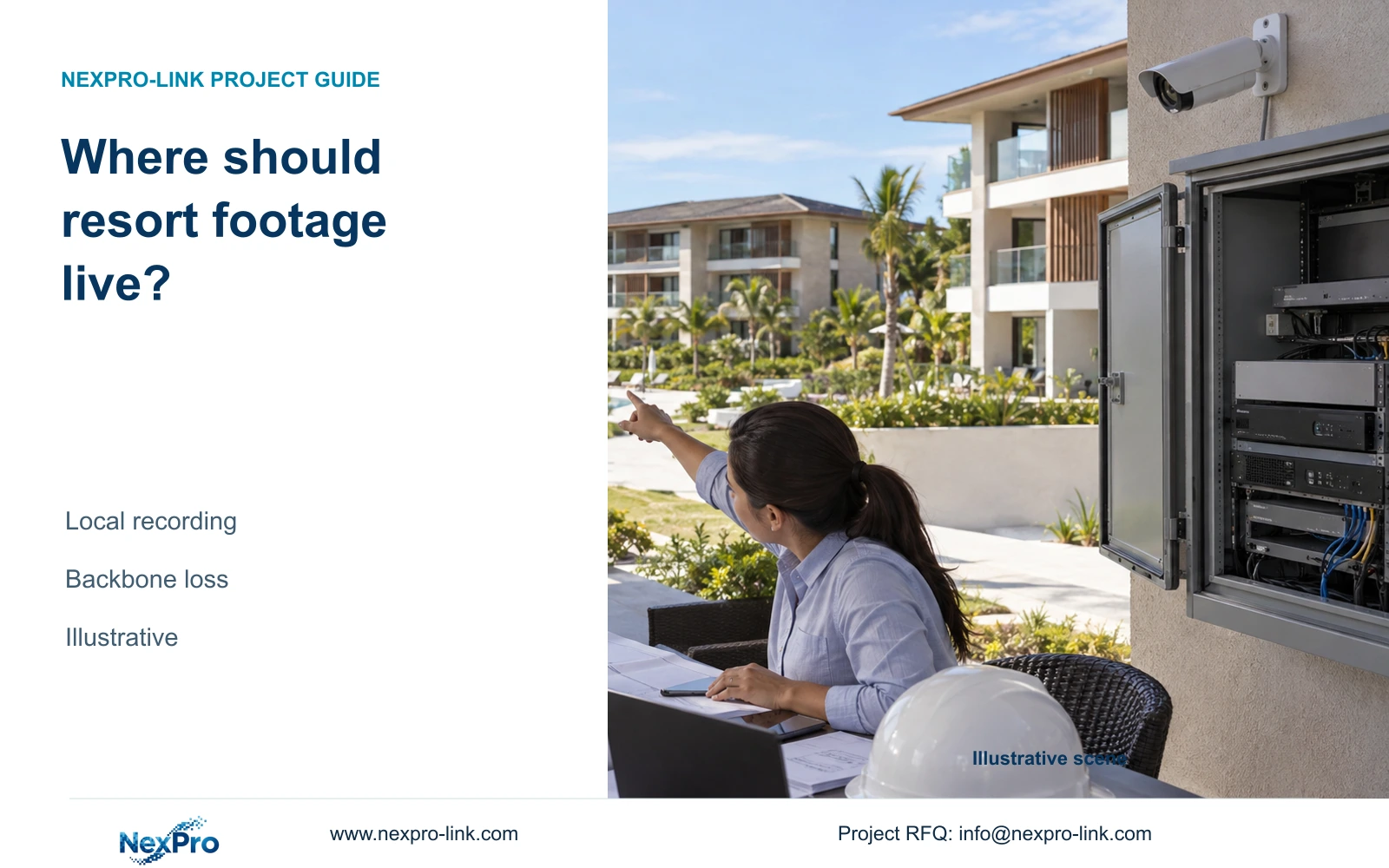
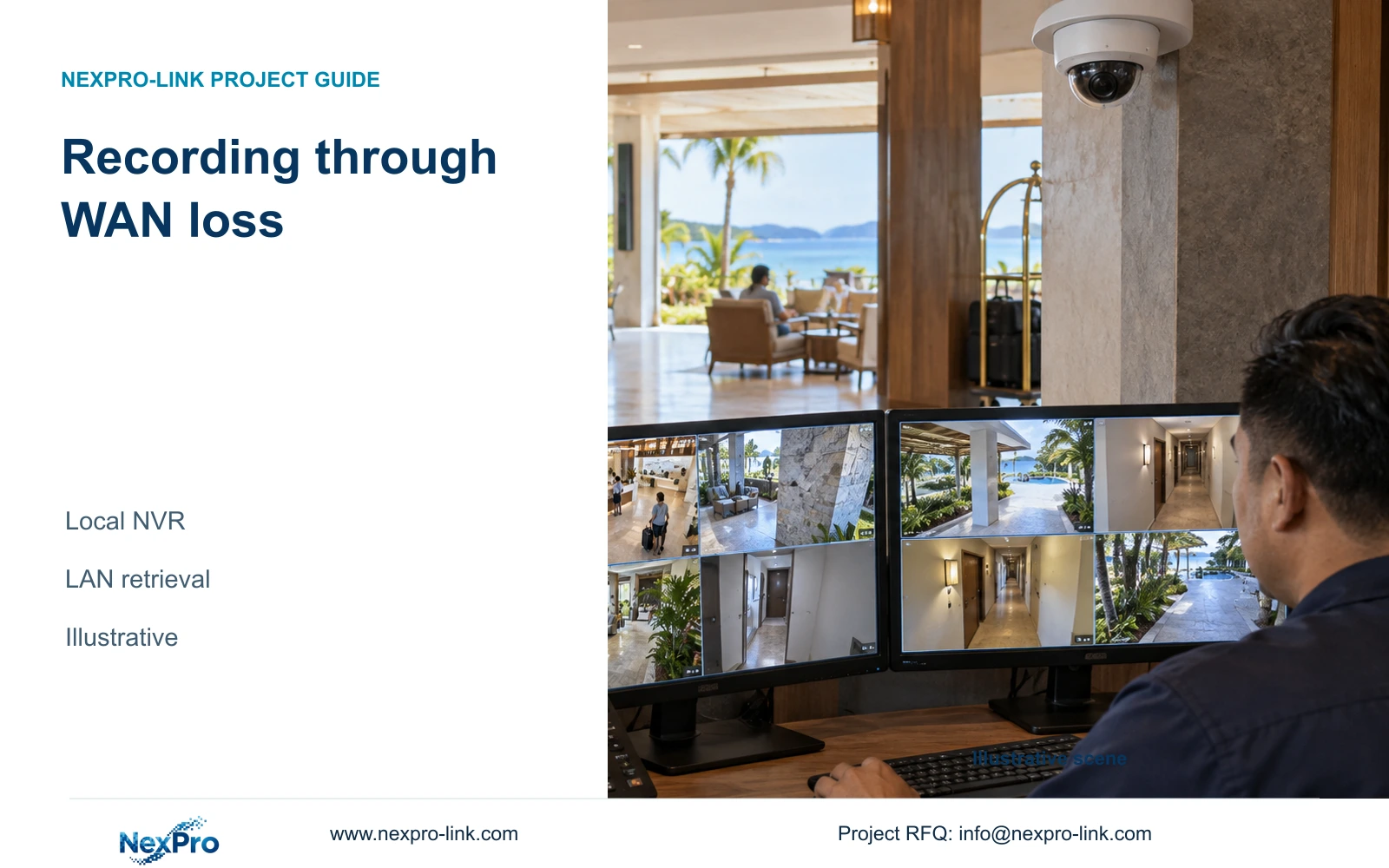
For central recording, interruption of the remote stream path affects the recording task regardless of whether the medium is wireless or fiber. With building-level recording, footage can remain local while reception loses access, provided local camera, network and recorder dependencies remain operational. Automatic recovery of missing central footage requires explicit platform support.
CASE04 illustrates local recording in three building groups. Its aggregate 384 Mbps recording input matches this topic's assumed recording total, but that does not mean every CASE04 backbone segment carries 384 Mbps plus eight viewing streams. Its actual path accounting is separate from this deliberately shared-link example.
Check other bottlenecks before treating a link upgrade as the solution. Switch forwarding, recorder input and client decoding have distinct limits. The 320 Mbps published input for one NexPro-NVR4449-4K does not qualify a single recorder for the example's 384 Mbps total, even if the link can carry it.
Section 04
Price civil work and link equipment as separate scope
Request a fiber quotation that identifies route preparation, cable, termination, active interfaces and testing. Request a wireless quotation that identifies both endpoints, mounting, power accessories and alignment or commissioning work. Compare installation access and any local service requirements on the same basis.
Separate initial installation from continuing service costs over an agreed evaluation period. Use actual quotation inputs for maintenance and replacement assumptions, explaining any proposed event. The supplied evidence contains no radio price, trenching rate or measured failure rate, so a brand-specific saving or payback period cannot be calculated.
Where wireless appears cheaper, identify the amount of initial saving and compare it with any documented additional service allowance over the chosen period. If that allowance is unknown, keep the economic conclusion provisional. A missing fiber civil-work item or radio power item should be restored to the evaluated scope before ranking offers.
The viewing calculation can influence equipment qualification without changing the cost boundary. Substream viewing reduces this example's planned demand, but the operator must still have a usable event-review workflow. Reducing essential recording detail to make a cheaper link fit would change the service being compared.
Section 05
Resolve protected power at both endpoints
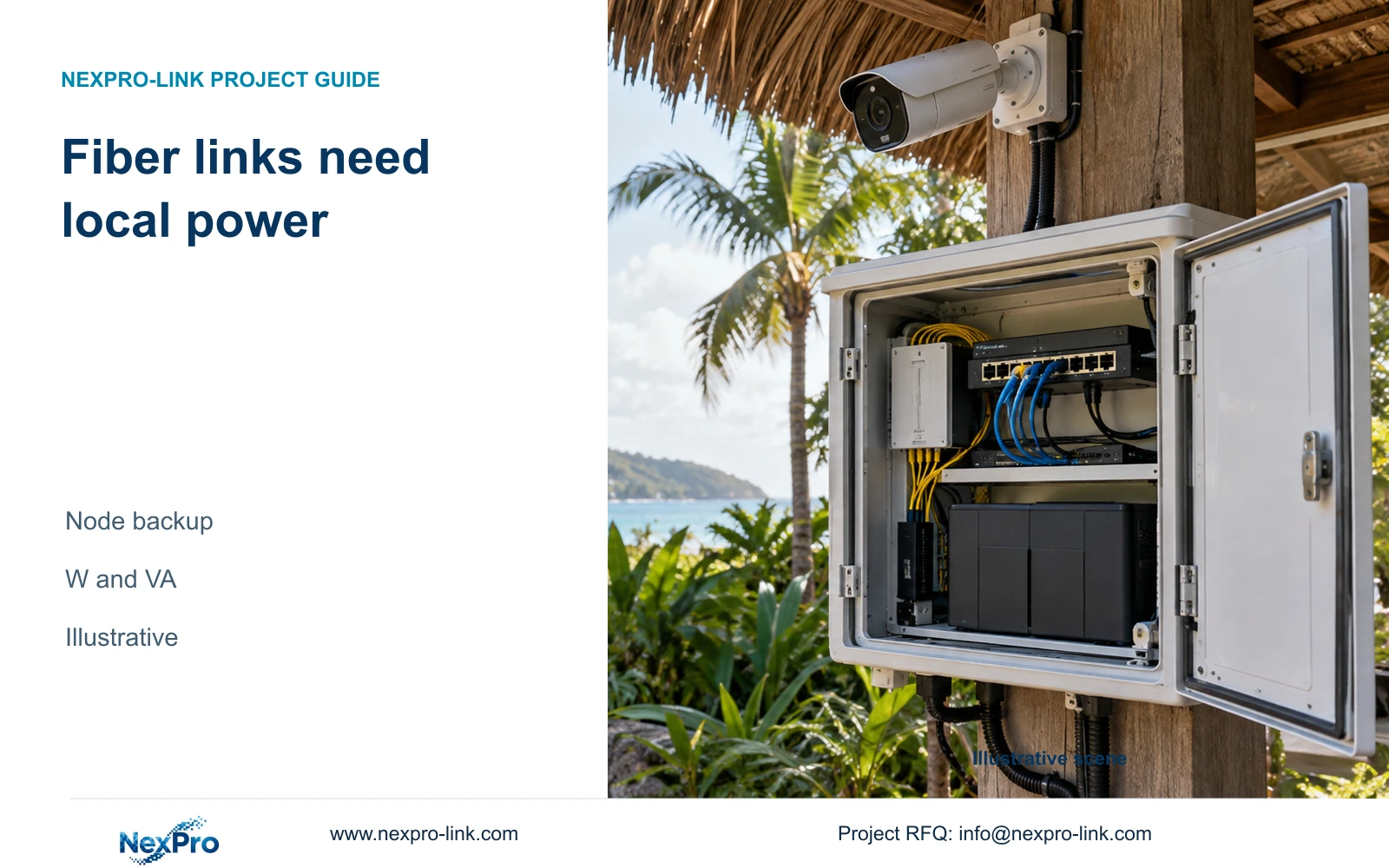
Identify the supply for each radio or active fiber interface and its associated switch. The medium carries data; the remote camera group still requires electricity. A UPS at reception cannot protect a gate cabinet that uses an unrelated local circuit unless an approved protected electrical path supplies it.
Calculate the protected AC load at each endpoint using a consistent boundary. If complete PoE switch input is included, do not add downstream camera power again. Match W and VA capacity, then obtain runtime for the actual supported battery configuration. Include the required central network and recorder supplies where recording remains central.
NexPro SW-POE1618G has 16 PoE access ports and two uplinks in its supplied record, but access-speed descriptions conflict and total PoE watts are absent. It remains an enquiry candidate until those fields are resolved. A purported gigabit uplink does not settle every port or power constraint in the link package.
Define the additional scope needed for continued local recording and compare it separately from transport. If the owner accepts temporary loss of central viewing but requires footage retention, local recording and protected remote power may be more consequential than increasing nominal link speed.
Section 06
Require a test at the proposed positions
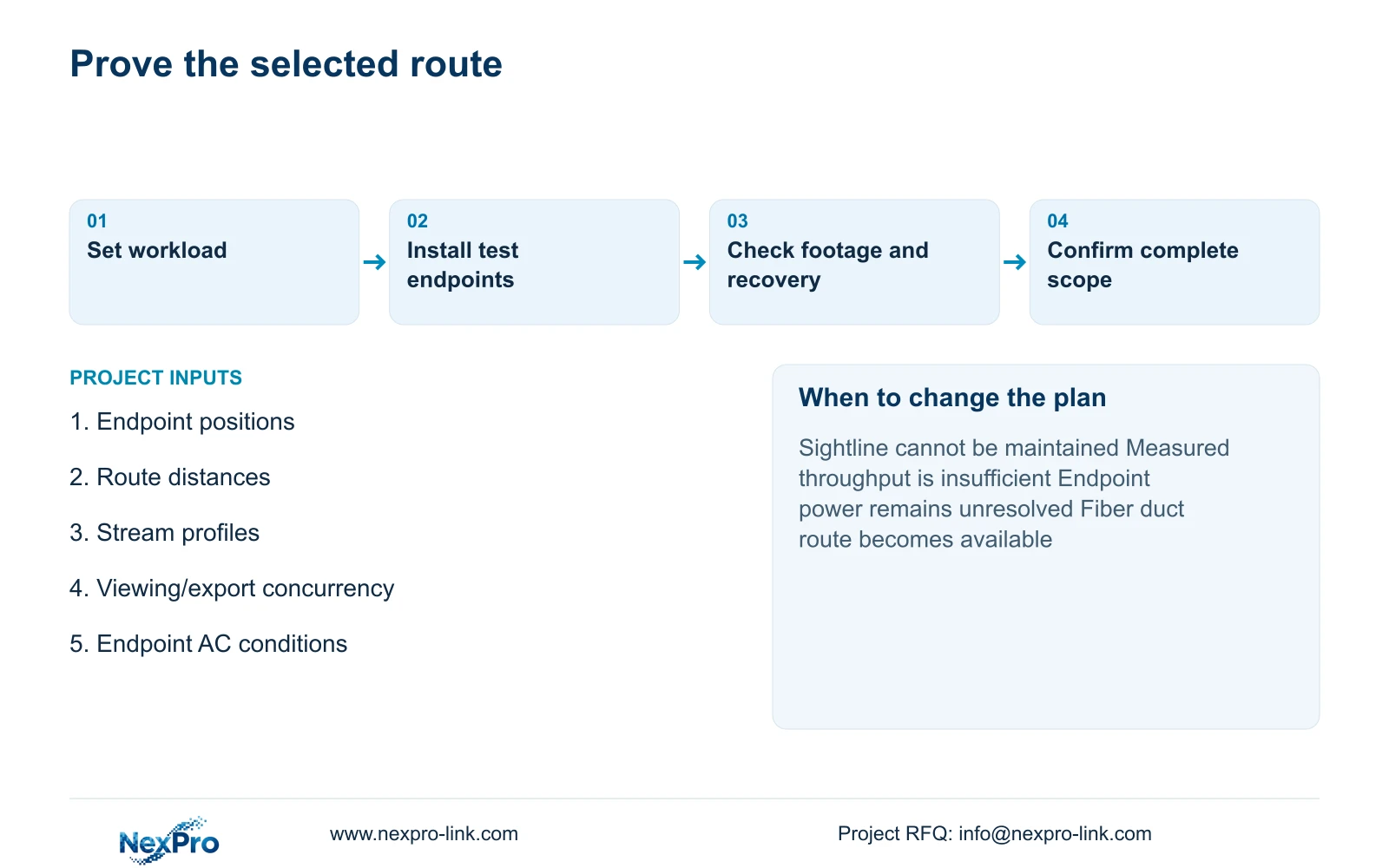
Qualify wireless at the intended mounting positions with the specified concurrent recording and viewing tasks. Record the selected equipment, configuration and observed conditions. Check retained footage and recovery behavior as well as live reception views. A demonstration at another site or an idle connection does not establish the resort's required service.
Select wireless where the site test supports the workload, the route remains suitable and its complete power and maintenance scope is acceptable. Change to fiber when the wireless path cannot be maintained or tested performance is insufficient. If fiber civil work is also impractical, revise the architecture around local recording and explicitly state the remaining central-access limitation.
Send the endpoint layout, route distances, stream profiles, concurrent viewing/export requirements and endpoint power conditions to info@nexpro-link.com. Include any available duct route or mounting constraint. Hotel project equipment support and BOQ and tender support can assist with a scope-matched equipment comparison; no wireless performance guarantee or quoted lead time follows from this teaching example.
Section 07
Buyer questions
Does the example mean the gate link needs 457.6 Mbps? Only if that link actually carries all the stated recording and viewing flows. A gate branch needs its own camera and operator traffic calculation. The example deliberately combines resort-wide flows on one shared path.
Can substream viewing reduce recording quality? The proposed comparison leaves main-stream recording unchanged. Confirm separate recording and viewing profiles in the selected system. The operator also needs a supported way to open the required detail view when investigating an event.
What belongs in a wireless acceptance demonstration? The intended endpoint positions, agreed simultaneous workload, usable recorded footage and the approved outage/recovery behavior. Document the configuration and observations without extrapolating a short test into a year-round availability claim.
Engineering references
These sources support the general planning principles. Always use the selected product's current datasheet and applicable project standards for final design.