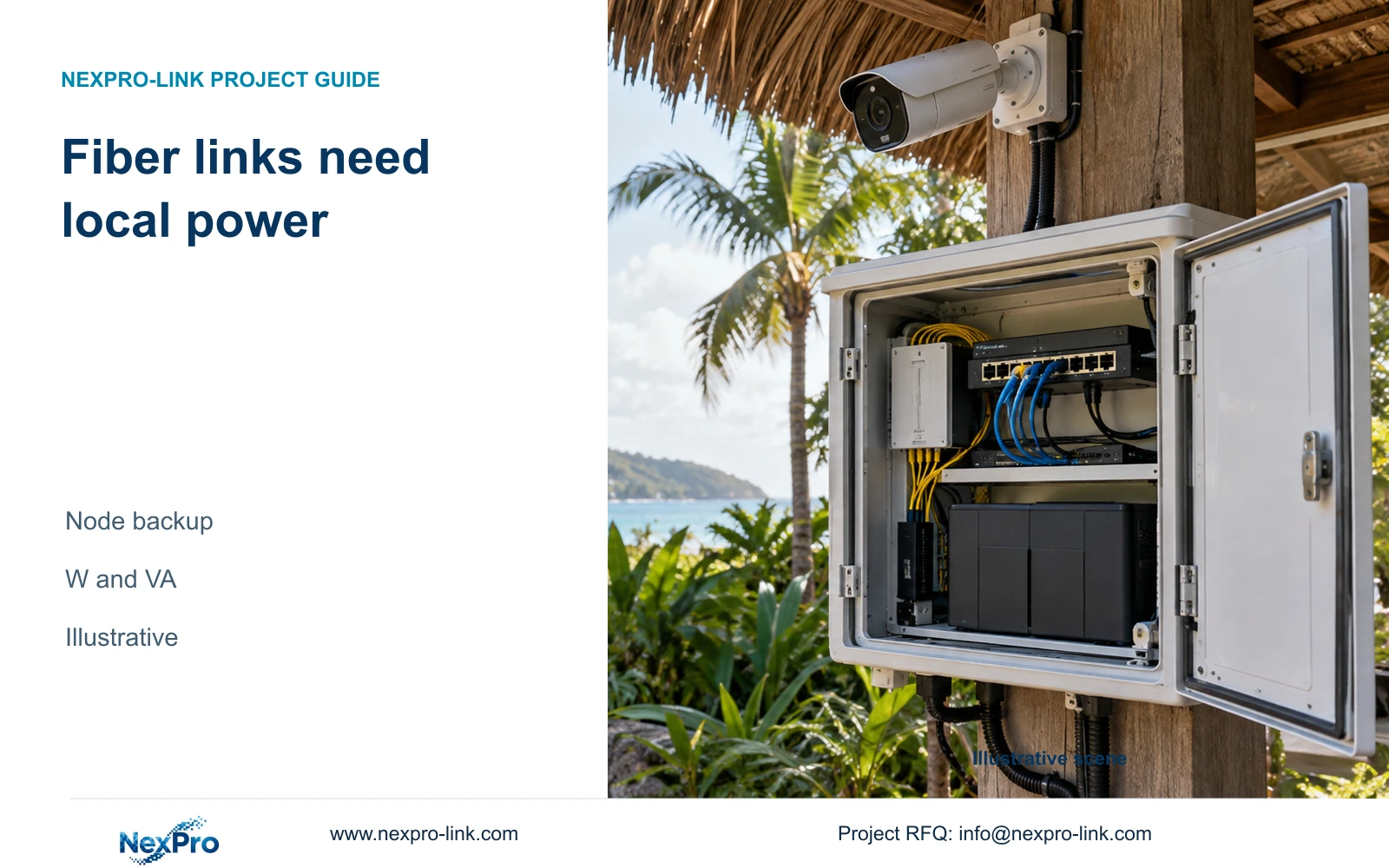
Protect a remote CCTV cabinet from its actual AC supply boundary. Spare capacity in the main building UPS cannot keep a locally powered PoE switch running through a fiber link.
Section 01
Identify every remote device required during an outage
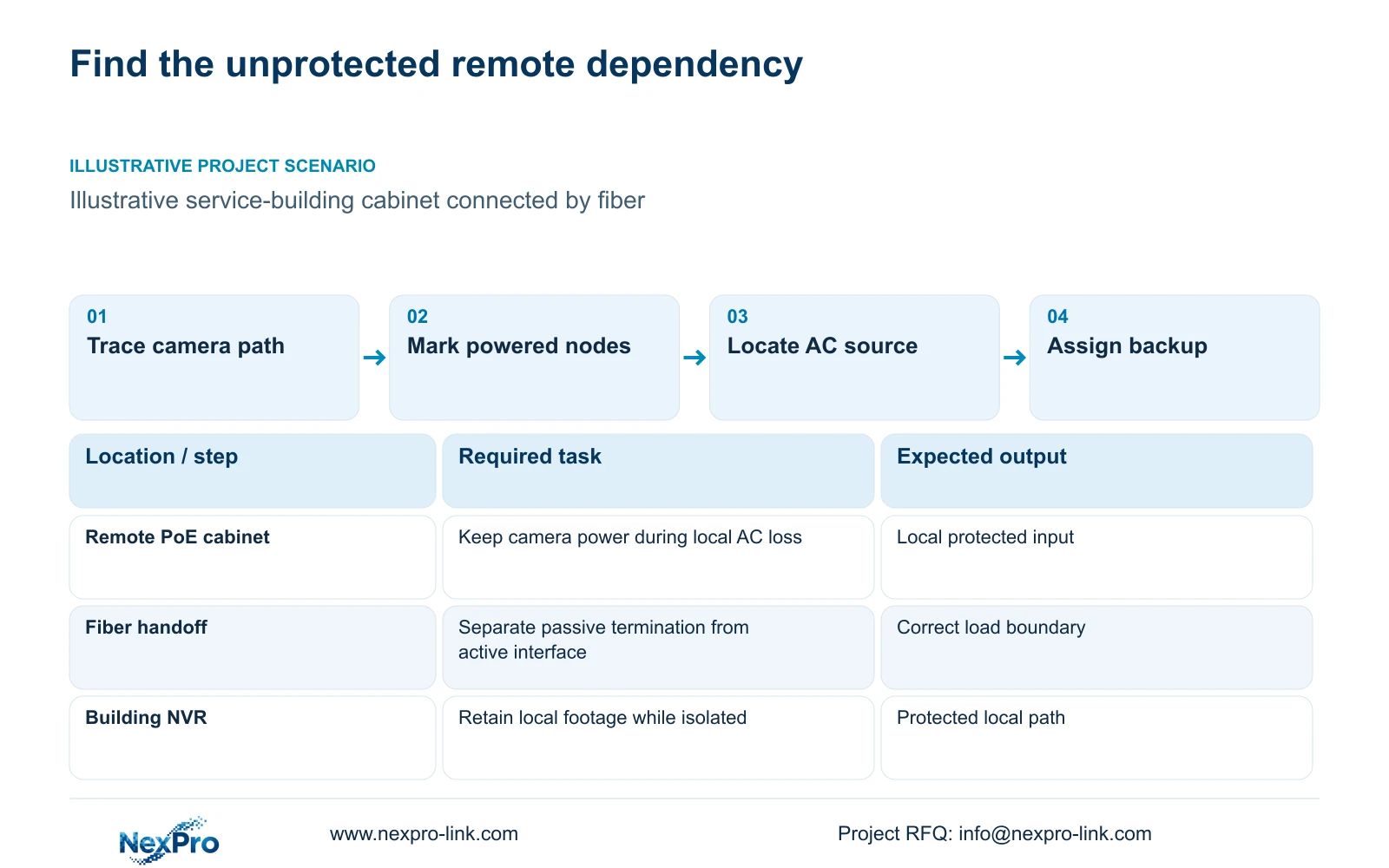
Provide local UPS protection where a remote cabinet uses local AC and must continue operating during its loss. Central UPS capacity is relevant only if an explicitly designed protected electrical path supplies that cabinet. A fiber connection to the main building does not establish such a path.
Trace the required service from each public-zone camera to its recording destination. List the PoE switch and any active uplink equipment, plus a local NVR where recording is distributed. If recording is central, identify the central equipment that must remain available as well. Every active dependency needs an assigned power boundary.
Use an AC load schedule with each figure labeled as measured, manufacturer maximum or planning assumption. Complete PoE switch input includes the downstream camera contribution. Adding the camera PD load again to that same input would overstate the UPS load. Passive fiber termination belongs in the equipment schedule but should not be assigned an invented powered load.
| Required task | Given information | Decision still needed |
|---|---|---|
| Keep remote cameras active | Switch uses local AC | Protect switch input and verify PoE operation |
| Retain footage during isolation | Local recorder proposed | Protect complete local camera-to-NVR path |
Section 02
Locate the cabinet's real AC supply
Identify the supplying circuit, voltage and upstream protection arrangement with the electrical team. Record whether generator power is available and which operating state the UPS must bridge. Equipment selection should follow that agreed source arrangement, not a network drawing that happens to connect the cabinet to reception.
For a central protected feeder, the electrical designer must resolve the actual installation and its boundary. For local backup, the cabinet has its own UPS and supported battery configuration. Compare both against the same required service and interruption target; a central NVR staying illuminated does not demonstrate that remote cameras are still contributing footage.
Keep the main equipment-room load separate from remote-node loads. CASE04 explicitly treats its total power as a cross-node budget and requires division into actual protection zones. Its aggregate figure is not a remote-cabinet measurement. The 750 W example used below is an independent illustrative load and must not be substituted for a CASE04 node.
Section 03
Calculate watts and VA for the selected cabinet
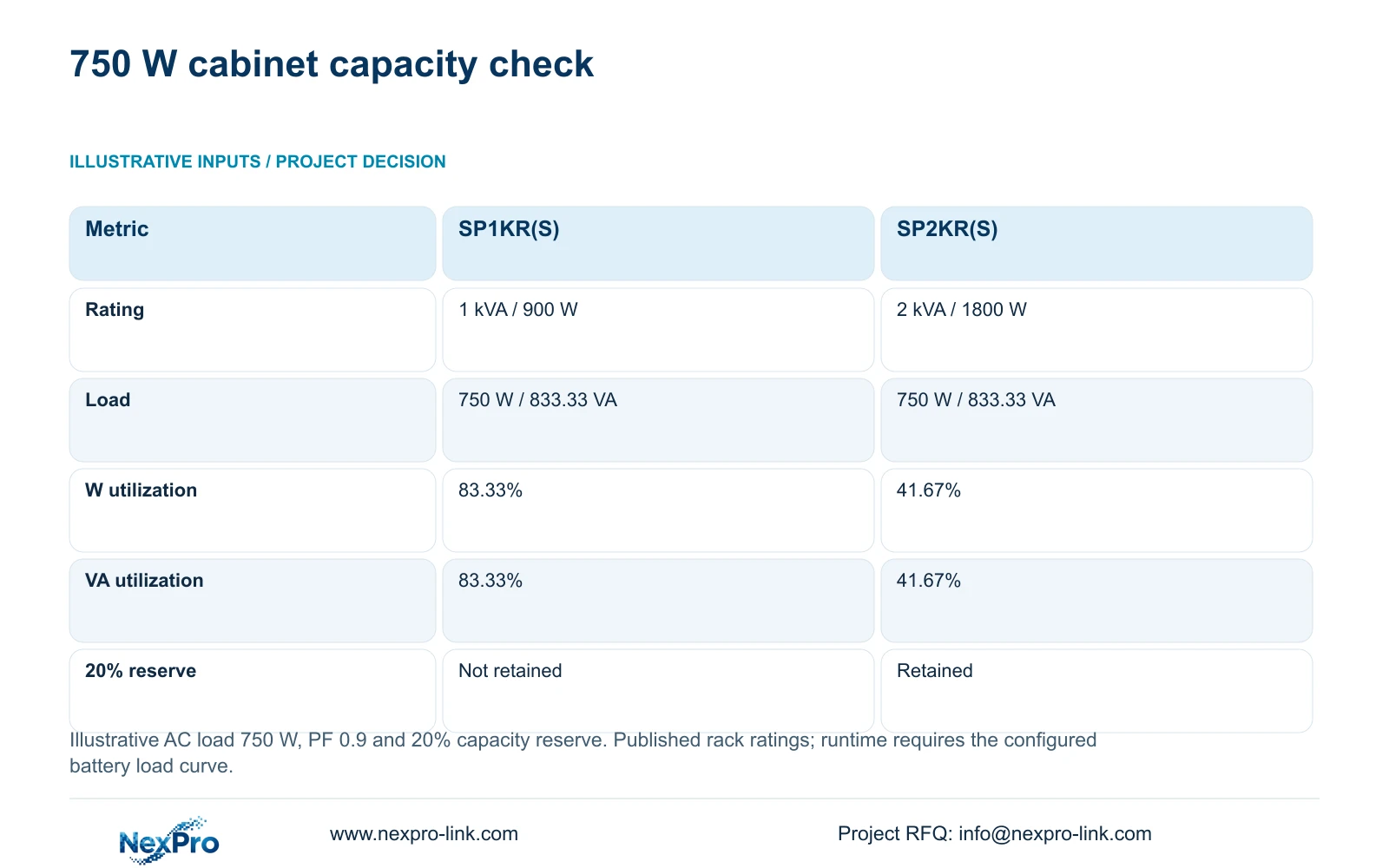
For the illustrative cabinet, protected AC load is 750 W and aggregate power factor is assumed to be 0.9. Apparent power equals watts divided by power factor: 750 / 0.9 = 833.33 VA. Compare real and apparent power separately with each UPS rating.
The published rack models are SP1KR(S), rated 1 kVA / 900 W, and SP2KR(S), rated 2 kVA / 1800 W. W utilization equals load W divided by rated W; VA utilization equals load VA divided by rated VA. The larger rack model meets this example's 20% reserve target in both dimensions.
SP1KR(S) exceeds the assumed steady load but operates at 83.33% of both ratings, leaving less than the selected reserve. That reserve is a project assumption, not a universal rule. SP2KR(S) is therefore the capacity candidate for these inputs. Its suitability still depends on the supported battery configuration, environment and actual load behavior.
| Metric | SP1KR(S) | SP2KR(S) |
|---|---|---|
| Published rating | 1 kVA / 900 W | 2 kVA / 1800 W |
| Assumed protected load | 750 W / 833.33 VA | 750 W / 833.33 VA |
| W utilization | 83.33% | 41.67% |
| VA utilization | 83.33% | 41.67% |
| 20% W and VA reserve | Target not retained | Target retained |
| Battery runtime | Configured load curve needed | Configured load curve needed |
Section 04
Compare local and central backup on continuity and service
Local UPS protection assigns an identifiable backup boundary to the remote node. It also creates another battery and maintenance location. Central protection can concentrate service work, but only an engineered electrical supply can extend it to the remote equipment. Compare the maintenance route and affected equipment when either arrangement is unavailable.
Specify runtime separately from capacity. Required minutes must correspond to the selected battery configuration at the actual protected load. Battery condition, temperature and supported discharge behavior affect the result. A larger kVA rating alone cannot establish a longer operating period, and a default battery figure for one model must not be transferred to another.
SP2K(S) is a tower model rated 2 kVA / 2000 W. It differs from the rack SP2KR(S), rated 2 kVA / 1800 W. Compare mounting and capacity with the exact designation, then obtain the relevant runtime information. Do not infer equal batteries or equal minutes from their shared 2 kVA rating.
Keep optional display loads outside the remote recording boundary unless viewing there is required. Adding a screen or other auxiliary equipment changes both capacity and energy demand. The quote should identify that increment and revise the runtime assessment instead of carrying forward the original duration.
Section 05
Provide fiber handoffs and service space together
Show passive termination, patch leads and active uplink interfaces as distinct roles. Specify the actual fiber route and the supported interface pairing with the project network designer. No generic fiber or transceiver SKU is established by the supplied records, so the proposal should describe the required interface without inventing a model.
The cabinet must accommodate the selected equipment's height, depth and weight, with cable space and maintenance access. Spare U positions alone do not establish that a UPS and its batteries can be installed safely. Obtain the actual mechanical information and resolve support, airflow and environmental conditions with the responsible specialists.
For camera copper tails, SP5648 and DT968MX are patch-panel and module candidates. They do not qualify the bulk cable, fiber termination or complete installed channel. Include the relevant testing and labels so a technician can trace the camera, switch port, uplink and supply without relying on an unrecorded installation arrangement.
Review replacement access before choosing the cabinet position. A local backup system may meet its electrical budget yet be impractical to inspect or replace. Compare relocation or an alternative enclosure arrangement where access conflicts with the resort's operating routes.
Section 06
Demonstrate continuity at the individual node
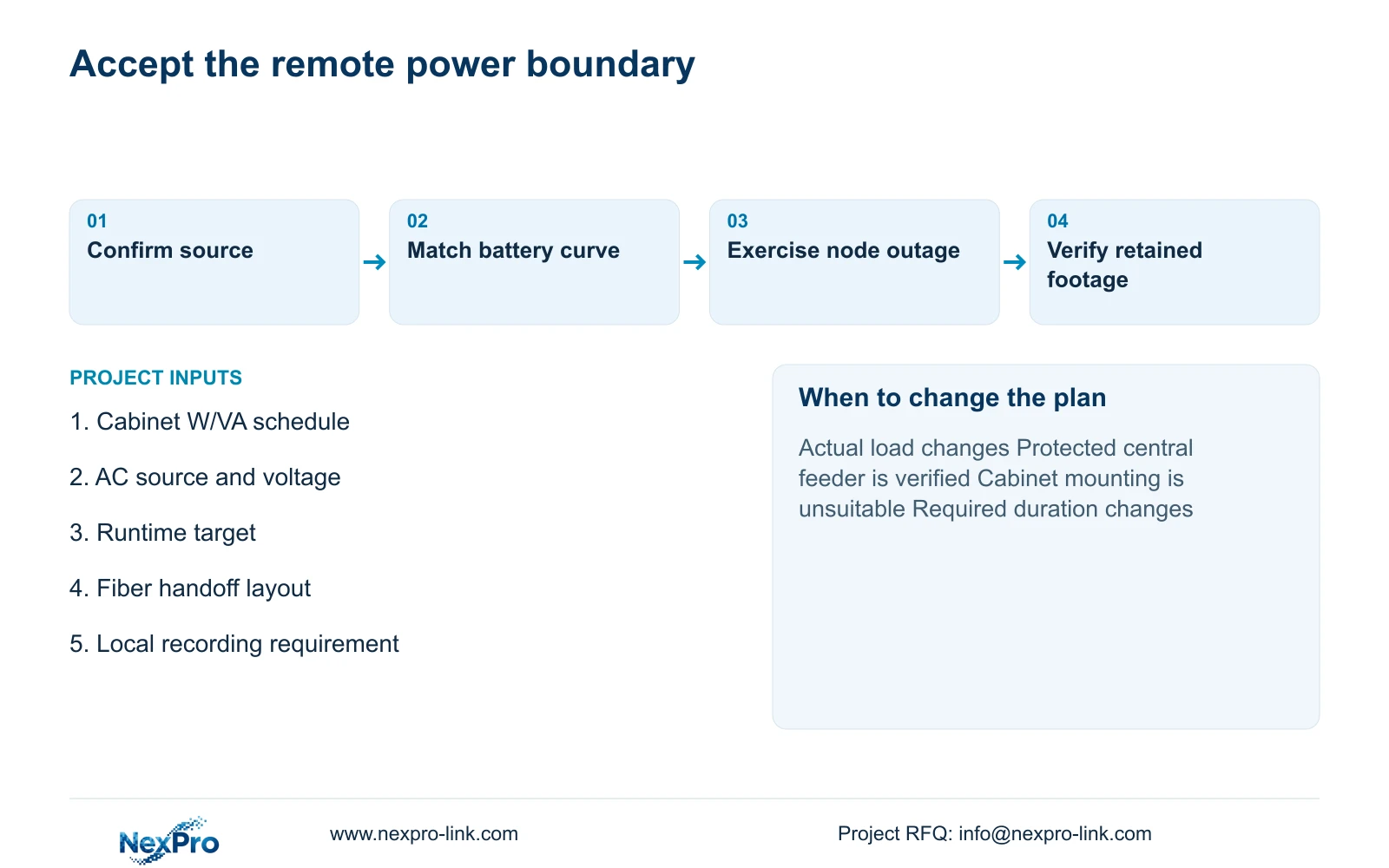
For a locally powered cabinet with an approved outage requirement, select local UPS protection and a load-matched battery configuration. In the stated 750 W example, use SP2KR(S) as the capacity candidate for the 20% reserve target. Change the candidate when measured load, mounting conditions or the reserve requirement changes; accept central protection only with a verified protected electrical path.
Acceptance should exercise the actual node supply interruption under the intended load, then verify camera recording, retrieval and recovery. Test backbone loss separately if local recording during isolation is required. Record the configuration, conditions and observations. Proposed checks do not establish a completed runtime result or qualify every node from one sample.
Send the per-cabinet W and VA schedule, AC voltage/source, required duration and fiber handoff layout to info@nexpro-link.com. Identify which nodes must record locally. Hotel project equipment support and BOQ and tender support can coordinate model and supply scope, while electrical installation, battery handling and safe changeover testing remain with the appropriate local professionals.
Section 07
Buyer questions
Can unused main-building UPS capacity protect a fiber-connected switch? Only through a designed protected electrical supply to that switch. Fiber carries data. Where the remote switch uses an unprotected local circuit, its outage protection must be resolved locally or through a separate approved power design.
Does a 2 kVA UPS guarantee an hour of recording? No. Obtain runtime for the exact supported battery configuration at the cabinet's actual load. Watts and VA qualify conversion capacity; battery energy and discharge conditions determine the duration.
What proves the remote node survived the outage? Relevant footage recorded through the test interval, retrievable by an authorized operator, with the required camera and network path operational. UPS indicators alone do not demonstrate the recording outcome.
Engineering references
These sources support the general planning principles. Always use the selected product's current datasheet and applicable project standards for final design.