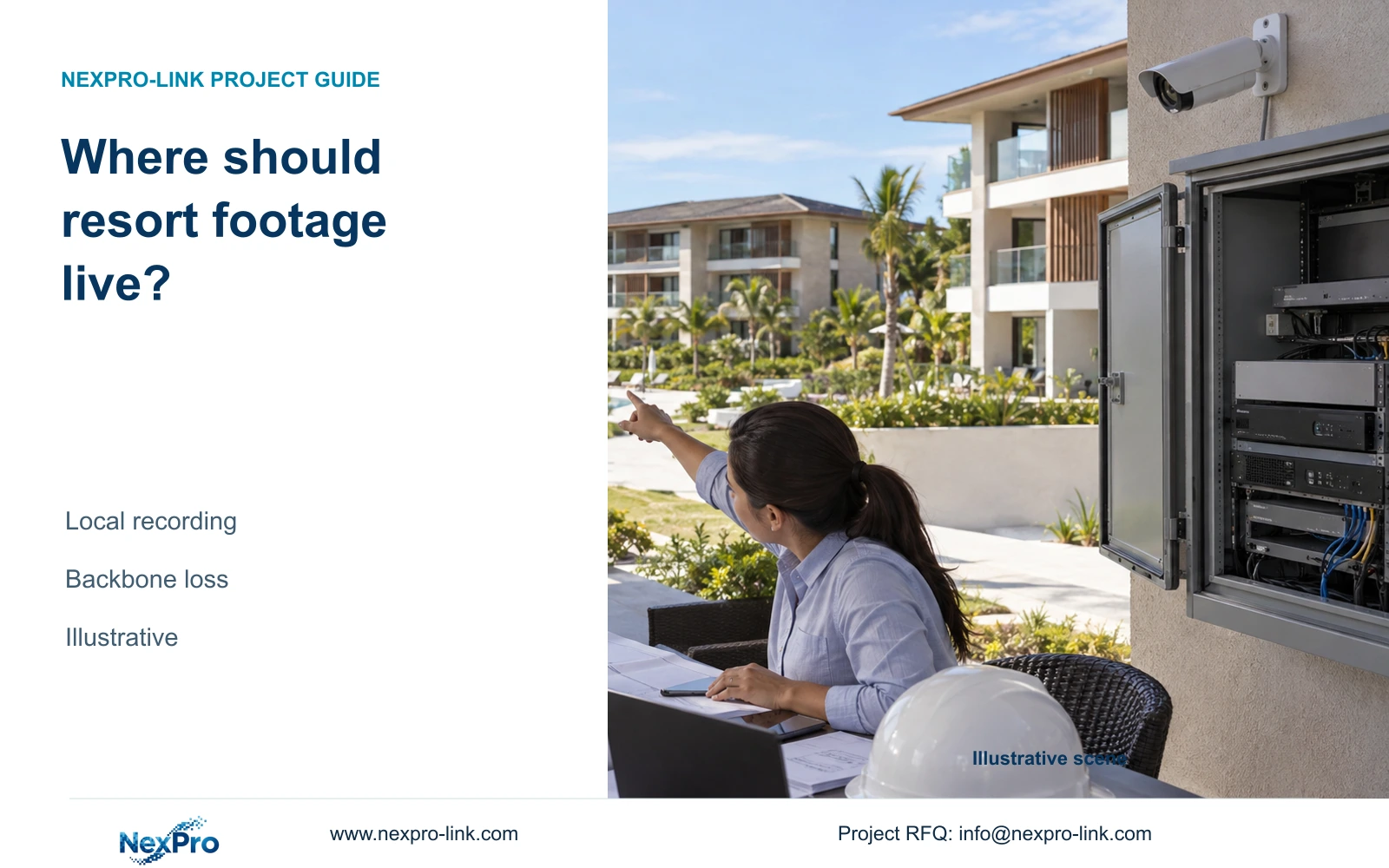
Building-level recording is appropriate when footage must survive an interbuilding link outage. Compare that requirement with cabinet access, storage allocation and protected power before selecting the architecture.
Section 01
Choose which buildings must record independently
Choose building-level NVRs where the resort must retain footage during an interbuilding backbone outage. Central recording remains an option where the approved continuity requirement permits that dependency. A hybrid arrangement suits projects with different requirements across buildings, provided the central client can perform the required viewing and retrieval tasks.
Map public entrances, reception activities, accommodation circulation and service routes to their recording locations. Give each view a defined purpose and identify who needs access during an incident. Bedroom count does not determine camera quantity, and guest-room interiors or other sensitive private spaces are outside this planning scope.
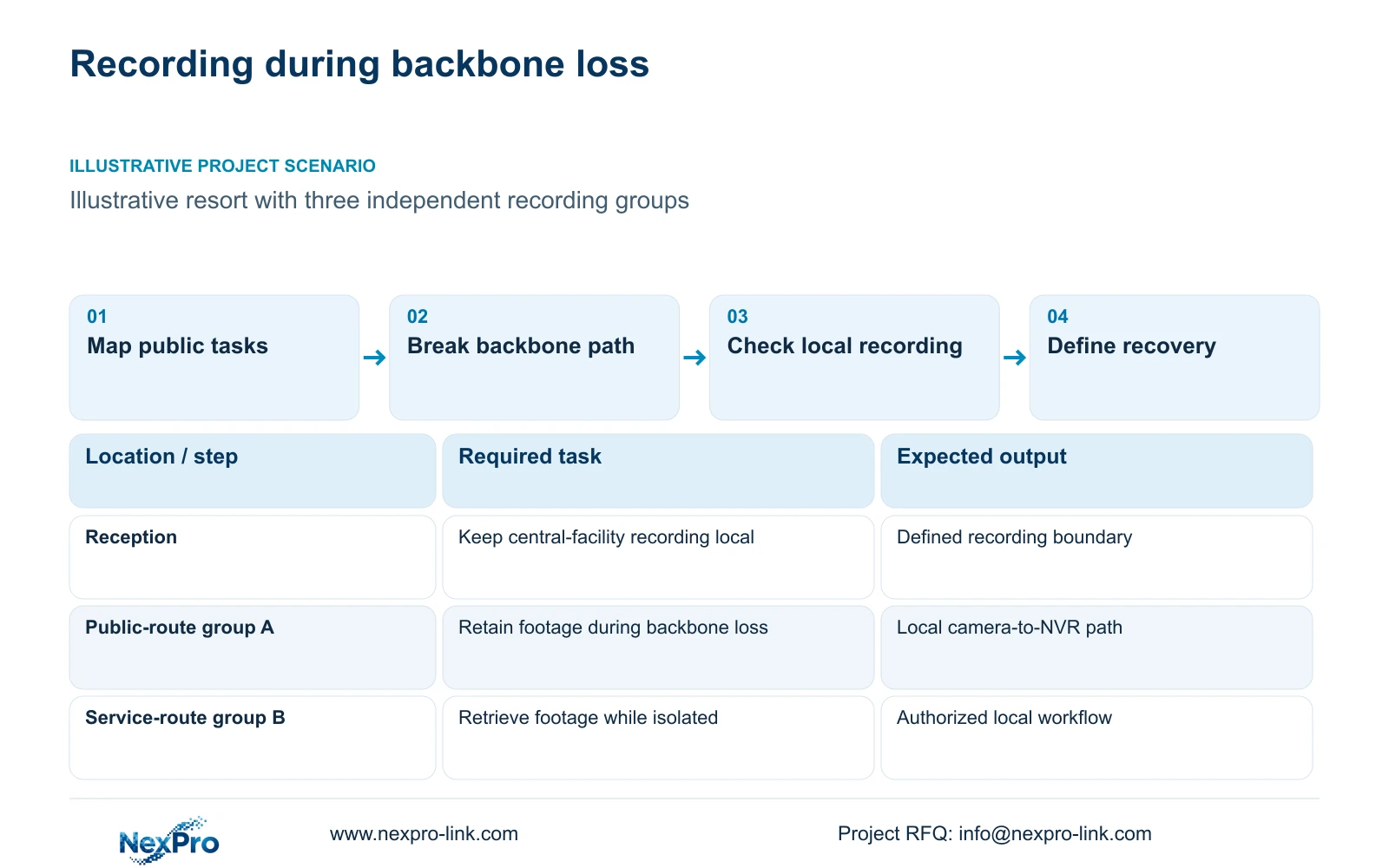
The illustrative CASE04 groups 96 cameras into three sets of 32: central facilities, accommodation public routes A, and accommodation or service routes B. These are teaching allocations, not a delivered resort. Use the grouping to ask whether each set has an independent camera-to-recorder path, a maintainable cabinet and a responsible local service team.
| Required task | Given information | Decision still needed |
|---|---|---|
| Retain accommodation-route footage | Two defined public-route groups | Locate recording within each independent group |
| Investigate incidents centrally | Reception has an operator position | Confirm supported search and export across recorders |
Section 02
Define what remains available after a backbone outage
Write the outage requirement as an observable result. For a building that must record independently, its cameras must still reach its NVR through functioning local network equipment. A recorder installed nearby provides no continuity if the configured traffic path still depends on an unavailable central node.
Separate recording from central visibility. Local footage can continue while reception loses live views, alarms or remote playback. The operator needs a documented way to recognize that condition and recover access after the backbone returns. Automatic synchronization or backfilling should appear in the specification only when the selected platform explicitly supports it.
Also distinguish a broken data link from loss of local electricity. Distributed recording addresses the first condition only when the local recording path remains operational. Define both events in acceptance, including the location from which staff can retrieve footage while the building is isolated.
| Item | Central recording | Building recording | Hotel effect |
|---|---|---|---|
| Backbone unavailable | Required remote stream path interrupted | Local path can remain operational | Continuity depends on actual routing |
| Central viewing | Remote views unavailable | Isolated building views unavailable centrally | Local recording and central visibility differ |
| Local AC unavailable | Remote cameras may stop | Local cameras and NVR may stop | Both require resolved power protection |
Section 03
Compare recorder locations and maintenance boundaries
A central equipment room concentrates disk replacement and routine access. Building cabinets spread those activities across the site. Compare access permissions, environmental suitability and the route technicians must take to reach equipment. A remote recorder that staff cannot service within the required restoration window creates a different operational risk.
CASE04 uses three NexPro-NVR4449-4K candidates. Its public record lists 49 channels, 320 Mbps input, four SATA positions and 18 TB per disk. The summary specifies 49 × 5MP or 9 × 4K, so channel count alone cannot qualify an arbitrary 8MP schedule. Recording mode, playback concurrency and the exact disk combination still need confirmation.
For the topic's calculation, the inputs are 96 cameras at an assumed average 4 Mbps, continuously recording for 30 days. Input equals camera count multiplied by bitrate. Video volume in decimal TB equals 0.0108 × camera count × Mbps × days; required usable capacity equals that volume divided by 0.80. These assumptions support storage planning, independent of recorder location.
Section 04
Calculate storage and traffic at their actual boundaries
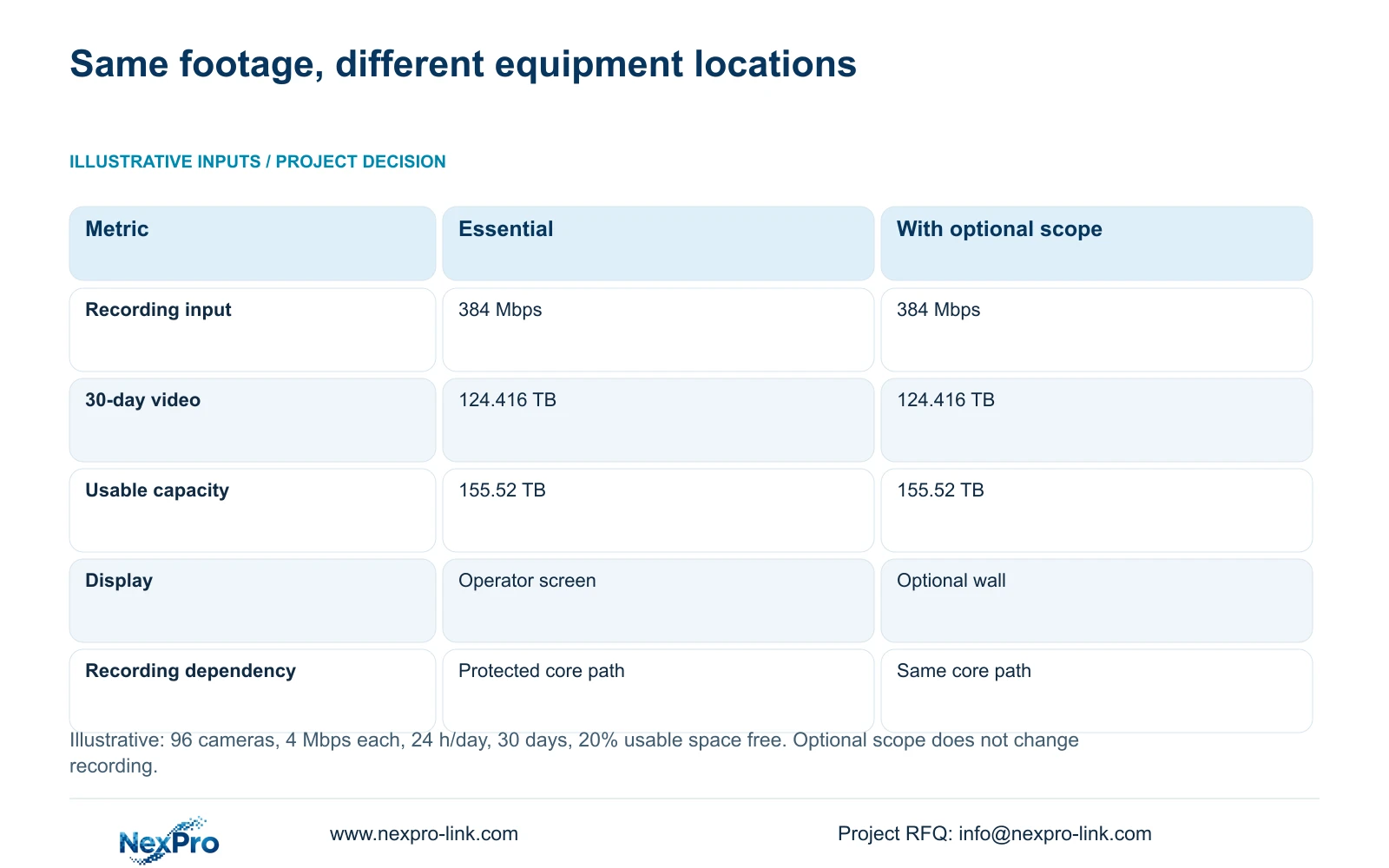
The comparison below preserves the essential recording service while adding optional display or recovery scope. It does not compare measured central and distributed performance. Both packages require the same recording data volume; moving disks between buildings does not reduce the footage generated.
Leaving 20% of usable space free means dividing video volume by 0.80. Multiplying by 1.20 would provide a different reserve. Keep raw disk capacity, any array deductions, formatted space and the recording budget separate. A hot spare cannot also contribute recording capacity.
CASE04 shares these recording assumptions and adds its own disk arrangement: three recorders with four 16 TB disks each, totaling 192 TB raw. Its assumed 95% formatted capacity is 182.4 TB, leaving a 145.92 TB video budget after the reserve. That exceeds 124.416 TB without RAID deductions. Each recorder receives 128 Mbps; a backbone segment carries only the streams actually routed through it, plus its concurrent viewing or export traffic.
| Metric | Essential recording-first package | Same core plus optional scope |
|---|---|---|
| Recording input | 384 Mbps | 384 Mbps |
| 30-day video data | 124.416 TB | 124.416 TB |
| Required usable capacity | 155.52 TB | 155.52 TB |
| Protected path | Cameras, network and recording | Same plus selected extras |
| Operator display | Task-sized monitor/workstation | Optional wall; independent recording |
| Cost boundary | Complete scope quotation | Documented incremental scope |
Section 05
Protect each building's recording path
Draw power separately from data. Fiber transports data and does not automatically supply electricity to remote switches. Every building that must retain footage needs an identified protected supply for its essential access network and recorder. Protect central viewing equipment separately if viewing during an outage is required.
Calculate PoE output per access group, then its AC input contribution to the UPS. When measured switch AC input already includes downstream camera power, do not add those cameras again. CASE04 assumes 16 cameras per node, 12 W PD peak each and 90% cable delivery efficiency, producing a 266.67 W PSE budget with 20% spare. These are case assumptions, not verified camera or switch maxima.
NexPro SW-POE1618G is a candidate with 16 PoE access ports and two uplinks. Its source has conflicting access-speed descriptions and no numerical total PoE budget. Obtain those fields before qualifying it. UPS selection must likewise satisfy each zone's W and VA limits and its configured runtime curve; an aggregate resort total does not justify one centrally located UPS for dispersed cabinets.
Section 06
Select an architecture with a defined recovery procedure
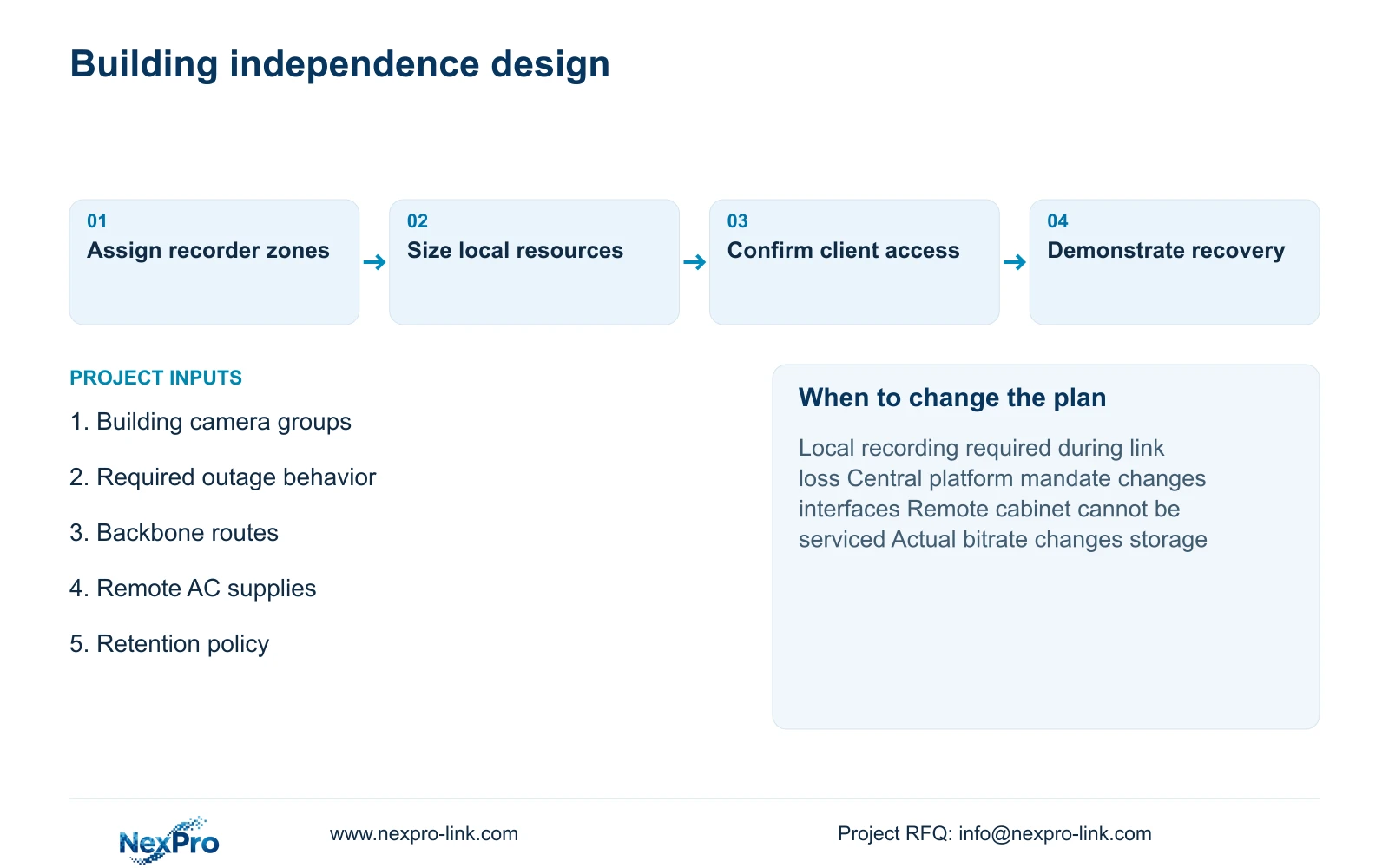
For the CASE04 objective, select local recording within each defined building group and central access only through a confirmed client workflow. Change to central recording where the approved outage requirement accepts the backbone dependency and central maintenance offers a practical advantage. Use a hybrid if only selected buildings require independence.
Include a controlled backbone interruption and a separate power-loss exercise in the acceptance scope. Verify retained footage, authorized retrieval and restoration of central access. Record observations against the actual models and software versions; these proposed checks are not completed test results.
Send the building layout, camera groups, link distances and remote power conditions to info@nexpro-link.com, with the required disconnected operating state. Hotel project equipment support and BOQ and tender support can help define model matching and coordinated supply. NexPro-Link's CCTV manufacturing core and supporting equipment coordination should remain separately described, with local installation and platform responsibilities identified in the proposal.
Section 07
Buyer questions
Does a central video wall require central recording? No. The display location and recording location are separate decisions. Confirm that the client or decoder can access the proposed recorders and perform the required simultaneous views without making the wall a recording dependency.
Can spare disk space in one building cover a shortage elsewhere? Do not assume pooled capacity. Allocate retention to each recorder and check the platform's supported storage behavior. Unused space elsewhere does not automatically extend an isolated building's recording period.
What must a comparable quotation include? The same camera tasks and retention, recorder and disk configurations, remote cabinets, protected supplies, backbone interfaces and local service boundaries. Price optional displays separately so they do not conceal missing continuity equipment.
Engineering references
These sources support the general planning principles. Always use the selected product's current datasheet and applicable project standards for final design.