A shared switch can reduce equipment count, but only when its routes, simultaneous PoE budget and outage boundary suit the hotel. Compare complete floor scope.
Section 01
Group cameras by actual cable routes
Choose a shared floor switch only when every assigned route meets its specified link basis, the simultaneous PoE budget is sufficient and the hotel accepts the wider outage boundary. Use local floor nodes when cross-floor routes or service-impact limits defeat that arrangement. Port price alone cannot decide the topology.
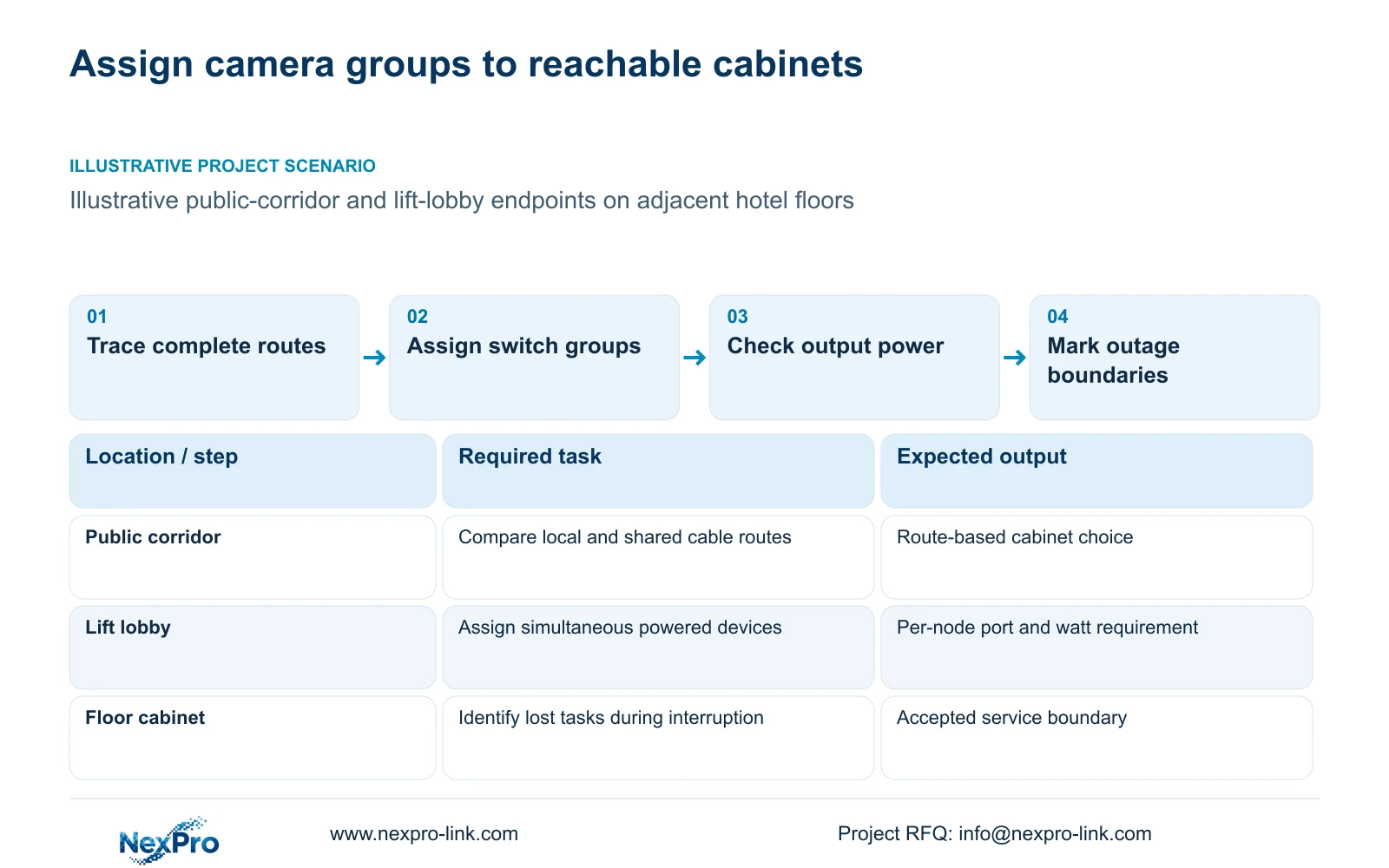
Assign cameras to cabinets using installed routes from endpoint to endpoint. Include horizontal travel, risers and explicit termination allowances. Keep patch cords separate from the permanent-link schedule. An average distance can support an early estimate, but it cannot show which cross-floor camera exceeds the intended link basis.
The supplied Fluke Networks source uses typical 90 m permanent-link and 100 m channel boundaries. These are different length definitions. Confirm the project's category, connection arrangement and test basis alongside destination requirements. The route drawing should identify the public corridor and lift-lobby endpoints without deriving quantities from guest-room numbers.
| Required task | Given information | Decision still needed |
|---|---|---|
| Connect the far corridor camera | Horizontal route and riser location | Complete permanent-link length |
| Supply the lift-lobby group | Camera tags and candidate cabinet | Port and simultaneous power allocation |
| Maintain floor recording | Required outage state | Protected access-node power path |
Section 02
Calculate per-floor PoE demand
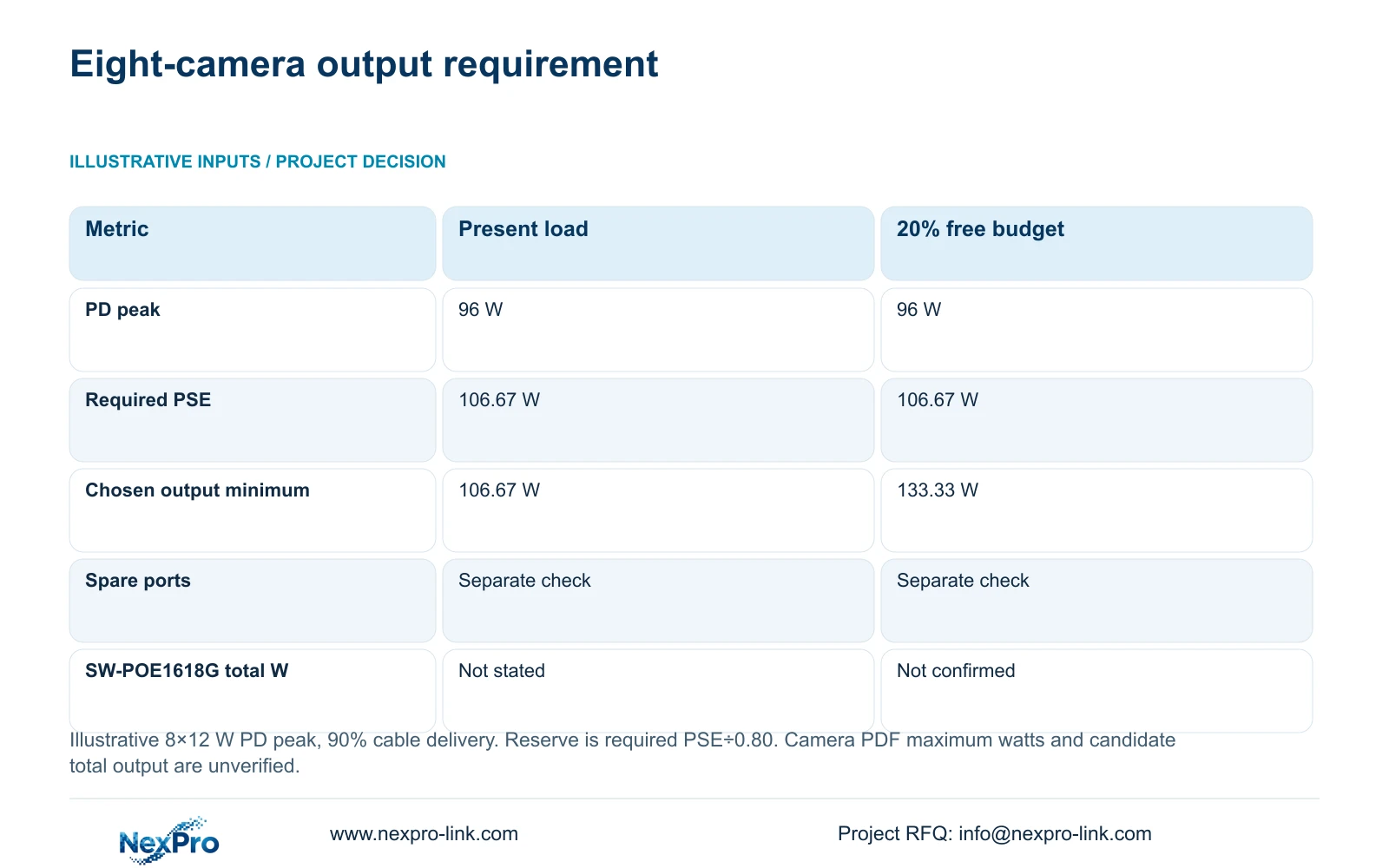
Calculate the group attached to each actual switch. In this independent teaching example, eight hypothetical cameras each require 12 W peak at the powered-device boundary. Their combined PD load is 96 W. The camera PDFs do not verify a 12 W maximum, so actual selection requires supported peak-power data for the intended operating modes.
Assuming 90% cable delivery efficiency, required power-sourcing-equipment output is 96 ÷ 0.90, approximately 106.67 W. To retain 20% of the chosen usable output budget free, use (96 ÷ 0.90) ÷ 0.80, approximately 133.33 W. Carry the unrounded intermediate value through the calculation; the table displays rounded results. Multiplying by 1.20 would apply a different reserve definition.
Both individual ports and the switch's simultaneous total output must support the devices. Free ports and free watts are separate resources. Option B is the appropriate planning minimum when the stated reserve target applies; Option A covers only the assumed present demand. Neither output number is the complete switch AC input used for UPS selection.
| Metric / condition | Present-load output | Output retaining 20% free |
|---|---|---|
| PD group peak (W) | 96 | 96 |
| Required PSE output (W) | 106.67 | 106.67 |
| Minimum chosen output budget (W) | 106.67 | 133.33 |
| Free port requirement | Check separately | Check separately |
| SW-POE1618G total power | Not stated in the read source | Must not assume it passes |
Section 04
Measure failure impact
Count which accepted camera tasks depend on each switch, uplink and supply. A shared access switch can place several floors within one interruption boundary. Local switches can separate some access-node outages, while a shared backbone or core remains a common dependency. Draw those boundaries without claiming a failure probability.
Evaluate a planned maintenance event as well as an unplanned interruption. List the public routes or lift approaches that stop reaching the recorder, the person authorized to act and the required restoration task. A smaller outage group has value where the hotel needs the unaffected floor to remain observable.
Power reserve does not provide a redundant data path, and spare ports do not prevent a switch outage. The 133.33 W teaching budget retains the stated output margin for eight assumed devices; it is not a continuity guarantee. If the shared boundary exceeds the hotel's accepted service impact, revise the grouping even when power and cable reach pass.
Section 05
Price cabinets and protected power
Compare switch equipment with the complete cabinet and support scope. Local nodes can require additional enclosure space, patching, protected supplies and service access. Shared nodes can need longer routes and greater simultaneous power. Obtain quotations on the same recording and outage duties so omitted infrastructure does not create a false price advantage.
Keep PD load, PSE output and complete AC input in separate columns. When a measured switch AC value includes its powered cameras, do not add those cameras again to the UPS schedule. UPS selection must satisfy both watts and VA; the requested battery configuration and load curve determine the runtime assessment.
SP5648 is a Cat6 48-port patch panel, and DT968MX is a Cat6 module. Neither establishes the cable specification or certifies the complete installed link. The supplied policy gives applicable main equipment a receipt-based 24-month limited hardware baseline; batteries, cables and project service costs require their own stated scope. Local electrical installation and safe changeover testing remain separately assigned.
| Retained outcome | Extra scope | Worth buying when | Counter-condition |
|---|---|---|---|
| Suitable cable reach | Local cabinet and backbone connection | Shared route exceeds specified basis | Shared routes meet the basis |
| Limited interruption boundary | Separate floor access nodes | Hotel requires independent floor maintenance | Shared interruption is accepted |
| Recording through power loss | Protected supply at each required node | Node is on the essential recording path | Continuity requirement excludes that path |
Section 06
Select a topology with service access
Choose cabinet locations that authorized staff can reach for inspection and replacement within the hotel's operating constraints. State the assigned cameras and cable identities, with usable power and link requirements for each node. Keep the data topology distinct from the protected-power diagram so a central UPS is not assumed to protect disconnected floor supplies.
NexPro SW-POE1618G remains an inquiry candidate with 16 PoE ports, two uplinks and an af/at description. Its title and detailed access-port speeds conflict, and numerical total output power is not stated. Request those fields before confirming a match. CASE03's six-node, 48-camera example is separate system context and does not establish this hotel's topology.
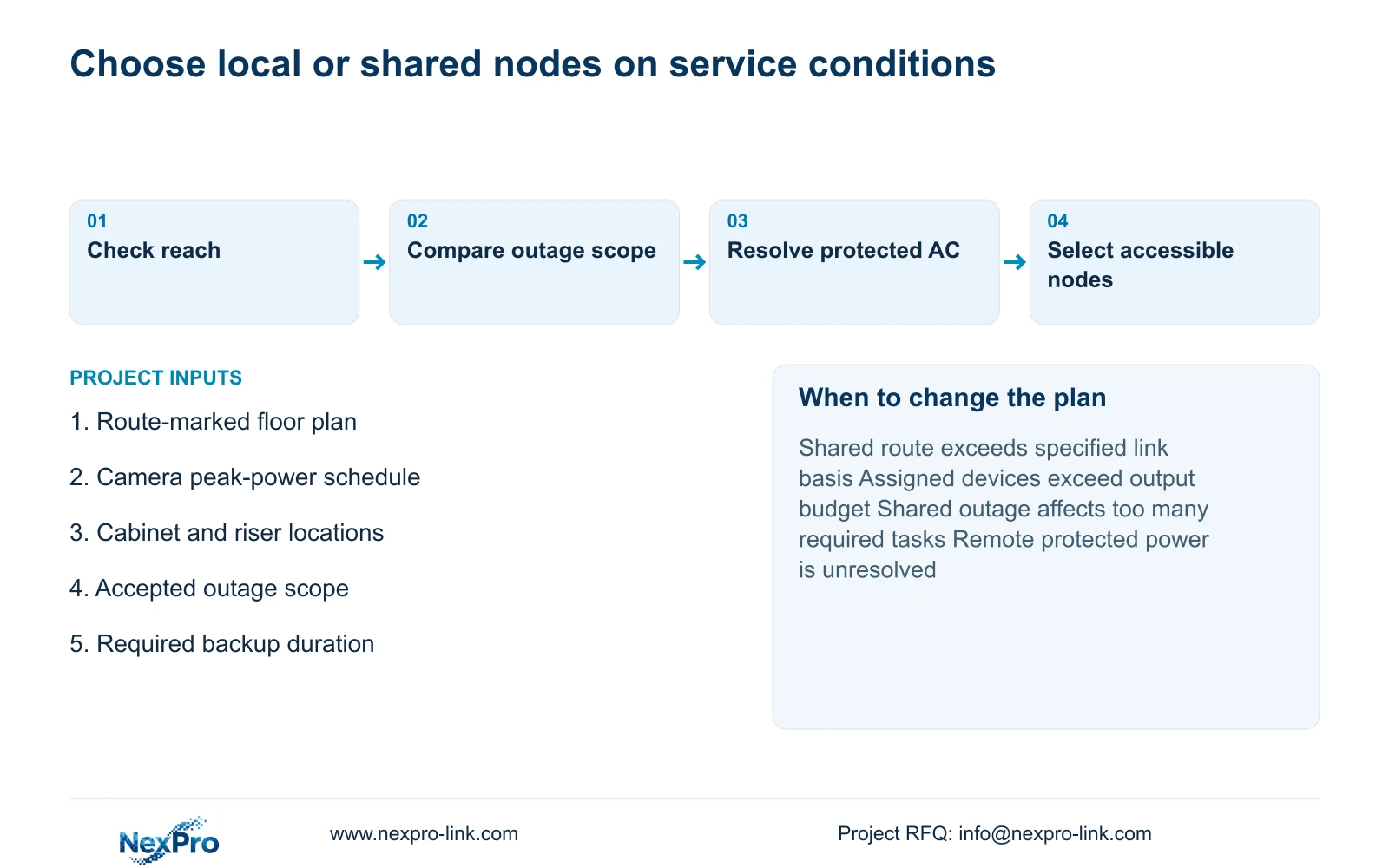
Recommend local nodes where verified route length or accepted failure impact requires them; otherwise compare the complete shared-node proposal. Change selection when camera peak power, grouping, cabinet access or backup duty changes. Send a route-marked floor plan, per-camera peak-power information, cabinet locations and required outage duration to info@nexpro-link.com. NexPro-Link can support model matching and a coordinated BOQ; actual supply and local-installation boundaries should be explicit.
Section 07
Buyer questions
Can unused PoE ports be treated as expansion capacity? Only after checking spare simultaneous power, uplink demand and recording resources for the intended additions. A physically empty port does not establish that the switch can supply another peak-load device.
Does one central UPS protect every floor camera? Only if every required access node has an actual protected supply path from that arrangement. Remote switches with independent supplies need their own resolved protection. Fibre connectivity alone provides no power continuity.
What switch information must a quotation resolve? Request access-port and uplink speeds, per-port PoE capability, usable simultaneous total output and complete AC-load information. For NexPro SW-POE1618G, the supplied speed conflict and missing total watts must remain unresolved until supported configuration information is provided.
Engineering references
These sources support the general planning principles. Always use the selected product's current datasheet and applicable project standards for final design.