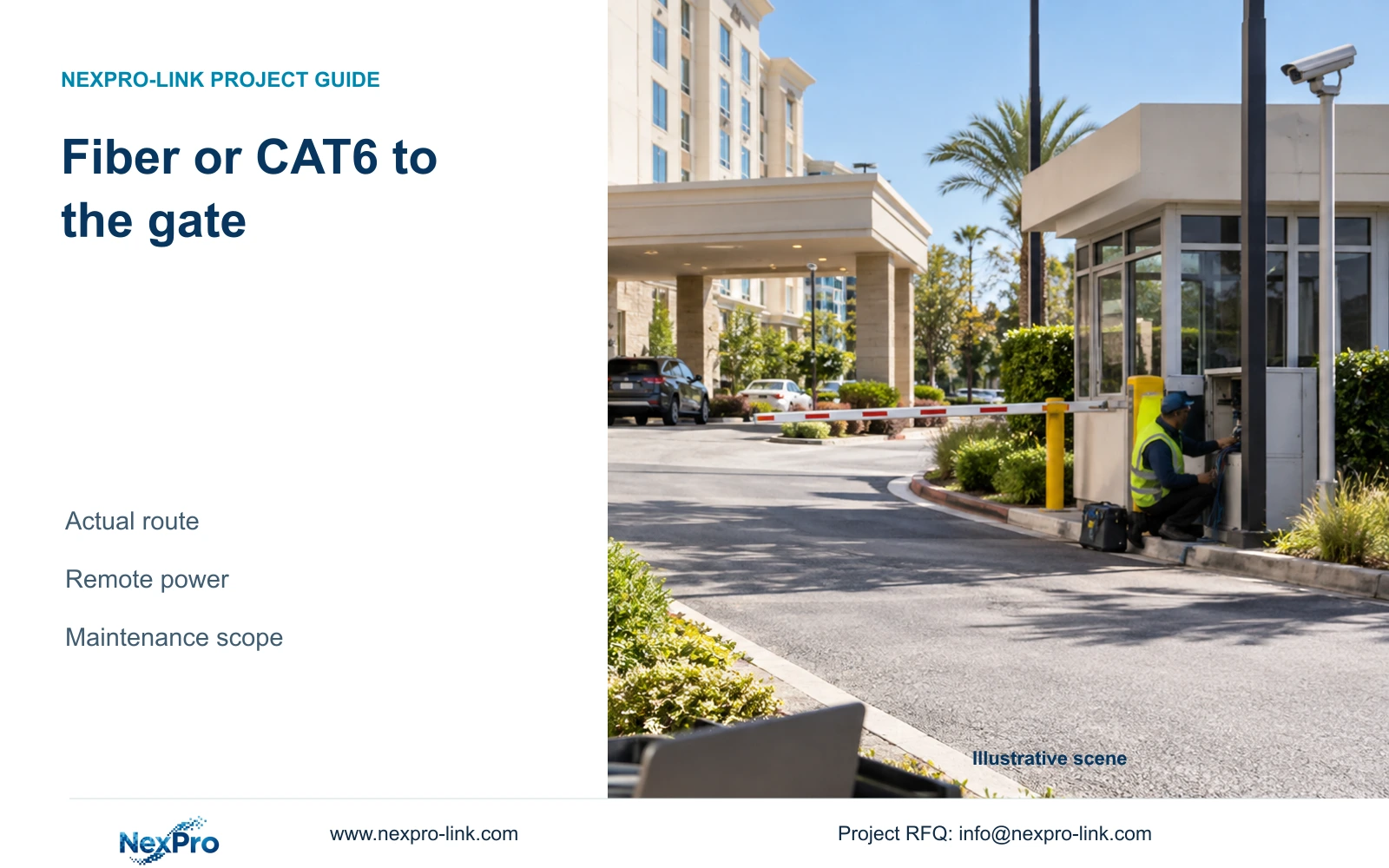
Use direct copper when the actual installed link meets its specified basis. For a longer gatehouse route, compare fiber with resolved local power and maintenance.
Section 01
Measure the installed route before choosing the medium
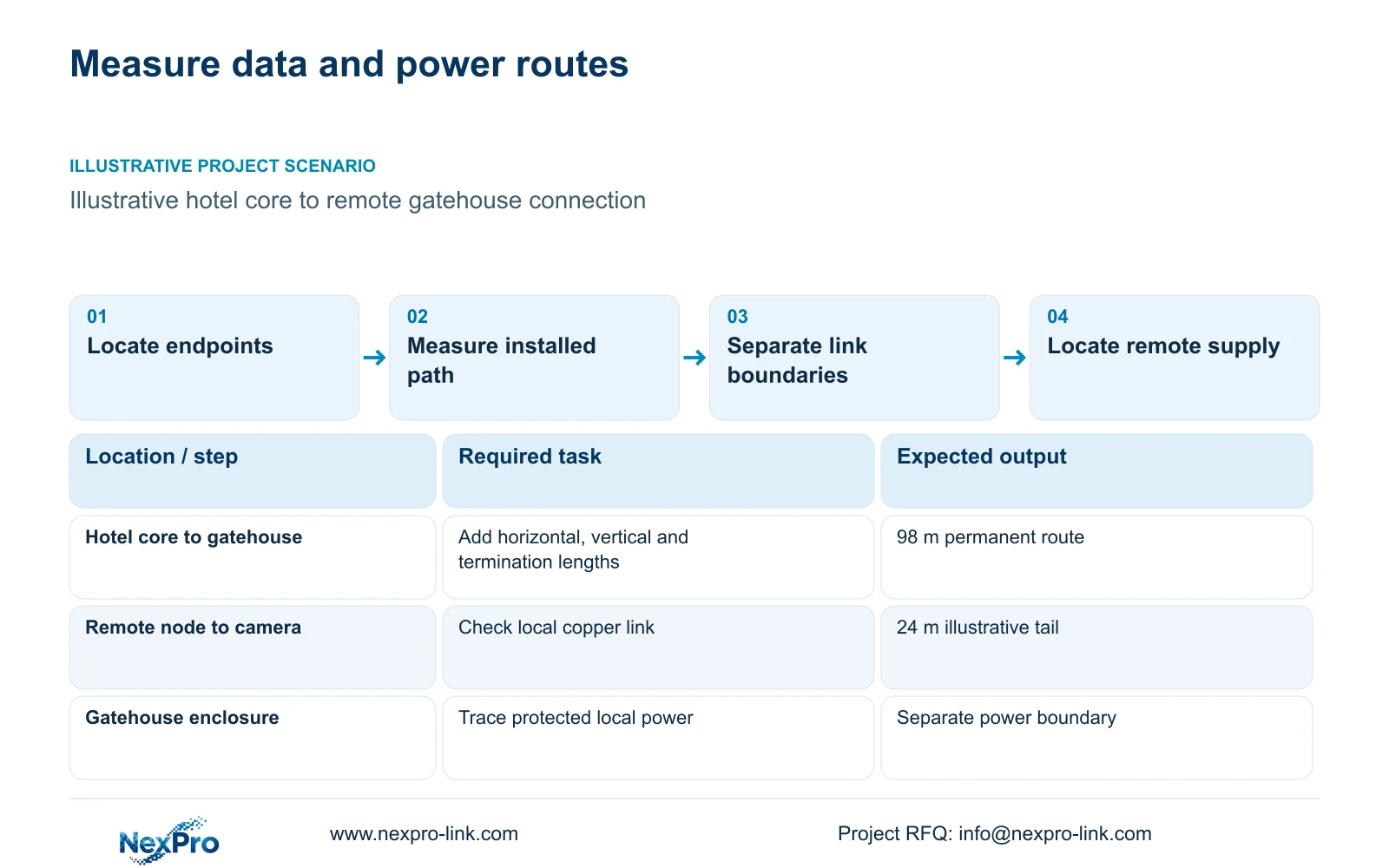
Use direct copper when the complete installed link meets the project's specified length, environment and performance basis. For the illustrative 98 m permanent route, compare a qualified fiber backbone with a short local copper tail, provided remote power and maintenance are resolved. Do not accept an extension mode as a general substitute for a standard copper link.
Measure from the actual termination points along the permitted installation route. Include horizontal runs, vertical changes and stated termination allowances. A gatehouse's straight-line distance from the hotel does not account for the route through trays, risers or approved crossings. Record provisional measurements separately from confirmed dimensions.
Schedule each endpoint independently. Total cable metres help estimate purchasing, but they do not prove that an individual run meets its link basis or can be cut continuously from the selected reel. Distributed leftover tails cannot be treated as one usable long run. Keep the route decision attached to the endpoint and its service task.
| Required task | Given information | Decision still needed |
|---|---|---|
| Connect gatehouse video to recording | Proposed endpoint positions | Measured installed route and link basis |
| Power remote cameras | PoE camera arrangement | Direct PSE path or supported local supply |
| Maintain the remote connection | Available equipment locations | Accessible termination and active-node positions |
Section 02
Separate the permanent link from the complete channel
The supplied Fluke Networks source uses the typical 90 m permanent-link and 100 m channel distinction. The channel includes patch cords. Apply the correct basis to the segment being measured, with the project's category, connector arrangement and test configuration. A permanent route below 100 m is not automatically acceptable under a 90 m permanent-link basis.
For the worked route, 82 m horizontal plus 12 m vertical plus 4 m termination allowance equals 98 m. Those allowances are already inside the permanent-route total. Do not classify them as patch cords to make the route appear shorter or add them a second time when ordering cable.
Specify the complete copper link components. SP5648 is a Cat6 48-port patch panel and DT968MX is a Cat6 tool-free module. Neither identifies a reel of cable or establishes the installed link's category by itself. Cable construction, sheath suitability, patch cords, connections and installation testing remain part of the project specification.
Section 03
Compare fiber with supported extension arrangements
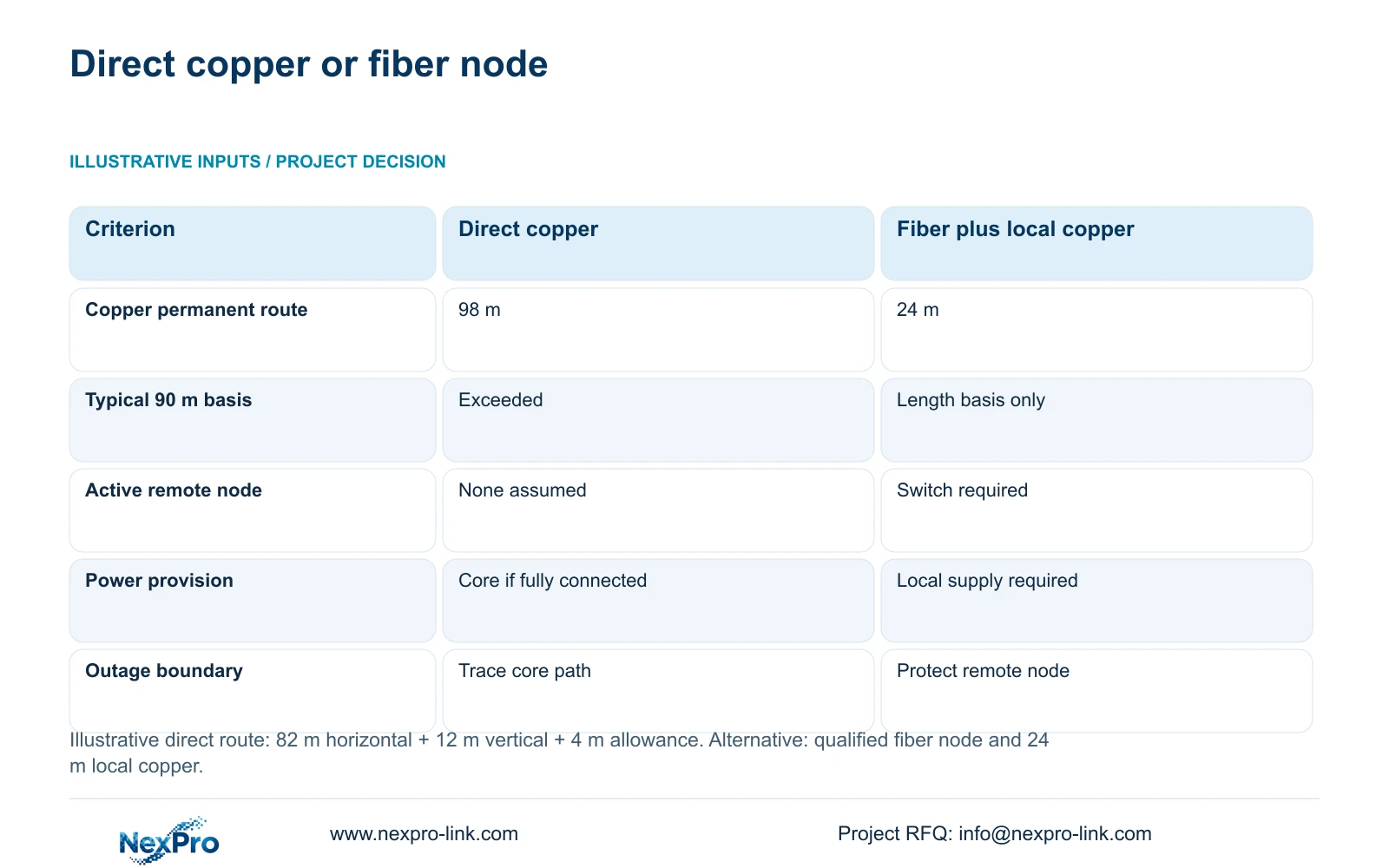
The 98 m direct permanent copper route exceeds the stated typical 90 m basis. The alternative assumes a qualified fiber connection to a remote node and a 24 m local copper tail. The tail satisfies the length comparison only; its components, PoE delivery and installed performance still require appropriate selection.
A supported extension arrangement is another design option, with its own documented distance, speed and power limits. Adding an extender or switch introduces an active dependency and changes the service boundary. Ask for the exact operating mode and supported endpoint arrangement. The evidence supplied here does not establish a particular extension product or performance limit.
Compare direct copper, an adjusted distribution location and fiber on complete scope. If a revised route brings copper within the specified basis without compromising installation or maintenance, direct copper may remain the simpler choice. Where the longer route remains, fiber is a candidate only after its interfaces, local supply and enclosure have been defined.
| Metric or condition | Direct copper route | Qualified fiber node plus local copper |
|---|---|---|
| Planned copper permanent route | 98 m | 24 m local tail |
| Typical 90 m permanent-link basis | Exceeds this basis | Within length basis only |
| Extra active dependency | None assumed | Remote switch and local power |
| Backup boundary | Core supply if fully connected | Remote node must also be protected |
Section 04
Resolve remote power and enclosure requirements
Draw the fiber data path separately from the protected-power path. Fiber does not automatically supply the remote switch or its cameras. Identify the local source and which devices must stay active during an outage. A valid backbone connection can still leave the camera service unavailable if the remote node loses power.
Select the enclosure and equipment for the actual location. Include access for termination and replacement, installation space, the supported equipment environment and its heat load. A camera's IP66 rating does not establish the suitability of a nearby switch, power supply or cabinet. Avoid placing serviceable equipment where routine access disrupts the lane unnecessarily.
NexPro SW-POE1618G is a 16-PoE-port and two-uplink candidate in the supplied record. Its access-port speed descriptions conflict, and no numerical total PoE budget is stated. Do not assume that its uplinks accept the proposed fiber interface or that it meets the remote group load. Request explicit interface, port-speed and output-budget information for the selected arrangement.
Section 05
Include civil works in the route comparison
The route price should cover the physical work needed to make the connection usable. Where applicable, identify containment, crossings, penetrations, access points and reinstatement. Existing pathways may reduce new work, but their availability and suitability need to be confirmed. A cable-only quotation cannot establish the cost of reaching the gatehouse.
Give each alternative the same required endpoint and outage service. Separate passive installation work from active equipment and protected-power additions. The cost manager can then see whether an apparent cable saving has shifted cost into an enclosure, a remote UPS or recurring access work. Use actual scope-matched quotations; no market prices are supplied for this comparison.
Allocate responsibility for route approval and local installation to the appropriate project parties. Network access and device ownership also need a hotel-approved arrangement when a remote node is introduced. These responsibilities should be visible in the BOQ and handover record, without placing passwords or privileged network details in initial commercial inquiries.
| Retained outcome | Extra scope | Decision condition |
|---|---|---|
| Gatehouse connectivity | New containment or crossing work | Existing approved route is unavailable |
| Outage recording | Remote protected supply | Fiber node is outside the core power boundary |
| Serviceable connection | Accessible enclosure and termination | Remote equipment needs safe local maintenance |
Section 06
Select the route with a complete service boundary
Choose fiber with a qualified local node for the illustrated long route when local power, protected operation and access can be provided. Choose direct copper when a measured alternative route meets the specified link basis and installation conditions. Use an extension arrangement only when its exact supported limits match the required service and its additional dependencies are accepted.
The final equipment list should identify both backbone ends, actual interface types, local copper links and protected-power devices. Retain endpoint labels and the agreed test basis in the handover. CASE09's separate 908 m copper-cutting example concerns its local camera routes; it does not specify this gatehouse backbone or establish a fiber purchasing length.
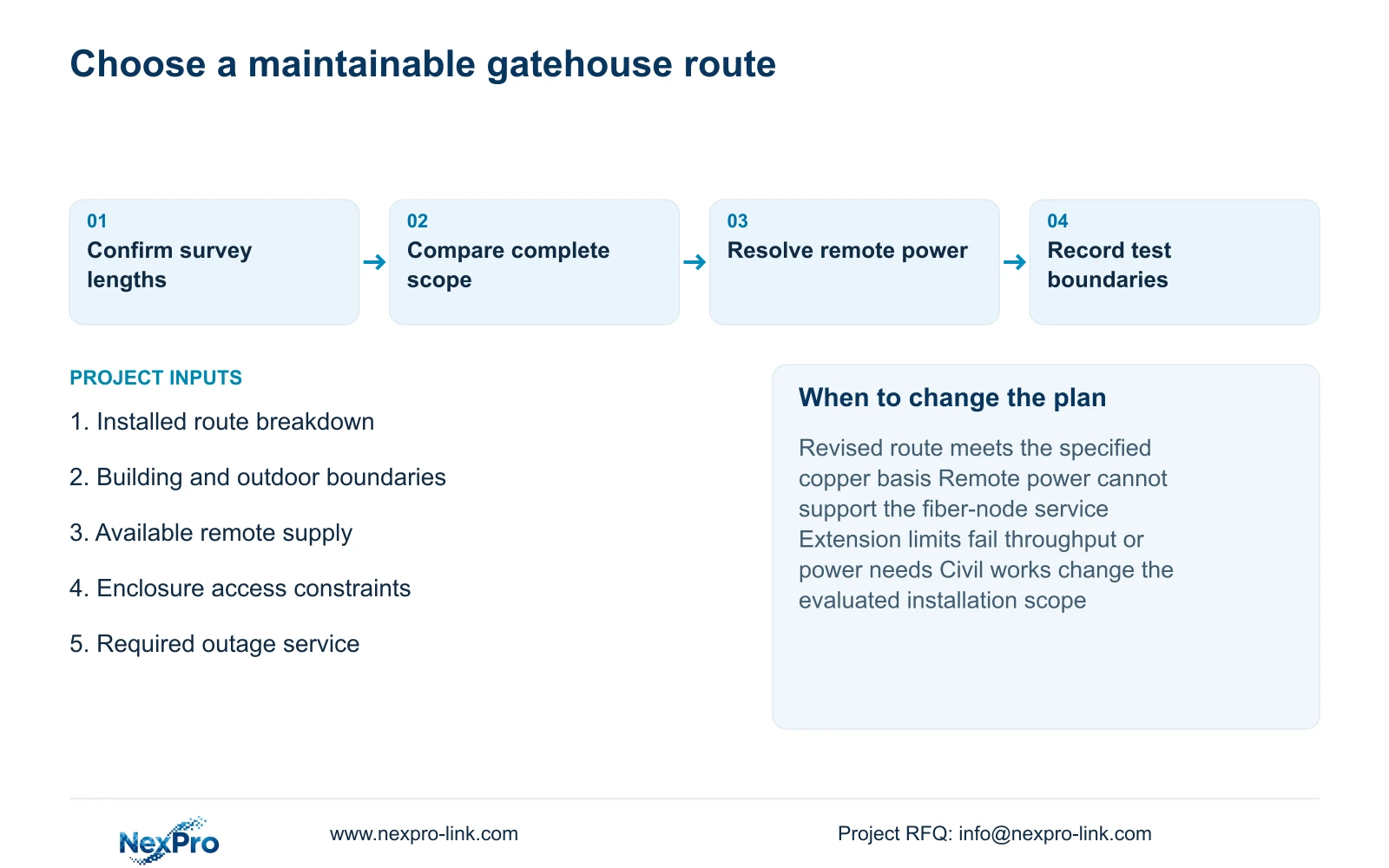
Send the measured route breakdown, building or outdoor boundaries, available remote power and maintenance-access constraints to info@nexpro-link.com. Add the required recording and outage behavior and destination. NexPro-Link can coordinate a scoped equipment and BOQ comparison, with local civil and electrical work separately assigned. Revise the proposal if survey findings change the route or remove the assumed remote supply.
Section 07
Buyer questions
Can a 98 m permanent copper route pass because the channel limit is 100 m? The two measurements have different boundaries. Under the supplied typical basis, the permanent link is 90 m and the channel includes patch cords within 100 m. Apply the project's specified configuration and test basis; do not exchange the two limits.
Will a fiber backbone keep remote cameras running during a power outage? Only if the remote active node and required camera-power path have protected supply. Fiber carries data; the proposal must separately show where remote power originates and how the selected service survives an outage.
What should be included in a copper-extension quote? Ask for the exact equipment, supported distance and operating mode, throughput, endpoint power capability and installation environment. Include intermediate-node power, enclosure, maintenance and testing scope so it can be compared fairly with fiber.
Engineering references
These sources support the general planning principles. Always use the selected product's current datasheet and applicable project standards for final design.